
By Johnathan Paoli
With over 13.5 million learners reliant on the public system, Basic Education Minister Siviwe Gwarube has called for unity and discipline, particularly at the provincial level, to overcome obstacles threatening the sector’s sustainability.
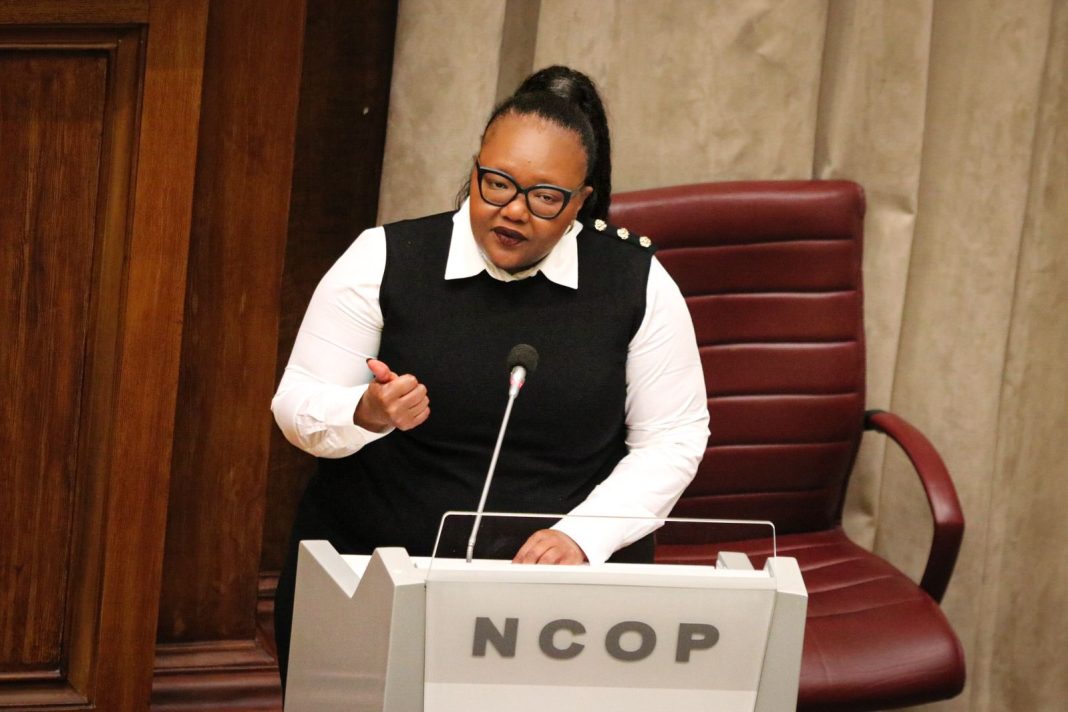
Gwarube presented her department’s 2025/26 budget to the National Council of Provinces (NCOP) on Tuesday, under the theme “Rooted in Purpose, Weathering the Storm, Growing Towards the Light”.
“Through better project management and grant monitoring, we aim to ensure that every allocation strengthens teaching and learning outcomes. This is a budget grounded in our constitutional duty and in the belief that education is the most powerful lever for transformation,” the minister said.
Addressing the nation’s urgent education challenges, Gwarube painted a picture of resilience akin to the baobab tree, highlighting progress in foundational literacy, infrastructure, inclusion and systemic reform despite severe fiscal constraints.
She outlined five national priorities.
They included expanding early childhood development (ECD), strengthening foundational literacy and numeracy, advancing inclusive education, improving teacher training, and enhancing school safety and quality environments.
Gwarube said there had been some significant strides such as the eradication of 97% of pit toilets since 2018, R230 million invested in ECD nutrition pilots, 10,000 ECD centres targeted for registration and R15.3 billion allocated to education infrastructure.
The Basic Education Laws Amendment (BELA) Act’s implementation, which focused on compulsory Grade R and new school admissions regulations, marked a systemic shift and was complemented by the launch of the National Education and Training Council.
However, she lamented funding pressures exacerbated by bailouts of state-owned enterprises, which had led to vacant teaching posts, late school payments and programme disruptions.
Despite an 8% budget increase to over R35 billion, no additional funds were secured for Grade R, which provinces must now absorb.
Parliament’s Education, Sciences and Creative Industries Standing Committee chairperson Makhi Feni welcomed the budget as a socio-economic catalyst, citing the R332.3 billion allocation as evidence of the government’s commitment to education amid economic challenges.
Praising literacy gains since 1994, Feni defended the BELA Act against accusations of racial divisiveness.
“The Constitution recognises all 12 official languages. No child’s language is under threat,” he said.
Feni stressed the need for oversight to ensure funds reached poor communities and called for urgent action to fill teaching vacancies nationwide.
Eastern Cape education MEC Fundile Gade highlighted education as a lever for poverty reduction and youth empowerment.
He lauded the BELA Act’s provisions for compulsory Grade R, multilingualism and digital governance reforms.
Gade praised the Basic Education Employment Initiative that has empowered 28,000 youths, including persons with disabilities.
Mpumalanga education MEC Cathy Dlamini championed education as the “sharpest spear” against inequality, detailing provincial infrastructure projects including new schools, sanitation upgrades and specialised institutions such as technical and agricultural schools.
She stressed the non-negotiable implementation of BELA reforms, framing education as central to the struggle for transformation.
KwaZulu-Natal MEC Sipho Hlomuka also expressed support for the budget, linking it to the province’s Academic Improvement Plan aimed at boosting matric results and foundational skills.
He emphasised curriculum modernisation such as coding, robotics, and technical subjects, alongside investments in new specialised schools.
Hlomuka highlighted efforts to fully implement BELA, especially regarding Grade R and isiZulu early-grade teaching, while pledging intensified teacher training to improve literacy outcomes.
Deputy Minister Reginah Mhaule framed the budget as a moral investment in democratic values of equity and inclusion.
She celebrated the expanded reach of the National School Nutrition Programme and Learner Transport Policy, progress in eradicating inappropriate schools, and extensive workbook distribution in all official languages.
Mhaule reaffirmed ongoing efforts to register ECD centres and improve rural and multi-grade school support, pledging safe and functional learning environments for all learners.
Gauteng education MEC Matome Chiloane acknowledged persistent challenges like teacher shortages and resource constraints, while commending the budget’s historic investment in ECD and literacy initiatives.
“Education is South Africa’s greatest investment in its future, demanding vigilance and adequate resourcing,” he said.
As the NCOP concluded its debate, the budget was hailed by some as a decisive step toward equity and transformation, while others rejected it as insufficient to confront South Africa’s profound educational inequalities and systemic challenges.
INSIDE EDUCATION