
By Johnathan Paoli
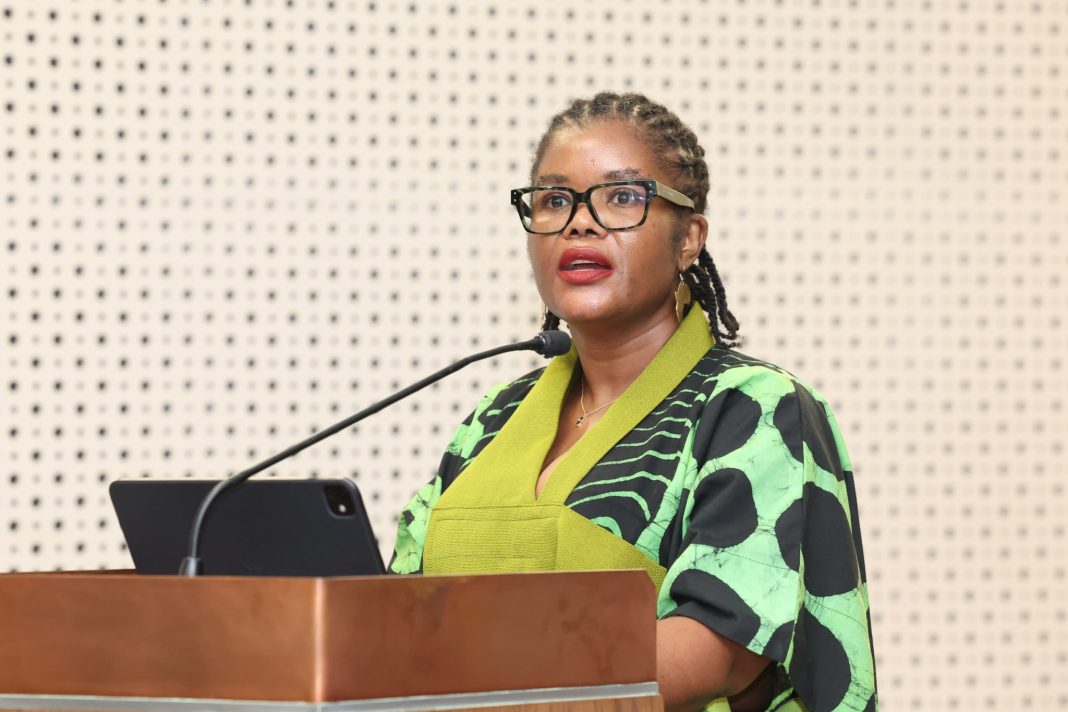
Higher Education and Training Minister Nobuhle Nkabane has reaffirmed South Africa’s commitment to strategic, mutually beneficial global partnerships in higher education, while placing transformation and national interests at the centre of internationalisation efforts.
Providing an update to the National Council of Provinces’ (NCOP) Select Committee on Education and Creative Industries on Monday on the department’s framework for the internationalisation of higher education, Nkabane said global cooperation has enriched South Africa’s academic system. This was through enhancing capacity, knowledge production and competitiveness on the international stage.
“Collaboration with international institutions enables our system to draw on valuable insights, resources and best practices. It allows us to remain aligned with global standards while strengthening our capacity locally,” Nkabane said.
She said South Africa’s internationalisation strategy was aimed at enriching the higher education system while protecting national interests.
The department’s Policy Framework for the Internationalisation of Higher Education was implemented in January 2021, following years of fragmented international activity by institutions.
It provides a coordinated strategy for global academic partnerships, curriculum collaboration and research exchanges.
Priority is given to partnerships within the Southern African Development Community, then the rest of Africa, followed by BRICS, the Global South, and finally broader global institutions in alignment with the African Union’s Agenda 2063.
Deputy director-general for universities, Marcia Socikwa, elaborated that internationalisation was a “steered process” to integrate global dimensions into teaching, research and community engagement.
Institutions must meet stringent quality assurance requirements for joint degrees and ensure all partnerships are accredited by the Council on Higher Education (CHE).
Socikwa presented employment equity statistics from the Higher Education Management Information System (HEMIS), which show modest but uneven progress.
Black African representation among associate professors increased from 18% in 2019 to 22.97% in 2023. However, white academics still occupy 60% of full professorships, while Black Africans account for just 23.56%.
Gender disparities also persist. While lecturer positions show near parity, men dominate senior academic and managerial roles.
The department’s data shows that even among junior lecturers, previously a space of gender progress, men now outnumber women.
To address these imbalances, the department continues to invest in the University Capacity Development Programme.
Socikwa confirmed the department was reviewing why many African academics exited academia prematurely and committed to closely monitoring their progression.
The deployment of foreign academics in South Africa remains a contentious issue.
According to institutional reports, foreign nationals constitute roughly 12% of academic staff, especially in the hard sciences.
However, HEMIS data shows a lower rate of 4%, revealing inconsistencies in university reporting.
To improve transparency and compliance, the department is working with the departments of Labour, Home Affairs, and International Relations and Cooperation to cross-verify employment data and immigration documentation.
A Service Level Agreement is being developed to formalise inter-departmental collaboration by March 2026.
Higher Education also supports the Employment Services Bill, currently before Parliament, which proposes enforceable caps on foreign hires across all institutions.
Fraudulent qualifications and procurement-linked corruption remain a threat to academic integrity.
The department worked with the Special Investigating Unit (SIU) and SAPS to bring the matter to light.
The department’s deputy director for university research support and policy development, Idah Makukule, reported that the National Qualifications Framework (NQF) Amendment Bill would introduce stronger penalties for academic fraud and improve the oversight of joint degrees.
She said that all international programmes must meet local quality assurance standards through the CHE, SAQA and partner verification.
Makukule also discussed the evolution of “internationalisation at home”, including virtual exchange programmes and curriculum decolonization, as a strategy to equip South African students with global competencies without necessitating physical mobility.
In response to parliamentary queries, the department committed to updating its systems to capture this information and ensure compliance with the national 3% disability employment target.
The department further pledged to enforce stricter reporting compliance among universities, standardise foreign staff data submissions and close loopholes that allow institutions to bypass regulatory scrutiny.
Members of the Select Committee welcomed the department’s transparency, but raised concerns about the slow pace of transformation, inconsistencies in data and the risk of foreign-dominated academia.
MPs called for clear timelines, stronger disciplinary action against non-compliant institutions and more direct support for young South African scholars.
Nkabane reaffirmed the department’s dual commitment to global excellence and local equity.
“Our institutions must reflect the demographics of our country and serve our national development goals. We will not allow internationalisation to undermine transformation,” she said.
The Select Committee pledged continued oversight and expects a follow-up report on policy implementation, staffing audits, and progress on disability inclusion in the months ahead.
INSIDE EDUCATION
Nobu