
By Johnathan Paoli
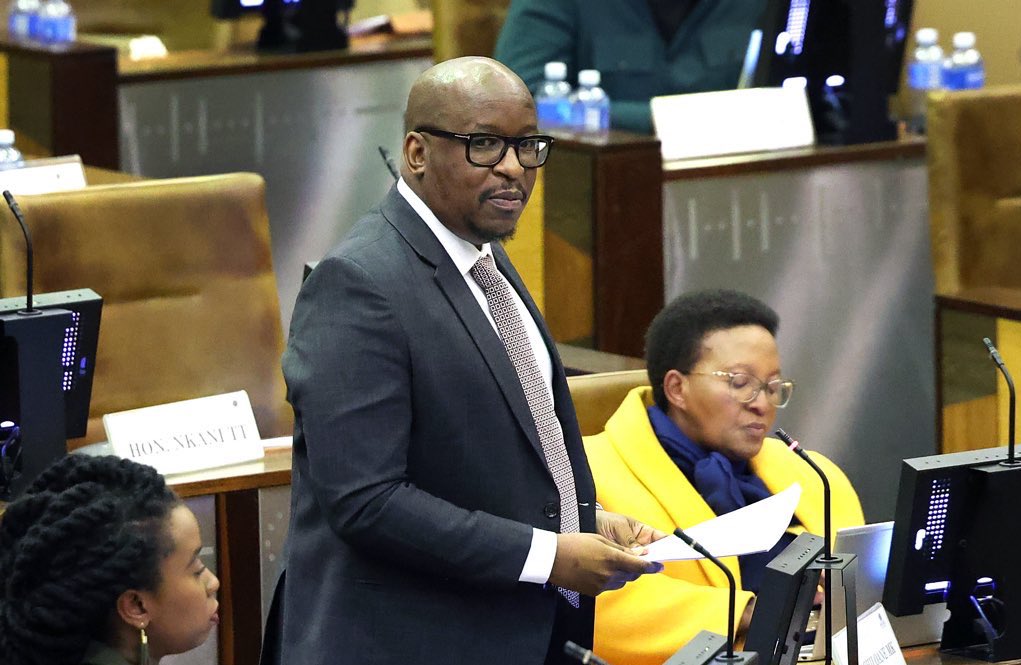
In a spirited and ambitious budget vote speech, Gauteng education MEC Matome Chiloane presented a record R68 billion allocation for the 2025/26 financial year, asserting the department’s unwavering commitment to education transformation, dignity restoration and long-term socioeconomic development through learning.
Addressing the Gauteng provincial legislature on Thursday, Chiloane framed the budget not merely as a fiscal instrument, but as a “compact with the future”.
“This budget rewrites futures. It restores dignity. It accelerates transformation in every classroom. We are not just teaching subjects; we are developing citizens. Through this budget, we are building the leaders and innovators of tomorrow,” Chiloane said.
The budget represents a 4.9% increase from last year’s R64.8 billion, with 93.9% of the funds sourced from the equitable share and 6.1% from conditional grants, including a R4.1 billion injection.
The MEC highlighted that this investment supported over 2.83 million learners, 104,804 educators and 3317 institutions across the province.
Before unpacking the budget’s four strategic pillars, Chiloane celebrated the department’s two consecutive clean audits, underscoring financial discipline and accountability.
“These are not just accounting milestones. They are the bedrock of public trust,” he said, adding that the department’s spending rate above 99.9% reflected exceptional execution capability.
Chiloane spotlighted the story of Sis Nomsa, a resident of Kokotela in Lawley Extension 2, who transformed her informal creche into a fully registered early childhood development (ECD) centre through departmental support.
This strategy aligns with the newly enacted Basic Education Laws Amendment Act, which makes Grade R compulsory.
Of the R734 million budgeted, R399 million is earmarked for the ECD grant.
The aim is to universalise Grade R access in public schools, expand 0 to 4-year-old ECD programme coverage, train ECD practitioners to NQF Level 6 and support ECD centre registration and compliance.
Chiloane emphasised the long-term economic impact, stating that every rand invested in ECD yielded up to R13 in return.
This allocation supported academic excellence through literacy, maths, science and technical skills development.
Chiloane also spotlighted success stories from Lufhereng Secondary School, which achieved a 100% matric pass rate and 97% bachelor passes, and will now receive a permanent structure.
Raymond Mhlaba Secondary School was lauded for consistent improvement and as well as Musawenkosi Buthelezi from Kwa-Thema, the province’s top learner and a product of targeted township school interventions.
Key programmes include General Education and Training Language and Reading Improvement, Siyavula Maths and Science Practice Programme, which recorded 2.3 million practice exercises, Technical High School Strategy, and Further Education and Training Improvement Plan for Grades 10–12.
With the largest allocation, Chiloane said this strategy aimed to reimagine the educational environment through school modernisation and infrastructure upgrades; school reorganisation to improve performance and resource use; and multi-certification skills programme that equips learners with certificates in artificial intelligence, digital literacy, robotics, first aid and even driver’s licences.
Chiloane noted that Gauteng’s 36 Schools of Specialisation (SOS) were achieving both national and international acclaim.
Among the highlights, the MEC praised Soshanguve SOS’s electric car project winning silver at the African Public Service Day in Ethiopia; Lethabong SOS’s partnership with BMW Roslyn; and Katlehong SOS learners job-shadowing at Hyundai, Kia and Mercedes-Benz.
He also noted that over 60,000 learner devices had been distributed and significant progress made in ICT infrastructure and coding education.
Beyond academics, the MEC said this strategy promoted learner safety, psychosocial support and holistic development.
Key investments included deployment of security guards and community patrollers at 1500 schools and letters of thanks from schools like Qalabotsha and Tshepo ya Rona praising the positive impact of improved safety.
Chiloane also paid tribute to Noko Selepe, the principal of Primrose Primary School, who returned to work after surviving a shooting by a 13-year-old learner.
Selepe received the MEC’s Harry Gwala Excellence Award for resilience and leadership.
Other initiatives include a school nutrition programme serving 1.73 million learners daily, learner transport for 228,592 pupils, integration of sports, arts and culture, and expanded mental health and girl-child support initiatives.
Budget breakdown and outcomes include R52 billion (76.6%), a 7.1% rise for personnel, R2.8 billion for infrastructure and R6.66 billion in transfers and subsidies for public, special, independent and ECD institutions.
Chiloane pointed to key performance results including an 88.41% matric pass rate, with 50.27% bachelor passes; all 15 districts got above 80% for three consecutive years and three districts exceeded the 90% target.
Looking ahead, Chiloane said the department’s budget was on a stable growth trajectory, and it was expected to reach R72.9 billion by 2027/28, a 29.7% increase over six years.
He welcomed the average annual growth rate of 4.0% as supporting sustainable long-term planning and called on the legislature to endorse the budget as a collective investment in Gauteng’s future.
INSIDE EDUCATION