


By Johnathan Paoli
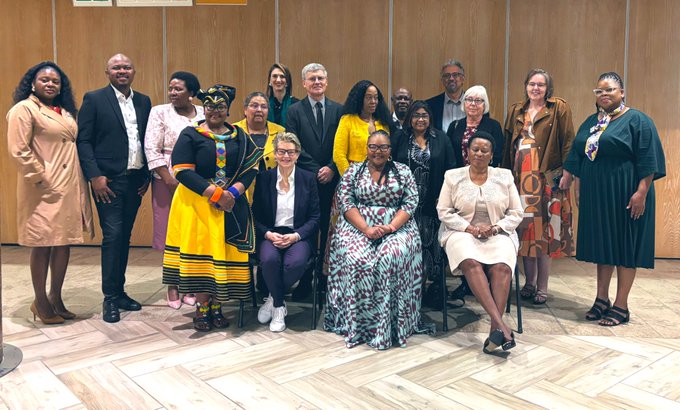
South Africa’s education landscape entered a new chapter as Basic Education Minister Siviwe Gwarube officially announced the appointment of the 15 members of the National Education and Training Council (NETC), a long-dormant statutory body now revitalised to advise on critical reforms in the schooling system.
Speaking at a media briefing in Pretoria, Gwarube said the establishment represented a decisive shift from incremental adjustments to bold reforms rooted in research and expertise.
“You are entrusted with a responsibility to fearlessly provide advice grounded in evidence and aimed at the best interests of learners. Yours is not the task of government, but the task of knowledge, expertise and wisdom.
“The council’s work begins today, and with it, the opportunity to ensure that in every classroom, in every province, every child has not just a seat in school, but a genuine chance at success,” she told the newly appointed members.
The minister used the platform not only to introduce the council’s members but also to outline the broader reform agenda her department has pursued over the past year.
In terms of strengthening foundational learning, literacy and numeracy have been placed at the centre of national education priorities, with a goal that all learners read for meaning and calculate with confidence by age 10.
In relation to teacher development, the Funza Lushaka bursary is being reviewed to focus on Foundation Phase teaching, while professional development programmes are being streamlined for greater impact.
Efforts are underway to systematically embed Grade R into the schooling system, ensuring universal access with improved quality.
A new memorandum of understanding with the South African Police Service expands partnerships to combat violence, crime, and extortion in schools.
Central to this vision is what the minister calls “evidence-led policymaking”.
She emphasised that good ideas could not come from the government alone, but must be informed by research, data, practitioners’ experience and civil society input.
The NETC brings together a group of 15 individuals, appointed not as representatives of constituencies but as independent experts.
Chairing the council is former Western Cape education HOD Penelope Vinjevold, whose decades of senior leadership in curriculum, governance, assessment and policy design have left a lasting imprint on South Africa’s schooling system.
Other appointees bring a rich mix of classroom experience, academic research, governance expertise and policy insight.
- Former Limpopo education HOD Khathutshelo Dederen has over 30 years of experience in curriculum development, ICT in education, and district support.
- Xolani Khohliso is a curriculum specialist and lecturer with expertise in blended learning, teacher training, and language methodologies.
- Zanele Mabaso is a social policy and advocacy expert with international experience at the World Health Organisation, specialising in youth development, gender, and rural school improvement.
- Madimetja Mamashela is a science education lecturer and mentor focused on Physical Sciences, curriculum development, and blended learning approaches.
- Judith McKenzie is an Emeritus Professor of Disability Studies at the University of Cape Town. She pioneered inclusive education and policy for learners with disabilities.
- Paulus Mentz, who is the Rector of Aros and former North West University academic, brings over two decades of experience in teacher education, governance and curriculum delivery.
- Lebogang Montjane is the director of the Independent Schools Association of Southern Africa and has strong expertise in law, governance and educational pluralism in the independent schooling sector.
- Mmatsetsweu Motaung is a veteran in Early Childhood Development (ECD), having led major initiatives at TREE and within the government.
- Nicolette Roberts is a mathematics education researcher specialising in early numeracy, bilingual learning and systemic improvement strategies.
- Getrude Rammala is a classroom practitioner with nearly three decades of experience and a background in union advocacy, focused on foundation phase training and assessment.
- Marie-Louise Samuels is a senior national ECD and curriculum specialist with more than 30 years in multilingual education and inclusive learning.
- Selvia Singh is the former chief national examiner and Geography and education lecturer, specialising in school and district improvement strategies.
- Glodean Thani is a Wits education policy lecturer and research psychologist with expertise in policy development, gender diversity, and monitoring and evaluation.
- Gabrielle Wills is a leading researcher at Stellenbosch University, whose work on education economics, early grade reading benchmarks and systemic resilience has influenced national policy.
The minister emphasised that the council was not a decision-making body, but an independent advisory forum.
She also confirmed that the council may co-opt up to four additional members and establish committees to draw in wider expertise as needed.
Gwarube acknowledged the 119 nominations received during the public call, thanking all individuals and organisations that participated.
She urged those not appointed to remain available to support the council’s work through sub-committees and ad hoc contributions.
The council held its inaugural closed-door meeting immediately after the briefing at the department’s head office in Pretoria.
INSIDE EDUCATION