
By Palesa Nguqu
Deputy Minister of Higher Education and Training Dr. Mimmy Gondwe says the African Union (AU) Skills Week has demonstrated the continent’s collective resolve to build a skilled, innovative, and resilient workforce.
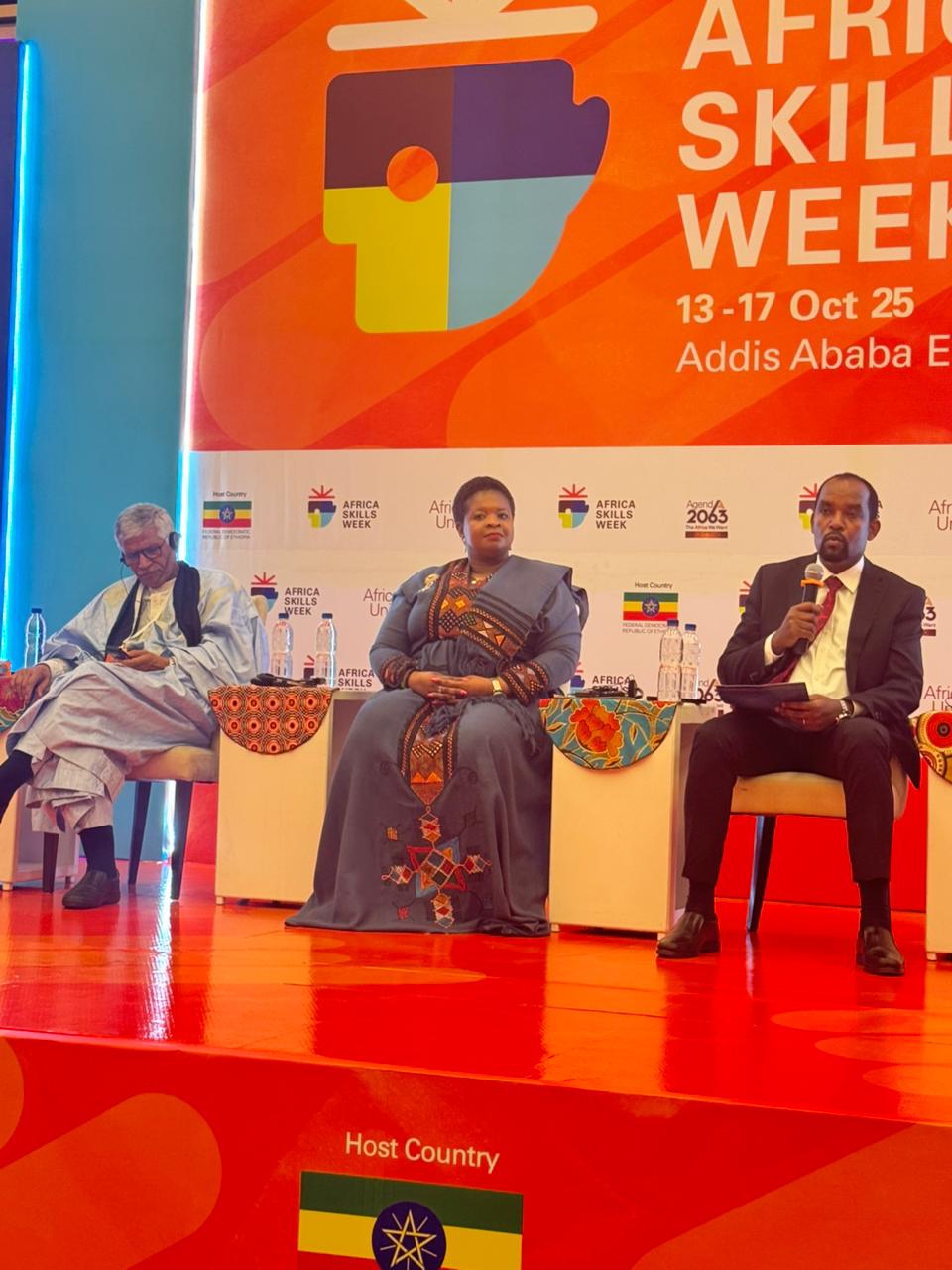
Gondwe made the remarks at the conclusion of her working visit to the Africa Skills Week, held from 13 to 17 October 2025 at the AU Headquarters in Addis Ababa, Ethiopia.
Held under the theme “Powering Africa’s Industrial Future: Skills for Innovation, Growth, and Sustainability,” the annual event serves as a continent-wide platform for promoting youth skills development and brings together policymakers, educators, industry leaders, and youth from across Africa to share best practices, launch strategic initiatives, and strengthen collaboration aimed at empowering young Africans for employment and entrepreneurship.
“We must continue to collaborate, share knowledge, and implement strategies that empower our youth and unlock Africa’s full potential. Together, we can shape a brighter future for all Africans,” said Gondwe.
The Skills Week aligns with the broader goals of Agenda 2063, the AU’s strategic framework to transform Africa into a global powerhouse focused on economic growth, social inclusion, and sustainable development.
During the week-long programme, Gondwe participated in a high-level ministerial panel on skills development and attended both the opening and closing ceremonies.
A key highlight of the event was the launch of the Continental TVET Strategy 2025–2034, which underscores Africa’s commitment to building a skilled workforce capable of driving innovation and economic resilience.
On the sidelines of the Skills Week, Gondwe held bilateral meetings with key stakeholders, including Ethiopia’s Minister of Labour and Skills, H.E. Muferihat Kamil Ahmed, to exchange best practices on youth skills development and explore the use of artificial intelligence (AI) to link unemployed youth with job opportunities.
She also met with AU Commissioner for Infrastructure, Energy, and Digitisation, Lerato Mataboge, to discuss potential collaboration between the DHET and the African Union.
“The five-day Africa Skills Week brought together over 850 participants from AU member states, regional organisations, TVET leaders, academics, and youth. It promoted learning, dialogue, and collaboration. South Africa remains committed to knowledge sharing, research, and implementation — ensuring no African youth is excluded from the skills revolution that will define the Africa we want and need,” said Gondwe.
According to Gondwe’s spokesperson, Sipho Stuurman, South Africa’s readiness for the Fourth Industrial Revolution (4IR) must be treated as a systemic transformation of education — encompassing policy, financing, institutional preparedness, and industry participation, rather than being viewed merely as a curriculum reform.
He noted that this aligns with the AU’s Continental TVET Strategy, which prioritises employability, lifelong learning, and integration with science, technology, and innovation.
“The Department, through the TVET Branch and with support from SETAs such as ETDPSETA and merSETA, has launched 15 operational 4IR centres,” Stuurman said.
He further advocated for curriculum updates across all qualifications to include digital literacy, data and AI basics, automation, robotics, and critical thinking skills.
Stuurman also underscored the importance of modular micro-credentials, noting that they allow learners to progressively accumulate skills and adapt to rapidly changing labour market needs.
“The post-school education and training (PSET) system should incorporate modular micro-credentials so learners can accumulate skills progressively,” he said.
He added that expanding workplace-based learning through stronger employer partnerships is essential to ensure that learners gain practical experience with real 4IR technologies.
Highlighting a successful example, Stuurman said the Takealot–DHET Memorandum of Understanding (MoU) illustrates how the TVET system can align with global megatrends.
“Takealot, one of South Africa’s largest e-commerce platforms, represents a real-world ecosystem that links digital transformation, green innovation, and youth employability — positioning TVET as a vital driver of future-ready, opportunity-driven skills development in South Africa,” he said.
INSIDE EDUCATION