
By Charmaine Ndlela
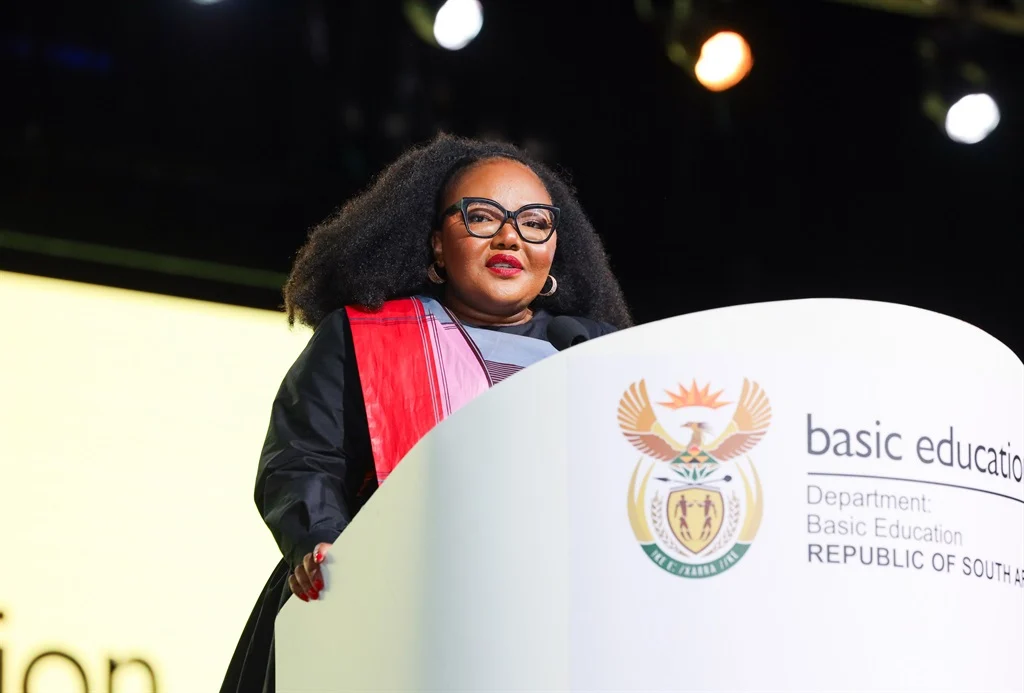
“Education is not a spectator sport; it is a national imperative that must be accessible to all,” said Basic Education Minister Siviwe Gwarube, speaking at the launch of the Teaching and Learning International Survey (TALIS) 2024 South Africa Report on Thursday.
TALIS, a large-scale international survey led by the Organisation for Economic Co-operation and Development (OECD), collects detailed self-reported data from teachers and school leaders on their working conditions, teaching practices, and learning environments.
The data supports evidence-based education policy formulation.
Gwarube noted that South Africa remains the only African nation to have participated in TALIS twice—first in 2018 and again in 2024.
“We stand here with a sense of pride, as this places our country in a position of continental leadership in evidence-led policymaking,” she said.
Addressing school safety, Gwarube acknowledged incidents of violence in schools but described them as showing a “downward trend.” She emphasised ongoing efforts to make schools safer.
“We signed a Safer Schools Protocol with the South African Police Service earlier this year, and rollout has begun in crime hotspot areas such as Inanda Township in KwaZulu-Natal, Emfuleni and Manenberg in the Western Cape, and uMtata and Nelson Mandela Bay in the Eastern Cape,” she said.
The Minister also revealed that South Africa now has one of the youngest teaching cohorts globally.
“This means our efforts to attract young people into the profession are bearing fruit,” she said.
The average teacher age has dropped from 43 in 2018 to 41 in 2024, while the OECD average rose to 45. In addition, 62% of South African teachers reported that teaching was their first-choice career, up from 49% in 2018.
On gender representation, Gwarube noted that 62% of teachers are women, but only 32% of principals are female.
“Despite this leadership gender gap, South Africa is performing above the OECD average of 15% for female school principals,” she added.
She further stressed the importance of mother tongue-based bilingual education (MTbBE), which equips teachers to work effectively in multicultural and multilingual classrooms.
“In 2025, the MTbBE programme will extend mother tongue instruction beyond Grade 3 into Grade 4, starting with mathematics and natural science and technology,” Gwarube announced.
The minister also said the department is committed to reducing administrative burdens so that educators can focus on teaching.
“A mandate task has been given to the newly operational National Education and Training Council to develop tools and systems to ensure teachers are not overburdened by administrative tasks,” she said.
Gwarube said the TALIS findings align with the department’s curriculum reforms and literacy accelerator programmes.
“TALIS confirms what our reforms already recognise: strong foundations are not optional—they are the oxygen of learning,” she said.
Gwarube also paid tribute to South Africa’s educators:
“To all our teachers: your work is not in vain. Your voices, captured in this report, are now part of our agenda for transformation. Let us move forward with the courage to change, the humility to learn, and the urgency to act,” she said.
INSIDE EDUCATION