
By Thapelo Molefe
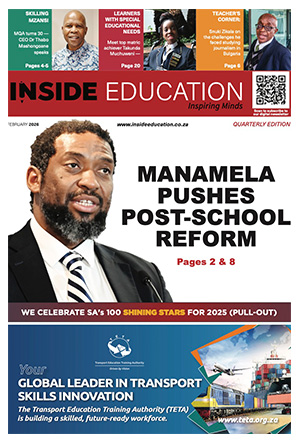
Higher Education and Training Minister Buti Manamela has said that government will soon unveil measures to ensure students with historic debt can complete their studies, as South Africa’s post-school education system grapples with a critical shortage of nearly 200,000 student beds.
Speaking during the State of the Nation Address (SONA) debate in Parliament on Tuesday, Manamela said his department is working with student organisations, vice-chancellors and college principals to address the financial exclusion of students unable to register due to outstanding fees.
ALSO READ: Santa Shoebox Project calls for volunteers to help deliver festive boxes
“Within a short space of time, we will announce measures to ensure that students with historic debt are accommodated so that they are not financially excluded from completing their studies,” the minister told the National Assembly.
The announcement comes as student protests over accommodation erupted at Cape Peninsula University of Technology (CPUT), the University of Cape Town, and Durban University of Technology.
Manamela revealed he left the SONA chamber immediately after President Cyril Ramaphosa’s address last week to personally intervene in the CPUT protests.
“On the evening of the State of the Nation Address, I left this Chamber not to rush to television studios or issue press statements, but to meet students from CPUT who were protesting outside Parliament about the quality of their accommodation. They were anxious, angry, exhausted, and uncertain,” he said.
ALSO READ: UFS study detects hormone-disrupting chemicals in menstrual products
Working with police, student leaders and university management, the minister said the last of those students would be moved to improved accommodation within days.
Defending government’s hands-on approach, Manamela stated: “So when some ask, ‘Where is government?’ the answer is simple: sometimes government is not on social media…sometimes government is in the corridor at midnight, fixing problems.”
The minister acknowledged: “Student accommodation remains one of the most urgent challenges in the post-school system. We face a shortfall of close to 200,000 beds.”
Manamela said government would not rely solely on traditional infrastructure development to address the crisis.
“We will not resolve this challenge through bricks and mortar alone,” he said, outlining plans for digital expansion through the National Online Learning System alongside physical infrastructure.
However, he cautioned that quality improvements are needed at the University of South Africa (UNISA), which serves more than 350,000 students.
“Digital and distance expansion must enhance learning outcomes, not merely inflate enrolment numbers,” Manamela said.
ALSO READ: Santa Shoebox Project calls for volunteers to help deliver festive boxes
He said active discussions are underway with the Finance Minister on university funding sustainability, infrastructure planning, and accelerating work on new specialised universities, including a University of Science and Technology.
His department is also engaging Public Works and Infrastructure to release state land and unlock blended financing models for constructing new universities and TVET colleges.
“This is not abstract ambition. This is not sophistry. It is coordinated state action,” he said.
Addressing 3.4 million young people not in education, employment or training (NEETs), Manamela outlined plans to position Community Education and Training (CET) and TVET colleges as primary institutions serving this cohort.
“CET colleges, through the National Senior Certificate for Adults, will provide young people with life skills, digital, financial and functional literacy as well as modular vocational skills such as bricklaying, motor mechanics, welding, cooking, sewing and related trades, linking them to work opportunities or further study,” he said.
ALSO READ: UFS study detects hormone-disrupting chemicals in menstrual products
Manamela welcomed the restoration of the 40% mandatory grant to employers and announced forthcoming consultations on reforming Sector Education and Training Authorities (SETAs).
He demanded new accountability standards from SETAs.
“We no longer want PowerPoint presentations, we want evidence. If you say you trained young people, tell us how many, where, at what cost, and how many are now employed.”
The minister cited the CATHSSETA-McDonald’s partnership, where approximately 5,000 young people were trained and absorbed into employment, as a model to be scaled up.
Manamela said TVET colleges must focus on “occupational trades leading to employment, modern workshops in partnership with industry, quality lecturers, and effective workplace-integrated learning.”
“We will mobilise all resources, partnerships and energy towards full implementation of the dual-system, already demonstrated through Centres of Specialisation. We will present further detail during the Department’s Budget Vote,” he stated.
In closing, the minister emphasised government’s focus on delivery over debate.
“Planning is not paralysis, and shouting is not governance. Some believe that if they shout their sophistry loudly enough, reality will surrender. But they blame you for believing in boring things: plans, budgets, engineers, timelines, and students actually sleeping in beds,” he said.
“Some are interested in noise. We are interested in progress. Let me tell you, before I drop the mic, that some ears in this house are too small for complexity, for patience and for work, but governing a country, unlike playing tennis, requires all three. The debate may be yours. The action is ours.”
INSIDE EDUCATION