
By Charmaine Ndlela
Basic Education Minister Siviwe Gwarube has called for stronger education systems across Africa, saying technology and artificial intelligence cannot replace basic literacy and numeracy skills.
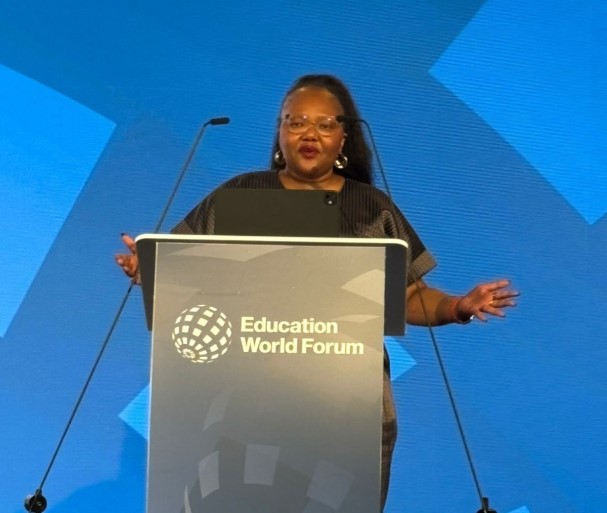
Speaking at the Education World Forum 2026 in London, Gwarube highlighted South Africa’s efforts to strengthen foundational learning and expand Early Childhood Development (ECD) programmes.
“South Africa is investing R10 billion over three years to expand Early Childhood Development, and a further R496 million to create 115 000 ECD spaces in three of our most rural provinces of Limpopo, KwaZulu-Natal and the Eastern Cape. These investments signify our commitment to children whose futures should not be determined by the circumstances of their birth,” she said.
“As a country we can be proud of the strategic shift we have made towards strengthening the foundations of learning.”
The R496 million allocation is linked to an outcomes-based early childhood development fund aimed at expanding access to early learning in Limpopo, KwaZulu-Natal and the Eastern Cape.
The Education World Forum is being held in London from 17 to 20 May under the theme “Educating for a Shared Future: Peace, Planet, Purpose and Pathways”. The forum brings together education ministers, policymakers and education sector leaders to discuss the future of global education systems.
Gwarube said South Africa had made a strategic shift towards prioritising foundational learning for the country’s 13.7 million learners.
“Strong futures require strong foundations,” she said.
She said the issue was particularly important for Africa, which has the youngest population in the world, making education critical to turning demographic growth into economic opportunity.
“If Africa is to rise, Africa’s children must rise first,” she said.
Referring to South Africa’s literacy crisis, Gwarube said about eight in 10 children could not read for meaning by the age of 10.
She described this as more than a literacy challenge, calling it a “future-readiness crisis” that affected learners’ ability to succeed in gateway subjects such as Mathematics, Science and Technology.
“When a child cannot read for meaning, every subject becomes difficult and opportunities become limited,” she said.
While many countries were discussing artificial intelligence, automation and the future digital economy, Gwarube said governments had to recognise that meaningful innovation could not happen without strong educational foundations.
“No country can build a high-tech economy on weak educational foundations,” she said.
“No country can leapfrog literacy, and no country can automate its way around numeracy.”
Gwarube said the future economy would require children who could think critically, solve problems, adapt and create, rather than learners who only knew how to operate technology.
She posed what she described as an urgent question for learners facing the future: “Will I be able to read well enough to participate in that future at all?”
INSIDE EDUCATION