


By Lebone Rodah Mosima
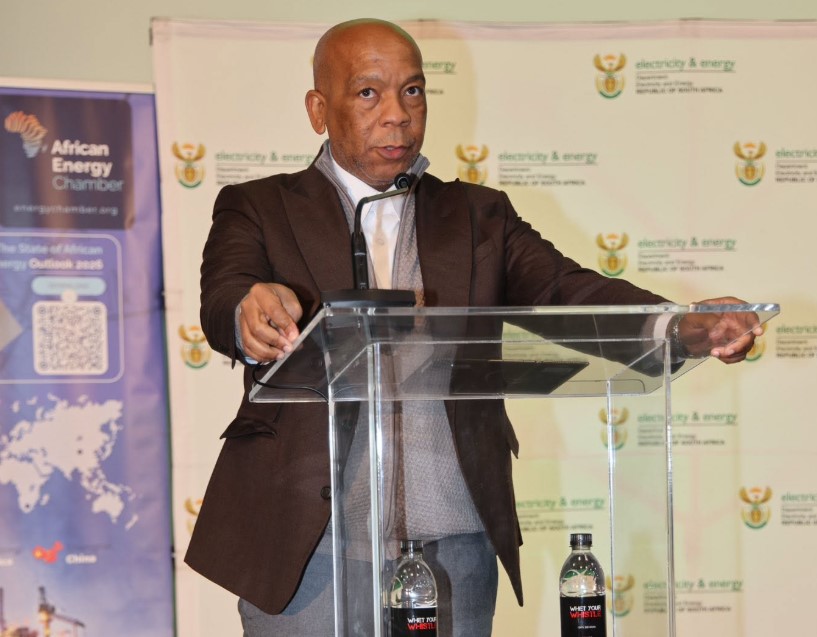
Minister of Electricity and Energy Kgosientsho Ramokgopa has urged young South Africans to take their place in the country’s energy transition, saying new generation, transmission, electrification and critical-minerals value chains could create businesses, jobs and wider electricity access.
Ramokgopa was speaking at the Youth in Energy Conference and Awards, hosted in partnership with the African Youths in Energy Network at Focus Rooms in Modderfontein, Johannesburg.
The conference focused on connecting young talent with opportunities in the energy sector, including renewable energy, transmission infrastructure, electrification, nuclear, critical minerals and regional electricity markets.
“We need to achieve energy sovereignty in the country, so that we have to draw from various energy sources. There is a multiplicity of energy sources,” Ramokgopa said.
“There’s an opportunity for us to participate in what you call the nuclear fuel cycle, on mining, the enrichment, the fabrication, and so forth.”
Ramokgopa said young entrepreneurs should look for opportunities in renewable energy, particularly innovations that could help lower the cost of electricity and expand access to underserved communities.
He said funding would be critical to turning promising ideas into scalable projects that could be introduced into the market.
Through its funding houses, he said, such ideas must create opportunities for scalability to enable market introduction.
“One of the opportunities that we share with you is on the transmission side. You can generate this electricity using solar, using wind, but you must transport the electrons,” he said.
“They must get to a point where they are needed, where they are going to be consumed, and for that to happen, we need to build a transmission infrastructure.”
Ramokgopa said young people should see South Africa’s remaining electricity-access gaps not only as a crisis, but also as an opportunity to develop technologies and business models that can power rural and poor communities.
He said about 1.6 million households still lacked access to electricity, while millions more people across Africa remained without reliable power.
“I just shared with you that 600 million people on the continent don’t have access to electricity,” he said.
“It’s only us, South Africa, where we are at about 92% of penetration. Sub-Saharan Africa outside the Sahara desert, people don’t have access to electricity. In the region, outside, people don’t have access to electricity.”
Ramokgopa said new electricity demand, including demand linked to data centres, was creating further opportunities for young people to develop energy projects and participate in the wider electricity market.
He said South Africa’s energy plans envisaged about 105GW of new generation capacity by 2039, alongside a major expansion of the transmission network.
He outlined the scale of the investment opportunity, citing about 14,500km of new transmission lines worth R440 billion, and new generation capacity worth about R2.23 trillion, in the context of South Africa’s GDP of about R7.63 trillion.
“So what we are doing in the energy sector, in the next 12 years, constitutes 30% of the total size of the South African economy,” he said.
“This presents an opportunity that will be available for the next 12 to 18 years, and young people are urged to position themselves to participate in this space.”
Ramokgopa also said South Africa needed to do more to benefit from the critical minerals required for the global decarbonisation agenda.
He said the country should build local ownership and participation across the value chain, from production and beneficiation to technology applications, electricity generation and infrastructure maintenance.
“So you, as young people, must choose your place in the entire value chain. We must use our endowments to benefit and transform the lives of our people,” he said.
Ramokgopa said the opportunities were not limited to South Africa, as the department was also working on electricity corridors to support regional energy security.
He encouraged young entrepreneurs to develop scalable energy projects that could be expanded beyond South Africa and into the rest of the continent, saying the department was willing to support viable ideas and innovations through policy interventions.
“We are going to support you and ensure that we are able to succeed in this agenda. I say to the team that the best measure of our success is not that the lights are on,” he said.
“It’s how many jobs we create in keeping the lights on, how many new skills we develop and bring on board, and how many entrepreneurs participate in maintaining this infrastructure.”
Ramokgopa said young people’s participation would be vital to building an inclusive energy industry, even though the transition would not automatically end localised electricity interruptions such as load reduction.
He said electricity should be used as a tool to fight poverty, exclusion and ignorance, and to help children remain in school, learn productively and prepare for future participation in the economy.