



By Lebone Rodah Mosima
Deputy Minister of Higher Education and Training Nomusa Dube-Ncube has called for greater industry involvement in shaping vocational education, including curricula, workplace learning and the assessment of practical competence, rather than only receiving graduates after they complete their studies.
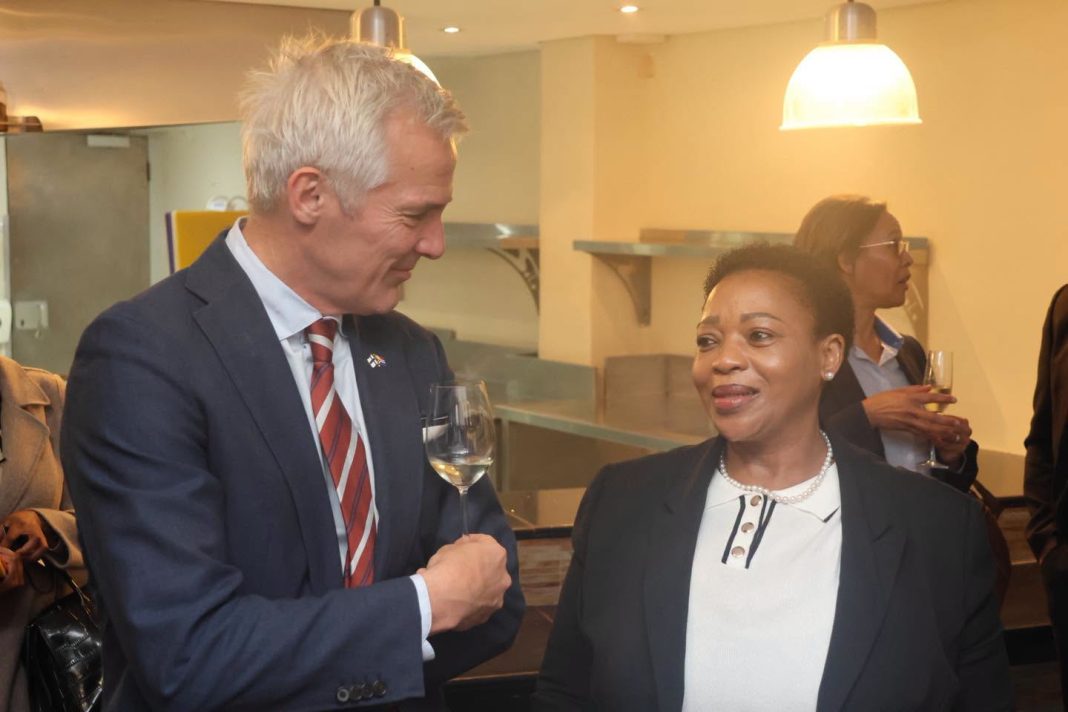
Dube-Ncube was speaking on Tuesday at the Skills for Industry: South Africa-Finland Exchange on Vocational Education and Skills Development at SARATEC, located at the Cape Peninsula University of Technology campus, where she appeared alongside Finland’s Minister of Education Anders Adlercreutz.
“Today is the foundation for something more strategic and enduring: a partnership that embraces the full potential of TVET to power South Africa’s economy,” Dube-Ncube said.
She said the engagement came at a significant time, with August marking both Women’s Month in South Africa and TVET Month, which is commemorated by the Department of Higher Education and Training.
She said the convergence was fitting as TVET colleges embody specialised training, blended teaching and learning, and capacitated lecturers as foundations of quality vocational education.
“‘From Skills to Jobs’ captures one of the most important questions facing education systems worldwide,” she said.
Dube-Ncube said South Africa’s response was the Skills Revolution, a commitment made by President Cyril Ramaphosa this year to shift towards practical, future-focused and industry-relevant occupational education.
She said this included incorporating science, technology, engineering, arts and mathematics (STEAM) disciplines while responding to the demands of the Fourth Industrial Revolution.
“Our task, together, is to design pathways that are sound today and adaptable tomorrow. This is where Finland’s experience becomes particularly instructive,” she said.
Dube-Ncube said skills must have a destination and that the success of vocational education should ultimately be measured by what happens after training, including employment, entrepreneurship, further learning and adaptability.
“These are the questions that should shape how we design vocational education,” she said.
“Our ambition is to move from Education → Graduate → Employer, to Education and Industry → Skills → Work → Lifelong Learning.”
She highlighted Finland’s focus on modular learning, recognition of prior learning and continuous reskilling as valuable lessons for South Africa.
Dube-Ncube questioned whether existing pathways are flexible enough to enable people to acquire the competencies they need at different stages of their careers, particularly as occupations and technologies evolve rapidly.
“Today’s partnership with Metso is a welcome example of what we hope to scale: stronger, more deliberate connections between companies, TVET colleges, universities, SETAs, government, and learners,” she said.
She outlined three questions to guide the discussion: what skills industries will need over the next five to 10 years; how partnerships can be redesigned so industry is genuinely involved in producing those skills; and what practical cooperation between South Africa and Finland could help accelerate progress.
“South Africa approaches this partnership with genuine hope and confidence. We are eager to learn from Finland’s experience, and we bring our own innovations and resilience in return,” she said.
“Our ambition is that when we meet again, we can point to specific institutions collaborating, specific learners who have benefited, specific educators capacitated, and specific industries active in training.”
Adlercreutz highlighted the importance of strengthening collaboration between governments, education institutions and industry to ensure vocational education and training remains responsive to changing labour-market needs and supports economic growth.
“We are, as we know, living in a time of rapid technological change, demographic shifts and evolving labour market needs,” Adlercreutz said.
He said globalisation, the green transition, digitalisation, automation and the rapid development of artificial intelligence were transforming industries and creating unprecedented demand for new skills.
He said vocational education was increasingly important in preparing people for meaningful employment and life.
“Vocational education and training should no longer be viewed merely as a second choice or an alternative pathway to academic studies,” he said.
“Today technical and vocational skills are recognised as key drivers of economic competitiveness, social inclusion and sustainable development.”
Adlercreutz said high-quality vocational education provides learners with practical skills, professional competence and the ability to adapt to changing work environments, while supporting employers through a skilled workforce and greater innovation.
He said countries, including Finland, were facing changing skills requirements as technologies, industries and societies evolve.
Addressing these changes required strong cooperation between governments, education institutions and employers to ensure education systems remained responsive to the needs of learners, workplaces and economies, he said.
“Through vocational education and training, apprenticeships and workplace-based learning opportunities, young people and adults can develop relevant skills, improve their employability and enter the workforce with confidence,” he said.
“By strengthening vocational education, we are not only creating pathways to decent work, but also supporting economic growth and a more inclusive future.”
Adlercreutz said Finland had developed a vocational education system that was highly valued nationally and internationally, with its learner-centred approach among its key strengths.
He said education institutions and employers must work together to ensure training reflects actual workplace needs.
“Practical learning is combined with classroom-based education as students gain experience through flexible workplace learning periods adapted to different sectors, employers and learners,” he said.
“Educational institutions and teachers remain responsible for guiding the overall learning process and ensuring that learning outcomes are achieved.”
He said longer internship or apprenticeship models could provide valuable learning opportunities, but required companies to have sufficient resources, skilled supervisors and the capacity to integrate students into daily work while supporting their learning.
Flexible models combining workplace learning with guidance from educational institutions could help ensure learners gain meaningful practical experience while maintaining education quality, he said.
“Our challenge is to ensure that vocational excellence receives the same respect, recognition and investment as academic excellence,” Adlercreutz said.
He said vocational education should be viewed as an equal and respected educational pathway, while education systems must remain flexible enough to respond to changing labour-market needs and different learner backgrounds.
Strong partnerships between education institutions, employers and policymakers were also essential to ensuring relevance and quality, he said.
“Life and learning must become a part of every educational system,” he said.
“We are far beyond the point where you graduate into a profession and retire from the same one 30-40 years later. International cooperation is at its best when experiences and perspectives are shared in both directions.”
Adlercreutz said the exchange provided an opportunity for Finland and South Africa to share experiences and explore how education systems could better respond to changing skills needs.
He said South Africa’s experience of developing education in a diverse and multicultural society also offered valuable lessons for Finland as it considered how education systems could create opportunities for learners from different backgrounds.
INSIDE EDUCATION