
By Charmaine Ndlela
The University of the Free State (UFS) has ceremonially handed back to the South African Academy for Science and the Arts (SAAWK) an archival collection documenting more than a century of the Akademie’s history and its role in the development of Afrikaans language, literature, the arts and science, as the two institutions move to digitise the material for wider research access.
Established in Bloemfontein in 1909, the SAAWK has played a significant role in the development and standardisation of Afrikaans in the fields of language, literature, the arts and, later, science and technology.
More than a century after its establishment, the Akademie’s archival collection is entering a new phase as the institutions collaborate on its digitisation, creating wider access to material that has been preserved at the UFS for more than 50 years.
The collection was entrusted to the UFS under an agreement concluded between the two institutions in 1972. Since then, the university has been responsible for its safekeeping, preservation, arrangement, description and access for research.
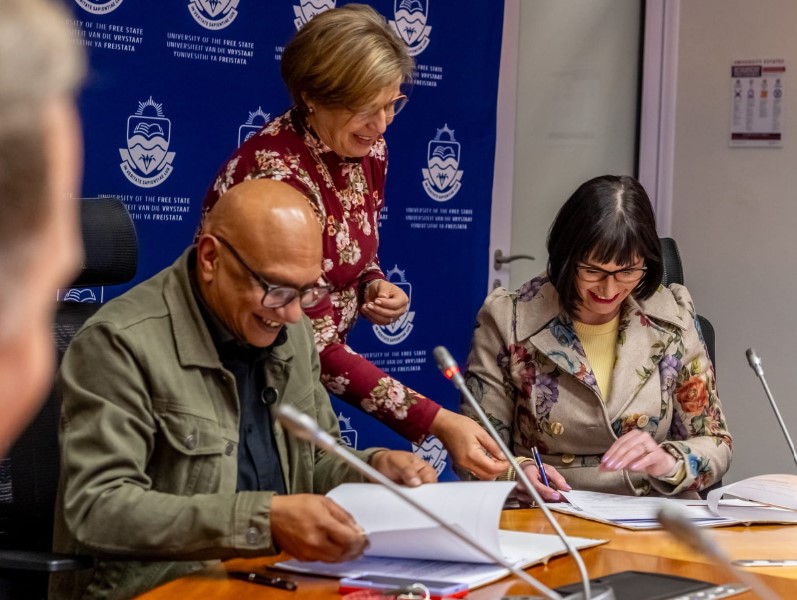
On 13 August 2026, the UFS and SAAWK marked the next stage of their longstanding relationship with the ceremonial handover of the collection and the signing of a Memorandum of Agreement that will facilitate continued collaboration on its digitisation.
For SAAWK Chief Executive Officer Dr Annelise de Vries, the collection provides an important window into the Akademie’s history and the development of Afrikaans as a language capable of carrying scholarship and scientific knowledge.
“The collection gives us an opportunity to look at the history of language planning and how Afrikaans developed into a language that could be used in science and scholarship,” she said.
“By making this material accessible through digitisation, we can create new opportunities for research and for understanding that history.”
The digitisation project is expected to take the collection beyond the confines of its physical archive, allowing researchers and students to engage more easily with material that has historically been primarily accessible through the University’s archival facilities.
Prof Vasu Reddy, Deputy Vice-Chancellor for Research, Innovation and Postgraduate Studies at UFS, described the occasion as an important milestone for both institutions.
“This event is historic and important,” Reddy said.
“The Akademie Collection is more than a collection. It is both a record of our intellectual past and a resource that will help shape responsible societal futures.”
Reddy said the partnership also demonstrated how heritage and scholarship could be brought together to support future knowledge creation.
“It is also about strengthening a partnership that connects heritage, scholarship, and future knowledge creation with one of our oldest Science Councils,” he said.
“I see this digitisation initiative as an investment in future scholarship, opening new pathways for research, discovery, and public engagement.”
For the UFS Library and Information Services (LIS), caring for the collection over the past five decades has involved balancing preservation with the need to make the material accessible to researchers.
Charlie Molepo, Head of Research and Scholarly Communications at LIS, said the responsibility of preserving such a significant collection was substantial.
“It’s quite a huge responsibility, because we had to make sure that the collection is preserved in an environment that is sustainable for its long-term preservation, while also making sure that it is accessible for research, both locally and internationally,” Molepo said.
LIS has developed metadata to make the collection more discoverable and introduced measures aimed at protecting the archival material from natural and human-made disasters.
Digitisation will add another layer of preservation while significantly expanding access.
“Digitisation opens up new opportunities for access, because researchers all over the world can easily access the collection, and our students can also access it,” Molepo said.
“It also allows us to preserve it because, as technology and software change, we need to be able to adapt to those changes.”
The project also highlights the evolving relationship between the UFS and SAAWK. Rather than simply transferring responsibility for the collection, the two institutions are continuing to work together to determine how the archive can be used to support research, teaching and scholarship.
Molepo said the collaboration could create opportunities for increased research activity at the University, including postgraduate work.
“Ultimately, it opens up new opportunities for the University to have more research within the institution, whether through collaboration or supervision of postgraduate students, because the Academy also has a lot of excellent researchers,” he said.
The significance of the collection therefore extends beyond its value as a historical archive. Its digitisation could create opportunities for researchers to revisit the history of Afrikaans, language planning, scholarship and the intellectual development of South Africa through primary archival material.
For students and academics, increased digital access could also make it easier to incorporate the collection into research and teaching, while allowing scholars outside South Africa to engage with material previously accessible primarily through the physical archive.
According to the university, the handover marks a significant transition for a collection that has spent more than five decades in the care of the UFS.
Reddy said the institutions’ responsibility was not simply to protect the past, but to ensure that the archive continued to contribute to contemporary scholarship.
“Our responsibility is not only to safeguard the archives, but to activate them as living resources for learning, research, and public understanding,” he said.
“When we preserve knowledge and make it accessible, we create opportunities for innovation, collaboration, and lasting societal impact.”
Through the digitisation partnership, the UFS and SAAWK are seeking to ensure that an archive built over more than a century does not remain confined to history books or physical shelves, but continues to inform research and scholarship.
“Together, the UFS and SAAWK are building a legacy that honours the past, enriches the present, and inspires future generations of scholars,” Reddy said.
INSIDE EDUCATION