



By Lebone Rodah Mosima
Deputy Minister of Higher Education and Training Yusuf Cassim has called for the development of a practical national student safety compact, with clear responsibilities for institutions, municipalities, law enforcement, accommodation providers and student leadership, measurable commitments and a mechanism for reporting progress.
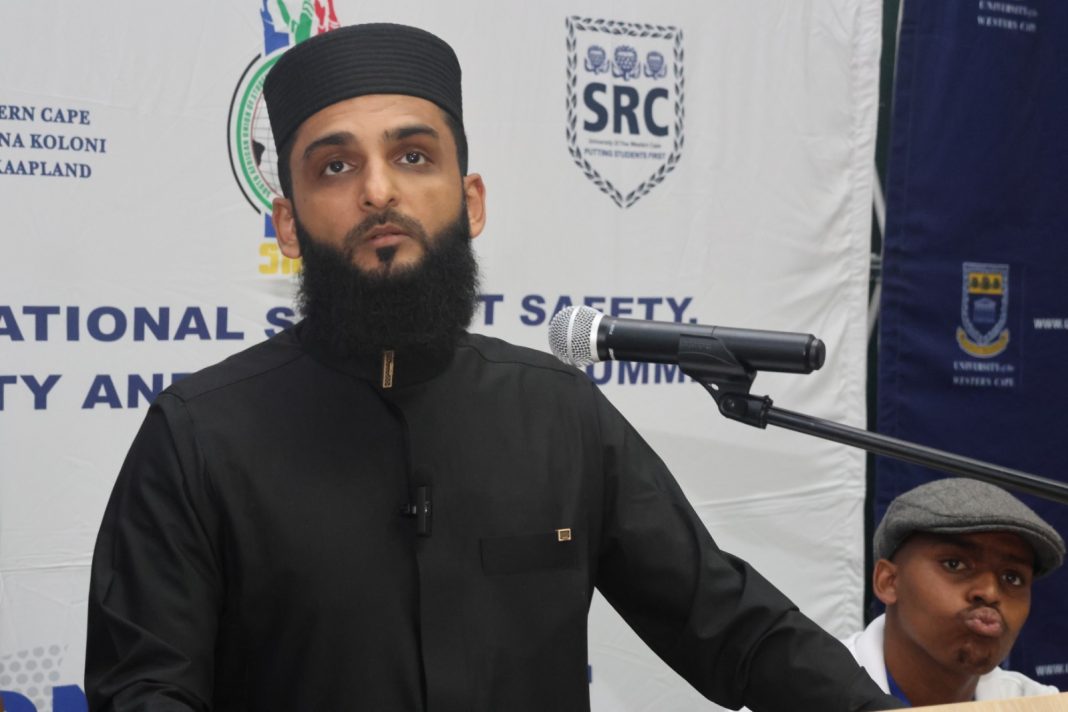
Addressing the National Student Safety, Security and Well-Being Summit 2026 at the University of the Western Cape on Friday, Cassim said student safety is not simply a policy issue but a human obligation.

“When a parent sends a child to university, they are entrusting us with their son or daughter. That trust comes with a responsibility. Not simply to have policies,” Cassim said.
“Not simply to hold meetings. Not simply to receive reports. Our responsibility is to make sure they are safe. And when a system is not working, our responsibility is not to defend it. It is to change it.”
He also urged that no parent should be afraid to send their daughter or son to university because they fear that they may not return home safely.

He said just days ago, this city once again walked in remembrance of Uyinene Mrwetyana.
He added that nearly seven years after the 19-year-old UCT student was raped and murdered in Claremont, the Uyinene Mrwetyana Foundation and UCT retraced the route she once travelled between Roscommon House, where she lived as a student, and the university where she was pursuing her education.
“Think about that for a moment. A young woman left her residence as a student pursuing an education and a future. The route between where she lived and the world she was trying to enter became a route of tragedy,” he said.

He said remembrance could not be the destination and questioned whether anything had changed since Uyinene’s death.
He said if Uyinene’s name has taught them anything, it is that they cannot measure student safety only by what happens inside the university gate.
“The campus gate cannot become the boundary of our responsibility,” he said.
“A student does not stop being a student when they leave the campus gate.”
He added that students remain their students when they walk to the residence, wait for a taxi, walk to a shop, cross a municipal road, enter a private residence and return home at night.
However he questioned who is responsible for student safety?’, and the answer cannot simply be, ‘the university’.

“The responsibility is much broader,” he said.
“Student safety is a shared responsibility, requiring universities, municipalities, law enforcement, accommodation providers, transport operators and students themselves to work together.”
According to the latest SAPS crime statistics for January to March 2026, he said 5,181 people were murdered nationally, an average of 58 lives lost every day.
He said the Western Cape recorded a murder ratio of 12.8 per 100,000 people, the second-highest provincial risk in the country.
“These may not be student-specific figures and we should not pretend that they are. But they tell us something important about the environment in which our students live, travel and study,” he said.
“These numbers tell us something uncomfortable: the environment in which our students live is not safe enough.”
He outlined that Cape Town gives one example of what is possible when people, technology, intelligence and partnerships are brought together.
He said the City’s approach includes drones and other ‘eye-in-the-sky’ capabilities, CCTV, automated licence-plate recognition, body-worn cameras, gunshot-detection technology, canine units and digitally enabled policing.
“But let me be clear: this Summit is not about celebrating one city’s model. It is about asking what works,” he said.
“But where systems are failing students, we must be equally prepared to say so.”
He said: “We cannot become more committed to protecting systems than protecting students.”
He noted that the measure of success cannot be how many cameras are installed, how many policies are written or how many meetings are held, but whether the student is safer.
“Technology alone, however, will never be enough. We need eyes in the sky, but also eyes on the ground,” he said.
“We need technology that identifies risk, people who can respond to that risk, and systems that ensure the response actually reaches the student.”
He said student accommodation, student wellbeing and student safety are responsibilities that he commits to execute with excellence and precision.
He said accommodation must be viewed not simply as a funding or housing issue, but as an essential component of the student’s educational experience and wellbeing.
“Where private landlords and accommodation agents participate in student housing, they must recognise that they are not simply providing a commercial service,” he said.
“They are providing the environment in which young people live and study, and they must uphold the applicable safety and accommodation standards.”
He stressed that student accommodation must be structurally sound, have appropriate access control, secure doors and windows, adequate lighting, meet fire-safety requirements and have safe electrical and gas installations.
He also said emergency procedures must exist, common areas must be maintained, students must know who to contact in an emergency, and safety concerns raised by students must be taken seriously and acted upon.
“These are not luxury standards or unreasonable expectations. They are part of what it means to provide a safe environment in which a student can live and learn,” he said.
“That is what we did at Western TVET College, where more than 60 students were displaced, and at the Central University of Technology’s Welkom Campus, where 1,392 students were affected by accommodation allowance challenges and faced the prospect of eviction.”
He added that at CUT, there were even administrative questions about the convenience of the proposed date.
“My response was simple: Make it happen,” he said.
“Because when students need government, government must be there — not when it is convenient, but when it matters.”
However, he said these interventions taught an important lesson: resolving an accommodation payment problem is not the same as fulfilling our responsibility for the student’s wellbeing and safety.
“We must therefore ask not only, ‘Was the student funded?’ We must also ask: ‘Where is the student living, and is it safe?’ That must become part of our national standard,” he said.
“This is where I believe this Summit can take the conversation even further: from safe campuses to safe student precincts.”
He added that a student should be able to move safely from the lecture hall, through the campus gate, along the street, to public transport and into their residence, with universities, municipalities, law enforcement and accommodation providers working together.
He stressed that there should be no safety vacuum simply because a student has crossed an institutional boundary.
“That is what a genuine continuum of student safety must mean,” he said.
He added that students know where the unsafe pathways are, and know which residences have broken gates, which transport routes make them uncomfortable, where harassment occurs and which reporting mechanisms work – and which exist only on paper.
He added that some of the most important safety intelligence in this country is therefore walking around our campuses every day.
“Students are not people we consult after decisions have been made. They are the people who live with the consequences of those decisions,” he said.
“And I believe student participation must become a formal part of institutional and municipal safety planning – not something we turn to only after an incident has occurred. Students should help identify risks, shape interventions and assess whether those interventions are actually working.”
In memory of Uyinene, he said it would be easy to commemorate her once a year, lay flowers, hold a walk, make speeches and then return to business as usual.
However, he said, the purpose of remembrance must ultimately be action.
“So today I want to propose that we begin moving towards a different national conception of student safety,” he said.
“Not a system in which every institution protects only its own piece. But a system in which the pieces connect.”
He expressed that the university knows its students, that the municipality knows the streets, SAPS knows the crime patterns and accommodation providers know the residences.
He added that private security knows the immediate environment, technology can provide intelligence and student leaders know the lived reality, adding: “We must bring these capabilities together.”
“That is what a genuine student safety compact should mean,” he said.
“If we meet again next year, we should not only be able to say that we spoke about student safety. We should be able to show what changed.”
Because ultimately, he said this is not about how impressive policies sound, or how many meetings we hold, or about how many cameras we install, or whether we can produce a beautiful presentation on student safety.
He added that the test is much simpler, and that when a parent in Limpopo, KwaZulu-Natal, the Eastern Cape, Gauteng, the Free State, the North West or the Western Cape puts their child on a bus and sends them to university, can that parent say: ‘My child will be safe.’
“That is the test. And when a young woman leaves her residence to attend a lecture, we must want her to return to that residence safely. When a young man walks home after studying late, we must want him to arrive safely,” he said.
“When a student reports a threat, we must want someone to respond. When a student enters accommodation, we must want that accommodation to be safe.”
He called for more than resolutions, and said: “Let us leave with commitments we can measure, partnerships we can activate and interventions we can see.”
“Let us be willing to confront what is not working. Let us be willing to change direction when we need to. And let us never become so comfortable with a broken system that we stop demanding better,” he said.
“Because every student deserves to know that when they leave home in pursuit of knowledge, opportunity and a better life, there is a system around them that will do everything reasonably possible to bring them home safely.”
INSIDE METRO