



By Charmaine Ndlela
The University of Johannesburg (UJ) has been ranked number one in South Africa in 10 academic subjects in the latest ShanghaiRanking’s Global Ranking of Academic Subjects (GRAS), with eight of those subjects also taking the top spot in Africa.
The results, released on Tuesday, place UJ among the leading universities globally across a range of disciplines, including engineering, education, business, management, political sciences and the natural sciences.
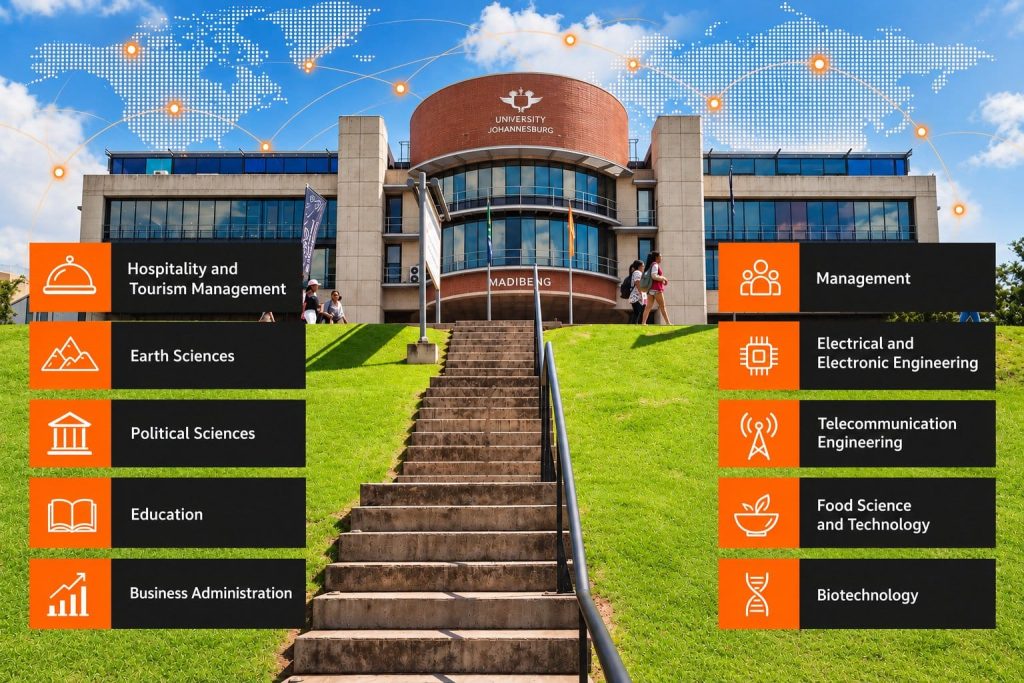
UJ was ranked number one in South Africa for Hospitality and Tourism Management, Earth Sciences, Political Sciences, Education, Business Administration, Management, Electrical and Electronic Engineering, Telecommunication Engineering, Food Science and Technology, and Biotechnology.
Eight of these subjects also ranked number one in Africa.
The university’s strongest global performance came in Hospitality and Tourism Management, where it was ranked 19th in the world.
UJ Vice-Chancellor and Principal Professor Letlhokwa Mpedi said the results demonstrated the university’s research strength across a broad range of disciplines.
“These results speak to the depth and diversity of research excellence at UJ. Being ranked number 1 in South Africa across 10 subjects, with eight of these also leading Africa, demonstrates the strength of our academic enterprise across a remarkably broad range of disciplines,” Mpedi said.
He said the rankings also reflected the university’s continued performance in established areas while highlighting emerging areas of research.
“Our continued global top 20 position in Hospitality and Tourism Management, together with the return of Political Sciences and the debut of Biotechnology, shows both the sustained quality and the evolving nature of our research strengths,” Mpedi said.
UJ was ranked in 15 of the 57 subject tables included in the 2026 GRAS.
The university secured second place nationally in Geography, Sociology and Chemical Engineering, while Economics was ranked third in South Africa.

Much of the bibliometric data used in the rankings, including research output, citation impact and international collaboration, covers the period from 2021 to 2025, while other indicators draw on faculty, awards and academic leadership data extending into 2026.
ShanghaiRanking assesses universities according to academic disciplines using indicators covering research output, research quality, research impact, international collaboration and the strength of academic faculty.
The ranking evaluates universities across 57 subjects in the natural sciences, engineering, life sciences, medical sciences and social sciences.
According to ShanghaiRanking Consultancy, the 2026 edition includes nearly 2,000 universities from around 100 countries and regions, covering about 20,000 subject units.
The assessment uses nine objective indicators grouped into five broad categories: world-class faculty, world-class research output, high-quality research, research impact and international collaboration.
The rankings are compiled using bibliometric data from sources including Web of Science and InCites, with publication thresholds varying according to the subject being assessed.
ShanghaiRanking first introduced global rankings by academic subject in 2009 before officially renaming the ranking the Global Ranking of Academic Subjects in 2016.