
By Charmaine Ndlela and Lebone Rodah Mosima
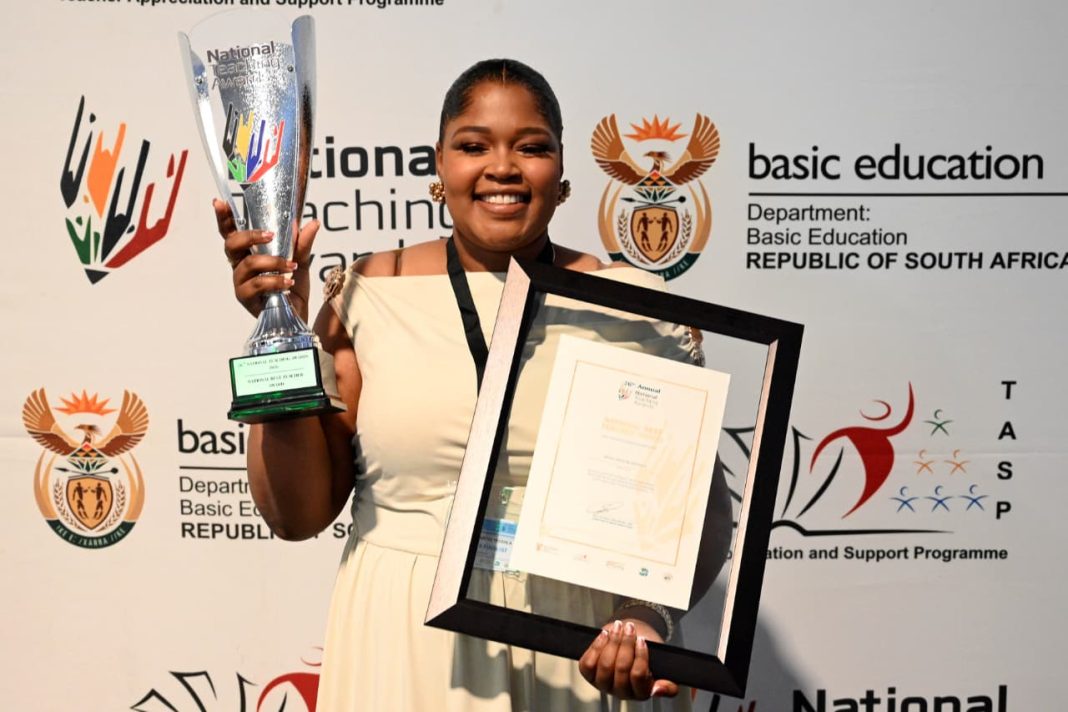
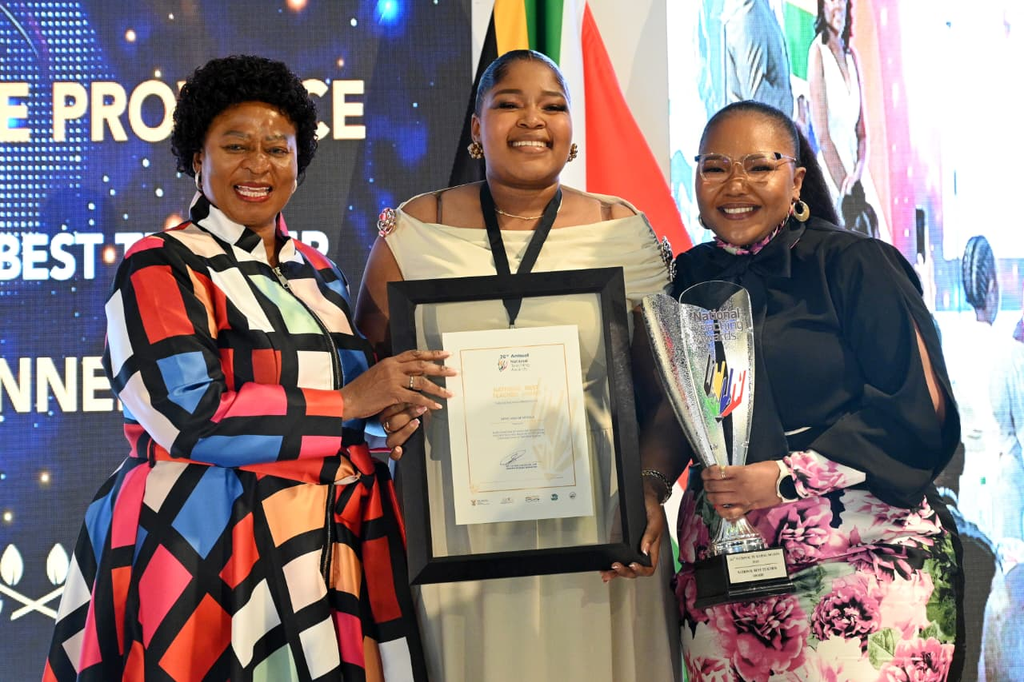
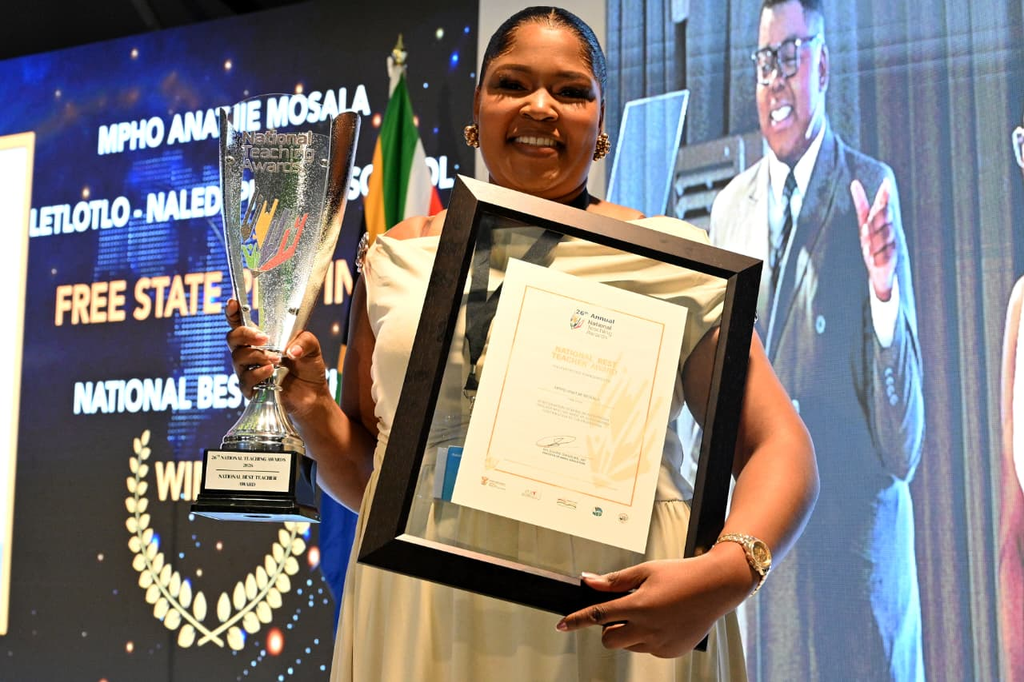
A Free State teacher from Letlotlo Naledi Primary School, Mpho Anatjie Mosala, has been named South Africa’s National Best Teacher at the 26th National Teaching Awards.
Mosala was recognised for her commitment to literacy and supporting learners beyond the classroom.
She was among more than 133 teachers who participated in the national adjudication process before being recognised at the awards ceremony hosted by the Department of Basic Education (DBE) at the Birchwood Hotel and OR Tambo Conference Centre in Benoni, Gauteng, on Thursday.
The National Teaching Awards are the department’s flagship platform for recognising educators whose dedication, innovation and leadership contribute to teaching and learning across the country.
This year’s awards were held under the theme, “Uniting for Excellence: Elevating Achievement, Empowering Educators to Shape South Africa’s Future.”
Speaking about her achievement, Mosala said her approach to teaching extended beyond the classroom, with a particular focus on understanding learners’ backgrounds and strengthening literacy from an early age.
“I’m a teacher that believes in supporting learners beyond the classroom and also understanding the background of my learners,” Mosala said.
“Most importantly, I am a language teacher. I believe in making sure that my learners know how to read for comprehension, and I also encourage early literacy in schools, neighbouring schools and in ECDs.”
Teachers from across the country were also recognised in categories covering school leadership, inclusive education, mathematics, science, Grade R teaching, primary and secondary school teaching and technology-enhanced learning.
The awards also recognised teachers whose work demonstrates the importance of strong foundations in literacy, numeracy and learner development.
In the Excellence in Secondary School Teaching category, Samukelisiwe Melody Msibi from Phendukani Full Service High School in KwaZulu-Natal took first position. Nokuthula Claudia Zulu from Prudens Secondary School in Gauteng was second, while Zininzi Ncwama from Monchusi Secondary School in North West took third.
In Excellence in Teaching Mathematics (GET), Fulufhedzani Zwivhuya Mulaudzi from Danel Mubvu Primary School in Limpopo took first position, followed by Winnie Sithembiso Mashabz from Laerskool Mooifontein in Gauteng and Thabo Ivirn Mazibuko from Makause Combined School in Mpumalanga.
Abiud Prosper Baloyi from Mungwazeni Secondary School in Limpopo was named the top teacher in Excellence in Teaching Physical Science (FET). S’nenhlanhla Nicholus Sibutha from Elangwane Secondary School in Mpumalanga took second position, followed by Sabata Benjamin Hlohlolo from Senakangwedi Secondary School in Mpumalanga.
Hortense Frances Stegmann from Welgemoed Primary School in the Western Cape took first position in Excellence in Technology-Enhanced Teaching and Learning.
Ridwaan Saith from Dr Yusuf Dadoo Primary School in Gauteng was second, while Emanuel Sampodi Tonga from Sihakwaneng Primary School in Mpumalanga took third.
In Excellence in Life Skills (Grade 1-6), Vusi Christopher Maseko from Hlanguphala Primary School in Mpumalanga took first position. Matabane Laura Mmutle from Thabanapitsi Primary School in Limpopo was second, while Mpho Molatlhwa from Pitso Tolo Primary School in North West took third.
Other educators recognised included Duduzile Constance Nkuna of Sekampaneng Primary School in Gauteng, who received the Kader Asmal Lifetime Achievement Award.
Mosimanegape Webster Moepi of Rayogana Primary School in North West received the award for Excellence in Primary School Leadership, while Mthobi Ian Fihla of Phakamisani Primary School in the Western Cape was recognised for Excellence in Inclusive Education Leadership.
Hendrik Jacobus Küchelhoffer of Hoërskool Trio High School in the Free State was recognised for Excellence in Secondary School Leadership.
In Excellence in Grade R Teaching, Danielle Sherilyn Bosch of Koos Sadie Primary School in the Western Cape took the award, while Xolile Gladness Mazibuko of Sipheni Primary School in KwaZulu-Natal was recognised for Excellence in Primary School Teaching.
Toetso Evidance Mmako of Molamo Primary School in Limpopo received the award for Excellence in Teaching Natural Science (GET), while Tshepang Confidence Olifant of Pholoho Special School in the Free State was recognised for Excellence in Inclusive Education Teaching.
Among the highlights of the awards was the Minister’s Special Award, which recognised Grade 6 and 7 teacher Paulos Emmanuel Mthimunye from Khulufunde Primary School in Buhlebesizwe, KwaMhlanga.
Mthimunye was nominated by one of his Grade 7 learners, Appreciate Jiyane, for his contribution and the positive and lasting impact he has had on his learners.
Mthimunye received R20,000, while Jiyane received R15,000.
Delivering the keynote address, Basic Education Minister Siviwe Gwarube said the National Teaching Awards provided an opportunity for the country to recognise educators who give the education system its “human face and its soul”.
“These Awards are an opportunity for the country to pause and recognise the people who give our education system its human face and its soul,” Gwarube said.
She said teachers played a crucial role in helping young people understand their potential, regardless of the circumstances in which they were born.
Gwarube used the example of two hypothetical 10-year-olds, Lindiwe and Nelson, to illustrate inequalities that can emerge before children enter formal schooling.
While Lindiwe had access to early childhood development, reading and other learning opportunities from an early age, Nelson grew up without access to an ECD centre and with limited opportunities to develop literacy and numeracy foundations.
Gwarube said the difference was not about ability, but about the foundations children received.
“The reality is that the majority of South African children are Nelsons and not Lindiwes and that is the great injustice that we, in the basic education sector, must work incredibly hard to correct,” she said.
She said the department’s focus on Strong Foundations for Strong Futures was aimed at addressing these inequalities through early childhood development, Grade R, Foundation Phase literacy and numeracy, teacher development, school safety, inclusion and improved governance.
Gwarube said more than 13,300 ECD centres had been registered over the past year against a target of 10,000, while about 1.2 million children were accessing registered ECD programmes.
The subsidy rate had also increased from R17 to R24 per funded child per day, while the department was implementing an ECD Nutrition Pilot in the Eastern Cape.
She said a R496 million fund had also been established to create ECD spaces in KwaZulu-Natal, Limpopo and the Eastern Cape.
Gwarube said 10,000 Foundation Phase teachers were receiving targeted training in literacy and numeracy this year, while the department was strengthening the National Reading Literacy Strategy.
She also said the department was reviewing the Post Provisioning Norms, which determine how teachers are allocated to schools.
“We want to have more teachers in the Foundation Phase, we want them to be better trained and to be highly skilled,” Gwarube said.
She highlighted the department’s support for Mother Tongue-Based Bilingual Education, saying language could play an important role in improving learning outcomes.
Gwarube also addressed the administrative burden placed on teachers, saying the department was finalising a circular aimed at reducing unnecessary administrative requirements.
“Teachers are not data capturers. Teachers must teach,” she said.
At the same time, Gwarube warned that teachers had a responsibility to protect learners and the teaching profession from abuse.
She said 40 teachers had been found guilty of sexual offences by the South African Council for Educators since January 2026, while fewer than 35% of teachers had submitted themselves for vetting against the National Register for Sex Offenders.
“All teachers must be vetted,” she said.
Gwarube also urged the sector to look beyond matric results when assessing the quality of the education system, saying foundational literacy, numeracy, learner retention and access to subjects such as Mathematics and Physical Sciences were equally important measures.
She said the National Teaching Awards should not only recognise individual excellence but also help spread successful teaching practices across the education system.
“These awards must connect recognition with system improvement,” Gwarube said.
“The purpose of these awards should therefore extend beyond today. An outstanding teacher should become a source of professional knowledge for other teachers. Excellence should travel, knowledge should travel.”
Gwarube thanked the country’s 485,000 educators for their contribution to South Africa’s education system.
She reflected on her own grandmother, who was a teacher, and described teachers as being like candles that consume themselves to light the way for others.
“To all 485,000 teachers, I want to say, on behalf of the people of South Africa, thank you,” Gwarube said.
“Thank you for your professionalism, for your courage and for the sacrifices you make for our learners.
“Thank you for building an education system capable of preparing South African children for the country they will inherit.”
She reminded teachers that while the awards ceremony was a moment to celebrate excellence, their work would continue when they returned to their classrooms.
“Teachers, on Monday, you will return to your schools and the work of building South Africa’s future will continue,” Gwarube said.
“But today, you must celebrate.”
She ended by calling for the work recognised at the National Teaching Awards to extend beyond the ceremony and contribute to stronger foundations for South Africa’s learners.
“May you continue to inspire the profession. May the work recognised today travel far beyond this room. And may our collective efforts continue to build an education system founded on strong foundations of learning,” she said.
“Strong foundations create strong futures.”
INSIDE EDUCATION