
By Willem Kitshoff
The debate around WhatsApp in schools is raising an important question: is the problem the platform itself, or how schools govern the way it is used?
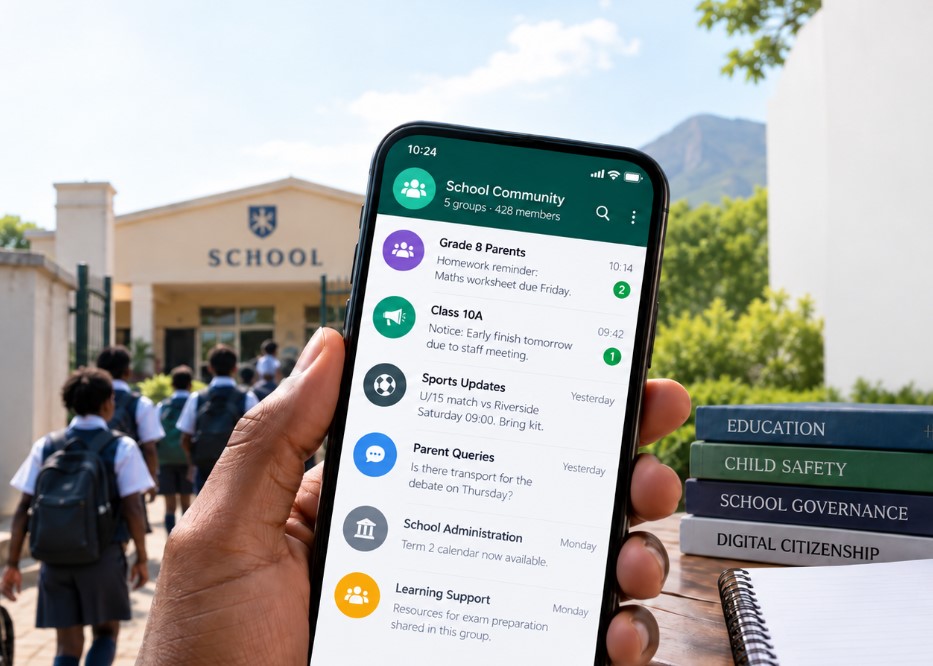
WhatsApp has become part of everyday school life, from homework reminders and parent queries to class announcements and sports arrangements. But when a platform designed primarily for personal communication becomes part of a school’s unofficial infrastructure, the boundaries between personal and professional communication can quickly become blurred.
That is where the real governance challenge lies.
The Department of Basic Education has identified “direct and largely unregulated digital communication between individual educators and learners,” as a potential risk.
Recent events show why the issue matters. In August, a teacher at Minerva Secondary School in Alexandra was placed on precautionary suspension following allegations of inappropriate communication with a 17-year-old learner. The teacher allegedly obtained the learner’s contact details through a WhatsApp group created to support schoolwork. The allegations remain under formal investigation.
The case highlights a critical question for schools: when communication moves onto personal phones and informal groups, who controls access, where are the boundaries, and what happens to the communication record?
WhatsApp isn’t necessarily the problem. The bigger issue is whether schools have the governance, boundaries and systems to ensure that digital communication is appropriate, accountable and safe.
Schools need to know who has access to information, who is communicating with whom, what is being shared and whether there is a reliable record of those interactions. That protects learners, but it also protects educators and the school itself.
The governance challenge goes beyond privacy. Informal communication can expose sensitive learner information, blur boundaries between teachers, parents and learners, and create opportunities for inappropriate contact. In more serious cases, poorly regulated communication can contribute to environments in which grooming or other forms of abuse can occur.
The answer is not simply to ban WhatsApp or replace one platform with another. It is to put proper governance around digital communication.
Schools need clear policies and systems that establish appropriate audiences, communication boundaries and times; protect personal information; retain reliable communication histories; and ensure that important records remain with the school when staff members leave.
Technology can play an important role in making those principles practical. A modern school communication system can allow schools to manage communication across WhatsApp, email, SMS and dedicated school apps from a more structured environment. Schools can control who receives information, target specific groups, retain message histories and create greater visibility over communication.
It can also make communication two-way in order to safely facilitate queries between parents and teachers. This way, school information, questions and parent/teacher engagement happens through an appropriate school-managed channel.
Technology cannot replace good policy or professional judgement. But the right technology can help schools enforce their policies, create visibility and make accountability part of the communication process rather than something they have to reconstruct afterwards.
As schools increasingly adopt AI and other digital tools, this governance layer becomes even more important. The question is no longer simply which platform a school uses, but whether its communication infrastructure supports privacy, safeguarding, accountability and continuity.
Ultimately, the question schools should be asking is not:
“Are our teachers allowed to use WhatsApp?”
It is:
“Do our communication systems give us the governance and visibility we need to protect our learners, our educators and our school?”
Technology will continue to change. The need for clear boundaries and accountable communication will not.
Willem Kitshoff is the CEO of d6, which works with more than 2,500 schools to support communication and engagement between schools and their communities.
INSIDE EDUCATION