
By Charmaine Ndlela
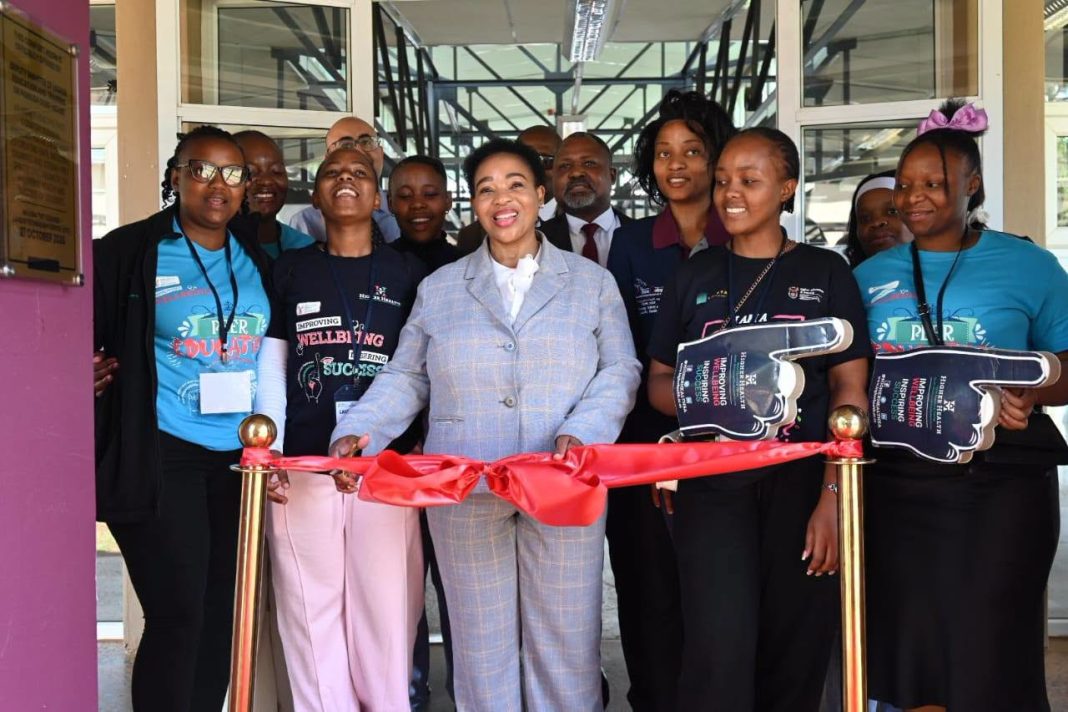
Deputy Minister of Higher Education and Training Nomusa Dube-Ncube has called for stronger support systems to protect students from gender-based violence (GBV), as she opened KwaZulu-Natal’s first post-school education and training (PSET) Comfort Room at Majuba TVET College’s Dundee Campus on Wednesday.
The launch comes amid high levels of violence against women in the province, which recorded 1,820 reported rape cases between April and June this year, the highest number nationally, according to Dube-Ncube.
Police also recorded 124 women murdered in the province during the same period.
Speaking at the college’s Dundee Technology Centre, Dube-Ncube said the facility would provide students with a safe, private space to seek help, access psychosocial support and be referred to relevant services.
She said police stations recording sharp increases in rape cases included Madadeni and Dannhauser, in communities served by the college.
“Behind every one of those numbers is a sister, a classmate, a mother, a learner. And we know that the numbers we see are only the cases that were reported. Many more were never spoken about at all,” Dube-Ncube said.
She said the classification of GBV and femicide as a national disaster in November last year underscored the seriousness of the crisis and the need for government departments and institutions to coordinate their responses.
Dube-Ncube said the Comfort Room was intended to address gaps in the support system that often leave survivors struggling to access healthcare, police, social workers and the courts.
She described how survivors could be forced to report assaults to different institutions, repeatedly recounting their experiences while trying to obtain assistance.
“At every one of those doors she must repeat the worst day of her life. Each office keeps its own forms and its own records. Nobody follows her from one door to the next,” she said.
Dube-Ncube warned that fragmented reporting and support mechanisms could result in secondary victimisation, discourage survivors from pursuing cases and allow perpetrators to escape accountability.
“A survivor does not experience a ‘system’. She experiences a series of separate doors, and too often, a series of closed ones,” she said.
The facility is intended to connect students with the services they need, providing a supportive environment where they can disclose their experiences, receive guidance and be referred to appropriate professionals.
It is the first facility of its kind in KwaZulu-Natal’s PSET sector and was established through a partnership between Higher Health, Majuba TVET College and the provincial Department of Health.
Dube-Ncube thanked Higher Health, led by Professor Ramneek Ahluwalia, the college and the provincial health department for establishing the facility.
“Not long ago I stood at a similar launch in Pretoria. What I saw there convinced me that this model works. Today, it comes home to KwaZulu-Natal, and I am particularly proud that it begins here in northern KwaZulu-Natal, among communities that need it,” she said.
The Comfort Room will offer support to GBV survivors, mental health and wellbeing interventions, peer educator-led assistance, HIV-related psychosocial support and access to Higher Health’s civic and soft skills programmes.
It will also host Survivor Clubs, which provide survivors with solidarity and pathways to professional assistance, and Transforming Mentalities Clubs, aimed at encouraging young men to challenge harmful attitudes and behaviours that contribute to violence.
Dube-Ncube said Higher Health’s experience showed that young people were willing to seek help when provided with safe spaces to speak.
According to the deputy minister, more than 394,000 students had completed GBV self-risk assessments over the past four years, with more than 20,000 subsequently requesting assistance.
Through its mental health programmes, Higher Health had also identified more than 188,000 young people who needed or were actively seeking psychosocial support.
Dube-Ncube said the facility would contribute to the national response to GBV and femicide, particularly in the PSET sector.
She said she was convening stakeholders across the sector, including universities, TVET colleges, Community Education and Training colleges, Sector Education and Training Authorities, Higher Health and student formations, to consolidate existing interventions, identify gaps and agree on coordinated commitments.
“A national plan that does not reach our campuses will not reach our young people,” she said.
The lessons learnt from the Dundee facility would inform the department’s contribution to the national intervention plan and help ensure the initiative formed part of a broader strategy to protect students.
“The Comfort Room model, and the lessons we learn here in Dundee, will be part of the PSET input that I take to the Inter-Ministerial Committee. What begins in this room today must become part of how the whole country protects its young people,” she said.
Dube-Ncube also called on young men to play an active role in preventing GBV by challenging abusive behaviour and harmful attitudes among their peers.
“Strength is not control. Love is not jealousy. ‘No’ means no, and silence is not consent,” she said.
She urged male students to speak out when friends threaten women, share intimate images without consent or abuse their partners.
She also called on student representative councils, peer educators and college leadership to ensure students knew about the facility and felt safe using it.
Dube-Ncube said the college must ensure the room was properly staffed, connected to local healthcare services, police and social workers, and that referrals were followed up.
“To our SRC, our peer educators and the student leaders from other TVET colleges: this room belongs to you. Its success will not be measured by how beautiful it looks today, but by whether students know it exists, trust it, and use it,” she said.
She encouraged school learners attending the launch to speak to a trusted teacher, parent or healthcare worker if they experienced violence or knew someone who needed assistance. She also highlighted Childline’s free helpline, 116.
The launch also recognised Majuba TVET College students who recently graduated from Higher Health’s Civic and Soft Skills Programme, receiving National Qualifications Framework Level 5 certificates accredited by the Quality Council for Trades and Occupations.
The graduates form part of a national cohort of 15,571 students who recently received certificates through the programme.
The initiative aims to strengthen civic education and life skills, promote active and responsible citizenship, and equip graduates with competencies needed to navigate the changing world of work.
Dube-Ncube said TVET colleges had an important role to play in developing skilled graduates who could contribute to safer and more inclusive communities.
The launch comes ahead of the annual 16 Days of Activism for No Violence against Women and Children campaign, which begins in November.
Dube-Ncube said the facility should represent a year-round commitment to supporting young people rather than an intervention limited to the annual campaign.
“Stigma survives in silence. Today, we open a door where young people can speak, and we commit, as government and as partners, to make sure that every door behind it is open too,” she said.
INSIDE EDUCATION