
By Charmaine Ndlela
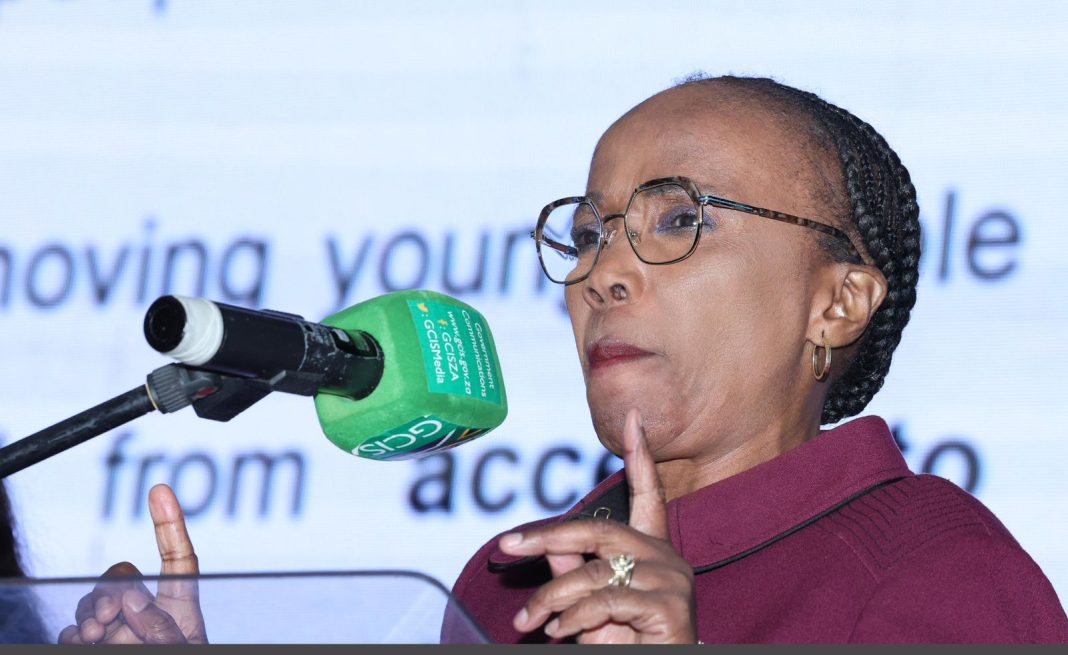
Minister in the Presidency for Women, Youth and Persons with Disabilities Sindisiwe Chikunga has called for urgent reforms to the education system, warning that barriers facing learners with disabilities could perpetuate their exclusion from the workplace.
“Disability-inclusive workplaces, such as those SARS is building, begin with an inclusive education system. The young Deaf South Africans in this cohort reached this point with the support of teachers, parents and communities determined that they should not be left behind,” she said while speaking at the launch of the South African Revenue Service (SARS) Deaf Accessibility and Cohort Programme in Pretoria on Friday.
Chikunga said the barriers were particularly severe in under-resourced township, rural and farming communities, where some special schools lacked accessible classrooms, ramps, suitable toilets and other facilities needed to accommodate learners with mobility impairments.
“If a child cannot enter a classroom with dignity, inclusion has failed before the lesson begins. Unless we address this exclusion at school, we risk reproducing it in the workplace,” she said.
She also highlighted inequalities in access to assistive technology and educational materials, contrasting learners in affluent communities who had access to specialised software and digital devices with those in rural areas who faced lengthy delays in obtaining Braille textbooks and other resources.
Deaf learners, she said, faced additional challenges, including a shortage of qualified South African Sign Language (SASL) teachers, inadequate interpreting services during examinations and limited access to visual learning materials.
Chikunga identified insufficient teacher training as another obstacle, saying many educators had not received the professional development needed to support learners with disabilities in mainstream classrooms.
She said emerging technologies, including artificial intelligence, automated captioning, speech-to-text applications and tactile reading devices, could improve access to education, but warned that their benefits would remain limited without affordable devices, connectivity and properly trained teachers.
The minister also called for changes in attitudes towards disability, saying learners with disabilities should not be treated as an additional burden on schools but as individuals entitled to equal educational opportunities.
Chikunga welcomed the SARS Deaf Accessibility and Cohort Programme, saying it was an example of how public institutions could turn disability inclusion commitments into practical measures.
Launched under the theme “Every Hand has a Voice – Shaping an Inclusive Future”, the programme seeks to improve access to SARS services for Deaf people through sign language support, dedicated consultations, digital skills development and stronger institutional capacity.
“Your work demonstrates, in the most concrete way possible, how inclusion can be translated from principle into practice through employment, skills development, accessible communication and institutional capability,” she said.
SARS has previously introduced measures to improve accessibility for Deaf taxpayers, including scheduled SASL interpreting services at selected service centres. In July, the revenue service published a schedule covering 11 centres across the country.
SASL became South Africa’s 12th official language in 2023, strengthening the recognition of Deaf people’s linguistic rights.
Chikunga said the SARS initiative reflected the government’s obligations under Section 9 of the Constitution, which guarantees equality before the law and prohibits unfair discrimination, including on the grounds of disability.
She also referred to South Africa’s commitments under the United Nations Convention on the Rights of Persons with Disabilities and the African Disability Protocol.
The launch coincided with Disability Rights Awareness Month, observed annually from 3 November to 3 December. This year’s national theme is “Creating Strategic Multi-Sectoral Partnerships for a Disability-Inclusive Society”.
Chikunga urged SARS to work with her department to expand employment opportunities for persons with disabilities, including through a dedicated employment stream building on the experience of the Deaf Accessibility and Cohort Programme.
She also outlined plans to establish partnerships between special schools and state-owned enterprises to improve infrastructure and educational conditions.
The proposal, which she described as one of her legacy projects, would bring together executives of state-owned enterprises, Sector Education and Training Authorities and industry associations to direct a portion of their corporate social investment budgets towards supporting special schools.
Although SARS is not a conventional state-owned enterprise, Chikunga said its position within the public finance system could help advance the initiative.
Turning to employment equity, the minister said government departments and private employers needed to accelerate efforts to increase the representation of persons with disabilities in the workforce.
The government has set a target of achieving 7% representation of persons with disabilities in the public service by 2030.
In March, the Department of Public Service and Administration issued a circular directing national and provincial departments to meet the existing 3% minimum employment target while making measurable annual progress towards the higher target.
Chikunga said Cabinet had approved annual increases of one percentage point, with the target for the 2026/27 financial year standing at 5%.
She said her department had achieved 5.56% representation of persons with disabilities, exceeding that interim benchmark.
“Across the public service, we can no longer plead with our colleagues. Those who continue to pay lip service to employment equity will be named, and they will be shamed,” she said.
Chikunga said the Department of Public Service and Administration had issued guidance to government departments on meeting employment targets, while her department had circulated a practice note to reinforce implementation.
She also said Cabinet had approved measures making the appointment of persons with disabilities to the boards of state-owned entities mandatory.
To support recruitment, the government was working with organisations representing persons with disabilities to establish a database of suitably qualified candidates for employment and appointments in public institutions.
Chikunga called on SARS to contribute to the initiative by sharing lessons from its Deaf Accessibility and Cohort Programme.
She also encouraged government departments, private businesses and the public to procure goods and services from Supported Employment Enterprises, government-supported operations that provide employment opportunities for persons with disabilities.
Such procurement, she said, could strengthen economic participation and create additional opportunities for people who continued to face barriers in the labour market.
Chikunga reaffirmed her department’s commitment to working with SARS, other government institutions and civil society organisations to ensure that persons with disabilities could access education, employment and public services without discrimination.
“In the South Africa we are building, every voice counts,” she said.
INSIDE EDUCATION