
By Lebone Rodah Mosima
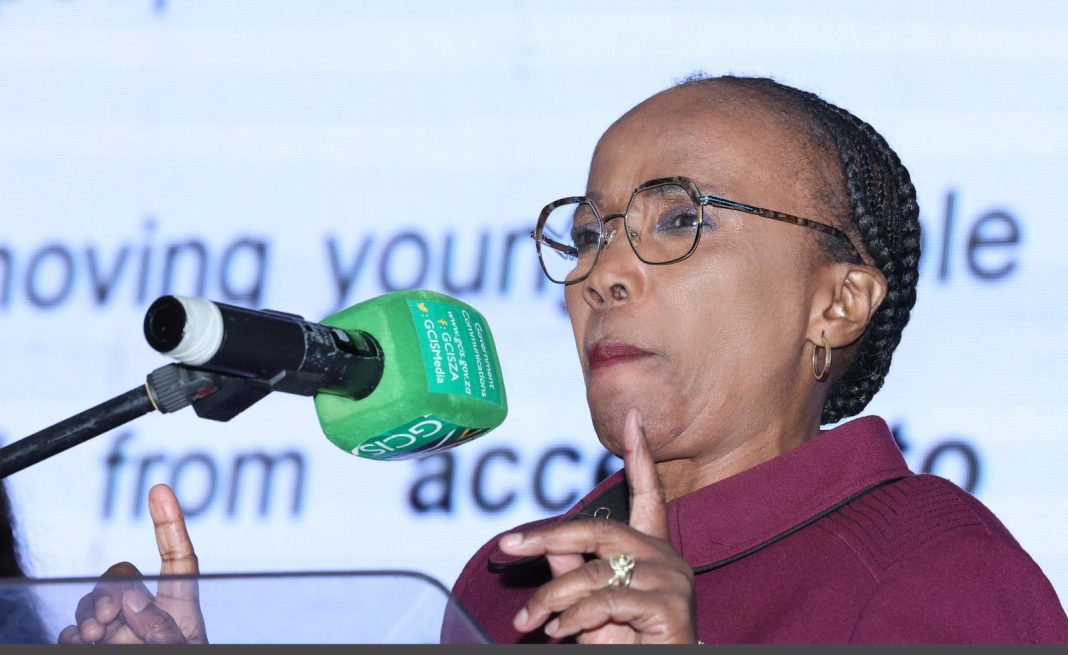
Minister in the Presidency for Women, Youth and Persons with Disabilities Sindisiwe Lydia Chikunga has called for stronger public-private partnerships to tackle South Africa’s youth unemployment crisis and food insecurity, saying government cannot solve either challenge on its own.
Chikunga was speaking on Wednesday at the launch of KFC Africa’s Impact Report in Bryanston, Johannesburg, under the theme: “Private Sector as a Partner in Youth Economic Inclusion and Food Security.”
“I also wish to commend KFC Africa for being one of the key corporate partners of the Youth Employment Service (YES) — the substantive public-private partnership that has transitioned more than 200,000 young South Africans from being labelled as “unemployed” to being registered as “employed” through a twelve-month work experience placement in the private sector,” Chikunga said.
“KFC’s participation in the YES architecture demonstrates, first-hand, how the transition from learning to earning can be operationalised at scale.”
Chikunga placed KFC Africa’s work within the broader Presidential Youth Employment Intervention (PYEI), which she said was government’s national response to youth unemployment and required a strong coalition between government, business and civil society.
She said the PYEI’s performance since its launch was now publicly documented, with interventions reaching millions of young South Africans across different employment and earning pathways.
“The SA Youth platform, which is the digital gateway of the PYEI, currently holds active registrations of more than 2.36 million young people, who are matched to opportunities in the labour market on an ongoing basis,” she said.
“The Employment Services of South Africa (ESSA) system has placed more than 402,515 young people into work experience, learnerships, and formal employment through PYEI-aligned partnerships.”
However, the latest PYEI fourth-quarter update places current SA Youth registrations at more than 5.9 million and ESSA registrations at more than 5.36 million. Since its launch in 2020, the PYEI has facilitated access to more than 2.5 million temporary earning opportunities through SA Youth and a further 422,667 opportunities through ESSA.
The call for deeper partnerships comes as South Africa continues to battle high levels of youth unemployment. According to Statistics South Africa’s first-quarter 2026 labour data, 4.7 million young people aged 15 to 34 were unemployed, while the unemployment rate stood at 60.9% for those aged 15 to 24 and 40.6% for those aged 25 to 34.
Chikunga said partnerships had to be backed by strong knowledge management and must be able to answer the critical questions of any strategic mission, allowing government and its partners to anticipate, respond to and navigate uncertainty.
She said the launch showed how private-sector partnerships could be implemented at scale.
“What we are launching today is indicative of what a partnership can look like when it is executed at scale,” she said.
“I therefore want to make a substantive call to KFC and its associated stakeholders. Our young people must be trained, integrated, and transitioned into viable businesses across the food, agricultural value chains, and related industries — from primary production, to logistics, and distribution to the food services, hospitality sector, and into the digital platforms that increasingly mediate all of these.”
Chikunga said every young South African involved in agriculture, food services or hospitality should have a clear pathway into sustainable economic activity.
She said youth economic inclusion could not be reduced to short-term participation, but had to mean the meaningful integration of young people into productive enterprises on terms that promoted ownership, agency and real prospects of wealth accumulation.
Turning to food security, Chikunga said South Africa’s challenge was not only the availability of food, but whether households could access it consistently and affordably.
“Too often, food security is viewed through a narrow and limited lens. Food security is not about the mere availability of food,” she said.
“Food is abundantly available — yet the marginalised remain food-insecure. The gap between availability and access is the substantive analytical question.”
She said food security also had to be understood through the lens of reparative justice, including the restoration of the rights of historically marginalised communities and their sovereignty over food systems.
Chikunga said South Africa could only be considered food-secure when all people had access to sufficient, safe and nutritious food that met their dietary and cultural needs, while also addressing the historical injustices that shaped current food inequities.
She identified several areas where the private sector could support youth economic participation and food security at scale.
These included supporting young South Africans to work the land, with specific attention to young women and persons with disabilities; helping emerging farmers transition into sustainable agribusinesses; investing in extension services, technical mentoring, market access, off-take agreements, supply-chain integration and patient capital.
She also said young South Africans and African entrepreneurs needed better access to local, continental and international markets, including opportunities created through the African Continental Free Trade Area, which brings together a market of about 1.4 billion people with a combined GDP of approximately US$3.4 trillion.
Chikunga said government and business also had to scale up youth employment in food, hospitality and distribution through targeted skills programmes, franchise expansion, enterprise development and the integration of youth-owned SMEs into supply chains.
She said the private sector could further support young people by helping expand affordable, high-speed data access in townships, rural areas and informal settlements, where many young people live and where digital platforms increasingly shape access to opportunity.
Chikunga said partnerships such as those with KFC Africa showed what was possible when social impact initiatives were linked to broader national priorities.
“You can count on our partnership and we very much look forward to working with you well into the future,” she said.
INSIDE EDUCATION