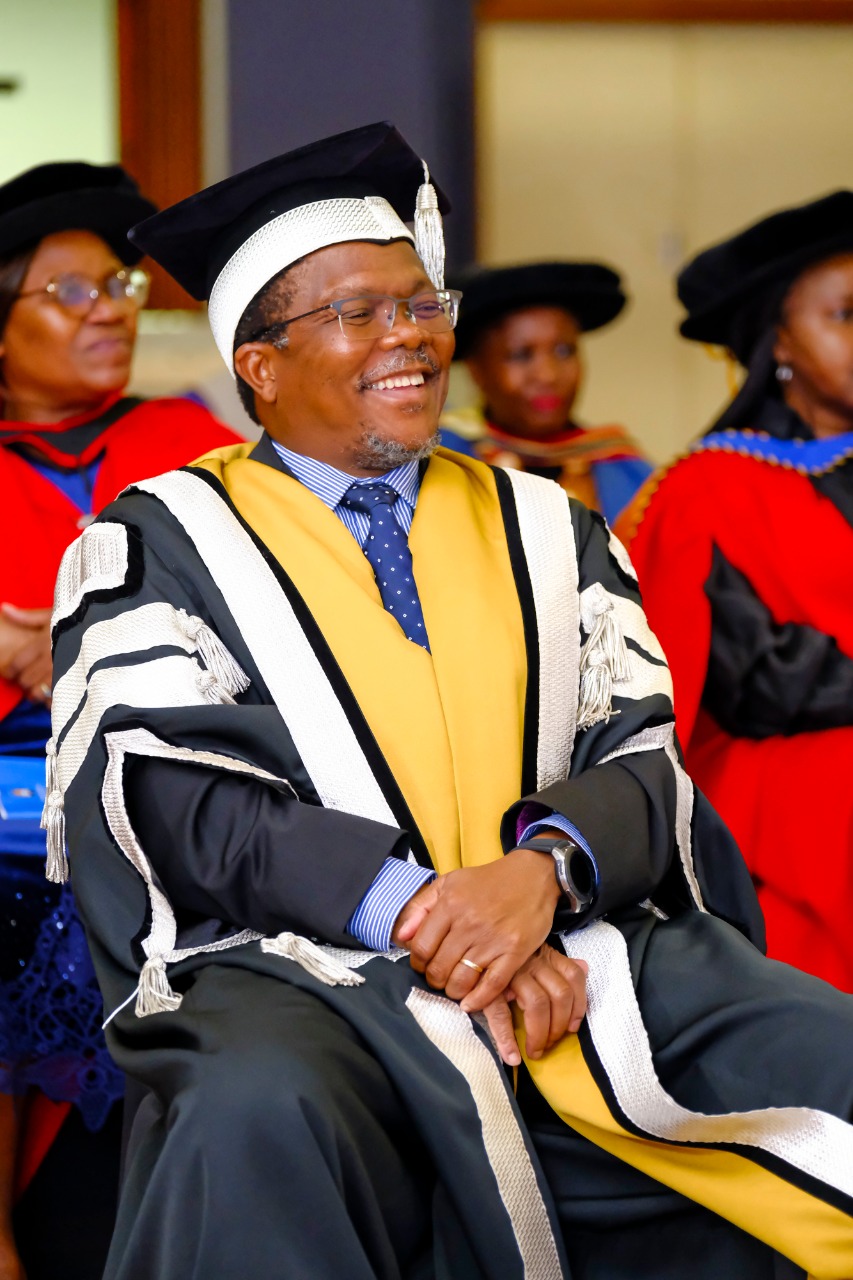

By Thapelo Molefe
The vice-chancellor of the University of Fort Hare has alleged that powerful political interests orchestrated violence, arson and intimidation at the institution in an attempt to remove him and collapse ongoing corruption investigations.
Speaking to Ann Bernstein, the founding director of advocacy group the Centre for Development and Enterprise (CDE), during a CDE-broadcast event, Professor Sakhela Buhlungu claimed that the torching of seven university buildings in October 2025 was not spontaneous student unrest.
Instead, he said, it was a calculated campaign funded by shadowy figures who want him gone before the Special Investigating Unit (SIU) releases findings against 33 politically-connected individuals allegedly implicated in academic fraud.
“It was supposed to be a tsunami to push the vice-chancellor out,” Buhlungu alleged.
“Taxi owners were there, the councillor was there, and a whole lot of other people were sitting in the shadows, pulling strings.”
His comments come amid sustained pressure from multiple quarters calling for his removal. Students, the university’s convocation, and some alumni have accused Buhlungu of corruption, poor governance and undermining student democracy.
The October 2025 protests were triggered by the university’s decision to appoint an interim Student Representative Council while amending the institution’s student governance constitution, a move students rejected as undemocratic.
Higher Education Minister Buti Manamela labelled the protests “criminality” and instructed the university council to reflect on several issues, including “concerns about the Vice-Chancellor’s contract”.
The University of Fort Hare Convocation has called for Buhlungu’s immediate departure, with its president Ayabulela Pezisa declaring: “He must leave. He must not go, he must leave.”
But Buhlungu offered a starkly different interpretation. He portrayed the violence as a politically motivated attempt to derail SIU investigations that threaten powerful figures.
“If you want to abort the SIU processes, what do you do? You get rid of the VC, you get somebody else who’s just going to throw their hands and forget about it,” he said.
Buhlungu dismissed suggestions that the October violence was an ordinary student protest. Seven buildings were destroyed in coordinated attacks, with structures selected for their strategic importance to the university, he claimed.
“Everyone has been to university. Everyone has seen unrest and protests,” he said. “But you don’t get seven buildings torched just because people are angry. It has never happened.”
The day after the first building burned, Buhlungu said he met with senior law enforcement officials including the provincial MEC for safety, the provincial police commissioner and crime intelligence officers. In that meeting, he alleged, authorities confirmed that significant funding was behind the destruction.
“We ended up agreeing with the law enforcement authorities that money was changing hands, that there was serious, serious money changing hands, and that it was sponsorship of the unrest,” Buhlungu claimed.
Despite this alleged acknowledgement, not a single person has been arrested for the arson.
Student leaders have maintained that the protests were a legitimate response to governance failures. Student leader Asonele Magwaxaza said during the October unrest: “An interim SRC is not student-centred. Those people are not democratically elected, they are installed by management.”
According to Buhlungu, the violence continued even after authorities promised intervention. He alleged that six buildings were torched the day after police undertook to deploy and restore order, with officers and a police water truck parked outside the university as flames consumed one structure after another.
Buhlungu said police explained their inaction by citing fears of another Marikana.
“The excuse was, we don’t want to use live ammunition. We’re scared because if we use live ammunition, there will be Marikana and we’ll be blamed,” he recounted.
“They say, listen, we’ve run out of rubber bullets. Rather we stand outside and watch the buildings burn.”
During the protests, student leader Uzusiphe Vuzane alleged that “they shot students using real bullets here in Alice Campus. One student was shot on the left knee, and another just above the heart near the shoulder.”
Unlike previous crises when President Ramaphosa dispatched a 19-member unit of the Political Killings Task Team (PKTT) to investigate crimes at Fort Hare, no such intervention has occurred following the October attacks, according to Buhlungu.
“This time around, there’s nothing. There is absolutely nothing,” he said.
Buhlungu’s account stands in sharp contrast to allegations made against him by critics.
University of Fort Hare alumnus Mbali Silimela wrote a letter during the protest to National Police Commissioner Fannie Masemola accusing Buhlungu of being “at the centre of a criminal syndicate within the university’s management”.
Convocation president Pezisa has accused Buhlungu of “neglecting alumni structures and perpetuating a culture of exclusion”.
“We don’t believe in the allegations alone, but we believe in what we see. Under his leadership, corruption and maladministration have taken place,” Pezisa said.
“A young vice-chancellor is needed to take Fort Hare forward.”
Buhlungu, however, framed his tenure as a battle against entrenched corruption and political entitlement.
“There is a general sense in which people feel entitled to Fort Hare,” Buhlungu said.
Student memoranda during the October protests demanded that 60% of university jobs and 60% of tenders go to residents of Alice, he noted. The local councillor had inserted himself into university affairs despite having no legitimate role, Buhlungu claimed.
“The councillor is completely rogue. Gone completely, absolutely rogue,” he alleged.
INSIDE EDUCATION