
By Johnathan Paoli
Basic Education Minister Siviwe Gwarube has called for urgent global investment in foundational learning and re-balancing education systems to ensure stability, confidence and meaningful change for all learners.
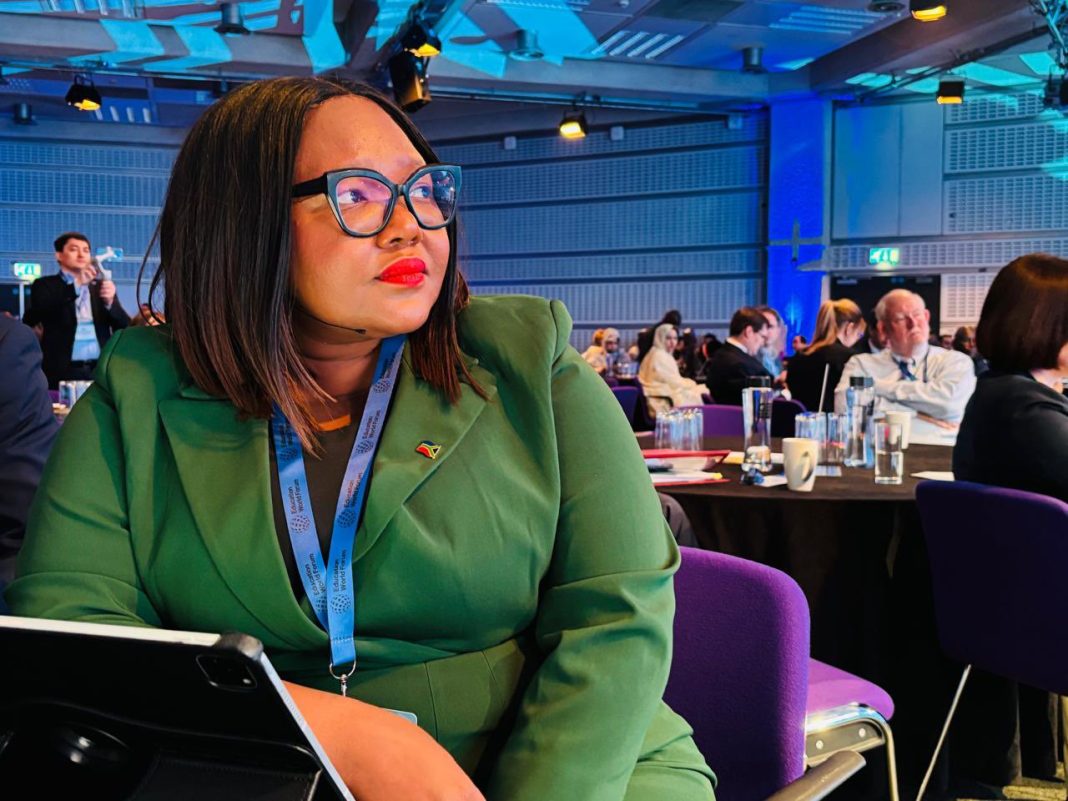
Speaking at the plenary session titled “How Can Education Systems Provide the Stability that Encourages Learning and Builds Confidence to Change?” during the Education World Forum (EWF) in London, Gwarube underscored the dual responsibility of education systems to both anchor learners in secure environments and equip them to adapt and lead in an unpredictable world.
“This is not just a technical question. It is a moral one. When education systems fail to provide stability, it is the poorest children, the most vulnerable, who suffer the most,” Gwarube said.
Reflecting on South Africa’s journey, the minister spoke of two parallel realities, namely significant progress in matriculation outcomes and tertiary access on the one hand and deep foundational learning deficits on the other.
“More young people, especially young women from poorer communities, are completing high school and gaining access to university more than ever before. Yet more than 80% of 10-year-olds cannot read for meaning in any language. This is not just a statistic. It is a warning bell,” Gwarube noted.
She attributed this imbalance to a system overly focused on the final years of schooling, to the detriment of the early grades.
She spoke about the strategic realignment of South Africa’s education priorities to fix the foundation.
At the heart of this new strategy is a comprehensive drive to expand and improve Early Childhood Development (ECD).
The department aims to integrate 1.2 million currently excluded children aged 3–5 into ECD programmes, particularly in rural and low-income areas.
“Access is not enough. We are supporting curriculum development, providing age-appropriate learning materials, upgrading compliance and investing in the professional development of ECD practitioners,” she said.
A major goal is to register 10,000 ECD centres this year, allowing them to access government subsidies and align with educational rather than merely social priorities.
Gwarube outlined reforms targeting primary schooling, including recruiting more foundation phase teachers to reduce overcrowding and introducing mother tongue-based bilingual education to improve comprehension and learner confidence.
She also called for enhancing teacher support through professional development in content mastery, classroom management and adaptive leadership.
“We are embracing the power of mother tongue instruction because children learn best in the language they understand,” she said.
Research shows learners taught in their home language consistently outperform peers learning in unfamiliar languages.
While emphasising foundational learning, Gwarube was clear that South Africa was not turning its back on innovation.
Coding, robotics and digital literacy remained on the agenda, but she warned that these could not succeed without strong educational basics.
She stressed that true stability in education did not mean resistance to change, but meant creating an environment where learners and teachers felt secure enough to explore, innovate and take risks.
The department is leveraging partnerships with the private sector and international bodies like Unesco to expand digital learning in rural areas.
“We’re training teachers in digital pedagogy and using technology to bridge the gap between urban and rural education,” Gwarube added.
The minister praised the forum as a global platform for collaboration and learning, stressing that education must be shaped not only in classrooms but also in communities, homes and workplaces.
Higher Education and Training Deputy Minister Mimmy Gondwe is leading a South African post-school education and training delegation at the forum.
She has emphasised vocational education, youth employment and public-private partnerships as key to reducing inequality and driving economic growth.
“The Education World Forum offers valuable collaboration opportunities. By sharing insights, we can strengthen our education systems and prepare our youth to meet the challenges of the future,” she said.
As the EWF continues this week, South Africa’s participation underlines a firm commitment to reshaping education not just as a system of learning, but as a foundation for long-term social, economic and personal transformation.
INSIDE EDUCATION