
Staff Reporter
Basic Education Minister Siviwe Gwarube has warned that cash-strapped provincial education departments are beginning to buckle, forcing the state to redirect money from early childhood development (ECD) to keep compulsory Grade R reforms alive.
South Africa is trying to implement the Basic Education Laws Amendment Act, which makes Grade R attendance compulsory.
At the same time, it is battling teacher-post placements, infrastructure backlogs and a literacy crisis in which 81% of Grade 4 learners could not read for meaning in any language in the 2021 PIRLS assessment.
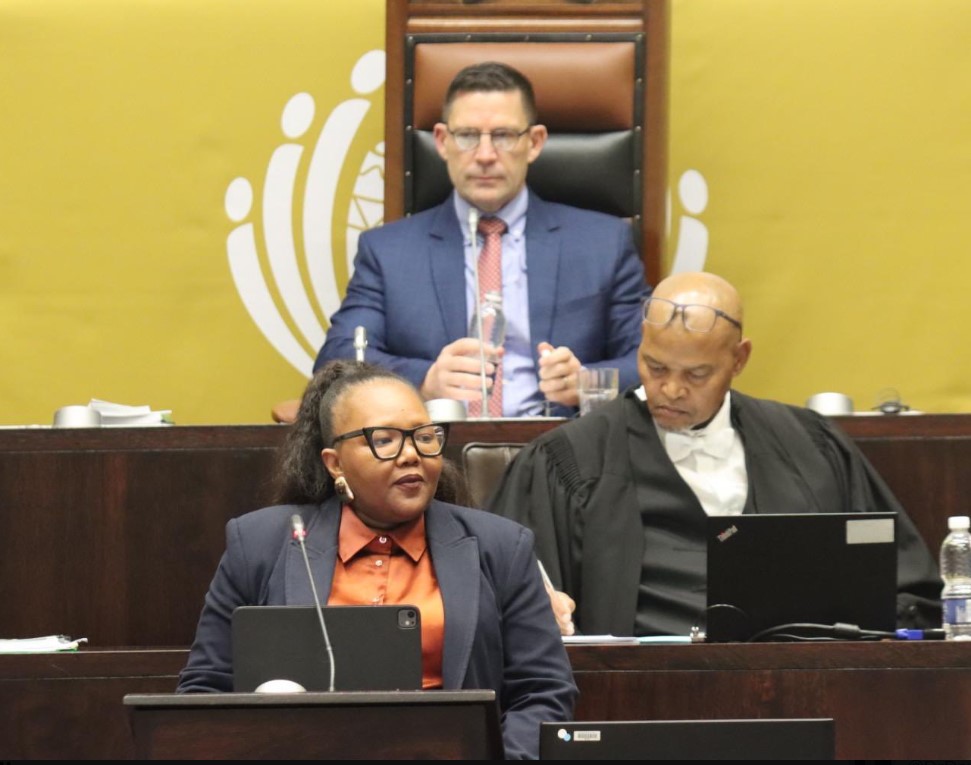
“Aligning qualified Grade R practitioner salaries with Foundation Phase educators, while appointing additional Grade R teachers, will cost approximately R10 billion over the Medium Term,” Gwarube told Parliament during her Budget Vote speech.
“National Treasury has not allocated the full funding required. We have therefore redirected R800 million from the ECD Grant to address immediate Grade R pressures. This is not ideal, but doing nothing would be worse.”
The Department of Basic Education’s 2026/27 allocation is R38.2 billion, including R32.7 billion for conditional grants. Those include almost R11 billion for school nutrition, R16 billion for school infrastructure, R4.6 billion for early childhood development, R477 million for mathematics, science and technology, and R307 million for learners with disabilities.
Treasury has said the ECD grant receives an additional R12.8 billion over three years to expand access to an estimated 300,000 more children and maintain the R24 per child per day subsidy introduced in 2025/26.
But Gwarube’s speech made clear that national allocations are not keeping pace with the full cost of implementation in provinces, where most schooling delivery takes place.
“The learner must not become the shock absorber for provincial cash-flow failures,” she said.
Gwarube said financial risks previously identified in provincial education departments were now “materialising in KwaZulu-Natal, the Free State and the Northern Cape, with others under growing pressure”.
She announced a “Multi-disciplinary Recovery Technical Support Team” to support provinces on budget planning, financial analysis and school resourcing.
“When provincial education finances fail, learners suffer first,” she said.
In September 2024, Gwarube said a financial analysis she had initiated projected that three provincial education departments would fall into the red by 2025/26, increasing to four by 2026/27 and seven in the outer year of the medium-term spending period.
The Northern Cape later told Parliament it had a R358 million shortfall on declared posts, equivalent to 663 educator posts, including 51 Grade R practitioners for which funding had not been provided by the provincial treasury.
Gwarube put the funding fight at the centre of South Africa’s attempt to break entrenched inequality before children reach formal schooling.
“Over 90% of South African children are Nelsons and not Lindiwes,” she said, referring to two fictional 10-year-olds in her speech — one who had access to structured early childhood development and one who did not. “This is the education injustice of our time”.
The latest Thrive by Five Index found that 68% of South Africa’s four-year-olds live below the upper-bound poverty line, 37% live below the food poverty line, and about 29% were not attending any group learning programme in 2024.
Gwarube said more than 13,300 ECD centres had been registered in the past year, exceeding a 10,000-centre target. She said ECD registration had grown by 200% between 2021 and 2026, giving more than 1.2 million children access to registered ECD programmes.
She also announced that an ECD nutrition pilot had entered implementation, with the contract advertised in March 2026 and centres in the Eastern Cape expected to be piloted soon. She said the programme responded to Thrive by Five findings that 7% of South African children were stunted because of malnutrition.
Gwarube said the department would rank provinces using a “quality basket” instead of relying mainly on the matric pass rate.
The basket will include the overall pass percentage, bachelor passes, distinctions, participation and performance in gateway subjects such as mathematics, physical sciences and accounting, and learner retention.
“[F]or too long, the national conversation on quality has been reduced to a single percentage – the national pass rate or the misleading myth of a 30% pass mark,” she said.
Gwarube also said 10,000 Foundation Phase teachers would receive targeted literacy and numeracy training this year, while the department refreshes implementation of the National Reading Literacy Strategy.
She said the Funza Lushaka bursary programme had shifted more strongly toward Foundation Phase education, with 55% of bursaries allocated to that phase in 2026, up from 42% in 2025.
Gwarube announced an independent external investigation into the Foundation Phase National Catalogue process, saying concerns about procurement for Grade 1 to 3 learning materials were serious enough to require outside scrutiny.
She said Treasury’s consideration of the matter had been inconclusive, but had raised concern about whether the department’s deviation from ordinary competitive bidding processes was lawfully justified and properly supported by the required records, reasons and approvals.
“Corruption in education is never victimless. And neither is weak governance,” Gwarube said. “Both are ultimately paid for by children.”
INSIDE EDUCATION