
By Johnathan Paoli
Despite the many challenges around implementing Information and Communication Technology to counter obstacles for persons living with disabilities, South African developers are proving that innovation can equal inclusion.
This week, a suite of assistive technologies aimed at transforming the lives of people with disabilities was launched at the Central University of Technology (CUT) in Bloemfontein.
“The technologies we introduce today are more than just tools; they are symbols of inclusion, innovation and purposeful change. They represent a future where no one is left behind in the Fourth Industrial Revolution. A future where ‘all means all’, including youth, women and persons with disabilities,” said Science, Technology and Innovation Deputy Minister Nomalungelo Gina.
The programme, which is a collaborative initiative of the DSTI, the Technology Innovation Agency (TIA) and CUT, showcased four transformative tools developed under the Technology Acquisition and Deployment Fund and the Grassroots Innovation Programme.
The deputy minister praised the launch, themed “Innovation for Inclusion: Empowering Abilities Through Technology”, as a bold statement that the time had come to dismantle systemic exclusion in workplaces, classrooms and public life.
The assistive technologies are all locally developed and aligned with the lived experiences of South Africans with disabilities.
They were incubated through TIA-supported programmes and refined at CUT’s Product Development Technology Station (PDTS).
Most of the developers are youth with disabilities, which affirms the importance of representation and inclusive design in innovation.
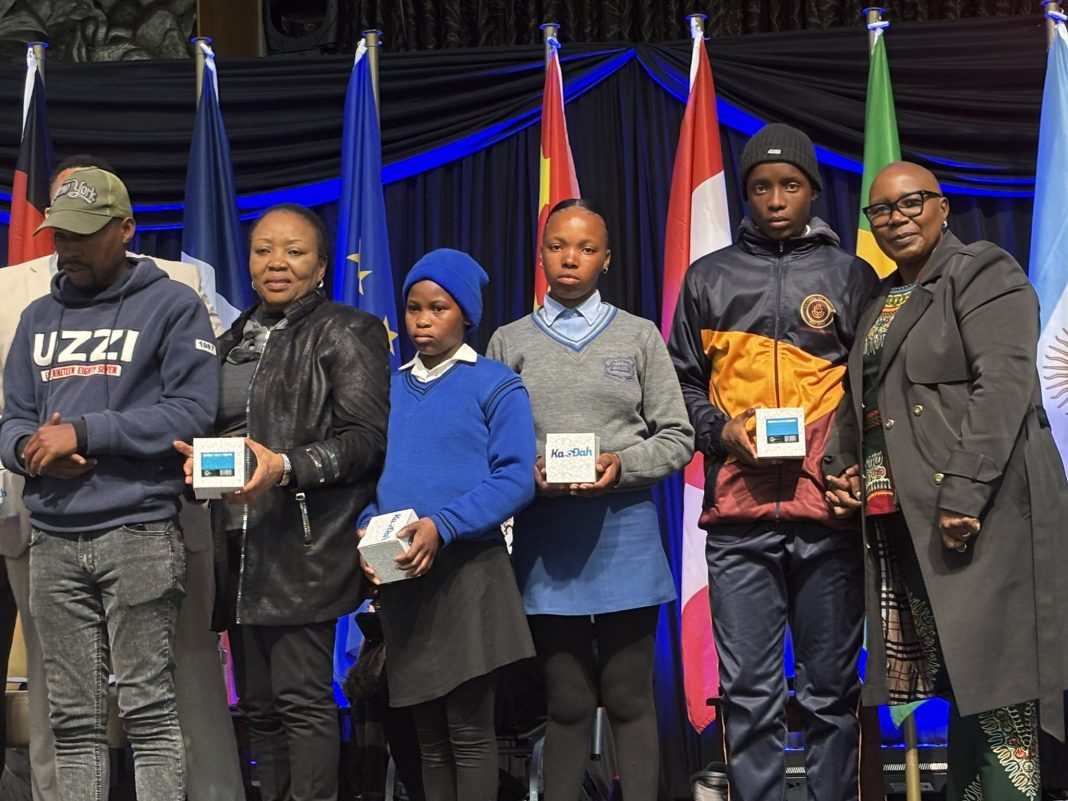
The Ka-Dah Device is a wearable hands-free system designed for the visually impaired.
It pairs a Bluetooth earpiece with a tactile interface, allowing users to operate smartphones without touching the screen, thereby enabling mobile access with independence and ease.
A real-time Video Remote Interpreting service called Virecom links deaf individuals to South African Sign Language (SASL) interpreters at public service points, such as police stations, to ensure fair access to justice and communication.
A mobile application, WeSignIt, converts written content into SASL through QR code scanning, enhancing comprehension and decision-making within the deaf community.
An innovative audio-description storytelling app called ShazaCin, which was created by a visually impaired South African entrepreneur, allows blind users to experience tourist destinations, cinemas and cultural landmarks through rich auditory narration.
CUT Vice-Chancellor Pamela Dube told the launch that assistive innovation was crucial.
“These technologies are not just projects; they are proof of what’s possible when innovation is driven by empathy and grounded in community,” she said.
Dube highlighted the university’s ongoing investment in inclusive technologies through its Centre for Rapid Prototyping and Manufacturing, which, alongside PDTS, has played a pivotal role in supporting student-led research, experiential learning and prototype development.
Dube spotlighted the Ka-Dah Device as an example of CUT’s innovation ecosystem translating academic research into impactful, real-world tools.
“It exemplifies how innovation can change lives. This is not the end of our journey, but the beginning of a more inclusive future,” she said.
Delivering remarks on behalf of Free State premier MaQueen Letsoha-Mathae, education MEC Manthlake Maboya reinforced the provincial government’s dedication to inclusivity.
“We cannot build a democratic and just society unless people with disabilities are at the centre of development,” she said.
Maboya confirmed that funding has been secured to expand disability services across the province, with a particular focus on eliminating barriers in rural schools and public institutions.
The DSTI shared its broader vision to scale these technologies nationally.
Plans include establishing a national disability innovation hub, expanding funding for youth-led tech startups, and partnering with NGOs, municipalities and national departments to integrate assistive technologies into service delivery.
Multiple departments, including Social Development, Women, Youth and Persons with Disabilities, and Small Business Development, are working together to ensure the rollout is multi-sectoral and sustainable.
The event also resonated globally, with representatives from G20 nations participating online and acknowledging South Africa’s leadership as the host of the G20 Disability Inclusive Working Group.
As the country accelerates its development of inclusive technology, the deputy minister stressed that a truly modern society must be one where all abilities were recognised, empowered and included.
INSIDE EDUCATION