
By Johnathan Paoli
Basic Education Minister Siviwe Gwarube has reaffirmed her department’s commitment to focusing on measurable change for education outcomes and shaping realistic solutions to the country’s Cape’s most pressing education challenges.
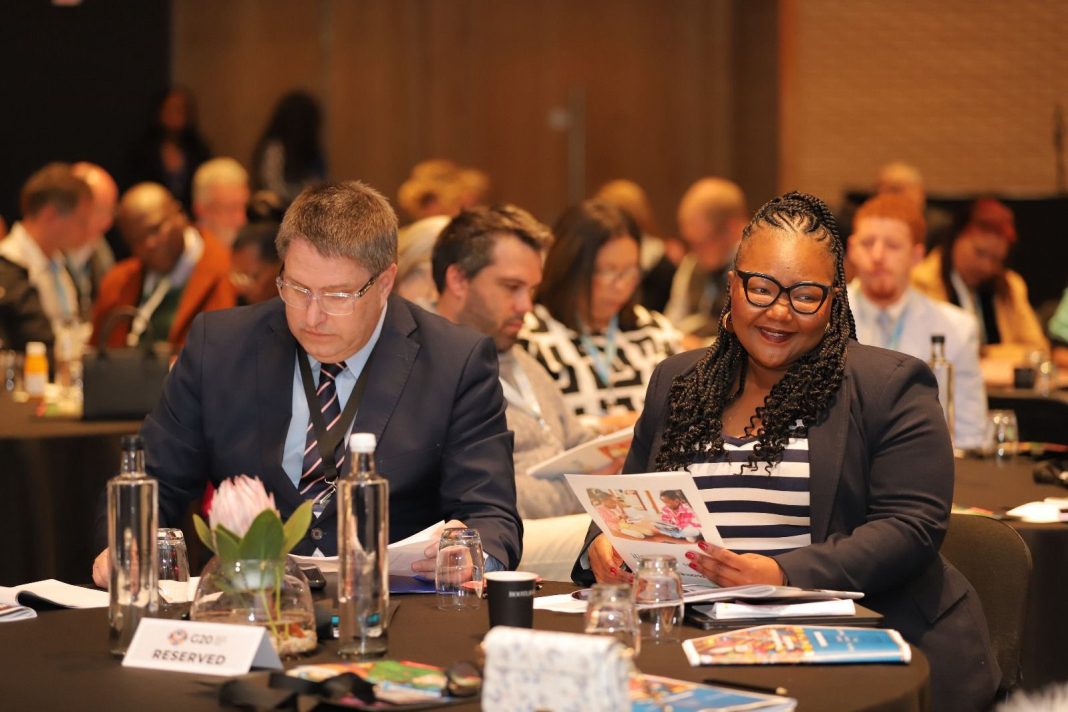
Speaking at the Western Cape Education Indaba under the theme “Putting Children First – Building a Future-Fit, Inclusive Education System” as part of South Africa’s G20 Presidency, Gwarube said the country’s role was to go beyond rhetoric and ensure that global commitments translated into tangible action and local realities.
“It is about ensuring that global debates on education are not abstract, but connected to the classrooms in Khayelitsha, the early childhood centres in George, the high schools of Cape Town, and the rural schools stretching across the Karoo and the West Coast,” she said.
The minister highlighted two of the G20’s central education priorities – quality foundational learning and professional development for teachers in a changing world. She said they were directly relevant to South Africa’s context.
“The transition from graduate to classroom must be smooth. We should align provincial induction programmes with university training so that learning continues throughout a teacher’s career,” she noted.
Drawing inspiration from international models such as Finland and Singapore, Gwarube argued that South Africa must craft a uniquely local approach.
“We must design a South African, and indeed a Western Cape model, rooted in our realities, enriched by global best practice and driven by our vision for injecting excellence into our education system,” she said.
She outlined six key areas for partnership-driven reform: aligning policy with teacher education, creating professional learning communities, planning teacher supply and demand, strengthening work-integrated learning, building seamless induction and continuous professional development systems, and advancing joint monitoring, evaluation and research.
“This indaba must not be remembered for speeches alone, but for the partnerships it builds and the commitments it inspires. If we meet this moment with rigour, creativity and a refusal to accept mediocrity, the ripple effects of our work here will be felt in every classroom across South Africa and beyond,” Gwarube said.
Western Cape education HOD Brent Walters set the tone for the meeting by reminding delegates that quality foundational learning, early childhood development (ECD) and professional teacher development remained the bedrock of an inclusive education system.
“Investing in teachers and the foundations of learning is not only an investment in education, but in the future of our society, economy, and nation,” Walters said.
Western Cape education MEC David Maynier echoed the call for practical solutions, warning that systemic reform required focus.
“We need to get early learning right, so that children have a solid foundation upon which they can build their school career. And we need to get teacher development right, so that our teachers are able to adapt to the changing context of our education system,” he said.
He highlighted the Western Cape’s progress in school infrastructure, innovation and learning recovery since the Covid-19 pandemic, while acknowledging the twin constraints of budget limitations and growing learner numbers.
The second session of the indaba zeroed in on ECD, with a series of presentations underscoring the sector’s importance.
Social worker and ECD activist Riedewhaan Allie stressed the urgency of reaching unserved communities, particularly where poverty and violence undermined children’s potential. He called for non-centre-based approaches that supporedt both children and caregivers.
The Learning Initiative director Ingrid Ahlert showcased the success in screening over 14,900 children for developmental delays, demonstrating how early intervention improved outcomes.
University of the Western Cape lecturer Kaylianne Aploon-Zokufa argued for greater investment in the ECD workforce, many of whom entered the sector as volunteers.
“Practitioners are at the frontline of shaping children’s futures. They need training, resources and recognition because their work changes communities as well as classrooms,” she said.
Throughout the day, speakers returned to the indaba’s guiding principles of solidarity, equality and sustainability.
The ministry as well as speakers maintained that putting children first was both the moral responsibility and the strategic imperative of all stakeholders, as this would secure growth, equality and opportunity for generations to come.
INSIDE EDUCATION