
By Johnathan Paoli
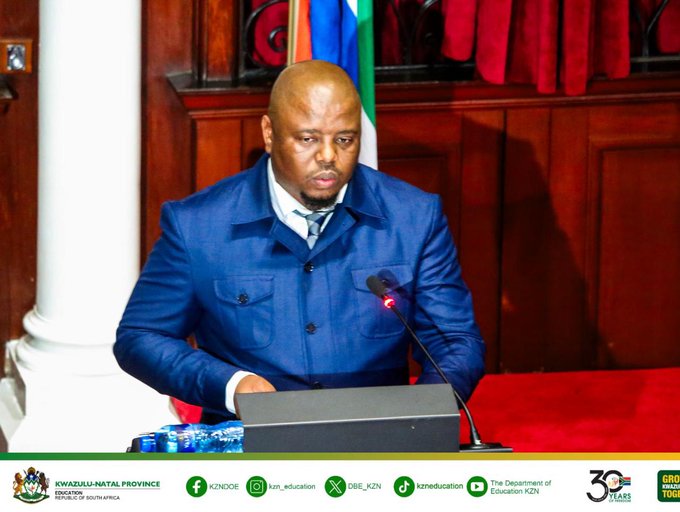
Despite fiscal pressures and mounting social demands, driving transformation, improving learner outcomes and strengthening infrastructure remain the principles of the KwaZulu-Natal’s education budget, according to MEC Sipho Hlomuka.
Tabling the department’s 2025/26 budget vote, Hlomuka unveiled a R56 billion allocation framed as a balancing act between constitutional commitments and financial constraints.
“I stand before you acutely aware of the magnitude of the work required to deliver quality education for the people of KwaZulu Natal. I am equally aware that the needs associated with this mandate far exceed available resources,” Hlomuka said.
He highlighted the cumulative R26.8 billion in budget reductions absorbed since 2021/22, warning that these have delayed school allocations, increased the risk of unauthorised expenditure and forced reprioritisations.
An R900 million advance from the equitable share helped relieve some pressure by enabling timely transfers to schools, but the MEC cautioned that core operations, particularly the protection of teacher salaries, would continue to dominate spending.
Nearly 90% of the department’s budget is consumed by the compensation of employees.
Of the 107,503 approved posts, 98,987 are currently filled, largely due to affordability constraints.
Hlomuka noted the growing unsustainability of maintaining the educator workforce under current funding levels.
In response, the department has implemented stringent cost-containment strategies including vehicle tracking systems which have improved fleet management and curbed misuse; R120 million in annual office lease costs is being reassessed, with plans to build or purchase state-owned facilities; a phased rollout of smart schools has seen 92 tech-enabled institutions launched; and operational costs such as travel, accommodation, and printing have been slashed.
The department is also conducting learner and staff verification to eliminate ghost employees and improve the allocation of resources across nutrition, transport and teacher provisioning.
Hlomuka unveiled a Provincial Academic Improvement Plan, focusing on reducing the number of schools with sub-70% pass rates, increasing passes in gateway subjects like Mathematics and Accounting, intensifying interventions such as spring classes, winter boot camps and high-flyer” support programmes, and sustaining district-level performance above 80%.
A major concern raised was the delay in filling 737 educator posts advertised in August last year.
School governing bodies (SGB) reportedly failed to submit timely recommendations, disrupting teaching and learning.
In response, the department invoked Section 6 of the Employment of Educators Act to appoint teachers directly.
The fifth phase of the Presidential Youth Employment Initiative has created 45,658 school-based jobs across KwaZulu-Natal, with 35,336 posts being funded through R881 million from the Labour Department and 10,322 jobs funded via R261 million from the National Treasury.
In addition, 1000 graduate interns and 390 TVET students have been placed in schools and district offices to gain practical experience.
With over 2.8 million learners in public schools and 29,000 in independent institutions, the department is prioritising foundational learning through strengthened Grade R and Pre-Grade R interventions.
The MEC said that in light of international benchmark assessments revealing persistent reading challenges in Grade 4, interventions included implementing the Qalakahle curriculum management strategy, expanding early grade reading instruction training for isiZulu teachers, distributing storybooks to 222 schools and procuring materials for 282 more.
Thousands of Grade R teachers and Early Childhood Development practitioners have also been trained in literacy, numeracy and curriculum implementation.
Despite storm damage and contractor delays, the department remains committed to infrastructure delivery, with construction currently under way at three technical high cchools: Mvaba (20%), Nombika (50%) and Mpumelelo (25%).
Design work is progressing at Sihayo and Dingeka technical high schools, while two new focus schools, the Maritime School of Excellence (Umlazi) and Mbuso Kubheka ICT and Engineering School (Amajuba), are scheduled to open next year.
A total of 24 schools are on track for completion in 2025/26.
Initially funded at R457 million in 2020, the budget has since dropped to R266 million, with only R94 million remaining for 2025/26.
As a result, learner beneficiaries will be reduced from 76000 to just 9000 unless additional funds are secured.
Meanwhile, the National School Nutrition Programme will operate with a R2.33 billion budget in 2025/26, feeding learners for 200 days.
The department has introduced breakfast meals at 3877 primary schools, reaching 1.4 million learners.
The department’s “My Life, My Future” campaign aims to reduce HIV infections, teenage pregnancy, and dropout rates. Over 750 youth were recruited as Learner Support Agents, reaching more than 100,000 vulnerable learners in hotspot schools.
A R69.3 million budget has been set aside for these interventions, including peer education camps and training for educators and school management.
Hlomuka called on all sectors including government, civil society, parents and educators to unite in support of the department’s transformation agenda.
INSIDE EDUCATION