
By Akani Nkuna
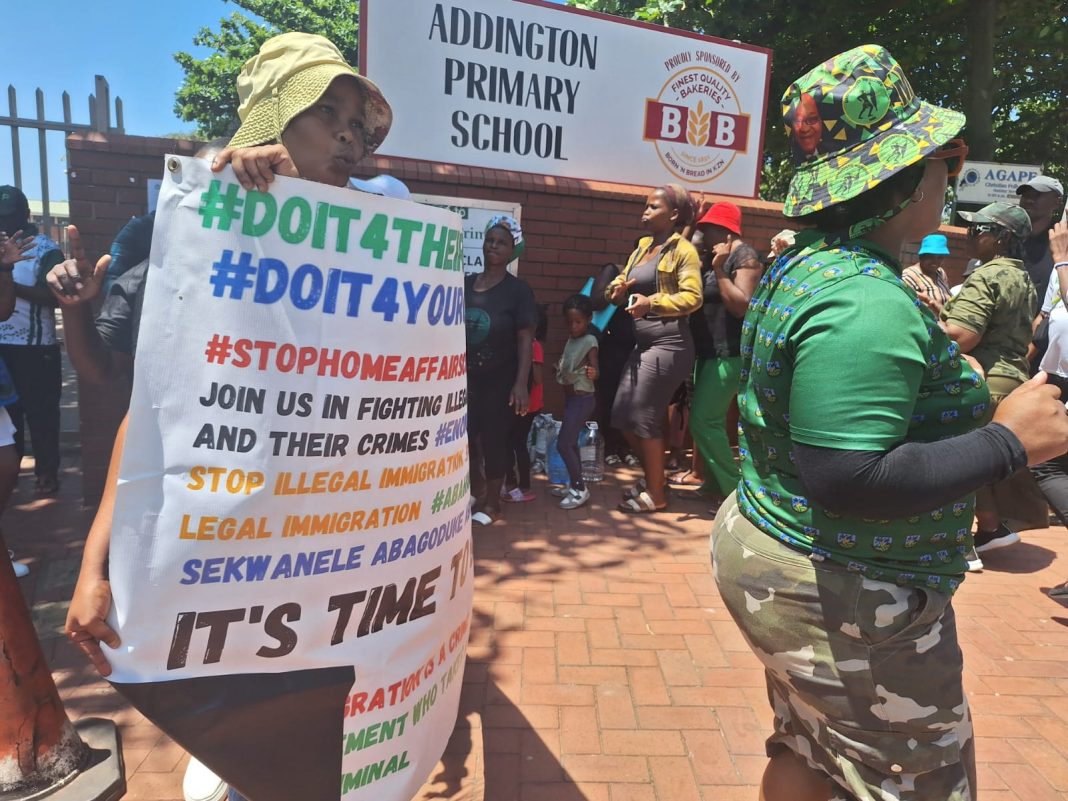
Protests at Addington Primary School near the Durban beachfront intensified this week, despite efforts by education officials to place some learners, while parents renewed objections to proposals that some children be accommodated at schools outside the central Durban area.
The SABC reported that 40 of the 66 children who required placement when the protests began were affected by the recent floods. Parents said that their children were placed at Addington for financial reasons and that they cannot afford scholar transport fees if they are moved to other schools.
ALSO READ: U-19 Young Proteas, humbled by Australia in World Cup
The leader of anti-illegal immigrant group March and March, Jacinta Ngobese-Zuma, told SABC that discussions with parents whose children were not placed at Addington, but were offered options outside the Durban precinct, including at Greyville, about 5 km away, highlighted the cost of transport as a major barrier to school placements.
She said protests would continue at the school until South African children were prioritised with placements.
Addington was the most viable option for parents, said Ngobese-Zuma, because it was in walking distance from homes in the inner city.
“We are saying to the department, you cannot solve one problem by creating another one. Because you are saying that solved the problem of placing them, but where did you place them? You obviously did not place them at a place which is convenient and affordable for them because some of the parents are even saying they cannot afford the fees at Greyville. They are willing to even try, but the transport is the issue,” she said.
The protestors were still gathered outside the school premises on Monday, singing derogatory songs and hurling insults at foreign nationals, whom they accused of “taking” school places from local children.
Police were outside the premises forming a guard around the yard, monitoring the situation, while parents arrived to pick up their children.
Ngobese-Zuma said that the learners who remained excluded were from impoverished backgrounds.
ALSO READ: IN PICS: Famalies demand justice as Ayanda Dludla appears
“We are here today because it is poor black people whose children cannot afford to go to school, which [authorities] do not regard as much of a big deal. But to someone who can actually walk to school instead of paying R900 on transport fees, it is a massive difference,” Ngobese-Zuma said.
“Our government never responds if you try and go about the right way of doing things. We are saying if they want to insist that foreign kids in this school must continue learning and not be disturbed, then we will continue to disturb them until the South African kids are placed,” she said.
INSIDE EDUCATION