
By Johnathan Paoli
Higher Education and Training Minister Nobuhle Nkabane has reaffirmed her department’s commitment to transforming the Technical and Vocational Education and Training (TVET) sector through strategic digital skills initiatives, partnerships and labour-aligned training programmes.
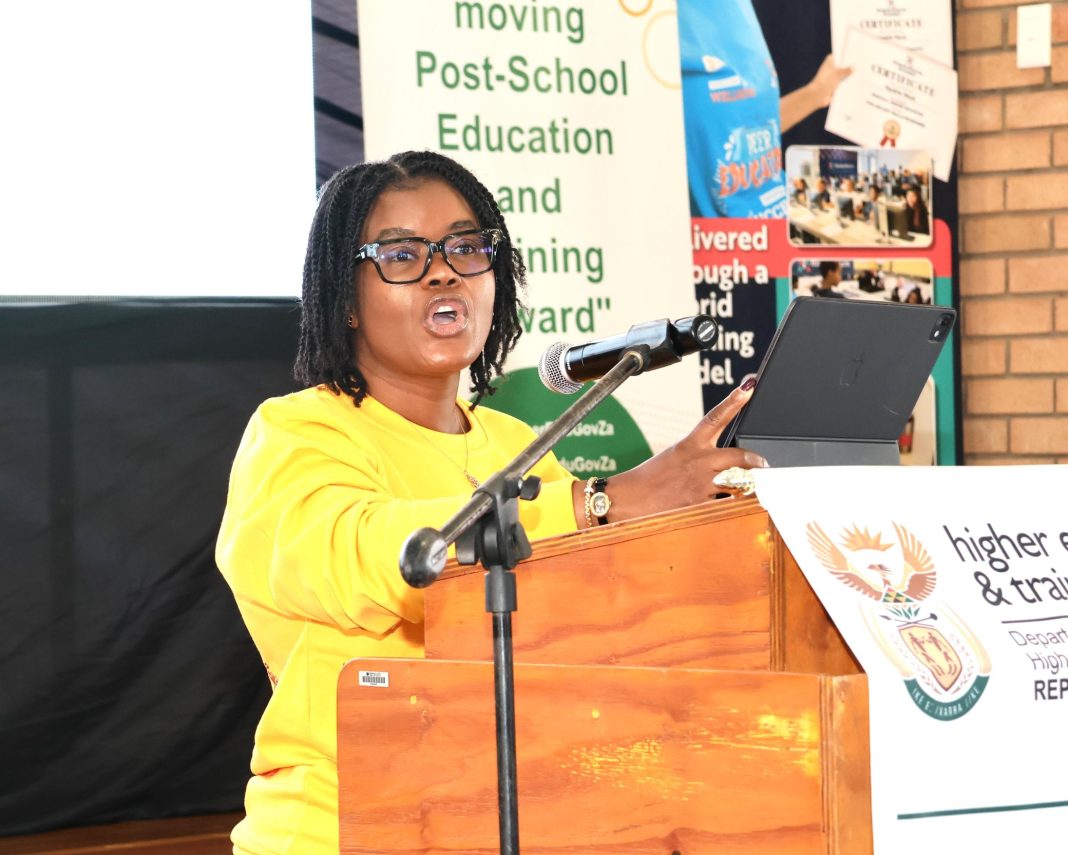
Speaking in conversation with former University of Cape Town Vice-Chancellor Professor Mamokgethi Phakeng, Nkabane highlighted several critical efforts to modernise the sector and address the country’s persistent youth unemployment crisis.
The minister was particularly enthusiastic about the partnership with NetCampus and Microsoft under a presidential initiative to build demand-led digital skills.
“We are excited to partner with NetCampus in this programme, which is one of the president’s priorities in post-school education and training. We recognise the severe skills mismatch in the country and are working to produce graduates that match the demands of our economy,” Nkabane said.
The programme stems from the Business-Government Partnership on Employment and Co-Funding, signed in September 2023 under the leadership of President Cyril Ramaphosa.
It aims to boost economic growth through digital skills development and job placement, coordinated by the Presidency’s Project Management Unit and Business Unity South Africa.
Nkabane revealed that introductory artificial intelligence (AI) courses have already been delivered to principals, deputy principals and senior managers at TVET campuses.
“But this is only the beginning,” she stressed. “We want this programme to reach students on the ground and ensure they leave with recognised certifications that support their employability or business ventures.”
She argued that expanding access alone was insufficient.
“We need to strike a balance between access and success. Training for the sake of training is not impactful, it must lead to meaningful pathways into work or entrepreneurship,” she said.
A cornerstone of Nkabane’s strategy is repurposing TVET colleges into Centres of Specialisation, offering high-impact, future-oriented courses in areas like robotics, welding, mechanical engineering, drone technology and cybersecurity.
She said these centres were being aligned with the country’s labour market intelligence systems and industrial needs.
“TVETs must produce graduates who are ready to be absorbed into the workforce. Our interventions are aimed at deliberately growing the sectors where young people can actively participate in the economy, especially the small business and informal sectors,” Nkabane said.
With approximately 3.8 million young South Africans not in education, employment, or training, the department’s efforts are targeted at drawing these youth into productive and future-ready learning environments.
“When these opportunities are offered, we want young people to come on board so we can thrive together,” she urged.
The minister also underscored a coordinated national approach through the newly established Inter-Ministerial Committee (IMC) on digital skills and employment.
Chaired by the Presidency, the IMC includes Nkabane herself, as well as ministers from Employment and Labour, Small Business, Communications, and the Industrial Development Corporation.
“This shows our commitment to tackling digital transformation from all angles, not in silos,” she said.
To ensure the relevance and credibility of TVET training, the Manufacturing, Engineering and Related Services Sector Education Training Authority has developed more than 50 new occupational qualifications in collaboration with industry and the Quality Council for Trades and Occupations.
These qualifications span data science, systems development, robotics engineering, drone operation, cybersecurity and cloud computing.
“These programmes are not just relevant, they are essential. They reflect the future of work and the kinds of careers young South Africans must be prepared for,” said Nkabane.
Despite her progressive agenda, Nkabane has come under fire in recent weeks over the controversial appointment of Sector Education and Training Authority (SETA) board chairpersons.
Parliament’s Portfolio Committee on Higher Education and Training rejected her written apology after she failed to appear before them on Friday, citing prior commitments.
She explained that she had been scheduled to travel abroad but, after the trip was cancelled due to lack of presidential approval, she committed to attending a gender-based violence and femicide (GBVF) event instead.
The controversy erupted after allegations that some SETA board appointees were politically connected or were officials from within her own department.
The committee is expected to press her on these appointments on Tuesday.
While Nkabane’s digital skills push signals a transformative vision for the TVET and post-school education sector, the backlash over the SETA board saga underscores the complex political and administrative terrain she must navigate.
With youth unemployment still stubbornly high and public confidence in government-led programmes under strain, her ability to implement these changes with credibility and accountability remains under scrutiny.
Still, the minister is resolute about the youth, describing the department’s mission as not just to train, but to empower, employ and elevate South Africa’s youth.
INSIDE EDUCATION