
Staff Reporter
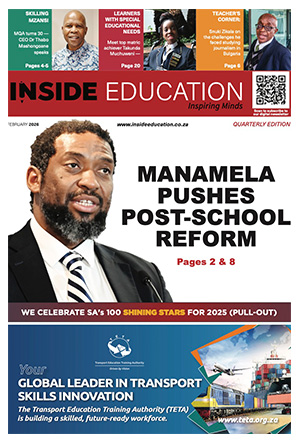
“This was not a political brawl; it was a legal, governance and student-protection response,” Higher Education Minister Buti Manamela told Parliament on Friday as he defended his decision to place the National Student Financial Aid Scheme (NSFAS) under administration.
The Portfolio Committee on Higher Education and Training held a full-day meeting with Manamela about how he reached the decision to appoint an administrator — Professor Hlengani Mathebula — and dissolve the NSFAS board.
Manamela placed NSFAS under administration on 4 May. In his presentation flighted at the meeting, he gave the reasons for the administration — the third in the last five years — as operational failures, an Auditor-General disclaimer, challenged data analytics, payments to 822 deceased students, funding for students whose family income was above the qualifying threshold, unresolved appeals, and numerous board resignations, including those of the chairperson and deputy chairperson.
The presentation said NSFAS had recorded nine material irregularities, including four newly notified irregularities, and had a closing balance of R85.356 billion in irregular and fruitless expenditure.
It also said Auditor-General data analytics had identified 14,169 students above the income threshold, 35,192 students funded despite rule failures, and 7,805 unresolved appeals.
Manamela said that no instruction had been given to the board regarding the appointment of a chief executive officer.
He said that while the former Board argued that the entity’s disclaimer audit related to a period before it fully took office, this did not absolve it of responsibility to act.
“The former NSFAS board had indicated to me that this didn’t happen in their period in a period wherein they served….but they also had a responsibility to act on those material irregularities,” he told the committee.
“This was not a political fight with the Board, but it was a legal governance intervention which was intended to protect the NSFAS and students,” he said.
He said an Auditor‑General report identifying material irregularities, coupled with governance instability and resignations, showed the board had not done enough by March 2026.
“[T]here’s an AGS report… with materiality, and which the board had the responsibility to act on… which they haven’t by March this year, 2026,”
“Even if I considered that report, which they gave me on the 30th of April, together with their quarterly report and their business plan as a board, you know, I do not think that it [was] satisfactory enough in order not to proceed with administration.”
“The very same report had indicated, for instance, that supply chain management had not been working… that Xcode had not been functional, that financial committees had not been functional,” he said, adding that by the time he acted, “the expertise that the board itself required had already been depleted”.
Pressed about why another administrator would stabilise NSFAS, he said administration remains a statutory mechanism any time a board cannot ensure stability.
“Administration comes in when whoever is the executive authority believes that there is a need for such an intervention, meaning that the board that exists at the time…is unable to oversee a stabilised institution.”
Manamela said that NSFAS was institutionally fragile. He said there were fragmented manual processes, high vacancy rates, poor systems integration, and the decommissioning of the Phoenix system. There were also problems with the Orion system and a R46 billion historical loan book that was 98% impaired.
The minister said administration was necessary to protect more than 800,000 students who depend on NSFAS for tuition, accommodation, food, books and other study-related costs.
The presentation said disbursements would continue, NSFAS staff would remain in place, accommodation measures would be protected and the administration would be temporary.
The minister also said that the dissolution of the Board was not a separate discretionary decision, but followed automatically from the appointment of the administrator under section 17D of the NSFAS Act.
He said the legality of the Board’s appointment was already the subject of a self-review application before the Pretoria High Court.
Committee chairperson Tebogo Letsie said in a statement following Manamela’s briefing: “Our interest is a stable NSFAS that works to benefit poor South African students who, without NSFAS support, will not come close to accessing post-school education opportunities. NSFAS must work for South Africans, and this committee will ensure that commitment becomes our reality.”
Letsie said the committee noted Manamela’s explanation that an informal meeting he had with the board was an information session on continuing work, but that the formalities of board meetings had not been complied with.
“Minister Manamela acknowledged and apologised for the error where one board member did not receive an invitation to the meeting. The committee notes his explanation that this was not a deliberate action on the Minister’s part and that no malice was intended,” Letsie said.
The committee said it would be patient with matters pending before the courts, including disputes arising from the decision.
“The committee notes the decision and the consequent challenges, and it trusts that the courts will resolve the matters under dispute. The reasons advanced appear genuine, and former board members have also raised concerns. It is expected that they would be dissatisfied, and the committee believes all issues will be adjudicated,” Letsie said.
The stabilisation plan outlined by Manamela includes maintaining operational continuity, fixing audit findings, strengthening consequence management, resolving data irregularities, clearing the appeals backlog, accelerating ICT digitalisation and completing a TVET college close-out project.
The administrator is expected to submit an initial stabilisation plan within three months and report quarterly to the minister.
Letsie called on Manamela to convene meetings more effectively in future to avoid procedural uncertainty and “grey areas in the work of government”, and not to act in a way that creates room for speculation.
INSIDE EDUCATION