Home Blog Page 138

Higher education minister confident about NSFAS online application launch

By Johnathan Paoli

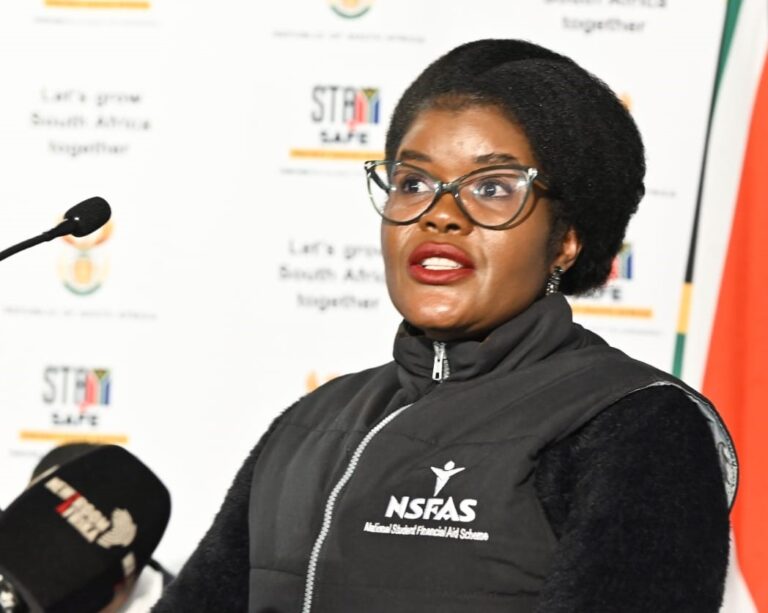
Higher Education Minister Nobuhle Nkabane has praised the official launch of the National Student Financial Aid Scheme’s (NSFAS) online applications for 2025, saying it is a step in the right direction to address the persistent challenges within the post-school education and training (PSET) sector.

Nkabane, who was joined by departmental director-general Nkosinathi Sishi and NSFAS administrator Freeman Nomvalo, told reporters on Friday that several enhancements had been made to the application portal to ensure a seamless
application process for prospective applicants.

The minister expressed her confidence at the launch, saying it was evidence of a people’s government working for the people.

Nkabane said that the school student scheme remained a critical tool in assisting students in overcoming the challenges and legacies of the past.

“They are the motive forces that must be utilised to contribute to the transformation of our country, and this social transformation is instrumental in improving the material conditions of our people,” she said.

The minister announced that the window for online applications would close on 15 December, but urged students not to leave applying until the last minute.

Nkabane said that as of Friday afternoon, there had been over 170,000 applications, with most coming from KwaZulu-Natal, Gauteng and Limpopo.

“We want our learners to tap into these opportunities in order to ensure inclusion in the economic drive and skills revolution,” she said.

Simultaneously, NSFAS hosted activations at schools across the country to assist learners and out of school youth in applying for funding.

The minister, joined by Nomvalo and Sishi, invited a group of students from local schools and accompanied one learner in her application to the student fund scheme.

The launch was initially scheduled to take place on Tuesday, but Nkabane explained that the postponement was due to allow time for a dry run of the online application system. This was to allow stakeholders, including learners, better understand the system and make inputs.

While acknowledging any anxiety caused by the delay, the minister expressed her confidence, saying that the various input meant that the process would be easier and more accessible to applicants.

Nkabane said the improvements formed part of an ongoing effort to address issues that had previously plagued applications, including system crashes and fund disbursement delays.

Nomvalo outlined the application process and said while the NSFAS bursary was available to applicants coming from households with a combined income of R350,000 and less, the scheme provided loans to applicants from homes with an
income between R350,000 and R600,000.

Nomvalo confirmed that the provision of incomplete and incorrect information would culminate in a rejection, but added that applicants would be given an opportunity to appeal.

He reminded aspiring applicants to apply to their respective institutions of higher learning as registration at a university or college is one of the main perquisites for a successful application.

Nomvalo highlighted the outreach programmes the scheme was intent on establishing throughout the country, especially in remote and rural areas to assist with the application process.

He announced the scheme’s establishment of a dashboard, which was expected to monitor applications and assist NSFAS in responding to challenges and issues on the ground.

He called on learners as well as out-of-school youth to visit the website, create a profile and start the application process.

Nomvalo said affidavits would not be accepted, and that originals were required.

Representatives of several political party youth formations attended the launch, including the African National Congress Youth League, the Umkhonto weSizwe (MK) party’s student wing and ActionSA.

The scheme has been at the centre of controversy due to inefficiencies, with many applicants facing communication breakdowns and challenges with payments.

However, the leadership of NSFAS have said that they remain optimistic about a smoother application process.

INSIDE EDUCATION

Home Affairs opens on Saturdays to help matriculants writing exams

By Lungile Ntimba

The Home Affairs Department will open its offices on Saturdays for five hours a day, from 21 September to 12 October, to support matriculants in preparing for their exams.

The initiative would only prioritise matriculants and learners who needed temporary identity certificates, ID collection and application services, Home Affairs Minister Leon Schreiber said on Friday.

“This initiative is specifically aimed to enable matriculants to write their exams, which is the first step towards economic empowerment of young people. We encourage matriculants who are waiting on their IDs, along with their parents, to make their way to the nearest Home Affairs or where they applied,” Schreiber said in a statement.

“We encourage clients who have applied for identification documents and have received their SMS notifications, to seize this opportunity by visiting their Home Affairs office to collect these critical documents.”

Deputy Minister Njabulo Nzuza will visit the Orlando Home Affairs office in Soweto on Saturday to support the initiative.

INSIDE EDUCATION

Almost 300,000 placement offers for Gauteng Grade 1 and 8 learners

By Johnathan Paoli

A total of 293,057 placement offers had been issued to parents of Grade 1 and 8 learners as of the early hours of Thursday, according to the Gauteng Education Department.

MEC Matome Chiloane said that this milestone followed the commencement of the 2025 online admissions placement for the learners on Monday. A total of 146,385 were made for Grade 1 and 146,672 for Grade 8.

A total of 148,744 offers have been accepted, while around 105,193 remain pending acceptance.

Chiloane reassured parents that placement offers would continue to be sent out in batches throughout the year.

Parents are encouraged to log on to the Online Admissions website www.gdeadmissions.gov.za within seven days of receiving an offer.

They can choose to accept the offer as final, which secures the learner’s placement at the school, or provisionally accept it while awaiting additional offers.

If a new offer is later accepted, the previous one will be cancelled.

“Placement offers will be issued continuously until all learners are placed. If an SMS confirms a child’s placement, no further action is required,” he said.

The MEC also reminded parents that placements depended on space availability and priority placement criteria.

He said parents should remain calm if they did not receive immediate SMS notifications, as they could check their application status online.

Concerns about application statuses changing from “Documents Verified” to “No Documents Submitted” have been addressed. This occurred during the document review process.

Chiloane emphasised the importance of patience and cooperation as the department worked to secure placements fairly for all learners.

For parents dissatisfied with their offers, there was a process to submit objections and appeals, which would be addressed in a timely manner, he said.

INSIDE EDUCATION

Education for the African child needs peace: Didiza

By Johnathan Paoli

National Assembly speaker Thoko Didiza has called for the ending of conflict, violence and instability on the continent as key to developing and furthering education of African children on the continent.

“Our success in educating Africans fit for the 21st century is also dependent on our success in silencing guns in order to ensure peace and stability, for there can be no proper education in volatile and war environments,” she said.

Didiza was speaking at the Conference of Speakers of African National and Regional Parliaments, under the theme, “Educate an African fit for the 21st Century: Building resilient education system for increased access to inclusive, lifelong, quality, and relevant learning in Africa” held at the Pan-African Parliament in Midrand on Wednesday.

She said the continent required the building of a resilient education system for increased access to inclusive, lifelong, quality and relevant learning in Africa.

Didiza said that while peace has been restored throughout Africa, pockets of terrorism and threats to peace haunted certain regions.

She said the need for investment in education wasunquestionable and that weak economic and financial standing should not be the yardstick which determinedwhether children should have access to quality education or not.

The speaker praised the recent national and provincial elections in South Africa as evidence of the importance of embracing democratic processes in furthering education.

She expressed her hope that South Africa’s sister countries would follow suit.

“Democracy remains the viable system of governance that can help us valorise our natural resources and build the resilience we need for prosperous economies on the continent,” Didiza said.

In closing, the speaker referenced the recent events in the Israel-Palestine conflict, and reiterated the call to support the people of Palestine in self-determination and the attainment of freedom against oppression.

“The attainment of democracy in South Africa against the barbaric apartheid system is living proof that no challenge can withstand the will and might of the united global community,” Didiza said.

The three-day conference will seek durable solutions to the fragile peace and security situation on the continent as well as food and energy insecurity exacerbated by the climate crisis. 

INSIDE EDUCATION  

NSFAS all set to launch online application platform

By Alicia Mmashakana

The National Student Financial Aid Scheme (NSFAS) application system has gone through several changes and enhancements and is ready to be launched on Friday, according to the Higher Education and Training Minister.

This follows the launch being delayed on Tuesday because a trial run was needed.

Minister Nobuhle Nkabane said the platform would ensure a seamless application experience for prospective applicants.

“Our focus includes aligning the new NSFAS application process with the needs of higher education institutions and addressing any operational challenges,” Nkabane said on Wednesday.

The minister will be joined by NSFAS administrator Freeman Nomvalo and learners who will participate in live application activations at the offices of the Government Communication and Information System.

Nine schools from the provinces have been identified. NSFAS officials will assist students and out-of-school youth in applying for NSFAS funding.

INSIDE EDUCATION

All systems ready for 2024 Matric exams

By Johnathan Paoli

Basic Education Minister Siviwe Gwarube has expressed confidence in her department’s readiness to administer the final National Senior Certificate examinations for the class of 2024.

Gwarube, along with Deputy Minister Reginah Mhaule and Director-General Mathanzima Mweli, led the departmental delegation in briefing the Portfolio Committee on Basic Education on the status of readiness ahead of the exams in
October and November.

In her opening remarks, the minister said the department had done a lot of work to prepare both the candidates and the system.

“It was very important for us to develop both the readiness of learners as well as the readiness of the system in tandem so that we can make sure that we can deliver a seamless exam period,” she said.

Gwarube said this was a pivotal moment for the learners who were in their last weeks of school.

Chief Director for National Assessment and Public Examinations, Rufus Poliah, reported that there were 732,448 full time candidates enrolled for the NSC exams – an increase of 8400 from last year.

Poliah said KwaZulu-Natal had the largest Grade 12 population with 172,213 candidates, while Gauteng contributed the second largest numbers with 136,620.

The Eastern Cape stands at 103,975, Limpopo at 94,236 and Mpumalanga has 68,4555 candidates.

The Western Cape registered 64,552 candidates, the North West enrolled 41,480, the Free State has 37,737 and the Northern Cape 13,180.

Poliah confirmed that there were 136,195 part-time candidates registered to sit for various subjects this year.

He said the examinations would take place in 6909 centres across the country, witha total of 162 question papers having been approved by Umalusi and ready for printing.

Poliah said this year’s class was the seventh cohort for South African Sign Language Home Language examinations, and that 23 schools nationally have 210 candidates registered for the subject, compared to 134 last year.

The Deputy Director-General for Curriculum, Barney Mthembu, highlighted several factors regarding the current cohort of learners.

They were in Grade R in 2012 during the year of implementation of the Curriculum and Assessment Policy Statement (CAPS) in its foundation phase.

Additionally, Mthembu confirmed the learners had entered Grade 8 in 2020 at the height of the Covid-19 pandemic, as well as having their Grade 9 year further disrupted by the systematic break in operations.

He said the learners experienced social distancing, which limited group work between teachers and group assessment activities.

Rotational attendance affected coverage of the curriculum and created content gaps, while teacher absenteeism, during the height of the pandemic, affected teacher curriculum coverage negatively for this cohort.

Mthembu said that despite the disruptions, they started to benefit from the “Learning Recovery Programme” at primary school and that strategies and interventions aimed at addressing the academic setbacks were introduced.

“This saved the cohort from rotational attendance and loss of teaching and learning time and helped to complete the Grade 10 Annual Teaching Plans (ATPs),” he said.

He said that in Grade 12 this year, the candidates were benefiting from the wealth of resources which were developed, including previous diagnostic reports, question papers and study material.

Furthermore, Mveli had visited 162 study camps in different parts of the country throughout the year in order to support the learners in their preparation.

The delegation highlighted the fact that the class of 2024 has benefited from being taught by teachers who have improved subject results in 2022 and 2023.

“The class of 2024 reached Grade 12 when schools have mastered the skill of using the diagnostic reports of the previous years for examination preparation,” Mthembu said.

The NSC examinations are expected to run from 21 October to 27 November, with marking to commence immediately after.

The department confirmed that 55,053 markers have been appointed. They will be stationed in 188 marking centres.

The results will be released to candidates on 16 January next year, with the minister announcing the results a day before its release.

INSIDE EDUCATION

Busy week for education sector on the impact of budget cuts

By Johnathan Paoli

The nation’s learners and teachers are keenly awaiting to hear what is happening on the basic education front this week, with a number of meetings planned on the impact of budgetary cuts in education departments across the country.

Basic Education Minister Siviwe Gwarube and her senior officials are expected to appear in at least two major meetings. Parliament’s Portfolio Committee on Basic Education is meeting on Tuesday and the Council of Education Ministers (CEM) on Thursday.

The budget cuts have created a challenging situation for many provincial education departments, which could impact the quality of education, including reducing teaching positions and cutting back on essential services.

The Western Cape is expected to cut 2400 teaching jobs by the beginning of next year. 

Western Cape MEC David Maynier has confirmed that that despite implementing a R2.5 billion budget cut, the province still faced a R3.8 billion budget shortfall over the next three years.

KwaZulu-Natal has announced its inability to afford 11,092 teaching posts, following a budget shortfall of R4 billion.

The provincial government agreed to a 7.5% wage increase for teachers and other public servants without increasing the provincial budget accordingly.

KwaZulu-Natal education spokesperson Muzi Mahlambisaid that while the recent budget cuts certainly exacerbated the situation, the crisis has been six years in the making.

“After all, the department is all about teaching and learning, but you end up only having educators with no equipment. In some instances, it is because we can’t buy those things. A lot of money goes into their payment,” Mahlambi said.

Mpumalanga has to deal with a shortfall of R876 million, while the North West has to source R485 million. 

The Eastern Cape has experienced a decline of 22.6% from over R4.6 billion to R3.5 billion due to fiscal consolidation.

The loss of funding comes despite MEC Fundile Gadehighlighting the urgent need for infrastructure development within schools in the province.

“A well-built school infrastructure promotes a positive learning environment, improves overall school quality, influences the educational experience and results in better educational outcomes,” Gade said.

Meanwhile, Gauteng education MEC Matome Chiloanehas warned that budgetary pressures are likely to impact scholar transport, school furniture, school nutrition, infrastructure, personnel and other subsidies.

Chiloane confirmed that over 3000 teacher posts were at risk.

He said his department has been working tirelessly to find means to secure public school teachers’ jobs, while also functioning optimally with a smaller fiscal budget.

“Look, all provinces are affected, we’re looking at around 3,400 teachers. Unfortunately, there will be a cut in certain programmes, scholar transport and school nutrition… we are cutting everywhere to ensure that we keep all our school educators,” Chiloane said.

The country’s economy has been under significant strain in the aftermath of the Covid-19 pandemic, a recession and deteriorating infrastructure and other support structures.

The government has had to prioritise spending in critical areas such as healthcare and social welfare, with the reallocation of funds resulting in reduced budgets for all sectors.

There have been ongoing issues with inefficiencies and mismanagement within the education sector, which has led to calls for better financial oversight and accountability, which in turn, have influenced budgetary decisions.

The provincial education departments have called for partnerships between the government and private sector to supplement education funding.

Many have advocated for exploring alternative funding mechanisms and reducing bureaucratic inefficiencies which could free up resources to be redirected towards essential educational services, including optmisingprocurement processes and reducing waste.

Minister Gwarube said the CEM meeting would include the provincial departments providing analysis on the impact of the cuts.

A provincial analysis reports would form the basis of the minister’s discussion with the National Treasury and the Finance Minister.

“I am working very hard to ensure we have a full understanding of the impact of the budget cuts in the sector. I am determined to work with the Treasury to ensure that we cushion the blow on frontline services in the sector,” Gwarube said.

The minister called for placing data-driven evidence before the Finance Minister to find innovative ways to avoid further cuts to the education budget.

INSIDE EDUCATION

Research must be linked to the delivery of a public good

0

By Edwin Naidu

There’s no shortage of information on the remarkable happenings in education, science and technology, for good or bad, in South Africa or Africa. 

If one considers social media platforms the best place to brag about who has received the latest accolade for doing their job, you would think that South Africa and the continent would be in far greater shape. 

Addressing unemployment, tackling poverty, fighting climate change and dealing with food security should be handled more effectively, considering the great brains in our midst. 

Just flip through the amazing content on LinkedIn shared by the National Research Foundation, and you will be amazed at the top-notch quality of our scientists’ work. Many are making their mark in unique collaborationsthroughout Africa and globally.

A situational analysis of the state of the education research field in Africa report by Education Sub-Saharan Africa (ESSA) and social development consultantsSouthern Hemisphere recently sketched the opportunity and state of play in sub-Saharan African countries. 

The figures reported mainly from desk research draw on data from key informant interviews and group discussions. They aim to promote education research for academic progression and to impact local education policies and practices.

Their work addresses the disconnect between researchers and decision-makers by promoting collaborations between education researchers and government agencies.

They also seek to address the minimal public funding opportunities for education research.

While encouraging donors and development partners to provide funding and support for government-led education research priorities, thus promoting local agendas, they also advocate for promoting inclusion, gender equity, capacity-building programmes and South-South peer learning networks.

The study says educational research in Africa presents a small yet promising landscape, characterised by the dedication of its actors and the rapid growth in research publications observed over the last two decades across most countries.

Unfortunately, Africa’s contribution to global education research is estimated at around 2.13%. More than 90% of the study was published after the year 2000. Some countries, including South Africa, Nigeria, Kenya and Ghana, dominate the field. 

Even in these countries, few institutions dominate the landscape regarding knowledge production.

African researchers face similar challenges in securing funding and conducting high-quality research, and there is a lack of opportunities for regional and international networking and collaboration. 

However, in education research, these challenges are much more pronounced. For instance, the study found that only 10% of African education research publications are funded, with partners outside providing up to 90% of the existing funding.

These challenges and potential solutions are also highlighted in the Action on Funding for Africa-led Education Research conference and the Forum for Education Research in/for/by Africa. Building on theseevents, the Enhancing Education Research in Africa (EERA) project aims to identify what is needed to create a vibrant and sustainable field of education research in Africa.

The study on the situational analysis was undertaken to ensure that the proposals from the EERA project aregrounded in the current reality of education research in

Africa, and builds on what is already underway.

The analysis uses the field-building framework to assess five main characteristics of education research in Africa: Knowledge base, resources (funding), field-level agenda, actors and infrastructure.

Knowledge base: Data collected through key informant interviews, desk reviews and group discussions revealsstriking insights into the Strengths, Weaknesses,Opportunities and Threats (SWOT) in the African education research ecosystem. 

Resources: While growing research outputs aligned with emerging priorities are observed, severe resource constraints and limited funding affect the quality and quantity of most publications, leading to limited utility for decision-makers and impact.

Field-level agenda: International organisations are crucialin funding education research on the continent. However, this heavy reliance on external funding, and therefore external agendas, often creates a gap between the research produced and the knowledge that decision-makers need.

Emerging partnership initiatives between government and education researchers give birth to a shared vision about countries’ education research priorities. However, this is the case only in a few countries. Moreover, the lack of funding remains a threat in contexts where such an alignment exists.

Actors: Although they are diverse and committed, the field of education research seems fragmented in most countries due to the lack of a shared vision and communication, insufficient collaboration among stakeholders, and the absence of a robust research culture including early career and women researchers.

Some education research networks and thematic groupsemerge across all regions. Institutional repositories and dissemination platforms are also actively raising the profile of African education research and researchers. 

Infrastructure: Threats to these emerging infrastructure elements include poorly curated dissemination and data-sharing platforms, difficulties accessing data, low-quality and predatory journals, and inadequate institutional support.

While a more equal female-male gender ratio is observed among academic staff in sub-Saharan Africa, huge disparities appear at the country level for education researchers.

Taking advantage of the strengths and opportunities identified in this illuminating report on the education research landscape, the EERA project plans to launch atheory of change process. 

Initially, long-term outcomes will be developed by leveraging stakeholders’ visions for the field of educationresearch and their expectations for an enhanced landscape. 

Building on lessons from this analysis, a Pathways of Change process involving a steering committee and other education research stakeholders will be initiated to propose tailored interventions and projects to enhance education research on the continent.

One hopes that such insights can be used effectively to boost research on the continent so that researchers’ work is indelibly linked to a better life for all. 

Edwin Naidu is the Editor of Inside Education

Where will the govt find R16bn to fund BELA’s Grade R plan?

By Edwin Naidu

Amid the political discord over the Basic Education Laws Amendment (BELA) Bill, there are growing concerns about the financial burden it may place on the government. 

Whether the government can afford the R16 billion needed to implement just one of the clauses, which could radically transform the education landscape, is a pressing issue that cannot be ignored. 

With Treasury cutbacks threatening teacher job cuts countrywide, Wayne Hugo, the University of Kwazulu-Natal’s (UKZN) Professor in the College of Humanities at the School of Education, told Inside Education that there was no clarity on where the R16 billion needed to implement just the Grade R aspect of the Bill would come from. 

“The government has indicated that there will be a reallocation of resources, but there is no new money for this. We need Grade R, which will be good for the schooling system. The cheapest way to fix the schooling system is to do it early so by the time children are in Grade 3, they can read and be numerate, but there’s no money for it,” he said.

In March, during a Portfolio Committee meeting to discuss funding the BELA Bill, it emerged that the costs were misaligned, and there was ambiguity about the funding responsibilities shifting between the Department of Basic Education (DBE) and the National Treasury. 

The BELA Bill seeks to amend the South African Schools Act to make school attendance compulsory from Grade R and no longer from Grade 1. 

In addition, it amends the right of governing bodies to have the final say about school admissions and language policies. Key provisions include addressing school disruptions, regulating homeschooling and strengthening governance accountability.

Currently, Grade R is not part of the compulsory basic education mandate. This is managed by Early Childhood Development practitioners under the Education White Paper 5 of 2001. The Bill will change Grade R’s function and funding. The introduction of Grade R will also have a material impact on staffing and infrastructure provision. 

Hugo added that the legislation brought much-needed tightening of regulations and clarity, such as the policy on corporal punishment. However, the greatest issue wasreducing the powers of School Governing Bodies. 

The Democratic Alliance has raised several issues over the Bill, with Basic Education Minister Siviwe Gwarube boycotting President Cyril Ramaphosa’s signing ceremony last Friday. 

Civil society group AfriForum said Afrikaans schools nationwide were currently facing significant pressure from provincial officials to offer English instruction, which could ultimately lead to these schools becoming single-medium English institutions. 

UKZN Professor Suriamurthee Maistry said as with any new legislation in a country with a diverse population like South Africa and given the unevenness of the country’s education landscape, contestation from those who felt that their powers were being eroded was expected. 

“The decision to reduce the powers of the School Governing Bodies is arguably the most challenging issue at hand for the state. BELA now gives authority to the provincial heads of departments in important matters like learner admissions, school language policies, code of conduct and promotions. 

“The language issue, namely the medium of instruction a school adopts, must now be sanctioned by the provincial HODs. In other words, schools cannot unilaterally decide on the medium of instruction. This clause is a direct response to the perception that some schools are using the language of instruction to exclude learners,” he said. 

Education Professor Vimolan Mudaly said if it was implemented, the BELA Bill may make some positive changes as the idea was to force children to attend school and remain there, which was a “good thing for our children’s future”. 

“It may impact parents’ pockets, but it certainly will mean more children will complete the 12 years of education than we have previously experienced. I’m also hopeful that language and admission policies will occur in a consultative process between the school and the Head of Department. This must not be a reason for any child to be excluded. The corporal punishment amendment is necessary, although this might also create some controversy,” Mudaly said. 

“New policy like compulsory Grade R schooling is a noble initiative as it is likely better to prepare young children for entry into formal school. Having said this, this initiative needs to be backed up by appropriately qualified teachers, and classrooms and teaching resources must be available.

“We must also remember that Grade R or pre-school education has only been available to the privileged classes in SA thus far. Poor people can’t afford this. But if this becomes legislation, then I am hoping there will be sufficient political will and determination by the DBE to give effect to this development.”  

Concerning resources, however, when discussing this earlier in the year before the Portfolio Committee on Basic Education, James Ndlebe, Chief Director of Education Management and Governance at the DBE, mooted the idea of a central procurement hub to allow the department to negotiate for goods and services. 

He provided an example of procuring textbooks at a lower cost and suggested that central procurement would be beneficial if schools agreed to it. 

Ndlebe acknowledged concerns about trust and proposed mechanisms for schools to opt-out if they found better deals elsewhere. He highlighted the need for transparency in demonstrating cost savings and clarified that central procurement would not override a school’s ability to negotiate locally. 

Meanwhile, the South African Democratic Teachers’ Union and National Professional Teachers’ Organisation of South Africa have welcomed the Bill’s signing, agreeing that it will bring change to integrate, deracialise and democratise schools.

INSIDE EDUCATION

FameLab winner to be announced this week

0

By Thapelo Molefe

Science enthusiasts and communication experts will converge on Thursday as FameLab South Africa hosts its national finals at the National Research Foundation in Pretoria. 

FameLab is an international science communication and public speaking competition that promotes science and technology by creating a platform for young scientists to find their voices and reach bigger audiences.

According to organisers, the competition will feature 10 exceptional science communicators, who have emerged from a rigorous selection process, showcasing their ability to make complex scientific concepts accessible and engaging. 

The finalists, selected from a pool of 16 semi-finalists, will present their three-minute talks on diverse scientific topics, ranging from antibiotic resistance and cosmological discovery to prosthetics and nanotechnology.

According to the organisers, the journey to the finals was “nothing short of remarkable”, with the semi-finalists demonstrating impressive scientific knowledge and communication skills.

The contenders include:
 Siphosethu Mgwili, Prosthetics and Orthotics, Walter Sisulu University,
 Nadia Olivier, Pharmacology, North-West University
 Nonkululeko Malomane, Chemistry, University of South Africa
 Tallulah Glasby, Microecology, Stellenbosch University
 Havilah Nnadozie, Antibiotic resistance, Rhodes University
 Luciano Willemse, Biochemistry, North-West University
 Yolanda Mngcongo, Nanotechnology, Nelson Mandela University
 Eduard Zehrt, Food science, Stellenbosch University,
 Nokuphiwa Madlala, Chemistry, University of South Africa
 Luyanda Mazwi, Centre for Astro-Particle Physics (CAPP) at the University of Johannesburg (NITheCS)

Within the context of government’s commitment to science engagement through the Department of Science and Technology’s Science Engagement Framework, FameLab speaks to key strategic aims in developing science communication, and promoting and popularising science for public audiences.

The winner will represent South Africa at the FameLab International competition in the United Kingdom.

The purpose of FameLab is to provide a platform for scientists and researchers to nurture their public speaking skills, especially researchers from historically disadvantaged communities who lack opportunities for public engagement to
develop these skills.

INSIDE EDUCATION