Home Blog Page 246

Coding skills for 600 teachers is only the beginning

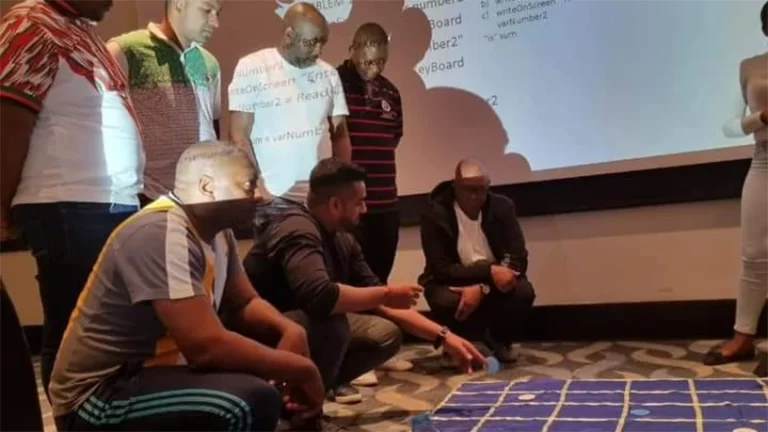
IN a collaborative partnership with teacher unions, non-profit organisation (NPO) Tangible Africa has trained over 600 teachers across South Africa in coding skills to implement in the classroom.

The teachers, who were trained between June and September, are now known as Master Trainers, and in turn, will train around 16 000 other teachers in offline coding, the NPO says.

Leva Foundation operations manager Jackson Tshabalala says 500 South African Democratic Teachers Union (SADTU), 40 National Teachers’ Union (NATU) and 60 Suid-Afrikaanse Onderwysersunie (SAOU) teachers were trained across all nine provinces in less than three months.

The training comes as government is looking to rollout a coding and robotics curriculum in South African schools.

The Department of Basic Education (DBE) believes a coding and robotics curriculum will develop learners’ ability to solve problems, think critically, work collaboratively and creatively, function in a digital and information-driven world, apply digital and ICT skills, and transfer these skills to solve everyday problems.

According to the DBE’s annual performance plan for 2022/2023, the full-scale implementation for Grade R to Grade 3, and Grade 7 is planned for the academic year 2023.

For other grades from 4 to 9, the subjects of robotics and coding will be on the pilot from 2022 to 2023, and full-scale implementation in these grades will be seen between 2024 and 2025.

Achievable coding

“This was a great collaboration between Tangible Africa and the teachers unions. The most rewarding part of the training was demystifying coding to some of the teachers who reported feelings of anxiety, fear and nervousness before the training, but afterwards felt encouraged, ready and excited to start coding at their schools,” says Tshabalala.

The training offered by 12 young facilitators from Tangible Africa, an engagement project of Nelson Mandela University Computing Sciences Department and the Leva Foundation, empowered the teachers to teach coding concepts without computers – by using limited resources, including a smartphone and coding app games (downloadable as TANKS, RANGERS and BOATS).

“This was also an empowering experience for our facilitators, who are mostly graduates from the university. They were able to share their technical skillset in a workshop setting, and for some of our facilitators it was their first time on a plane. The training allowed our facilitators to build up their capacity to offer future Unplugged Coding workshops to other organisations,” says Tshabalala.

SADTU vice-president of education Faseega Solomon says the project by Tangible Africa suited the Teacher Union Collaboration training earmarked for the year since it was themed “skills for a changing world”.

The annual training is a partnership between the major unions in the country and the DBE.

“What stood out from all the other service providers was that these coding concepts could be taught in schools without the necessary infrastructure and gadgets. Teachers will be able to develop skills needed for the 21st century, like problem-solving and collaboration, to empower learners irrespective of the resources they have available at their schools,” says Solomon.

She commends the Tangible Africa facilitators for being well-trained and presenting the training in a fun and interactive manner.

Tangible Africa says many of the Master Trainer teachers are now already implementing the training in their classrooms and receiving requests from other schools for further training. Solomon believes the training will not stop at the earmarked 16 000 teachers, but will reach even more schools to have a multiplying impact.

NATU director Prof Sitwala Imenda says by using the Master Trainer teachers to capacitate other teachers, it also removes the fear they have about these concepts: “When they see their colleagues handling the coding and robotics content, they are motivated. Furthermore, by using this cascading approach, instead of using private entities, we also achieve economies of both scale and skill.”

He continues to say the skills taught will assist learners and teachers not only in the technological world in which we live today, but also in the future. “By exposing educators of NATU to these concepts and principles, we seek to create a critical mass of teacher champions to imbue learners with skills for the future,” says Imenda.

Koos van der Walt, who co-ordinated the training of 60 SAOU teachers in the central region, agrees the coding concepts could be taught in both high resource and low resource schools.

“I haven’t seen teachers enjoy themselves this much during training in a long a time. They were eager to take the concepts back to the classroom and were extremely positive about the training,” says Van der Walt.

Thinking it through

Teachers who received the training were oriented to coding and robotics as a subject and encouraged to understand the thinking processes required from learners.

“Some of these things we are already doing in the classroom, like problem-solving, logic and movement. The training helps to demystify what coding is, and how easy it is to implement in the classroom,” says Hudson Park Primary technology integrator and ICT teacher Kelly Bush.

Bush, from East London, has developed lesson plans based on the TANKS and BOATS apps that formed part of the training.

Tangible Africa notes this work has earned her a provincial nomination for the National Teachers Awards, taking place later this month.

“The lesson plans link with concepts learners are familiar with in the South African environment. Items we use in the lessons are readily available, like egg boxes, chairs or shoes, so that even under-resourced schools can follow the lessons,” says Bush.

Another teacher, Mary Ann Chetty from Astra Primary School in Chatsworth, who participated in the SADTU Master Training, says she was already introducing coding concepts into her classroom and planning to offer extra-curricular games to children at her school in Kwa-Zulu Natal.

“I have a much better understanding of what we can do at our school with coding and robotics. The fact that the games are unplugged helps so much for a school like ours,” says Chetty.

SOURCE| ITWEB
We can predict final school marks in year 11 – it’s time to replace stressful exams with more meaningful education

0

JOHN FISCHETTI

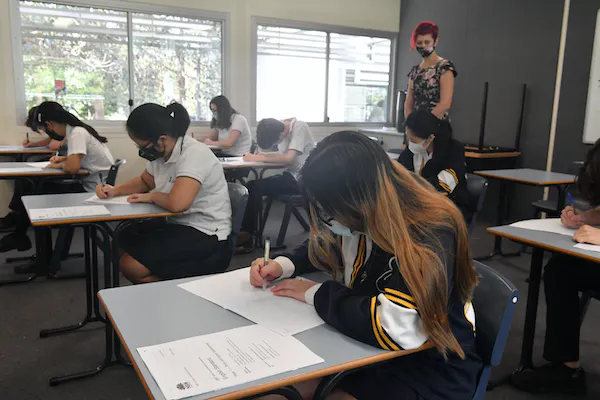
YEAR 12 students around Australia are preparing to sit their final exams. For many young people this is one of the most stressful parts of school, with their future supposedly coming down to one number.

This is an outdated way of finishing school and working out what students do in the next phase of their lives.

Universities and TAFEs are increasingly using other methods – such as interviews or portfolios – to offer places to school leavers. In 2021, more than 25,000 NSW students applied for an early offer through the “schools recommendation scheme”, to lock in a university place before they sit their exams. This is up from 5,447 in 2014, suggesting year 12 exams may not be as necessary as we once thought.

Our research shows you can reliably predict a student’s year 12 results by year 11. This also suggests we don’t need a battery of stressful exams to work out if a student is suited for tertiary education.

This gives us the opportunity to radically rethink how the final years of school are structured.

Our research

Two years ago, we studied more than 10,000 students in the Catholic Education Diocese of Paramatta, NSW. We have repeated the study and our work now includes 20,000 students across 21 exam areas.

We used predictive analytics which links multiple pieces of information about student progression through school.

We used 17 variables including year 9 NAPLAN scores, Higher School Certificate subject choices and year 11 attendance. We also use demographic information, such as how long a student has lived in Australia and a school’s socioeconomic rating.

Across both our studies, we found we could predict year 12 results in year 11, with a 93% accuracy rate.

Our purpose here is not to label students, but to change the focus of school and the efforts of students and teachers.

What can we do differently in schools?

We are already seeing the beginnings of new ways of “doing school” in Australia. Some schools are changing their focus from year 12 exams to students doing internships, creating portfolios of work, doing TAFE or university certificates, or doing an overseas exchange.

In British Columbia, Canada, final school assessments include a project that connects “real-world” applications of the curriculum for each student.

In Estonia, now among the world leaders in education, traditional “knowledge and understanding” approaches have been replaced with a strong emphasis on critical thinking, problem-solving, entrepreneurship, digital skills and citizenship. These are all qualities that fit with both employers’ needs and measures of success in the adult world.

Students undertake a cross-disciplinary creative project to graduate from the equivalent of year 10 – an example might be studying the impact of music on managing the onset of dementia in older people. They then do a research project before finishing high school.

Year 12 exams are outdated

High school as we’ve known it has been dominated by high stakes, high-pressure exams that have outlived their usefulness. If we can reliably predict the results, we don’t need the tests.

We know young people’s mental health is already poor, and has suffered further during COVID.

We should be looking for ways to improve, rather than exacerbate this. We also know universities are increasingly open to other ways of admitting students.

There is an enormous opportunity here to reallocate resources and create a modern, meaningful school experience that excites young people. It can encourage them to seek career-building activities, study overseas, learn languages or follow passion projects – not just study for stressful exams that tell us what we already know.

The research for this piece is a continuation of the work initiated by Dr Raju Veranasi for his 2021 Phd at the University of Newcastle.

THE CONVERSATION

South African universities are making a shift – but there’s a catch

0

THE latest PwC Vice-Chancellor Survey for 2022 showed that universities are rapidly transforming to become more digitally aligned – making a big shift to virtual schooling- but access remains the biggest hurdle.

The survey questioned vice-chancellors and deputy vice-chancellors from 26 of South Africa’s universities. PwC also conducted benchmarking analysis across public universities based on their 2021 audited annual financial statements.

PwC found that during the pandemic, many universities were forced to accelerate their digital learning deployments faster than expected.

Despite this, due to the rate of acceleration to digital platforms, many learners had challenges with accessibility, inclusion and engagement, said PwC.

“We were reminded that the digital equity gap in Africa unfortunately persists. Moreover, the initial reaction to virtual learning has left students divided on whether they prefer physical classes to online learning.”

According to another PwC report, the Voice of the Student Survey, almost half of all students (49%) prefer virtual learning, 38% prefer hybrid learning formats, and 13% prefer in-person classes.

Only 13% of students indicated a preference for in-person classes, with most preferring either a hybrid or online medium for teaching and learning.

South Africa is not alone in this phenomenon, higher education institutions across the globe have been forced – over the past two years – to take a closer look at many different aspects of their operations, including how technology is disrupting their traditional business models.

According to a Global Market Insights report, the number of students taking online courses has expanded rapidly, with the e-learning market capping $250 billion in revenue in 2020.

By 2027, this is expected to surge to a compound annual growth rate of 21%, said PwC. Vice-chancellors, in response to the group’s survey, added that the higher education industry is significantly behind the corporate world when it comes to digitalisation.

Many respondents believed that in-person learning should be the preferred method – university stakeholders remain positive about the shift towards virtual classrooms as complementary.

PwC expects even more students to prefer virtual learning, especially when virtual learning experiences improve, advances in digitisation are made, and access to technology becomes more affordable.

STAFF REPORTER

How Teaching Assistants Are Paid

0

TEACHING assistants were introduced into schools via the Presidential Youth Employment Intervention (PYEI) programme. These assistants receive online training during their time in the programme and are also paid a stipend for the work they do at schools.

The Presidential Youth Employment Intervention (PYEI) programme was introduced to provide employment opportunities for the unemployed youth of South Africa. Through the programme, these individuals will receive training which will provide them with the necessary skills for future employment.

As teaching assistants, they assist the teacher in the classroom with various tasks and also provide additional support to the learners. During their time at the schools, they develop skills which would be useful in other disciplines and also provides them with work experience that many employers look for. 

The teaching assistants receive a monthly stipend for the work they do. While all teaching assistants receive the same stipend, each province provides them with the money through different systems. 

Every month they receive a stipend of R 4 081.44 before deductions. Deductions include Unemployment Insurance Fund (UIF) payment which may be used when they become unemployed or within six months of the termination of their employment. 

UIF payments will either be made from the Personal and Salary (PERSAL) System, the school or the province. Each province will distribute these payments in different ways to the Department of Labour. 

Stipends are provided to assistants via PERSAL or through the schools. PERSAL is a central system used for the administration of the public service payroll. The provinces that use PERSAL, provide the stipends directly to the assistants.

These provinces distribute their stipends in the following way:

  • Eastern Cape: PERSAL
  • Free State: Direct transfer to schools.
  • Gauteng: Direct transfer to schools.
  • KwaZulu-Natal: PERSAL
  • Limpopo: Transfer to district then district transfers to schools.
  • Mpumalanga: Transfer to district then district transfers to schools.
  • Northern Cape: PERSAL
  • North West: Direct transfer to schools.
  • Western Cape: Direct transfer to schools.

February and March 2023 stipends will be paid from unspent funds from Phases 2 and 3 of the PYEI programme. Phase 4 of the programme will use unspent funds from the Phase 3 budget. Approximately 255 100 people are looking to be placed in Phase 4 with a budget of R6 million.

STAFF REPORTER: Careersportal

Vroom-Vroom: NWU, TUT, UFS and UNISA engineering students flick solar-powered vehicles on the road to prove their mettle

CHARLES MOLELE

GENERATION Z is more committed than ever to social good, with businesses’ social impact initiatives influencing their career choices and helping them to hit the ground running after high school by streamlining and aligning their interests.

This was evident at this year’s 2022 Sasol Solar Challenge, which included the participation of dozens of high-flying school learners and engineering students from various local and international universities.

Among the solar car teams taking part in this year’s Sasol Solar Challenge were the high school team Genuine JV from Pretoria, including top engineering students from the Free State Central University of Technology, North West University’s Solar Car Team, the Unisa Solar Team, UFS Solar Team, TUT Solar Team and the Brunel Solar Team, a group of talented engineering students from Belgium and the Netherlands.

According to organizers, the solar car teams typically partner with leading technology companies to test and develop cutting-edge innovations during the solar challenge.

The students set out on the Sasol Solar Challenge in Brakpan on Friday, covering a route with control stops from Johannesburg and across several quaint, Godforsaken small towns, propelling and driving their solar-powered cars along steep slopes and sweeping curves around the buttresses of the Lootsberg Pass (N9).

For the uninitiated, there are three major stops on each stage of the solar challenge: the start line, the control stop and the finish line.

On Monday night the eight solar car teams – with journalists, engineers, volunteers and event organizers in tow, arrived in Graaff-Reinet, a picturesque small town on the foothills of the Sneeuberge, or the Snow Mountain.

The participating students are expected to proceed to Jeffreys Bay, Riversdale, Caledon and finally arrive in Cape Town on Friday September 16 2022, to showcase the solar-powered car that they designed from scratch and built to travel without using a single drop of fuel.

Before setting out on the challenge, the UNISA Department of Mechanical Engineering hosted an official solar car preview ceremony at the Unisa the Science Campus, to showcase the car to the college and entire university.

“We wish the solar car team well as they start their tour to Cape Town today. We are praying for them and cheering them on to finish strong,” said Professor Simi Dube, Acting Executive Dean of the College of Science, Engineering and Technology.

The UFS, which has entered its solar-powered vehicle, Lengau (meaning Cheetah in Sesotho), said its main objective was to establish capacity in the students and staff through acquired practical knowledge on the management, design, construction, and actual racing of solar-powered vehicles.

“Our long-term aim is to continually improve on the design, technology, science, and project implementation to participate in events and challenges around ‘green’ energy and relevant technologies. An additional aim is the popularisation of electric vehicle (EV) technologies through outreach programmes,” said Dr Hendrik van Heerden from the UFS Department of Physics and project manager of Team UFS.

The biggest surprise at the challenge is the participation of Grade 9 to 11 learners from the John Vorster Hoër Tegniese Skool in Pretoria.

Their solar-powered car is known as the Voltwagen, supported by the Genuine JV Team.

“The 2022 Sasol Solar Challenge is our first competitive solar event. Taking part in this event is a huge opportunity, an achievement and a learning curve for us,” said team manager Dr Marlize Kantor.

“We have been preparing for this moment and it’s finally here. It is going to be an unforgettable experience not only for the team but the entire school … Additional to testing the car, we also practised our respective roles which includes safety, telemetry, communication and strategic planning.”

The Genuine JV team consists of 32 members, including learners from grades 9 to 11, teachers, parents and volunteers, with a combination of skills from electronics, digital systems, mechanics, civil technology, robotics, media relations and logistics.

Tshwane University of Technology’s (TUT) is also taking part in the fierce competition, using their solar car called the SunChaser 4, an energy efficient, high technology solar powered vehicle, built by the Faculty of Engineering and Built Environment.

The vehicle was designed, built and is driven by a team of staff members and students from TUT.

During the control stops on the journey to Cape Town, the Sasol Solar Challenge made a few stops and invited school learners from various schools in Sasolburg, Winburg and Middelburg in an attempt to give them an opportunity to experience STEM (Science, Technology, Engineering and Mathematics) in the real-world and learn more about the solar-powered car challenge.

On Saturday, the community of Winburg, Free State, gathered at the main street of the town to welcome and support the solar car teams on their second control-stop of the event.

“The reaction that we received from the community of Winburg was overwhelming. The most notable thing is that they were at the control-stop before us. They knew that we were coming, and they were prepared to host us with open hearts and also show support to the teams,” said Robert Walker, owner and director of the Sasol Solar Challenge.

“We hope to continue to impact more communities along the route.”

Eight schools from the area participated in the programme which was conducted at the control-stop.

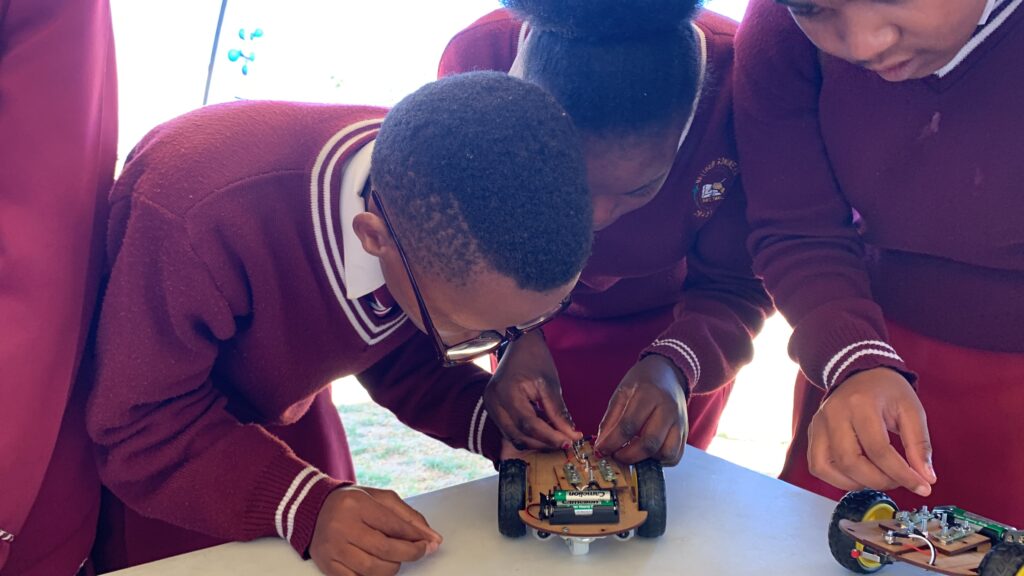
The learners had an opportunity to learn more about solar technology, robotics and e-mobility through solutions created for real-world challenges.

Brunhilde Rossouw, DA Councillor of Winburg and town ambassador, said: “Our children don’t often get these opportunities to experience STEM in real-life. I was a school teacher for 35 years and there is nothing more exciting than introducing programmes to learners that can entice them to become interested in possible future careers. We are grateful to the Sasol Solar Challenge for bringing this event to our community and we hope to see the event here again in 2024.”

Nozipho Mbatha, Senior Manager: Group Brand and Sponsorships at Sasol, said: “One of the key objectives of the Sasol Solar Challenge is to stimulate a sense of wonder and curiosity about STEM among learners – to create awareness, excitement and unique opportunities for them with a specific focus on STEM subjects. Today we have witness this in Winburg, with the excitement that we have received from the community.”


A total of 300 learners from Middelburg visited schools program of the #SasolSolarChallenge to learn more about #STEM

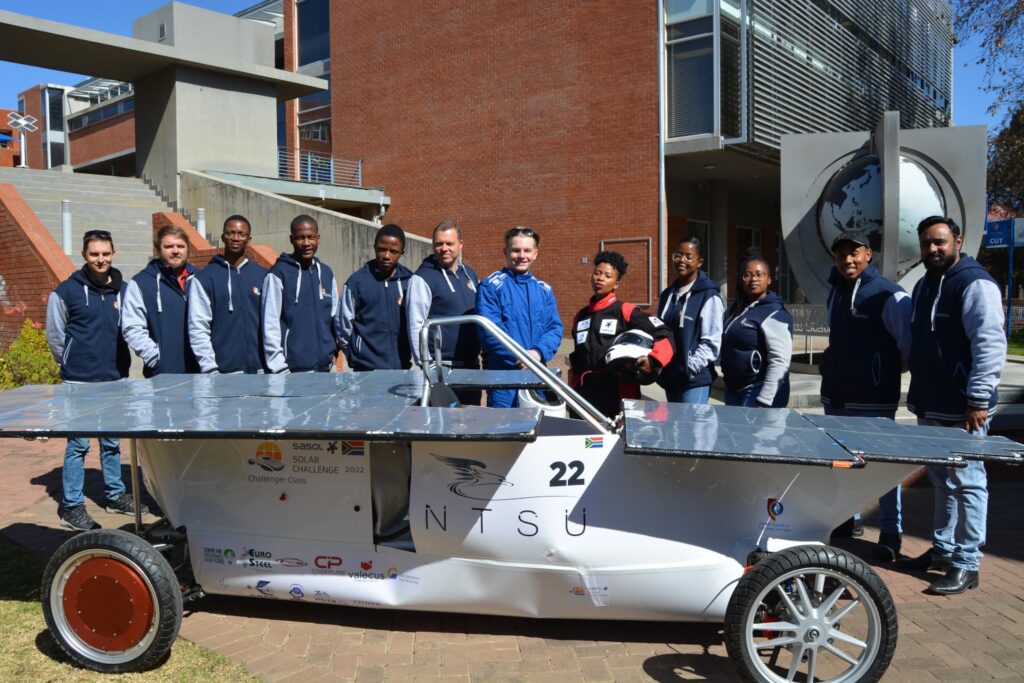
The 3D (CAD) Solar Car “Ntsu” designed by team “Seilatsatsi” from Free State Central University of Technology is competing in 2022 Sasol Solar Car Challenge.

INSIDE EDUCATION

5 classroom management strategies to try this year

A rise in harassment and violence against teachers is taking a toll on already-exhausted educators. A recent survey from the American Psychological Association found that 6 in 10 teachers reported student violence or verbal aggression during the pandemic, with nearly half expressing a desire or plan to quit or transfer schools.

To create a teaching environment where educators feel safe, school leaders may want to consider adding evidence-based behavior management strategies to their back-to-school plan. The more preventative maintenance teachers can do through proactive strategies, the less likely they will encounter problem behavior.

Here are five classroom management strategies to help educators regain control of their classrooms: 

1. Understanding students 

Getting to know each student individually will enable teachers to better evaluate the nature of the problem behavior when it occurs and respond appropriately. Additionally, challenging behaviors are much less likely when a teacher and student build a rapport based on trust and understanding. To build this rapport, teachers’ nonverbal behavior and paraverbal communication need to reflect their compassion for each student.

2. Practicing patience

An important de-escalation skill is what the Crisis Prevention Institute (CPI) terms “Rational Detachment”–the ability to manage one’s behavior and attitude and not take the behavior of others personally. When faced with student misbehavior, instead of thinking something like, “I can’t take this disrespect anymore,” teachers can use positive self-talk such as, “I’ve seen this before. This behavior is not about me. What is it about, and how can I help?”

3. Staying Calm

The first step in practicing rational detachment is remaining calm. When teachers encounter disrespectful or challenging behavior, starting with a deep breath will help them relax and remain silent, allowing them to further assess the situation at hand. Conversely, if a teacher overreacts, the entire class will take note of the cause, which virtually guarantees that some students will try it again. However, remaining calm does not mean ignoring the problem. From the students’ perspective, a teacher will have backed down and relinquished authority. Consequently, both overreacting and ignoring the situation result in the loss of control and authority.

The second step is simply to wait calmly and silently while assuming a supportive stance (i.e., standing askance or sideways to the student who issued the challenge) and “model cognition” (i.e., the teacher acts like they are thinking). An example of the latter action is standing with a hand on one’s chin, perhaps tapping the index finger to give the impression of thinking. These body positions are supportive, non-confrontational, and, most importantly, signal a willing determination without adding any more tension to a volatile situation.

The simple act of waiting, combined with a supportive stance, often solves the problem without the teacher ever having to say a word. Teachers have reported experiences where the silent period (usually lasting only five to nine seconds) causes the student to throw up their hands in defeat and say something like, “Fine. I’ll do it even though it’s dumb!” and storm back to his seat. Teachers can later address the student’s misbehavior on their own terms and set effective limits.

4. Setting effective limits 

Establishing clear, consistent classroom expectations can help students monitor their own behavior. Post the expectations where they are clearly visible so they can serve as reminders. Additionally, they should be stated in simple and positive terms that address what students can do. For example, instead of saying, “No side talk,” the posted expectations should say, “Please raise your hand to add to the conversation.”

5. Being aware of the causes of misbehavior

In all cases, a proper response to student misbehavior begins early in the chain of events. Being mindful of precipitating factors–preexisting circumstances that cause distress behavior–and early warning signs can prevent an incident. For example, if a student seems consistently irritable or inattentive in the morning, could hunger be causing the behavior? Can steps be taken to ensure the student gets breakfast in the cafeteria before class, or can the teacher keep granola bars on hand? Classroom management is not just about avoiding student disruptions. It’s also about creating an environment that enables students to focus on learning.

A common saying at CPI is, “Conflict is inevitable, but combat is optional.” Being proactive is the key to reducing the frequency and intensity of incidents so that the classroom can remain a safe, productive environment for students and teachers.

eSchoolnews

UWC students fly South African flag high at varsity beach volleyball champs in Brazil

0

TWO University of the Western Cape (UWC) students are flying the South African flag high in Brazil where they are competing in the International University Sports Federation (FISU) World University Beach Volleyball Championship from September 6-10.

In the hopes of giving their best shot and bringing the title home, Tamlyn Thomas, a second-year BEd (foundation phase) student, and Lukholo Jooste, an education degree student, joined the South African squad in Maceió to compete for the Beach Volleyball Championship title.

Starting his volleyball journey at the age of 12, Jooste said that playing the sport prevented him from being influenced by negative factors as he was growing up.

“I started playing volleyball at the age of 12 through a non-profit organisation called Yebo Volleyball. They came to my primary school and introduced the sport to us. From there, they took us to trials at the Western Cape Sports School, where I was one of the learners who got selected. In 2014, I started training at the school, learning a lot from my coach, Clinton Stemmet, who is one of the best volleyball players in the country. As a school team in high school, we always looked up to him.

“I am so in love with the sport because it enables me to be more active and prevents me from being influenced by negative factors. Also, being at the beach every weekend is an amazing feeling, to meet lots of people and learn a lot from different individuals, which enables me to grow as a person,” said Jooste.

Expanding on her gratitude at being selected to represent South Africa, Thomas said that knowing that one’s efforts and dedication have paid off is both gratifying and an honour.

“It is both satisfying and an honour (to be chosen for Team SA), knowing that the sacrifices and hard work paid off. I also feel that there is a sense of belief from my coach and teammates for trusting me and allowing me to be in this position.

“Volleyball is one of the few sports where, as much as you are part of a team, your individual contribution can make or break a game. Thus, the fact that I can better myself with every game is great in and of itself. It also allows me to be as passionate and expressive as I want to be,” said Thomas.

With Elmien Cloete selected as head coach of South Africa’s beach volleyball team at the championship, she added that traditionally, the UWC volleyball teams have always been a force to be reckoned with, so having UWC Sport members as part of the overall team travelling to the FISU World University Beach Volleyball Championship is not surprising.

“Testament to this is that both members of the South African beach volleyball men’s team are UWC alumni. Despite having major successes at a provincial and university level, the sport does not receive the same level of support as other codes from the big wigs.

“It’s only through more competition and exposure at the highest levels that athletes can test their skills. They can learn from their experiences, share them upon return, and improve all the time. Sport evolves all the time, and if you are not part of what is happening globally, you will always play the catch-up game,” said Cloete.

Weekend Argus

Biko’s ideal of black self-reliance more relevant than ever before, says Ramaphosa

CYRIL RAMAPHOSA|

ON this day 45 years ago, Stephen Bantu Biko died in police custody in Pretoria Central Prison.

Human dignity, the principle at the heart of his black consciousness activism, was denied him. In the words of the family lawyer Sir Sydney Kentridge, his was “a miserable and lonely death on a mat on a stone floor in a prison cell”.

It remains a source of great sorrow all these years later to recall that Steve Biko was just 30 years old when he died. He was cut down in his prime by those who feared the power and resonance of his ideas of self-liberation and his efforts to infuse black men and women with pride and dignity.

He never got to see in his lifetime what he called ‘the glittering prize’, the realisation of a true humanity. Writing about this ideal, he famously said: “In time we shall be in a position to bestow upon South Africa the greatest gift possible – a more human face.”

When we won our freedom in 1994, we understood that the right to vote was just one part of our struggle for human dignity.

Twenty-eight years into our democracy, we are confronted with many challenges, such as poverty, unemployment and inequality. As a result, we often lose sight of how far we have come in giving effect to the principles on which our Constitution is founded and that anchored Steve Biko’s thought and teachings.

In 1977 a heartless regime killed one of our country’s most promising leaders by depriving him of the food, water and medical treatment he urgently needed as a result of brutal beatings by the apartheid police.

Twenty years later, in a 1997 judgment, the Constitutional Court said that fulfilling the fundamental rights of every citizen and striving to achieve their socio-economic rights is the hallmark of a democratic society aiming to salvage lost dignity.

In South Africa today, we continue to work to fulfil the basic rights of every South African so that they may lead quality lives free of disease, hunger and deprivation.

Successive democratic administrations have implemented policies to salvage the lost dignity of this country’s majority by providing education, health care, housing and basic services.

In South Africa today, a decent education is a fundamental right. The state invests in early childhood development, in supporting learning outcomes for our youngest citizens, and provides social relief through school feeding programmes to ensure young learners achieve the best outcomes possible.

Through the National Student Financial Aid Scheme and various other forms of state support, thousands of young South Africans from poor backgrounds have been able to become doctors, lawyers, teachers, scientists, artisans and entrepreneurs.

The government supports poor and vulnerable citizens through an extensive social safety net and provides work opportunities through mass public employment programmes.

In the repressive South Africa in which Steve Biko died, freedom of speech was curtailed and political activism attracted detention or worse.

In South Africa today, young people of the same age as Steve Biko was and even younger are at the forefront of activism for causes closest to them, and they are able to organise free of harassment or banishment. Freedom of speech and association, the right to protest and the right to equality before the law is upheld for all.

As a country, we have come a long way towards the fulfilment of human dignity, the principle that Steve Biko so cherished. Yet, we still have so much further to go.

Without a job, without a house, electricity or running water, without land, without skills or opportunities, millions of South Africans are still deprived of the lives they seek and deserve. That is why government is working with social partners to build an inclusive economy, create employment, enable businesses to thrive and tackle poverty and hunger.

In considering the relevance of Steve Biko’s life and legacy, we recall his powerful call to the people to be architects of their own liberation. This call is as important now as it was back then.

We must be focused on addressing our challenges to achieve a truly free and equal society. We each need to play our part by using the foundational rights in our Constitution to build a South Africa free of poverty and hunger, underdevelopment, crime and violence.

As Steve Biko urged, let us march forth with courage and determination on our common quest for true humanity.

From the desk of the President

Parent-teacher organizations aren’t only for the kids

0

They’re known at school as the group of parents who orchestrate everything from Halloween parties to book fairs, but a parent-teacher organization isn’t just for the kids.

Parents join a PTO for all kinds of reasons. It has helped some revitalize career skills, share passions, find job opportunities, and assuage the middle-age friend desert, all while making sure the kids have fun.

“I thought it was important for my kids to see I thought they were important and that their education was important,”′ said Judy Walters, 54, of central New Jersey, recalling her stay-at-home-mom days raising two little girls. “But really, I wanted to meet people and have a life.”

The PTO was where Walters met some of the people she still considers best friends.

“I got close to a number of my room-mom people, and I met a lot of parents who I wasn’t close to but still really liked and enjoyed,” she says.

PTO is a common acronym for the group of parents and teachers who work together to fundraise, plan activities and provide extra enrichment for students. The term can be used interchangeably with the Parent Teacher Association, a national nonprofit headquartered in Alexandria, Virginia, or the PTC, or parent-teacher council.

As kids return to school this fall, you might see flyers or emails pleading for parents to get involved. PTOs play an important role as school boards face tough budget choices, particularly for “extras” non directly related to the curriculum.

Especially as schools and families emerge from pandemic lockdowns, people are looking for ways to connect. PTOs can provide that at a time in life when making new friends typically slows down because of work and family.

Sara Dean, 46, signed up for her school’s PTA, nervous about assimilating into what she saw as an established group. But by spring, she was happy to have made new friends.

Dean hosts the podcast “The Shameless Mom Academy,” which discusses women’s empowerment, and balancing parenthood and work. She devoted an episode to what she learned from working as the PTA president at her child’s school outside Seattle.

“The opportunities for bonding happen quicker,” she said of working on the PTA. “There is more comradery and ease of building relationships that I wasn’t expecting but that was a lovely experience.”

She also didn’t expect to pick up career-building skills.

Dean was used to working independently, as a writer and podcast host and producer. As PTA president, she was thrown into building teams, helping everyone get along, and finding resolutions to problems the school faced — skills that could easily translate into corporate America or the world of nonprofits.

“That’s not why I signed up but it’s a benefit that is really cool,” she said.

The same goes for Colleen Nolan, 46, of Newton, Massachusetts. The eight years she spent working various roles on an elementary school PTO led, she said, to two nonprofit board positions — at a city food bank and a neighborhood improvement group — and a paid, part-time position as a records keeper.

“I met people in the neighborhood and, over the years, they recognized me as someone who was a `doer,’” Nolan said. “People saw me as someone who could answer questions and they used me as a resource.”

Many parents bring their passion projects to the PTO, said Andy Garlick, an elementary school principal in Needham, Massachusetts. These might include personal finance, diversity, or cultural customs from another country, for example. Parents bring what they know to the table.

“There’s a lot of people who want to use the minimal free time they have to do good in their community,” he said.

There are criticisms and jokes, of course. In the 2018 comedy “Bad Moms,” Christina Applegate and Mila Kunis spar over who is the better PTA presidential candidate. And the Netflix series “Ginny & Georgia” shows a snooty mother from “Wellsbury, Massachusetts” arguing with an outsider from Texas about how to best raise money for the PTA.

In reality, wealthy neighborhoods tend to have far more parental involvement and fundraising power than areas without such affluence. This leads to more enrichment opportunities for students, and more educational necessities like books or tech gadgets. Some argue it compounds inequities in the U.S.

And PTO parents often spend their own money. Some organizations have dues and others don’t, but many parent volunteers end up paying for projects and events.

Kimberly Rae Miller, 39, of Suffolk County, New York, joined the PTA to become more involved and was surprised to find how much money it required out of her own pocket.

But, she said, “If you have the time and financial resources to participate, it’s a great way to have access to a part of your children’s life that you don’t always have access to.”

AP

Skills and training development crucial to fighting unemployment in South Africa, says Deputy President David Mabuza

WENDY MOTHATA|

SOUTH AFRICA’S ability to reverse rising levels of unemployment and poverty depends on its progress to deliver training and skills development programmes that address today’s challenges.

This is according to Deputy President David Mabuza, who was speaking in his capacity as the Chairperson of the Human Resource Development Council (HRDC) at the Sedibeng TVET College in Vereeniging, Gauteng.

“Apart from those in the schooling and training system, the reality is that we have an unsustainably high number of unemployed young people. Something drastic needs to happen,” he said.

Citing the Statistics South Africa (Stats SA) data, he said the country’s unemployment rate stood at 33.9% in the second quarter of the year, with almost 12.3 million jobless people.

“Most concerning is that 35.7% of youth between the ages of 15 and 24 are classified as not being in employment, education, or training.”

He has since urged the Council to put measures in place to ensure that those who have lost employment and learning opportunities can bounce back.

According to the Deputy President, this could be made possible through a package of skills development interventions that will create viable options in life.

“What the COVID-19 pandemic has taught us is that certain jobs may not come back as we know them.”

He said the Council needs to look at working with industry to design targeted skills programmes that will facilitate the absorption of youth into entrepreneurship and employment.

“Many a time, we keep deliberating on our challenges, and we make undertakings to change course, but very little is done to implement all the good resolutions that we take to change the situation,” the Deputy President said.

To this end, he called on the body to finalise the programme of action immediately.

He urged members to reflect on whether their work will produce skills that are appropriate for citizens to thrive in the era of the Fourth Industrial Revolution (4IR).

“Instead of trying to do everything, we should reflect on how we prioritise and select a portfolio of interrelated national high impact interventions or projects to deliver tangible results for our country.”

More critically, Mabuza said the Council needed to mobilise necessary financial resources from government and the private sector to drive these initiatives.

“How do we ensure that the HRDC strategy responds to the current job seekers and those pursuing entrepreneurship?”

He emphasised that the programme of action should lead to the realisation of a better environment for learning and training.

“With proper education and training, we can move forward as a country.”

Business skills

He told the delegates that the evolving nature of doing business has set in motion the shifting content of skills and capabilities needed to build and grow a sustained modern economy.

“It requires a quick paradigm shift and reorientation to realign the content of our curriculum offerings and skills development programmes so that we can respond to the demands of industry and the economy,” he said.

In addition, he said the 4IR, National Digital and Future Skills Strategy provides a critical framework for inclusive partnerships between industry, labour, higher education institutions and society to imagine and build a new set of skills and capabilities for the country.

“From the foundations of basic education to tertiary levels, key resources and infrastructure must be provided to accelerate the provision of relevant and appropriate skills.”

He said he was encouraged by the Sedibeng TVET College with prides itself on new cutting-edge research and technology in disciplines like mechatronics.

He thinks that the combination of mechanical engineering, electronics and computer systems will go a
long way in developing the skills required as a country and growing the economy.

“As the Council, we need to ensure that all our TVET Colleges have strategic partnerships with industry
players across all economic sectors,” he said.

Digital divide

Meanwhile, he said the country needed to bridge the digital inequality gap, especially among unskilled
and low-income citizens, especially amongst women and girls.

He raised concerns about the 750 000 learners who did not return to school due to the pandemic.

“These increasing dropout rates, compound the already high number of young people that are not in
education, employment, and training.”

He also highlighted how COVID-19 exacerbated the issue of the digital divide in society.

“While other schools in affluent areas were able to continue learning during COVID-19, those who have
no access to ICT have been disadvantaged, thus lagging, hence our call for the mobilisation of requisite
resources from the government and private sector to jointly drive these initiatives,” Mabuza said.

INSIDE EDUCATION