Home Blog Page 26

U-19 Young Proteas humbled by Australia in World Cup

0

By Johnathan Paoli

The South Africa Under-19 cricket team received a sobering reminder of the standards required at Super Six level as they opened their ICC Under-19 World Cup campaign with a six-wicket defeat to Australia Under-19s, leaving the young Proteas under immediate pressure in Group I.

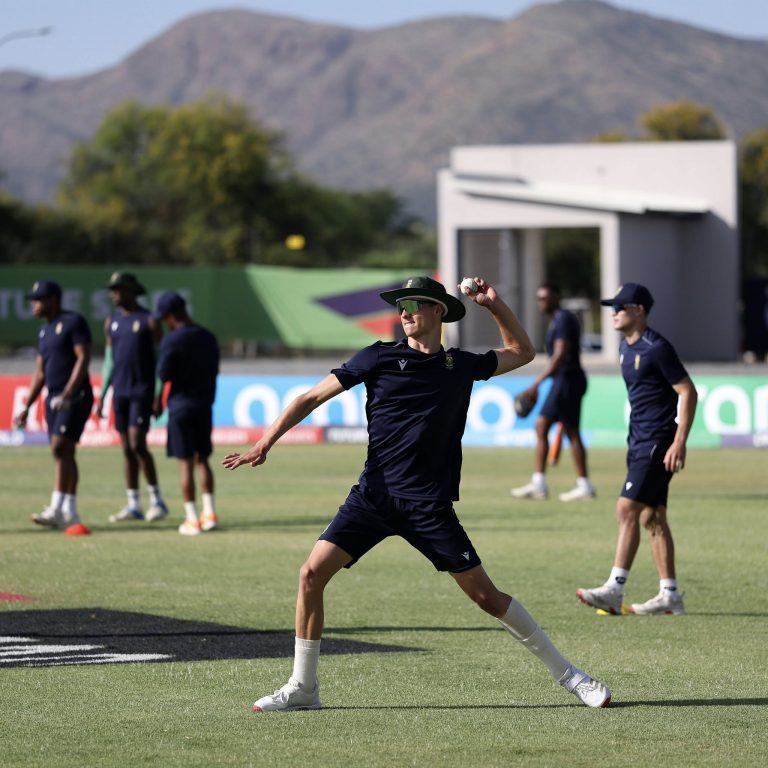
WINDHOEK, NAMIBIA – JANUARY 25: JJ Basson of South Africa celebrates the wicket of Ollie Peake of Australia during the ICC U19 Men’s Cricket World Cup 2026 Super Six match between Australia and South Africa at Namibia Cricket Ground on January 25, 2026 in Windhoek, Namibia. (Photo by Matthew Lewis-ICC/ICC via Getty Images)

For the country, the match again exposed familiar issues that have dogged the team throughout the tournament, from fragile starts with the bat, an inability to build meaningful partnerships, and a lack of scoreboard pressure against top-tier opposition.

ALSO READ: Next wave of infrastructure investment must include people, not only platforms

Despite the loss, the team’s performance was celebrated by the national Proteas team on social media.

“The Proteas U19 fought valiantly with the ball, showing a disciplined and determined effort throughout,” the team said on its X account.

Batting first in Windhoek, Namibia on Sunday, South Africa Under-19s were rocked early by a disciplined Australian bowling attack that made full use of the conditions.

The Proteas lost four wickets inside the opening powerplay and slumped to 37/4, placing themselves firmly on the back foot before the innings had settled.

Australia’s seamers hit consistent lengths and forced errors, while the South African top order struggled to adapt.

With movement on offer and fields attacking, South Africa were unable to rotate strike or counter-punch, leading to a steady procession of wickets.

ALSO READManamela urges shift from university-only mindset

Brief resistance during the middle overs helped South Africa limp past the 100-run mark in the 28th over, but the recovery never truly gathered momentum.

Regular breakthroughs ensured there was no late surge, and the innings ended at a modest 118 all out in 32.1 overs.

Despite entering the Super Six stage, many have noticed that the SA side has yet to produce a complete batting performance against high-quality opposition.

While South Africa’s bowlers showed commendable discipline and managed to apply pressure through tight lines, the target never allowed them the freedom to attack relentlessly.

Australia batted with patience, absorbing pressure and rotating strike smartly through the middle overs.

Although wickets fell at intervals, there was no sense of panic as the Australians closed in on the target; eventually reaching 122/4 in 32.5 overs, sealing a comfortable six-wicket win and making a confident start to their Super Six campaign.

For South Africa, the defeat follows a worrying trend, as they entered the Super Six stage on the back of a heavy 55-run loss to West Indies Under-19s, a match in which their batting again failed to fire during a chase.

ALSO READ: WATCH: McKenzie unveils new sports facility at Heidedal Primary School

That loss came despite an encouraging bowling effort that restricted the West Indies to 234 after a dramatic late collapse.

Across the tournament, South Africa have managed just one win over Tanzania, while suffering defeats to Afghanistan, West Indies and now Australia.

Australia, by contrast, arrived in the Super Six brimming with confidence after winning all three of their Group A matches, including a dominant performance against second-placed Sri Lanka.

While there is still time to salvage the campaign, the loss to Australia has reinforced the scale of the challenge facing the young Proteas as they attempt to turn a faltering World Cup into a meaningful contest.

INSIDE EDUCATION
DBE kicks off national teacher training workshops in Mpumalanga

0

By Charmaine Ndlela

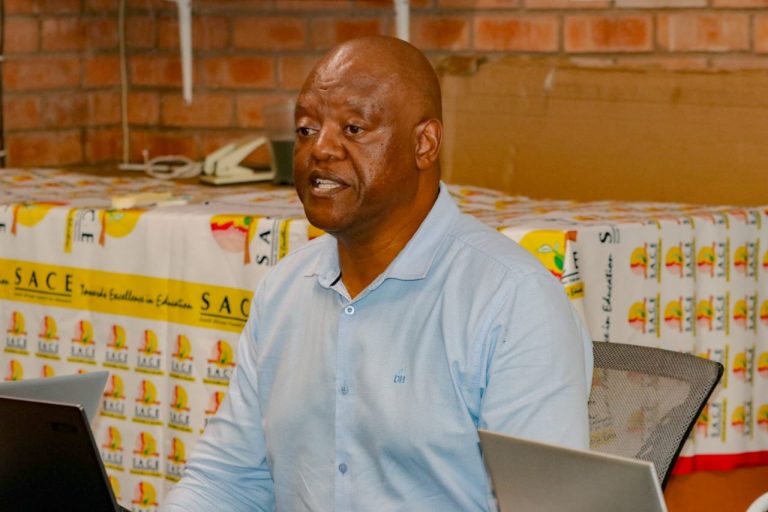
The Department of Basic Education (DBE) on Monday officially started the national rollout of teacher training workshops in Mpumalanga, to support the implementation of the Online Teacher Development Platform (OTDP).

“The platform is designed to give teachers wider access to development opportunities, allow them to learn at their own pace, and promote teacher agency through individualised training,” DBE media liaison Lukhanyo Vangqa told Inside Education.

ALSO READ: Next wave of infrastructure investment must include people, not only platforms

“It enables teachers to reflect on their own classroom practice through guided reflection questionnaires and to focus on content that directly responds to their identified professional needs,” he said.

The 2026 rollout focuses on in-person and online training, supporting the integration of Continuing Professional Teacher Development (CPTD) activities.

Vangqa said the primary purpose of the workshops is to popularise the platform among teachers, nationwide.

“These workshops are meant to ensure that teachers are able to navigate and use the platform effectively,” he said.

ALSO READ: Manamela urges shift from university-only mindset

 “We also want teachers to be fully aware of the content that is available on the platform, to collaborate with other educators, and for subject advisors to be able to schedule and manage their training sessions using the platform.”

Addressing long-standing concerns around the administrative workload faced by teachers, Vangqa said the shift to the OTDP would significantly reduce paperwork.

“One of the biggest complaints from teachers has been the amount of administrative work they have to deal with,” he said. 

“This platform changes the training process from a paper-based system to an online one, which will go a long way in reducing the administrative burden.”

ALSO READ: WATCH: McKenzie unveils new sports facility at Heidedal Primary School

Vangqa said that basic education minister Siviwe Gwarube has appointed an advisory body, the National Education and Training Council (NETC), to address the issue of excessive administration.

“The minister has tasked NETC with looking specifically at how we can alleviate the administrative burden on teachers,” he said. 

“They will be making submissions shortly to the administrator, and these proposals are expected to greatly decrease the workload faced by educators.”

INSIDE EDUCATION

Next wave of infrastructure investment must include people, not only platforms

By Charles Cheng 

As countries push ahead with digital transformation, infrastructure planning is evolving. It is no longer just about connectivity and platforms; it is also about building a skills pipeline that enables citizens and businesses to utilise technology effectively and securely at scale.

In South Africa, the skills-and-infrastructure link is especially real for young people entering the next phase after matric. The question is increasingly practical: what skills translate into opportunity, and how quickly? 

Micro-credentials and industry certifications are gaining momentum as shorter, stackable routes to build job-relevant capability, prove competence, and access entry points into the digital economy.

Digital transformation is also raising the bar on what “readiness” looks like. 

Organisations may have networks, devices and platforms in place, yet still struggle to use technology at scale because the talent pipeline is too thin. 

The pressure shows up most sharply in the roles that keep modern systems running and secure, from cybersecurity and cloud operations to software development, data and analytics, and the technicians and engineers responsible for resilience and uptime.

This is why many national digital strategies now treat talent development as a foundational enabler of economic competitiveness. 

In South Africa, the National Digital and Future Skills Strategy calls for a coordinated approach to building digital skills across the education and employment system, recognising that the ability to participate in the digital economy depends on both access and readiness.

 Digital infrastructure delivers its full value only when it is matched with human capacity. If we plan networks, cloud and digital public services without planning the skills to build, secure and operate them, we create an implementation gap, and the benefits of digital transformation stay out of reach for too many people and too many businesses.

 From connectivity to competitiveness – why the shift is urgent

The urgency is being driven by rapid change in the labour market. Employers increasingly expect skills requirements to shift as digital tools and AI reshape how work is done.

At an economic level, skills are becoming a form of national preparedness, enabling countries to adopt technology faster, attract digital investment and build competitive local industries that create jobs.

Within education, the response is accelerating. Universities and TVET colleges are strengthening alignment with labour-market needs, adopting industry-certified programmes, micro-credentials and applied learning pathways to close the gap between study and employability.

Skills ecosystems are becoming part of infrastructure planning because talent now determines speed. It determines how fast a country can modernise services, how quickly businesses can adopt cloud and AI, and how confidently society can manage cyber risk. In that sense, skills are no longer separate from infrastructure, they are infrastructure.

Building skills at the scale required cannot be achieved by governments or education systems acting alone. What is emerging across markets is a more deliberate model of public–private collaboration, where industry supports education institutions with curriculum input, practical exposure, and recognised certification pathways that better match real-world job requirements.

 Huawei’s approach is one example of how this collaboration is being implemented through structured, long-term programmes in partnership with universities, colleges, governments and industry bodies. 

A central mechanism is the Huawei ICT Academy, a global programme that partners with universities and higher learning institutions to provide industry-aligned curriculum, hands-on learning and certification pathways. Through the programme, Huawei works with educators and institutions to help students gain relevant technical exposure in areas such as networking, cloud, AI and cybersecurity.

 Huawei also supports digital talent development through initiatives such as the Huawei ICT Competition, which provides an international platform for students and teachers to strengthen practical skills and innovation.

We don’t approach talent development as a once-off CSR initiative. We approach it as a core part of digital ecosystem building, partnering with education institutions, supporting instructors, and expanding access to recognised certification pathways that help young people move from learning to earning.

Through the Huawei ICT Academy, we’ve expanded more than 2 600 academies globally, training over 200 000 students each year, across a wide range of countries and institutions. In SA, Huawei has academies at 88 universities, TVET and private colleges. 

 Planning for physical networks and human networks

As governments and industries prepare for more advanced digital economies, including AI-readiness, cybersecurity resilience and cloud-enabled service delivery, the case is strengthening for skills to be embedded into the same planning logic as fibre, spectrum, data centres and public digital platforms.

 This means measuring talent pipelines, strengthening educator capability, expanding applied technical programmes, and building pathways from classroom to workplace. It also means sustained collaboration in aligning public sector priorities, education system capacity, and industry requirements so that the workforce grows in step with the infrastructure it must power.

The countries that compete best in the next decade will be the ones that build both physical networks and human networks, together. That is how digital transformation becomes inclusive, scalable and economically meaningful.

Charles Chen is Deputy CEO of Huawei South Africa.

INSIDE EDUCATION

Four learners killed in Vaal scholar transport crash laid to rest

By Thebe Mabanga  

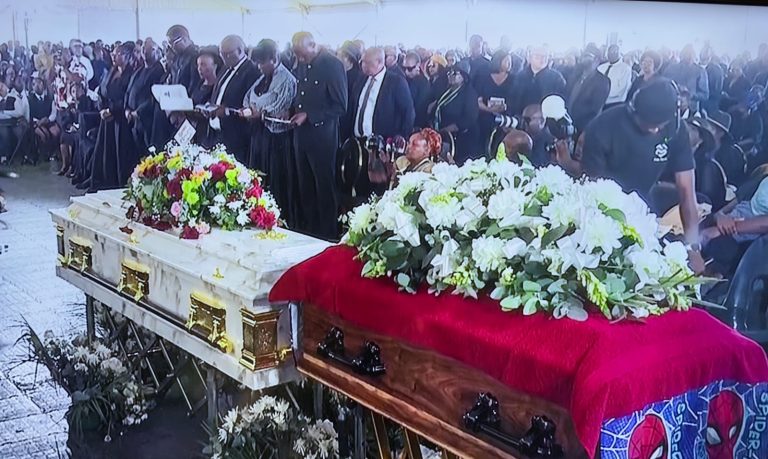
Four victims of the scholar transport accident that claimed 14 lives in the Vaal last Monday were laid to rest on Sunday.

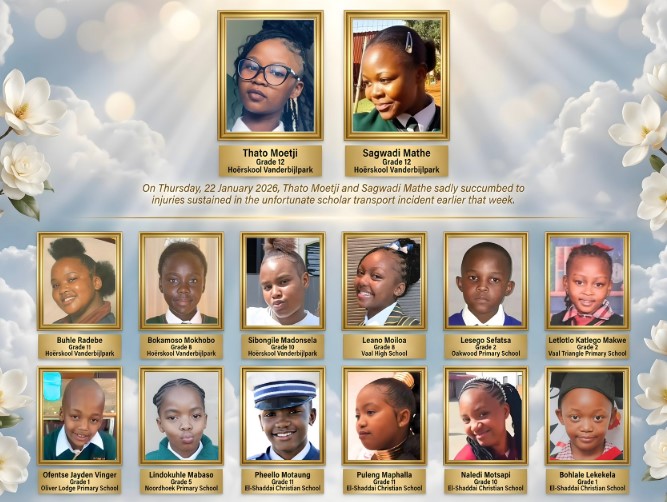
Leano Moiloa, who had turned 14 exactly a week before the tragedy, was buried in Sebokeng. Thato Moetji, who was due to turn 17 next week, Ofentse Vinger (6) and Bokamoso Mokhobo (13) were laid to rest at a joint funeral held at the Soul Tsotestsi Sports Ground.

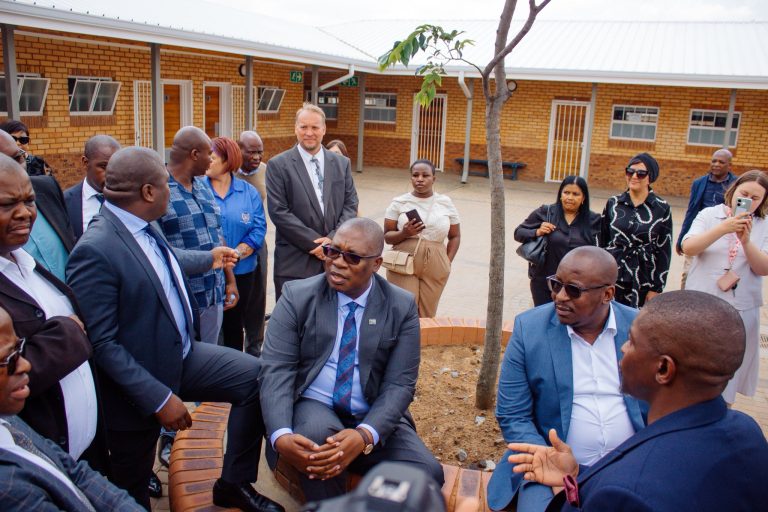
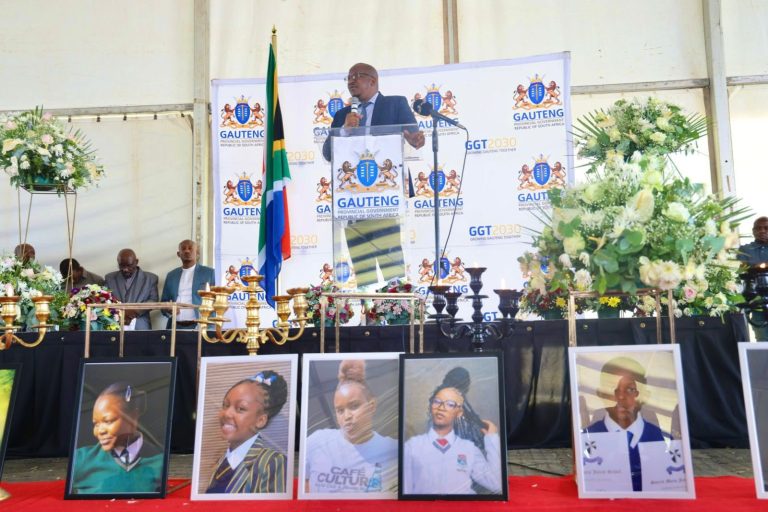
The funeral was attended by several dignitaries, including army chaplains, Minister in the Presidency responsible for Women, Youth and People with Disabilities Sindisiwe Chikunga, Deputy Minister of Transport Mkhuleko Hlengwa, Gauteng Premier Panyaza Lesufi, Gauteng Education MEC Matome Chiloane and Roads and Transport MEC Kedibone Diale-Tlabela.

Sedibeng executive mayor Lerato Maloka and Emfuleni executive mayor Sipho Radebe were also present.

Renowned preacher Bishop Maratehi Seleke officiated at the service, alongside representatives from school governing bodies, the South African Principals’ Association, funeral undertakers, and taxi and scholar transport associations.

Industry associations used the occasion to pledge concrete measures aimed at improving road safety. The taxi industry, while acknowledging the Gauteng government’s efforts to formalise and regulate the sector — including cashless systems and scheduled services — said these interventions would contribute to improved safety.

In her tribute, Chikunga spoke of “14 bright mornings, 14 incomplete notebooks and 14 dreams” cut short by the tragedy. She delivered a stern message to the taxi industry, warning that they “do not carry loads, but carry futures,” and cautioned that if safety and driver conduct were not improved, operators must “step up or step aside.”

She further urged law enforcement to leave no stone unturned in investigating the incident, adding that “if crimes were committed, they must be prosecuted without fear or favour.”

Chikunga also noted that, in her capacity as minister responsible for youth, she bore responsibility for the driver at the centre of the tragedy, 22-year-old Ayanda Dludla, who remains in custody after abandoning his bail application.

She said Dludla must be held accountable for his actions and face consequences, but stressed that there should also be room for rehabilitation and education to prevent other young drivers from repeating the same mistakes.

“Accountability is part of healing. Justice has mercy,” she said.

Chiloane praised businesses — led by the Vaal Undertakers Forum and the scholar transport association — as well as individual businesspeople who contributed to the funerals, including those who assisted with burials outside the province.

He also paid tribute to his department’s teams for providing psychosocial support to affected families and schools, noting that “our grief is collective, and the call for change is non-negotiable.”

Lesufi opened his eulogy with hymn 110, Holokile (“All Is Well”), and called for a broader overhaul of the schooling system so that parents are not forced to enrol children in schools far from home.

He told the families that “this is not their pain to bear” but rather to be shared.  

Various clergy and gospel artists contributed to different parts of the service, while a local tombstone company donated tombstones.

The learners were laid to rest at Jacobskop and Vanderbijlpark cemeteries.

INSIDE EDUCTION

Gauteng opens R240m special needs school amid learner placement pressures

By Thebe Mabanga

The Gauteng Department of Education has launched a R240 million school for learners with special needs in Springs, Ekurhuleni, catering for learners with epilepsy, autism and other specialised needs.

The Dr W.K. du Plessis School for Learners with Special Education Needs was funded entirely by the provincial government through a combination of equitable share and conditional grants, and was constructed by the Department of Infrastructure Development.

Gauteng Education MEC Matome Chiloane welcomed the opening of the school, saying it addressed a critical need in the Far East Rand. The school caters for learners from Grade 1 to Grade 12 and currently enrols about 380 learners. It also offers boarding facilities for 60 learners, which are currently operating at half capacity.

Chiloane said the school would help ease pressure on the province’s waiting list for learners with special needs, which currently stands at around 300.

The school achieved a 100% matric pass rate in the previous academic year, with 73% of learners obtaining bachelor passes.

Ekurhuleni Executive Mayor Nkosingiphile Xhakaza described the school as a boost to the province’s skills development base, given Ekurhuleni’s role as Gauteng’s industrial and logistics hub.

Xhakaza said the metro currently spends R12 million annually on educational support through bursaries, equipment, facilities and other interventions, and expressed confidence that the school would produce learners who could benefit from these initiatives.

Gauteng Premier Panyaza Lesufi said the opening of a school was always exciting, adding that opening one for learners with special needs was particularly significant.

“Learners with special needs should not be limited to menial or clerical work,” Lesufi said, noting that the school would help ensure their meaningful participation in the mainstream economy.

He challenged Chiloane to continue opening a new school every month, pointing out that a school had been opened during each week of the current school year.

MEC for Infrastructure Development Jacob Mamabolo praised the speed at which the project was completed, noting that construction began after the Covid-19 pandemic. He said the issuing of the occupancy certificate — a process that can take up to 12 months — had been fast-tracked to allow learners to occupy the school this year.

Protest disruption

The launch was briefly disrupted by a protest by learners from surrounding schools. Chiloane met with the protesters and later told attendees that they were “raising legitimate issues”, instructing senior officials to attend to their concerns.

The protesters called for the placement of unplaced learners and for infrastructure upgrades to address overcrowding, claiming that some classes had as many as 70 learners.

Chiloane confirmed that the province currently has about 2 000 unplaced learners in Grades 1 and 8. He said the department was rolling out mobile classrooms to increase capacity and would also use “host schools” and available spaces such as school halls, supported by subject specialists.

He noted that Gauteng receives between 70 000 and 80 000 new learners annually due to inward migration, adding that infrastructure development was struggling to keep pace with demand.

Addressing concerns around admissions for foreign nationals, Chiloane said South African learners should receive preference. He dismissed claims that applicants could secure placement by applying as foreigners, saying the system required valid documentation to verify nationality or immigration status.

He warned that action would be taken against any school or district official found to have illegally facilitated placements.

Gauteng Legislature Education Portfolio Committee chairperson Moipone Mhlongo welcomed the opening of the school and its focus on learners with special needs. She also used the occasion to pay tribute to the 14 learners who died in a recent accident in the Vaal, calling for tighter regulation of scholar transport.

Acting Deputy Principal Heindrich Terblanche said the new and refurbished facilities would motivate both learners and educators to achieve even better results. He attributed the school’s success to dedicated teachers, strong parental support, and learners “who absorb material like a sponge”.

The school caters for learners with mild to severe intellectual learning disabilities, as well as epilepsy and autism. It is equipped with gross and fine motor equipment, specialised classrooms, therapy rooms, on-site nursing support and specialist educators. It also features newly equipped cooking and life-skills centres.

Originally founded in Kimberley in the Northern Cape, the school relocated to Springs in 1968, where it has operated from its original buildings until the recent upgrade.

The school serves communities in KwaThema, Tsakane and Duduza — collectively known as Kwa Tsaduza — as well as the towns of Springs, Brakpan and Nigel.

INSIDE EDUCATION

Scholar transport system ‘failed our children’, says Chiloane

By Akani Nkuna

Gauteng MEC for Education Matome Chiloane has lashed out at the province’s scholar transport system, blaming regulatory failures and systemic shortcomings for the fatal crash that claimed the lives of 14 learners in Vanderbijlpark earlier this week.

“This tragedy did not occur in isolation. It occurred within a system — a scholar transport system that has for too long operated in the shadows,” Chiloane said.
“A system with inadequate oversight, insufficient regulation and no meaningful accountability failed these 14 children. It failed these 14 families, and it must change.”

He warned scholar transport operators that the province would no longer tolerate negligence.

“To scholar transport operators across Gauteng, hear me clearly today: the era of recklessness is over,” he said.

Chiloane was speaking at a memorial service held at Saul Tsotetsi Sports Ground in Sebokeng, where mourners gathered amid heavy grief and visible anguish following the tragedy that has shaken the Vanderbijlpark community and the country at large.

The MEC urged the public to allow the law to take its course, while stressing that consequences must follow. He referred to the scholar transport driver, 22-year-old Ayanda Dludla, who has since abandoned his bail application following his first appearance at the Vaal Magistrate’s Court on Thursday, 22 January.

“There must be accountability. The blood of these 14 children cries out for justice — and justice they will have,” Chiloane said.

He announced plans for stringent reforms to regulate scholar transport through a three-pronged partnership involving parents, schools and transport operators. Under the proposed framework, operators will undergo rigorous vetting, including roadworthiness inspections and psychological assessments of drivers.

“Our schools will not accept learners transported by private scholar transport unless there are signed contracts between parents, the operator and the school. All three parties must take full responsibility,” he added.

Bereaved families, still grappling with shock and trauma, found the strength to address the congregation of community members, government officials, church leaders and fellow learners. Many spoke of shattered dreams and young lives cut short before they could leave their mark on the world.

Thato Moetji, a Grade 12 learner at Hoërskool Vanderbijlpark who succumbed to her injuries on Thursday, 22 January, was remembered as disciplined, gentle and deeply principled.

“It saddens us that today we mourn a soul taken too soon,” said her relative, Boitumelo.

“She lived with kindness, humanity and faith, touching everyone she met. Pure in heart and disciplined in her life — she was an angel among us.”

An aunt of Lindokuhle Mabasa, a Grade 5 learner at Noordhoek Primary School, said the family was struggling to come to terms with the loss of a child known for her curiosity and love of learning.

“We have suffered a great loss as a family. We had high hopes that Lindokuhle would grow into an exceptional, educated young woman. Even at her tender age, she showed a passion for education,” she said.

The father of Ofentse Jayden Vinger, who had just begun his schooling journey in Grade 1 at Oliver Lodge Primary School, reflected on the pain of a life cut tragically short.

“I had my son outside of marriage, and circumstances meant we lived apart, but we had a good relationship,” he said.

“As young people, we must respect cultural values and listen to our parents. It pains me deeply that my boy is no more. We did not have much time together in this lifetime.”

INSIDE EDUCATION

IN PICS: Families demand justice as Ayanda Dludla appears

0

By Marcus Moloko
Photos: By Eddie Mtsweni

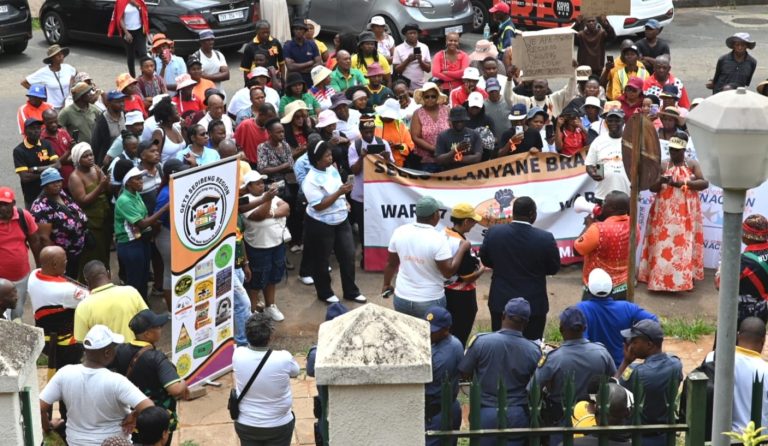
The steps of the Vanderbijlpark Magistrate’s Court became a gathering place of sorrow and outrage on Thursday as families, learners, and community members assembled during the first appearance of 22-year-old scholar transport driver Ayanda Dludla.

22-year-old scholar transport driver Ayanda Dludla. Photo Eddie Mtsweni

Dludla, charged with 14 counts of murder, three counts of attempted murder, and reckless and negligent driving, remains in custody following Monday’s devastating crash that claimed the lives of 14 schoolchildren.

ALSO READ: Vanderbijlpark crash victims to be buried in joint funeral service

He is expected to return to court on 5 March as investigations continue.

Parents outside court. Photo: Eddie Mtsweni

Outside the courthouse, the scene was heavy with grief. Parents clutched photographs of their children, some breaking down in tears while others displayed placards with messages indicating their frustration.

ALSO READ: Mkhwanazi to MPs: EMPD blue lights scandal was oversight, not corruption

The tragedy unfolded when the minibus taxi carrying learners collided with a truck.

Twelve children died at the scene, while two more succumbed to their injuries on Thursday morning.

On Wednesday, the Department of Education released the names of the deceased learners, who were pupils from schools across the Vaal area, including Hoërskool Vanderbijlpark, Vaal High School, El-Shaddai Christian School, Oakwood Primary, Vaal Triangle Primary, Oliver Lodge Primary, and Noordhoek Primary.

The community is now preparing to bid farewell to the children. A memorial service will be held on Friday at Sebokeng Hall, followed by a joint funeral service on Sunday at Saul Tsotetsi Sports Ground in Sebokeng.

ALSO READ: Mbalula moves to shut down ANC succession debate ahead of 2027 conference

The pictures outside court told a story of heartbreak and solidarity. The atmosphere was one of mourning mixed with anger, as residents demanded accountability while bracing for the painful days ahead.

INSIDE EDUCATION

Memorial today for Vanderbijlpark crash victims, funeral set for Sunday

By Charmaine Ndlela

A memorial service for the 14 learners killed in Monday’s Vanderbijlpark crash will be held at 11am on Friday at Sebokeng Hall, ahead of a joint funeral service on Sunday at Saul Tsotetsi Sports Ground in Sebokeng.

The learners died on Monday when the minibus taxi they were travelling in collided with a truck. Twelve learners died at the scene, while two succumbed to their injuries on Thursday morning.

On Wednesday, the Department of Education released the names of the deceased learners, who were pupils from several schools across the Vaal area:

Hoërskool Vanderbijlpark

  • Bokamoso Mokhobo (Grade 8)
  • Sibongile Madonsela (Grade 10)
  • Thato Moetji (Grade 12)
  • Sagwadi Mathe (Grade 12)

Vaal High School

  • Leano Moiloa (Grade 8)

El-Shaddai Christian School

  • Pheello Motaung (Grade 11)
  • Puleng Maphalla (Grade 11)
  • Naledi Motsapi (Grade 10)
  • Bohlale Lekekela (Grade 1)

Vanderbijlpark

  • Buhle Radebe (Grade 11)

Primary schools

  • Lesego Sefatsa (Grade 2), Oakwood Primary School
  • Letlotlo Katlego Makwe (Grade 2), Vaal Triangle Primary School
  • Ofentse Jayden Vinger (Grade 1), Oliver Lodge Primary School
  • Lindokuhle Mabaso (Grade 5), Noordhoek Primary School

The driver of the scholar transport taxi, 22-year-old Ayanda Dludla, appeared in the Vanderbijlpark Magistrate’s Court on Thursday. Dludla has been charged with 14 counts of murder, three counts of attempted murder, and charges including reckless and negligent driving, among other charges.

Investigations are ongoing.

Dludla remains in custody and is expected back in court on 5 March.

INSIDE EDUCATION

Dr Gladys West, mathematician who helped invent GPS, dies At 95

0

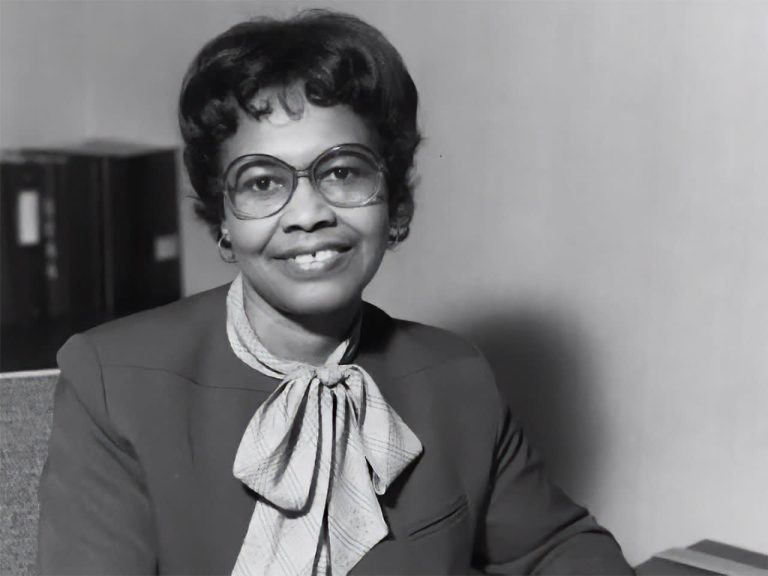
Dr. Gladys West, the mathematician whose work laid the foundation for modern GPS technology, has died at the age of 95. She passed away on January 17, 2026, reportedly surrounded by family at her home in Alexandria, Virginia.

West’s contributions underpin a technology now embedded in global commerce, aviation, emergency response, and everyday navigation, though her role went largely unrecognized until late in her life.

Born Gladys Mae Brown on October 27, 1930, in Dinwiddie County, Virginia, she grew up on a small family farm in a largely sharecropping community. Determined to chart a different path, she graduated at the top of her high school class and earned a scholarship to Virginia State College (now Virginia State University), where she completed both a bachelor’s and later a master’s degree in mathematics

After a brief period teaching, West joined the US Naval Proving Ground (later the Naval Surface Warfare Center) in Dahlgren, Virginia, in 1956, becoming only the second Black woman hired as a programmer at the base and one of just four Black employees overall. She would remain at Dahlgren for 42 years, retiring in 1998.

From the 1960s through the 1980s, West worked on complex mathematical models of the Earth’s shape using satellite data, a foundation for turning orbital measurements into precise location information. She programmed early high‑performance computers, including the IBM 7030 “Stretch,” to refine geodetic Earth models that later became a core building block of the Global Positioning System used in phones, cars, aircraft, and critical infrastructure worldwide.

In the late 1970s she served as project manager for Seasat radar altimetry data at Dahlgren, supporting the first satellite designed to remotely sense Earth’s oceans. West also contributed to an early‑1960s study on planetary motion and received formal commendations from the Navy for her technical work.

While advancing technically, West continued her education, earning a master’s degree in public administration from the University of Oklahoma via distance learning. After retiring at 68, she set her sights on a doctorate. A stroke temporarily derailed those plans, affecting her hearing, vision, balance, and mobility, but she persisted, completing her doctorate in 2000 at age 70.

Despite the scale of her impact, West’s contributions remained largely unrecognized for decades, even as her white colleagues were more visibly celebrated. In 2018, a brief biography she submitted for an event hosted by her sorority, Alpha Kappa Alpha, helped spark viral interest in her story and a wave of honors.

She was inducted into the US Air Force Space and Missiles Pioneers Hall of Fame in 2018, named Female Alumna of the Year at the HBCU Awards, listed in the BBC’s 100 Women of 2018, and received the Royal Academy of Engineering’s Prince Philip Medal in 2021. The Virginia Senate also passed a resolution commending her “trailblazing career in mathematics and vital contributions to modern technology.”

West often spoke about working under segregation and Jim Crow, supporting the Civil Rights Movement while being unable to protest publicly as a federal employee. She later noted that white co‑workers frequently received recognition and opportunities she did not, even as her calculations quietly reshaped global navigation.

In a 2020 interview with The Guardian, she admitted that she still preferred paper maps to digital navigation, even her life’s work now underpins the way billions of people move through the world.

Residents evacuated as DWS rushes engineers to Mbombela’s Senteeko Dam

0

By Levy Masiteng 

The Department of Water and Sanitation (DWS) has dispatched a team of dam safety engineers to the Senteeko Dam, in the Mbombela Local Municipality, Mpumalanga, to conduct an urgent technical assessment and monitor reported structural damage.

An evacuation alert has been issued for communities downstream of the dam.

The DWS confirmed that the dam, with a storage capacity of 1.8 million m³, is at risk of failure.

ALSO READ: Manamela urges shift from university-only mindset 

Authorities have warned that an imminent dam wall failure could potentially release the water into the Suidkaap area, posing serious risks to lives, property, and infrastructure.

Mpumalanga has been hit by persistent heavy rainfall and flooding in January, with authorities issuing repeated flood alerts and reporting damage to infrastructure and disruption to communities in parts of the province.

The DWS said areas most likely to be affected include communities in close proximity to the dam, particularly the Barberton Valley.

“Relevant communications, warnings, and evacuation processes are being implemented by the relevant authorities to ensure the safety of communities living downstream of the dam,” said DWS spokesperson Wisane Mavasa.

ALSO READ: Milnerton assault case postponed for victim consultation

To mitigate the risk, the owner of the dam is expected to start supervised excavations of a side-channel spillway.

This aims to lower the water level in the dam, reducing undercutting of the spillway channel and preventing catastrophic failure, according to the department. 

“Our assessments indicate that undercutting of the spillway channel is continuing, which poses a threat to the stability of the dam,” Mavasa said. 

“However, there is currently no overtopping of the dam wall, and no excessive seepage has been observed on the earthfill embankment.”

Wisani said that while inflows from Die Kaap River have made it difficult to significantly lower water levels, river flow observations showed a decrease since Monday. 

The Senteeko Dam, officially registered as My Own Dam, is a privately owned, 26-metre-high earthfill embankment dam with a concrete spillway, which is owned by the Shamile Communal Property Association (CPA). 

The dam is primarily used for irrigation purposes.

ALSO READ: Universities hold the key to early learning turnaround, Manamela tells Lekgotla

Mavasa said that the dam’s safety remains a national priority and has told communities to comply with evacuation instructions, avoid low-water bridges, and stay away from rivers and flood-prone areas.

“We also urge members of the public to share verified information responsibly and to follow guidance issued by authorities on the ground.”

INSIDE EDUCATION