Home Blog Page 289

DBE, Umalusi reiterates that no matric learner can pass with a 30% overall rate

QUALITY assurance council, Umalusi, on Tuesday reiterated that no learner in South Africa will be able to pass their matric by obtaining 30% in all subjects.

This after One SA Movement leader Mmusi Maimane recently questioned the quality of education being offered in South Africa and called for an end to the 30% pass mark.

“A 30% pass mark undermines the intellect of SA’s youth and allows for obfuscation of the basic education crisis, education leaders to escape accountabilities and the entrenchment of mediocrity and low expectations,” Maimane said.

The Department of Basic Education and Umalusi said this week that this was not true.

“Pass rates at this level are as old as the matric certificate itself, which is more than 100 years old. If learners were to obtain 30% in all subjects, they would fail. We have to remind each other what the purpose of the National Senior Certificate is. The National Senior Certificate gives learners access to a number of post-school opportunities,” said Umalusi CEO Mafu Rakometsi.

Basic education minister Angie Motshekga has responded to the ongoing public debate on the matric pass mark, dismissing claims it is 30%.

The minister said the debate and claims made about the pass mark demonstrated a lack of understanding about the NSC pass requirements.

The requirements are split into three categories which qualify pupils either for bachelor’s degree or diploma studies and the higher certificate pass.

  • To obtain a bachelor pass, explained the minister, pupils are required to get a minimum of 40% for their home language, 50% in four other subjects and at least 30% for the language of learning. 
  • For a diploma pass, pupils must obtain 40% for their home language, at least 40% in three other subjects and a minimum of 30% in the language of learning. 
  • For a higher certificate pass, the home language pass mark remains 40%, at least 30% in the language of learning and at least 40% in two subjects and a minimum of 30% in other subjects 

All pupils are required to pass six of the seven subjects regardless of whether they obtain a bachelor, diploma or a higher certificate pass.  

The minister reiterated that 30% is a minimum requirement for a single subject and not an aggregate pass mark for all grade 12 subjects. 

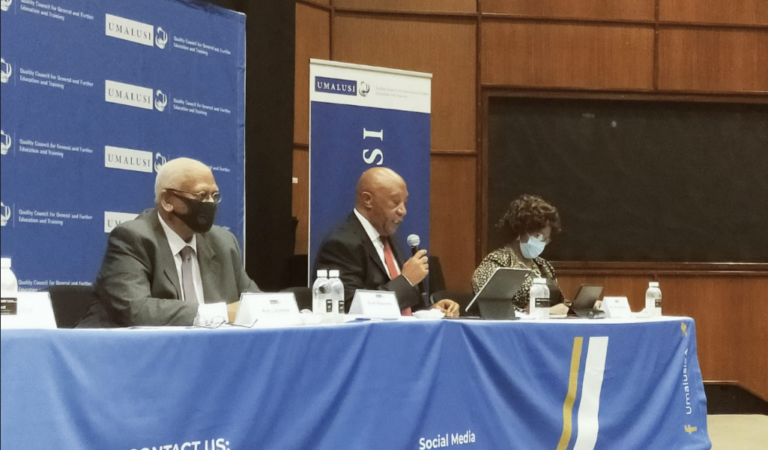
Umalusi approves the release of 2021 national examination results

UMALUSI, the Quality Council in General and Further Education and Training, has approved the release of the 2021 national examination results, but has requested the Department of Basic Education (DBE) to block the results of candidates implicated in irregularities pending investigation.

Those included in irregularities are candidates involved in group copying and those who had early access to question papers.

During a media briefing on Tuesday, the Quality assurer said it has picked up a new trend in a few sectors in KwaZulu-Natal and Gauteng where learners were given early access to question papers a few hours before they write.

Professor John Volmink, Chair of the Umalusi Council, said that the executive committee of Umalusi noted that apart from some examination irregularities identified during the writing and marking of the examinations, there were no systemic irregularities reported that might have compromised the credibility and integrity of the November 2021 National Senior Certificate (NSC) examinations administered by the DBE.

“The Executive Committee of Council approves the release of the DBE November 2021 NSC examination results based on available evidence that the examinations were administered largely in accordance with the examination policies and regulations,” Volmink said.

“In respect of identified irregularities, the DBE is required to block the results of candidates implicated in irregularities, including the candidates involved in group copying, pending the outcomes of further DBE investigations and Umalusi verification. In the cases where candidates had unauthorised access to question papers, the results of the implicated candidates should be blocked pending further DBE investigations and Umalusi verification,” he said.

Pay attention to matters of non-compliance

Umalusi has required the DBE to address the directives for compliance and improvement highlighted in the Quality Assurance of Assessment report. The department has until 15 March 2022 to develop and submit an improvement plan to Umalusi.

“Particular attention should be paid to recurring matters of non-compliance. The Executive Committee of Council commends the DBE for conducting a successful examination despite the challenges presented by COVID-19,” the Umalusi Chair said.

Umalusi noted incidents of unauthorised and early access to question papers detected at some of the examination centres in KwaZulu-Natal and Gauteng.

“Specifically, Life Sciences and Agricultural Sciences papers were the affected subjects in those centres. This practice can potentially compromise the integrity of examinations if it is not addressed decisively,” the Umalusi Chair said.

Once again, Umalusi has appealed to all stakeholders involved in the examination process to refrain from engaging in such unscrupulous acts of dishonesty.

“In the meantime, the results of implicated learners will be blocked, pending further investigations by the DBE and verification by Umalusi. It is also worth noting that there are severe consequences for those found guilty of such criminal activities, regardless of whether they are learners, teachers or officials.

“Similarly, isolated incidents of group copying continue to plague the national examination system. These malpractices do not augur well for our examination system and the education system in general,” Volmink said.

  • * SA News

Gauteng High Court rules that South Africa’s matric results should be published publicly

THE North Gauteng High Court has ruled that the Department of Basic Education should continue to publish the matric results publicly on media platforms and newspapers.

The ruling comes after the Department of Basic Education said in an 11 January statement that matric exam results will no longer be published on media platforms, in line with the recently introduced Protection of Personal Information Act (POPIA).

“In order to comply with the provisions of the POPIA, the usual practice of publishing the National Senior Certificate (NSC) results on public platforms (media platforms) will not occur for 2021,” it said.

“As was also the practice in previous years, all learners will be required to obtain their statement of results from the schools they attended. In this way, every learner’s personal information with regards to the outcome of their National Senior Certificate exam will be protected.”

The decision was challenged by civil society group AfriForum, Maroela Media and Anlé Spies (a 2021 matriculant) who argued that matric students who do not live close to their respective schools would be prejudiced by the decision.

Spies, who sat her exams in Pretoria but lives in Gqeberha, argued that it is critically important that she receive her results as quickly as possible so that she can prepare for the start of her university career. She said that there are several learners who moved or relocated to addresses far away from the schools where they sat their matric exams.

On Tuesday, Basic education department said it has noted the Pretoria High Court ruling and will abide by the ruling.

“This means that the Department will make available the results to stakeholders who requested access. The conditions of the court ruling must be taken into account in line with the provisions of the Protection of Personal Information Act 4 of 2013,” the department said.

“In addition to accessing results from media platforms, the Department also urges candidates to register on the website to view the results when they become available. Candidates will have to go through a two-step verification process before receiving confirmation of their registration.”

A 13-digit ID number and Exam Number will be required for registration.

The DBE website is zero-rated, which means it can be accessed whether you have data or not.

Registration is now open! By lunch time more than 10,000 people had successfully registered.

  • * Inside Education

Department of Basic Education to Abide By Court Decision Regarding Publishing of NSC Results

THE case against the publication of South Africa’s matric marks is expected to be heard in court this week after the Department of Basic Education announced the marks will not be made publically available due to regulatory concerns.

The urgent application will be heard in the North Gauteng High Court in Pretoria on 18 January before the matric results are made available on 20 January 2022.

The department has said that it will not oppose the urgent application and will abide by the decision of the court.

In a statement on Tuesday, the Department of Basic Education said that matric exam results will no longer be published on media platforms, in line with the recently introduced Protection of Personal Information Act (POPIA).

The department said that publishing personal information online would be a contravention of the Act. It confirmed that matric results are still scheduled to release on 21 January 2022 and that results would still be available from schools. Historically, the matric results have been made widely available with students identified through their ID numbers or exam numbers.

“In order to comply with the provisions of the POPIA, the usual practice of publishing the National Senior Certificate (NSC) results on public platforms (media platforms) will not occur for 2021,” it said.

“As was also the practice in previous years, all learners will be required to obtain their statement of results from the schools they attended. In this way, every learner’s personal information with regards to the outcome of their National Senior Certificate exam will be protected.”

Civil society group AfriForum, Maroela Media and Anlé Spies (a 2021 matriculant) served court papers on Friday to oppose the Department of Basic Education’s sudden decision not to publish the 2021 matric results in the media on an urgent basis in court.

Spies, who sat her exams in Pretoria but lives in Gqeberha, is arguing that it is critically important that she receive her results as quickly as possible so that she can prepare for the start of her university career. She argues that there are several learners who moved or relocated to addresses far away from the schools where they sat their matric exams.

The department has communicated its position to stakeholders it has engaged including SANEF and other parties.

“Meanwhile the Department urges candidates to register on the DBE website to view their results when they become available. Candidates will have to go through a two-step verification process before receiving confirmation of their registration. A 13-digit ID number and the examination number will be required for registration,” the department said.

The DBE website is zero-rated, which means learners can access it whether they have data or not.

The department said that more than 10 000 people had successfully registered by noon on Sunday.

Matric results are expected to be released on 21 January.

  • Inside Education

Back to school| Schools in coastal provinces set to reopen for 2022 academic year on Wednesday

WENDY MOTHATA|

SCHOOLS in coastal provinces such as KwaZulu-Natal, Eastern Cape, Northern Cape and Western Cape are set to open on Wednesday.

This after learners in inland provinces returned to school last week on Wednesday.

The Department of Basic Education announced that this year schools will follow a staggered calendar.

Basic Education Spokesperson Elijah Mhlanga said: “This time we believe that we’ll be able to start in time and be able to cover the entire work that’s in the curriculum schedule for this year.”

On the other hand, the Government Communication and Information System (GCIS) said that the government is committed to every learner receiving the best possible education.

“We call on families to assist learners by providing support systems. It is essential that we encourage learners and instil in them the importance of education,” GCIS said in a statement.

With two days before schools in coastal provinces reopen, parents in Kwa-Zulu Natal are concerned about the readiness of schools as some of the schools in the province were recently damaged by the storms.

The parents say they are concerned about the number of schools that have been damaged by the storms.

The mother of a Grade 3 learner in KwaZulu-Natal, Phila Mkhize has urged the government to act with urgency in making sure that the children are back at school.

Mkhize said, “I’m very concerned about the affected schools. This may delay our children. Some of the schools affected by the storms are unusable. The government must act with urgency to make sure that our children are back at school.”

The KZN Education Department said that they have started with processes to assist the affected schools.

With all the concerns from parents, KwaZulu-Natal Education MEC Kwazi Mshengu said that the department is ready to begin the academic year.

Mshengu said on Monday some of the teachers were welcomed at schools to prepare for the return of pupils.

Mshengu said a total of 191 schools were affected by the KZN storms and they are receiving immediate attention.

“Those schools that were damaged (191) are receiving immediate attention through the deployment of mobile classrooms as the substitute to the classrooms that are damaged,” he said.

However, the minister said some schools did not open on Monday to avoid risking the lives of educators. He added that re-opening may be affected by the weather conditions.

“KZN schools are ready to welcome learners on Wednesday. All the schools welcomed the educators today. However, 39 schools under uThukela District which we instructed not to open to avoid risking the lives of educators as there was flooding today. The only thing that will stand on our way to re-open all schools is the weather conditions,” he said.

The MEC further said that the rotation system will ease the pressure, “The rotation system will ease the pressure to an extent that even schools that would not have received mobile classrooms by Wednesday will re-open.”

He emphasized that grades 12 and 11 in particular, will use the classrooms that were not damaged.

Meanwhile, Western Cape Education spokesperson Bronagh Hammond said that the department is striving, by all means, to ensure that all pupils are placed in a school for the 2022 academic year.

This is after the department struggles to place some of the pupils who are not registered for the academic year.

  • * Inside Education

Government opens registration to access matric results online

SIMNIKIWE MZEKANDABA

THE Department of Basic Education (DBE) has urged matric learners to register on its website to view their results when they come out on 21 January.

Previously, scores of matric learners would find out their examination results on various public media platforms, most notably newspapers.

However, last week the DBE announced it would ceaseto publish matric exam results on any media public platforms, in order to comply with the prescripts of the Protection of Personal Information Act (POPIA), a decision that’s received mixed reaction from the public.

In a statement issued on Sunday, the department urged learners that wrote the 2021 National Senior Certificate (NSC) exams to register online to access their examination results.

It states: “Candidates will have to go through a two-step verification process before receiving confirmation of their registration. A 13-digit ID number and the examination number will be required for registration.

“The DBE website is zero-rated, which means it can be accessed whether you have data or not.”

It noted that registration is now open.

According to the department charged with SA’s basic education, more than 10 000 people had successfully registered on the site by lunch time on Sunday (16 January).

In the statement, the DBE also reveals it’s received representations from a vast array of organisations and individuals following the decision to stop the practice of publishing the NSC examination results. In addition, there is an urgent court application on the matter, it states.

Eyewitness News reports that lobby group AfriForum, Maroela Media and Anlé Spies, a 2021 matriculant, brought the court application on the matter.

Furthermore, the South African National Editors Forum (SANEF) has decried the department’s decision, saying it’s not only unfortunate, but also came as a surprise, as there was no prior warning or consultation with media houses.

SANEF goes on to say the decision has negative financial implications for media companies – which had already, for instance, procured additional printing paper and created the architecture for data sets to be able to publish the results in print and digital form.

The DBE explains: “In handling the matter, the department is guided by the need to comply with all the legal obligations, but in the final analysis, the Constitution commands the DBE to act in the best interest of the learner.

“In a quest to strike this delicate balance of complying with POPIA and act in the best interest of the learner, the department has been engaged with a number of role players, including the Information Regulator and SANEF.

“In view of the latest developments with regards to the release of the 2021 matric results and the impending litigation, the department has decided it will abide by the decision of the court. The department has communicated its position to stakeholders it has engaged, including SANEF and other parties.”

Following news of the DBE’s decision, the Information Regulator sought to clarify how POPIA impacts the publishing of matric results.

The Information Regulator is empowered to monitor and enforce compliance by public and private bodies with the provisions of South Africa’s data privacy law, POPIA.

Speaking on SABC’s SAfm, Information Regulator chairperson advocate Pansy Tlakula said the DBE has a legitimate reason for publishing matric results through various media platforms in order to make those results accessible.

However, if it decides to do that, it must ensure it complies with POPIA. The media platforms must also ensure they comply with the Act, she explained.

“This requires training in advance; it’s not something that they can do two weeks before publishing those results. For instance, the planning will require them to decide which personal information they share with the media – is it necessary to share ID numbers of learners with the media that, in my view, constitutes over-processing of personal information.

“If they want to disseminate the results through media platforms, they must inform all the learners and all the parents of their intention to make matric results available in various media platforms. They must inform them on which media platforms those results will be made available and how the results can be accessed.

“In addition, the department must give the learners and the parents the right to object to the publication of their results in the media and the objections should be considered before publishing the results.”

  • * ITweb

Free State education department closes QwaQwa schools amid heavy floods

THE Free State education department has suspended schooling in Qwaqwa due to heavy floods.

The downpours have damaged a large part of Qwaqwa, limiting the movements of residents, including learners and teachers.

According to the spokesperson for the Education Department, Howard Ndaba, MEC Tate Makgoe, together with other stakeholders, will on Monday assess the situation and accordingly advise schools in Qwaqwa whether they will continue with the suspension.

The department says it took this decision to protect pupils, teachers, and non-teaching personnel at schools.

The department further urges learners, teachers, and parents to exercise extreme caution during these devastating floods.

Makgoe, said together with other stakeholders, they will on Monday assess the situation and accordingly advise schools in QwaQwa whether the suspension of schooling will continue or not.

“We are painstakingly taking this decision to protect our learners, teachers and non-teaching personnel in our school,” Makgoe said.

The department conveyed condolences to the family and friends of those who have lost their lives due to this tragedy.

In urging learners, teachers and parents to exercise caution, the department has called on them to stay indoors in case of heavy rain and stormy weather.

Those living in low lying areas, which often experience flooding, are also urged to take extra caution and never try to walk, swim or drive through fast-moving flood water.

“If they must travel by car, they must try to identify alternative routes that are not exposed to flooding. Avoid cross flooded areas. It’s best to stop, turn around and go another way. Teachers who are driving should never attempt to cross flooded low water bridges,” the department said.

People are also urged to watch for washed out roads, earth slides, and fallen trees or power lines.

The department has encouraged parents and teachers to help in emphasising these precautionary measures at home and at school.

Spectators Allowed Back At School Sporting Events – Motshekga

CO-OPERATIVE governance and traditional affairs minister Dr Nkosazana Dlamini-Zuma has extended the country’s national state of disaster by another month. 

Dlamini-Zuma signed an extension, published in the government gazette on Friday, until February 2022 as the country remains under adjusted level 1 of the national lockdown. 

March will mark two years since SA was first put into a state of national disaster when the first positive Covid-19 case was detected in KwaZulu-Natal.

In a second government gazette published on Friday, basic education minister Angie Motshekga announced that spectators would be allowed to attend school sports events. 

“Spectators at the venue of a sport event are permitted and the number of people permitted at a venue at any time is limited to the number as prescribed under the regulations in respect of gatherings for the particular adjusted alert level at the time.”

Under level 1 regulations, gatherings are restricted to no more than 1,000 people indoors and no more than 2,000 people outdoors. 

“If a venue is too small to hold the prescribed number of people, observing a distance of at least 1.5m from each other, then not more than 50% of the capacity of the venue may be used, subject to strict adherence to all health protocols and social distancing measures,” the amendment to the regulations read.

She said, “Parents were quite at pains that when there are sporting activities, they drop their kids they can’t really be spectators or only one parent is allowed so again we’ve had to look at that to allow parents to be part of their children’s development growth and also be able to be spectators in the sporting activities which are permissible”.

Minister Motshekga explained that the regulations that will govern attendance at school sport and cultural events fall below the general rules for attendance at gatherings

The last regulations around the attendance of spectators at events were published in December 2021.

Here are the rules regarding the attendance of sporting events. 

  • Indoor sports venues can have a maximum of 750 people in attendance;
  • Outdoor sports venues can have a maximum of 2,000 people in attendance;
  • If a venue is too small to accommodate these maximum limits, the limit is at 50% of that venue’s capacity.

Every person attending a venue where a sport or cultural activity is taking place must…

Every person, when attending a gathering and in order to limit exposure to COVID-19 must-

(a) wear a face mask;

(b) adhere to all health protocols;

(c) maintain a distance of at least one and a half metres from each other;

An owner or operator of a sporting facility or an organiser of a sporting event must ensure compliance with the limitation on the number of persons attending such a gathering contemplated in sub regulation (10)(b).

If the owner of a sporting felicity or the organiser of the event does not comply with the regulations and are found to have committed an offense, they may be liable for a fine or a prison sentence not exceeding six months. 

If an enforcement office, who is in charge of monitoring Covid-19 compliance at an event, see’s non-compliance he or she may order people to disperse from the venue.

If the person refuses, they can be fined or jailed. 

Artificial intelligence is getting better at writing, and universities should worry about plagiarism

MICHAEL MUNDZAK and SARAH ELAINE EATON

THE dramatic rise of online learning during the COVID-19 pandemic has spotlit concerns about the role of technology in exam surveillance — and also in student cheating.

Some universities have reported more cheating during the pandemic, and such concerns are unfolding in a climate where technologies that allow for the automation of writing continue to improve.

Over the past two years, the ability of artificial intelligence to generate writing has leapt forward significantly, particularly with the development of what’s known as the language generator GPT-3. With this, companies such as Google, Microsoft and NVIDIA can now produce “human-like” text.

AI-generated writing has raised the stakes of how universities and schools will gauge what constitutes academic misconduct, such as plagiarism. As scholars with an interest in academic integrity and the intersections of work, society and educators’ labour, we believe that educators and parents should be, at the very least, paying close attention to these significant developments.

AI & academic writing

The use of technology in academic writing is already widespread. For example, many universities already use text-based plagiarism detectors like Turnitin, while students might use Grammarly, a cloud-based writing assistant. Examples of writing support include automatic text generation, extraction, prediction, mining, form-filling, paraphrasing, translation and transcription.

Advancements in AI technology have led to new tools, products and services being offered to writers to improve content and efficiency. As these improve, soon entire articles or essays might be generated and written entirely by artificial intelligence. In schools, the implications of such developments will undoubtedly shape the future of learning, writing and teaching.

Misconduct concerns already widespread

Research has revealed that concerns over academic misconduct are already widespread across institutions higher education in Canada and internationally.

In Canada, there is little data regarding the rates of misconduct. Research published in 2006 based on data from mostly undergraduate students at 11 higher education institutions found 53 per cent reported having engaged in one or more instances of serious cheating on written work, which was defined as copying material without footnoting, copying material almost word for word, submitting work done by someone else, fabricating or falsifying a bibliography, submitting a paper they either bought or got from someone else for free.

Academic misconduct is in all likelihood under-reported across Canadian higher education institutions.

There are different types of violations of academic integrity, including plagiarism, contract cheating (where students hire other people to write their papers) and exam cheating, among others.

Unfortunately, with technology, students can use their ingenuity and entrepreneurialism to cheat. These concerns are also applicable to faculty members, academics and writers in other fields, bringing new concerns surrounding academic integrity and AI such as:

  • If a piece of writing was 49 per cent written by AI, with the remaining 51 per cent written by a human, is this considered original work?
  • What if an essay was 100 per cent written by AI, but a student did some of the coding themselves?
  • What qualifies as “AI assistance” as opposed to “academic cheating”?
  • Do the same rules apply to students as they would to academics and researchers?

We are asking these questions in our own research, and we know that in the face of all this, educators will be required to consider how writing can be effectively assessed or evaluated as these technologies improve.

Augmenting or diminishing integrity?

At the moment, little guidance, policy or oversight is available regarding technology, AI and academic integrity for teachers and educational leaders.

Over the past year, COVID-19 has pushed more students towards online learning — a sphere where teachers may become less familiar with their own students and thus, potentially, their writing.

While it remains impossible to predict the future of these technologies and their implications in education, we can attempt to discern some of the larger trends and trajectories that will impact teaching, learning and research.

Technology & automation in education

A key concern moving forward is the apparent movement towards the increased automation of education where educational technology companies offer commodities such as writing tools as proposed solutions for the various “problems” within education.

An example of this is automated assessment of student work, such as automated grading of student writing. Numerous commercial products already exist for automated grading, though the ethics of these technologies are yet to be fully explored by scholars and educators.

Overall, the traditional landscape surrounding academic integrity and authorship is being rapidly reshaped by technological developments. Such technological developments also spark concerns about a shift of professional control away from educators and ever-increasing new expectations of digital literacy in precarious working environments.

These complexities, concerns and questions will require further thought and discussion. Educational stakeholders at all levels will be required to respond and rethink definitions as well as values surrounding plagiarism, originality, academic ethics and academic labour in the very near future.

The authors would like to sincerely thank Ryan Morrison, from George Brown College, who provided significant expertise, advice and assistance with the development of this article.

What a STEM E-Learning Platform Can Offer Your Child

THE importance of STEM education is in no doubt. Science, technology (including coding), engineering and math skills are vital for our future workforce and any child who excels in one or more of these areas has a bright future.

If your child has a particular interest in STEM subjects or shows signs of special abilities or talents in them, you may be looking for additional activities outside of school to help nurture their skills.

You may also be looking for classes if you are concerned about your child’s progress in any of the STEM areas.

What are your options? There are summer camps and after school programs offered by specialist providers for a start. Your child’s school may offer extracurricular programs, too. A further option is one that your child can do from home whenever it is convenient.

It’s the use of a STEM e-learning platform.

This option offers your child a flexible, personalized course and access to specialist teaching without needing to leave your home.

How a good e-learning platform should work

A child’s experience of e-learning should begin with diagnostic testing. Capturing where a child’s strengths and weaknesses lie means that all online lessons can be pitched to best maximize progress from the get-go.

Diagnostic testing will follow the same format as ongoing assessments throughout the course. It will be fun, interactive and engaging. Data from regular assessments throughout your child’s e-learning course can demonstrate how much and where they are making progress from beginning to end.

This data-driven approach improves the instruction your child will receive because it helps your child’s teacher choose the correct pathway through the learning content for your child.

On a good e-learning platform, your child’s assessment data should be easily visible to you, meaning you can keep an eye on their progress, too.

As for the activities your child will engage in, these will include learning videos, presentations and multiple styles of interactive activities for your child to build and strengthen new skills.

Your child will learn from completing online worksheets that give immediate feedback, and through games and quizzes.

Your child can also meet their teacher online and have the opportunity for direct teaching and discussion with them.

The whole system of instruction, activity and assessment should appear on a friendly, attractive interface that’s appealing to children.

The advantages of an e-learning platform

Here are four of the most significant advantages of this style of learning.

Engagement

All parents know that children are naturally drawn to screens. They love almost any kind of online game and would happily spend hours immersed in technology. Why not put this to good use?

E-learning platforms leverage the enjoyment that children get from electronic games and activities by combining it with powerful teaching and learning opportunities.

Engaging video content and gamification of learning are common features of good learning platforms. Your child is guaranteed to enjoy learning this way.

Personalization

You can pick exactly what you would like your child to learn. You’ll find many of the course options on a good platform are relatively specific.

So instead of ‘computing’, you’ll find courses on app development or coding, for example. It means your child can follow a particular interest or work on something they need special help in.

It could also mean that they get more experience of something they’ve only touched on briefly at school.

The other way these are tailored to the individual child is through the exact course content.

As mentioned earlier, a robust system of regular micro assessment means that your child’s learning can be personalized to suit their progress throughout the course. Two children on the same course won’t necessarily follow the same program of study for this reason.

Accessibility and flexibility

Your child can access their additional STEM learning whenever it is a good time. All they will need is an appropriate electronic device and a stable internet connection. Many students choose to access their e-learning platforms regularly after school or on weekends.

However, the possibilities are endless. They could use a long journey or time spent waiting for an appointment to get stuck into some bitesize learning.

The great thing about e-learning is that it is far easier to fit into a busy schedule than any in-person class or activity. You can easily add extra-curricular STEM learning to your child’s other out-of-school interests like sports and music.

Success

Good e-learning platforms have proven track records of success. This comes from all the points above: personalization, high levels of student engagement and the flexibility of the courses are a winning formula.

e-Learning Industry cited a study by Brandon Hall Group Research that showed students retain up to 5 times more knowledge from an e-learning course compared to in-person teaching. They attribute this to the bitesize nature of the content on e-learning platforms.

5 exciting STEM courses your child can take on an e-learning platform

Coding

Your child can learn C#, HTML/CSS, Java, Python and Scratch. They could be a beginner or learn at an advanced level. Their course would be suited to their grade level and tweaked using diagnostic and regular assessment. Children are encouraged to use their preferred system to solve challenging real-world problems.

Game development

Game development e-learning courses are naturally popular with children and young people. They can use their creativity to build and test exciting gameplay.

3D designing

This practical e-learning course will also appeal to your child’s creative side. They can learn how to design meaningful 3D objects using relevant software.

Arduino

Arduino is a program that helps students develop skills in electronics. They can create circuits, from beginner level to advanced. They can go on to create exciting things like home automation and wearable devices. This will demonstrate the real-world value of their new skills.

AI-aware app development

Students can learn app development alongside AI and create fully-fledged, downloadable apps with a real-life purpose.

The rise of e-learning has opened some doors into the exciting world of STEM.

These subjects are more accessible and more engaging than ever before for students of all ages. You can ignite a lifelong love of STEM in your child and help them develop skills for their future career.

Why not explore the many exciting e-learning options available further?

  • * elearninginside.com