Home Blog Page 321

Panyaza Lesufi cleared in R30 million tender fraud

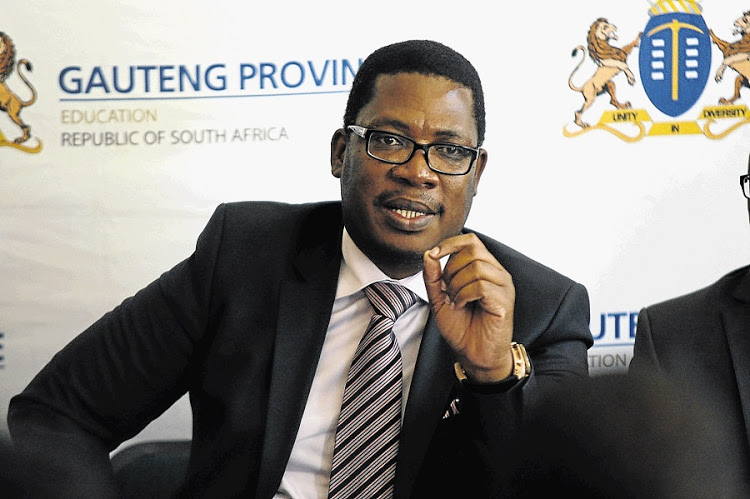
Gauteng Education MEC Panyaza Lesufi was cleared in the controversial R30 million tender that was reported he influenced in 2020.

This was said by Deputy Public Protector Kholeka Gcaleka on Wednesday during a media briefing on the release of 16 investigative reports.

Gcaleka said even though the contract was irregularly awarded, they found nothing wrong with how Lesufi awarded the tender.

Gcaleka said the allegations that Lesufi unduly influenced the award the R30 million tender to IN2IT was “found to be unsubstantiated”.

“There is no evidence indicating that Lesufi was involved in any procurement process of the SOC [Security Operations Centre] tender or that he disregarded the provisions of the code of conduct for members of the provincial executive council.”

“The investigation revealed that e-Gov advertised and awarded the SOC tender to IN2IT without following proper procurement processes and this constituted improper conduct and maladministration,” said Gcaleka .

Adding that those responsible for awarding the tender should be subjected to disciplinary action.

READ: SIU freezes accounts of decontamination companies contracted by GDE

“The provincial MEC of finance and e-government must ensure that Cyril Baloyi, the departmental head, conducts training in respect of all the executive officials of e-gov and officials involved in supply chain processes. This must happen within 30 working days of the report.

“Baloyi must also institute disciplinary steps against Mr Muthivhi for advising IN2IT of the tender award before a letter of appointment was issued and the contract signed by e-gov and IT2IT and against Ms Koyana for failing to follow supply chain processes in that she evaluated only two request for quotations on her own, outside the prescribed supply-chain management policy,” said Gcaleka.

In response Lesufi said: “I just hope those who insulted me and even laid a criminal case with the police will do the honourable thing”.

Lesufi was accused by Anton Alberts of the Freedom Front Plus of influencing the awarding of a tender to IN2IT Technologies.

The complaint was laid back in 2020 when the Gauteng finance and e-government department irregularly awarded a contract to IN2IT Technologies.

Lesufi did not come out unscathed from this matter with some saying there is no way he cannot know of a R30 million tender from his department, as well as the R431 million tender current under investigation by the country’s Special Investigating Unit (SIU).

The department has been under fire since earlier investigations revealed that it had spent R431 million on decontaminating schools between June and August last year.

That investigation further established that there was no need to decontaminate the schools as they were not occupied for months because learners were at home during the hard lockdown. 

The SIU has said that the seven companies were irregularly appointed along with over 200 others. 

To this the MEC said, “Let us wait for the SIU report”.

READ: SIU freezes more bank accounts of companies linked to the GP department of education tender for sanitizing schools

Gauteng Education Department launches a new vaccination site

NYAKALLO TEFU|

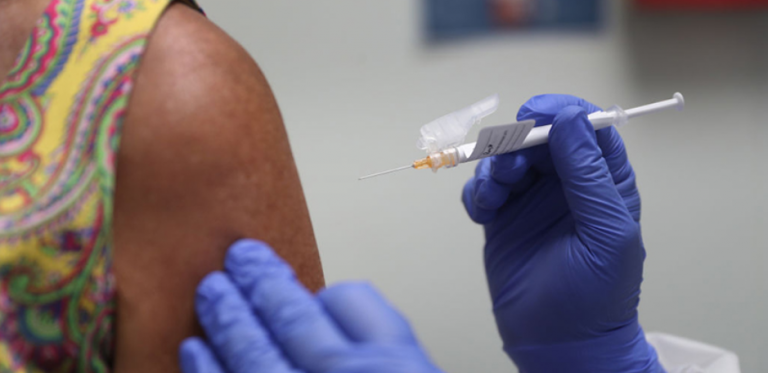
The Gauteng department of education (GDE), together with Discovery, launched a new vaccination site in Gallagher Estate in Midrand, Johannesburg on Wednesday.

The new site is established as part of efforts to get educators across the country vaccinated.  

In an effort to improve the vaccination of educators, the Gauteng Department of Education has partnered with Discovery to launch a new site, we hope to vaccinate more of our teachers, said GDE spokesperson Steve Mabona.

Mabona said they those scheduled to come to the Midrand vaccination site are urged to do so in order to fast track the process.

“Today, the end of June is the end of term 2 and we want to make sure that by the beginning of the new term we are done with this process,” said the provincial spokesperson.

READ: BREAKING: Schools to shut down from Wednesday

The department of basic education launched its vaccine rollout drive last week, aiming to vaccinate over 500 000 teachers and non-teaching staff across the country.

The drive started a few days before President Cyril Ramaphosa announced the compulsory closing of schools in South Africa as the country faces increasing infections of the deadly Covid-19 delta variant.

According to the World Health Organization, the Delta variant  – which originates from India – has been identified as the superior variant. This is because it spreads more rapidly and is reported to be much deadlier.

Ramaphosa on Sunday also announced that to deal with the spread of the virus, the country will have to be moved to alert level 4.

However, it is not all bad. On Monday, Minister of Basic Education Angie Motshekga announced that over 200 000 educators have been vaccinated across all 9 provinces.

READ: 200 000 educators and staff vaccinated so far

The minister said the vaccination of all teachers and non-teaching staff is set to end on 9 July.

Gauteng has over 60 sites where teachers and staff can get their Covid-19 jab.

Head of Gauteng Education Department Edward Mosuwe said they are excited that today they started a new vaccination site.

“We will vaccinate over 4000 teachers and non-teaching staff today and another 4000 tomorrow. On Friday, we will vaccinate another 4000 [at the new site alone],” said Mosuwe.

Adding that all teachers need to take advantage of this opportunity as this is an opportunity of them to be safe.

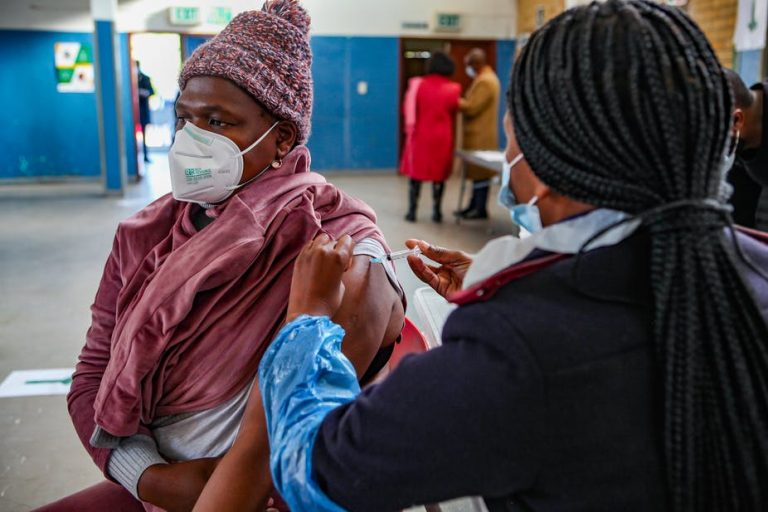
Anna Matsheni, a teacher who got their vaccine jab today at the new site today, said the morning started off really slow but everything was going according to plan.

“I got vaccinated today. I am not feeling some of the side effects people said I would get which include being dizzy. I am okay,” said Matsheni.

Arina Ace, another teacher who was vaccinated at the same site, said she was very afraid when she came for her vaccination.

“I am very impressed with how well organized the whole process was, I came here to vaccinate because I want to be part of the solution to the pandemic,” said Ace.

DBE Minister Motshekga is currently on a nation-wide vaccine drive campaign. On Monday she was in the Free State where she announced the updated date for shutting down schools. Motshekga visited the Northern Cape on Tuesday and her next stop wil be at the Eastern Cape.

READ: DBE Covid-19 provincial vaccine rollout campaign

DBE Covid-19 provincial vaccine rollout campaign

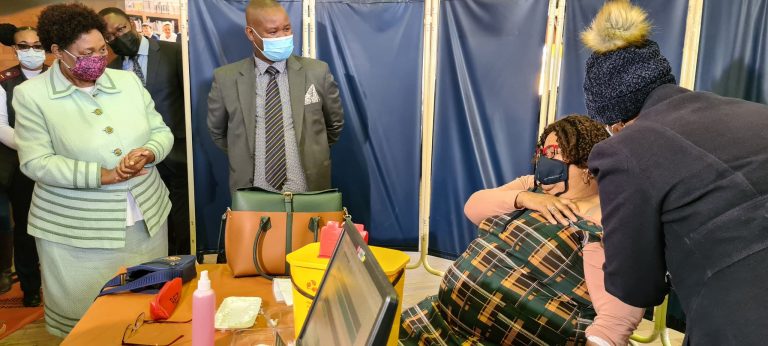
Minister of Basic Education Angie Motshekga was in the Northern Cape on Tuesday to monitor the vaccine rollout programme under the campaign, “Drop all and vaccinate!”.

The minister, together with the MEC for Education Zolile Monakali in the province visited the Warrenton Primary School vaccination site.

Motshekga encouraged all educators and support staff at schools to make use of this opportunity to vaccinate.

She said this will contribute immensely to create a safe and stable environment in our school.

The Northern Cape was one of the provinces that recorded one of the highest increases of Covid-19 infections at the schools.

Earlier this month, Monakali said the department recorded 264 new positive Covid-19 cases, which included educators, learners and support staff at schools in one week alone.

READ: The Northern Cape sees sharp increases in Covid-19 infections in schools

“These statistics are very concerning as they lead to the sporadic closure and reopening of schools, thus having a negative impact of valuable learning and teaching time,” he said at the time.

May saw the province close 79 schools for disinfection in the province.

Monakali said schools were observing all protocols in the province.

“There is social distancing. The schools have been disinfected and we all wear masks. The challenge that we are facing is that learners, educators and the support staff come from communities where big events are attended.

“They attend super spreader events and when they come to school, they infect and spread the virus,” he said.

During her campaign in the province, Motshekga made an appeal to teachers to use the vaccination drive programme to vaccinate.

“Many, many others want this opportunity that has been given [to educators]. It has been given to us. It is good for us, it is good for our learners and it is also good for communities,” said Motshekga.

She added: “We have to strive to make our environments safe places so that we don’t infect our learners.”

Motshekga said the education sector has lost a number of teachers to the pandemic, “we don’t want to lose any more,” she said.

“Despite the fact that the vaccine does not prevent you from being infected, it does reduce the risk of sickness in health. So it does some amount of protection, so it is worth it,” she said.

READ: Nine schools in the Northern Cape expected to reopen following Covid-19 cases

South Africa’s latest Covid-19 lockdown puts spotlight back on vaccination failures

SHABIR MADHI

South Africa is in the grip of another resurgence of COVID-19. Gauteng province, the country’s economic hub, where 25% of the population live, is the epicentre. But infection rates are expected to rise in other major provinces as well.

To ease pressure on the health system and slow the rate of transmission, President Cyril Ramaphosa recently announced tighter lockdown restrictions. Shabir Madhi is the director of the South African Medical Research Council Vaccines and Infectious Diseases Analytics Research Unit and co-founder and co-director of the African Leadership Initiative for Vaccinology Expertise at the University of the Witwatersrand. He sheds some light on South Africa’s situation.

How bad is the situation?

Based on the limited sequencing that’s been done, it appears that the Delta variant has emerged as the dominant variant in the latest resurgence. According to the latest research, it is much more transmissible and possibly also more virulent compared to previous variants.

The previous Covid-19 resurgence, which peaked in January 2021, was dominated by the Beta variant.

The current resurgence in South Africa differs by province, and even within a particular province. Gauteng, the country’s economic hub and one of nine provinces, is probably two to three weeks ahead of what will likely be experienced particularly in the Western Cape, Eastern Cape and Kwazulu Natal provinces.

In Gauteng the data show that the daily rate of Covid-19 infections in the current wave is two and a half times higher than at the peak of the first or second wave. Unfortunately, President Cyril Ramaphosa’s announcement on Sunday of stricter lockdown measures is unlikely to stop the trend.

We are likely to see many more Covid-19 cases being hospitalised as well as people dying from COVID-19 in the next two to three weeks in Gauteng. This is because severe disease usually lags behind infections in the community by about two to three weeks.

But, looking at the trajectory of the outbreak in India, we can expect the number of cases to start gradually decreasing after that.

To a large extent it depends on whether people adhere to the regulations, particularly avoiding indoor gatherings in poorly ventilated spaces and ensuring they wear face masks when indoors or in crowded spaces.

What is your biggest concern?

We’ve simply failed the people of South Africa by not ensuring that they were timeously vaccinated. The vaccine programme that’s under way has struggled to meet even the revised targets set by the National Department of Health. To date, under 5% of South Africans have been vaccinated, including less than one-third of those older than 60 years who were targeted to be vaccinated by the end of June 2021.

Constraints in supply of vaccines have obviously been a challenge. Countries like South Africa have been unable to gain access to adequate numbers of Covid-19 vaccines. This has been due to the inequitable distribution of vaccines around the world.

These failures, however, also speak partly to lack of planning. South Africa didn’t engage early enough with pharmaceutical companies in bilateral discussions to ensure it could get vaccines early. It only started earnestly engaging with companies in January this year. This simply put it at the back of the queue.

But equally important have been the impediments in allowing easy access and inadequate community mobilisation, particularly of the targeted high-risk groups. This has held back the rapid scaling-up of vaccination.

Had we vaccinated high risk individuals above the age of 60, as well as others with other comorbidities before the onset of the current resurgence, the number of people being admitted to hospital, and the number of people dying, would have been reduced significantly.

That’s been the biggest disappointment.

There were a series of other miscalculations too.

One was around deployment of vaccines. People were asked to register on the electronic vaccination data system, an online portal to manage the COVID-19 vaccine rollout. All this did was exacerbate the inequity that exists in the country when it comes to healthcare. The demographics of those who have been vaccinated indicate that people on medical aid schemes (and likely from higher socio-economic groups) are more likely to have been vaccinated. This comes as little surprise considering their greater ability to register on the electronic data system, as well as more opportunities to be vaccinated in private and public facilities.

The system looked good on paper. But it is simply not doing what it was intended to do – to get as many people vaccinated as possible.

Furthermore, it appears that less than two thirds of the COVID-19 vaccines that had arrived in the country by mid-June have been used. Since then a few million more have reportedly landed.

This tells us that the country simply hasn’t sorted out the logistics to ensure that it can get vaccines into the arms of people as quickly as possible.

Another major setback was the debacle around the AstraZeneca vaccine. In January a South African study – which I led – showed that the vaccine didn’t protect against mild or moderate COVID-19 due to the Beta variant.

The World Health Organisation (WHO) looked at all the available data following the study, and recommended that even countries such as South Africa where the Beta variant was dominant should continue using the AstraZeneca vaccine because it was likely to protect against severe disease due to the Beta variant.

But a decision was taken by the government to ignore the WHO guidance.

The result was that South Africa chose to sell the 1.5 million doses it had secured from the Serum Institute of India to other countries through the African Union.

Six months later there’s even more evidence that the AstraZeneca vaccine would probably protect against severe COVID-19 due to the Beta variant and works extremely well against the Delta variant.

The study that showed that the vaccine didn’t protect against mild to moderate COVID-19 due to the Beta variant didn’t mean that the vaccine wouldn’t necessarily protect against severe COVID-19 due to the Beta variant. Which is why the WHO made its recommendation – a view I supported. The government’s decision dramatically set back the country’s vaccination programme.

As it happens, the effectiveness of the AstraZeneca vaccine against the Delta variant for hospitalisation is 75% after the first dose – and 92% after the second dose.

What should be done?

We need to ensure that we get as many people vaccinated as quickly as possible.

In my view we shouldn’t be trying to focus on getting a second dose of the Pfizer vaccine into people who have already received a single dose. We need to ensure that we get as many people as possible above the age of 60, and those above the age of 40 with underlying medical conditions, vaccinated.

A single dose of the Pfizer vaccine has been shown to have more than 90% protection against hospitalisation due to the Delta variant. With two doses of the Pfizer vaccine that goes up to 96%.

And we need to ensure that we use the 4 million doses of vaccine the country has in the space of the next two weeks, and not two months. That is what we need to focus on. Unfortunately, the rollout of COVID-19 vaccines is already too late to reduce hospitalisation and death due to the current resurgence in Gauteng, but could still be useful for those provinces that are at an earlier stage of the current resurgence.

Nzimande on student debt, financial exclusions and infrastructure backlogs

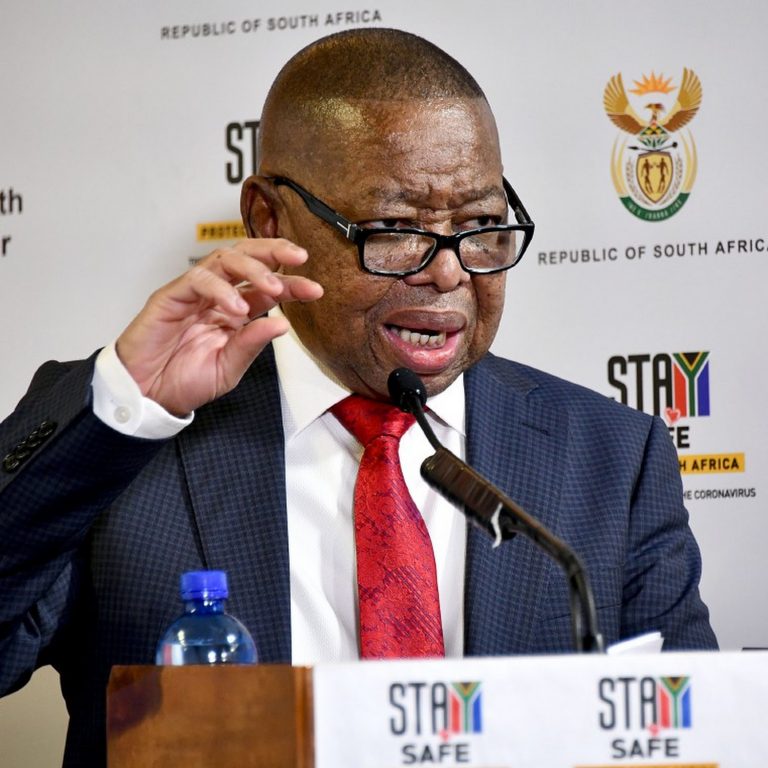
Student debt is growing in the university system. This is according Minister of Higher Education, Science And Innovation, Dr Blade Nzimande during his address to members of the South African Student Union (SAUS) at their eighth National Elective Conference held at the University of Venda on Sunday.

Nzimande said it is extremely worrying to note that inequitable patterns of student success still prevail. He said this was especially true for African and coloured male students.

Adding that this category of students continue to be the least successful in the university system.

“There are four categories of affected students that have been identified.

“They include NSFAS [National Student Financial Aid Scheme] students, students who are recipients of other scholarships and bursaries, self-paying students – including the so-called ‘missing middle’ students, and international students,” said Nzimande.

The minister added that his department and higher education stakeholders have acknowledged that there have sometimes been delays in the processing of historic debt of NSFAS qualifying students. He said the main challenges are linked to administrative challenges in resolving the debt.

“The Department is working with NSFAS and institutions to ensure a speedy resolution of the processing of historic debt claims,” he said.

Inside Education has previously reported that student historic debt to universities has escalated to approximately R14 billion.

Analysts say this has caused a sustainability crisis in our higher education institutions.

According to the Universities South Africa (USAf), this crisis has been ongoing for decades and that it is now time for a government-led policy process that produces a long-term, sustainable solution.

READ: Historic debt: The crisis in student funding

At the time, USAf’s Chief Executive Officer Professor Ahmed Bawa said student debt cannot possibly be resolved at the institutional level.

“USAf must signal now, as we did signal in December 2017, that the long-term sustainability of this bursary programme is of deep concern to us,” said Bawa.

He added that the perennial challenge of the further accumulation of student debt accrued by students who fall outside of the NSFAS threshold in family income requires a government-led approach.

“As you are aware there has been significant growth in funding allocated to the National Student Financial Aid Scheme to support qualifying students: R12.3 billion in 2017/18 to R43 billion in 2021.

“In the current financial year an additional amount of R6.4 billion was allocated through reprioritisation within the department’s budget and the National Skills Fund to address the NSFAS shortfall,” said Nzimande.

READ: Higher Education budget vote: NSFAS gets more funds but shortage persist

He added that following a meeting he had with SAUS earlier this year, USAf has initiated a process to work towards a system-wide approach to the issue of student transcripts and certificates and outstanding fees.

The minister said his department has also requested from the USAf up to date information from all institutions which will contribute to the policy review process, and form part of the review of student financial aid.

Nzimande said currently in progress is the development of a policy framework for the regulation of university fees in order to ensure that fees are kept at affordable levels for all families that need assistance.

“These efforts in the long-term aim to ensure that going forward all students are able to access some form of financial support for their university studies. However, without substantial additional funding being available in the sector, student debt will continue to be a problem,” said the minister.

Adding that he understands that the issue of debt owed by students has led to higher education institutions withholding of academic records.

“I have had several engagements with universities on this matter. All institutions have agreed to provide a certificate of completion to potential employers where students have met all the requirements for graduation, but still have university debt,” said Nzimande.

Other Challenges

Nzimande said the issue of access in higher education institutions is multifaceted.

He said as much as financial access is the most pressing for students, he is also concerned that the other dimension of access is not getting adequate attention, “that of epistemological access – the type and form of knowledge that students have access to or are unable to access”.

“One of our key challenges facing out higher education system is that of the urgent necessity to transform the relations of knowledge production – especially the patriarchal, class and racialized nature of knowledge and its production in our country.

“This is a crucial dimension in the dismantling of barriers, through access to relevant, transformatory and liberating knowledge,” said the minister.

He added that another key dimension of dismantling barriers is that of ensuring that we build student centred and student friendly universities and other post school institutions. Institutions that are not student friendly constitute a serious barrier to effective financial and epistemological access, he said.

On the University of South Africa (Unisa)

Nzimande said his department also had to tackle the issue of poor throughput in distance education programmes.

He said Unisa also faces challenges in governance, management and the quality of higher education provision at this institution.

“As a result, I appointed a Ministerial Task Team to conduct a review of Unisa with a strategic focus on its mandate as an open and distance education institution. The mandate of the Task Team includes analysing the scope, capacity, systems and organizational structure in relation to the University’s mandate and mission.

He said the team will make recommendations on measures required to ensure that Unisa is strategically positioned as an institution with a clear mandate and mission supported by the necessary structures and capacity for a sustainable future.

Higher Education Infrastructure Backlogs

Nzimande said his department, together with the Development Bank of Southern Africa (DBSA), are facilitating a Student Housing Infrastructure Programme (SHIP) for the construction of student accommodation.

“Our aim is to address the shortage of student housing and accelerate the development of at least 300 000 beds over a ten-year period, and we are working towards delivering even more than this.

“As part of our development, the University of Fort Hare, Nelson Mandela University, University of North West and University of Western Cape, Sefako Makgatho University and University of Limpopo are the first beneficiaries of our SHIP Phase 1 developments.

“Phase 1 SHIP developments enabled an investment of about R3.5 billion, including the DBSA commitment of R1.6 million debt funding for 12 000 student beds. Phase 2 SHIP developments comprise of about 24 000 student beds of 12 institutions including six universities,” said Nzimande.

200 000 educators and staff vaccinated so far

NYAKALLO TEFU|

The Department of Basic Education (DBE) said on Monday that more than 200 000 educators have now been vaccinated across the country.

DBE Minister Angie Motshekga addressed the media on Monday following President Cyril Ramaphosa ‘s Sunday announcement of the compulsory shutting down of schools from Wednesday. The decision was taken after the country saw massive spikes of Covid-19 infections across provinces.

In her address, Motshekga said the early closing of schools will not affect the teacher vaccination programme.

The minister was speaking during a media briefing held at Seemahale Secondary School in Botshabelo, Free State. The minister said she and her team were in the Free State as part of monitoring the vaccination of teachers and support staff.

“As you know the programme started last week and in this province good progress has been made. Learners in public and independent or private schools should be released for winter vacation on Wednesday, 30 June,” she said.

Motshekga said she was pleased with the programme and stressed that staff members in the education sector scheduled to receive their jabs next week should make themselves available although schools were closed. 

Adding that her sector wants to conclude the vaccination programme by next week. 

READ: BREAKING: Schools to shut down from Wednesday

“The vaccination programme for the Basic Education Sector personnel, will proceed as planned; the workers are advised to adhere to their schedules, and strictly adhere to COVID-19 protocols, as stipulated in the Regulations.  

“Schools designated as vaccination sites, must remain open to continue with the vaccination programme.  It is important that we all work together to complete the vaccination as soon as possible,” she said.

The minister added that , “If by the time we reopen, we still find out that there are still some teachers who have not been vaccinated, we will arrange with health (sic). But we are saying, any other person who has no reason, either flu vaccine, or Covid-19, who would not have vaccinated this time, we want all of them to come now.

“Because when we reopen in July, we don’t want to be running a vaccination programme,” she said.

Free State Education MEC Tate Makgoe and the province’s Health MEC Montseng Tsiu both said they were very pleased with the turnout of educators and staff.

Tsiu said the province plans to inoculate 32 000 educators and staff in the province.

“We are hoping to vaccinate everyone by Friday so that we are at least left with people that will be doing mop up next week,” said Tsiu.

Tsiu said the province has 29 vaccination sites and 28 of them are on school premises.

The health MEC reiterated that those who were infected with the virus in the past 30 days or received the flu vaccine in the past 14 days were advised not to take the Johnson and Johnson vaccine as yet but were urged to register.

Motshekga said eight provinces will continue with the vaccine rollout on Monday to Friday.

READ: Public schools set to shut down, reopen 19 July

The minister added that the Limpopo Department of Education has successfully vaccinated 30 000 educators and staff since Friday.

She said she was happy with the turn out so far and is satisfied with the turnout thus far. Adding that the department of health and the department of basic education remains hopeful that the target will be met as scheduled.

The vaccination drive began after 300 000 Johnson and Johnson vaccines arrived in South Africa, aimed at vaccinating teachers and non-teaching staff from both public and private schools.

DBE spokesperson Elijah Mhlanga said they want 582 000 education staff to be vaccinated by 8 July.

The Minister said schools designated as vaccination sites must remain open to continue with the vaccination programme.

“It is important that we all work together to complete the vaccination as soon as possible,” said Motshekga.

READ: Unions welcome the closure of schools

Public schools set to shut down, reopen 19 July

NYAKALLO TEFU|

Minister of Basic Education Angie Motshekga on Monday announced that public schools across the country will shut down this week and reopen on 19 July.

The decision comes after President Cyril Ramaphosa’s address on Sunday that schools must be closed by 30 June 2021 due to the third wave of the coronavirus in South Africa.

Addressing media on Monday, Motshekga said teaching will stop on Wednesday, and that the department will use both Thursday and Friday to enable teachers and managers to properly close schools.

The minister also said parents should make arrangements for learners at boarding schools to be collected by Friday.

“Public schools will come back from the winter vacation early on 19 July instead of 26 July 2021, as it was originally scheduled in the 2021 School Calendar,” said Motshekga.

Adding that school management teams (SMT), teachers, learners in hostel facilities and learners with special education needs waiting for parents to pick them up should report at school until Friday 2 July.

READ: BREAKING: Schools to shut down from Wednesday

“Parents, need to make arrangements that by Friday 12:30, there should be no learners in our hostels and facilities,” said Motshekga.

The minister said schools must make arrangements that for the remaining three days, learners continue to receive their meals.

Adding that the department encourages our learners to remain safe.

Motshekga said learners should not gather in crowds.

“They must apply hygiene practices as all times and avoid activities that may expose them to infections,” said Motshekga.

Schools were initially meant to close on 9 July. The date was brought forward following the governing party’s decision to place the country on stricter restrictions for the next 14 days.

National Professional Teachers’ Organization of South Africa’s (Naptosa) Basil Manuel said the department of basic education needs to let go of this calendar because the pandemic is so unpredictable.

“We need to make decisions based on how the pandemic is because if not, we will continue changing dates of closing and reopening schools,” said Manuel.

READ: Unions welcome the closure of schools

Manuel said the date set by the DBE is not realistic and it would be best if schools open a week later to the proposed date.

“Winter holidays are normally three weeks, maybe we should do that because teachers have been at school for the longest time without a break, this is the longest time in history,” added Manuel.

Education Union of South Africa’s (EUSA) Spokesperson Kabelo Mahlobongwane was harsher in his response.

“She [Motshekga] must just relax,” he said.

“The reopening of schools will be guided by the third wave and not her ambition to see teachers and learners spread the virus through these unsafe buildings she refers to as schools,” said Mahlobongwane.

Mahlobongwane said the focus right now must on saving lives. Adding that, “this is the only thing EUSA will entertain”.

Mahlobongwane said teachers who feel the anxiety of going to work on Thursday and Friday should take their two days sick leave.

“Should they face any challenges come third term, they should contact us for assistance – members or non-members,” he said.

Motshekga said the DBE together with the Council of Education Ministers (CEM) agreed that the usual winter vacation learner support programmes for grade 11 and 12 organised by provinces, districts and schools should continue.

“They have been instructed to continue under very strict conditions in compliance with the Covid-19 health and safety protocols,” said Motshekga.

However, Manuel told Inside Education that Naptosa is not satisfied with this decision.

“We have questioned these camps for a long time, we believe that we are looking for trouble particularly with this variant of this virus because those residential camps, the supervision is too little,” said Manuel.

Manuel said they cannot have tutors or teachers “coming in and out” of venues, making it easy for the virus to spread.

“We do not want things to go pair-shaped, it is a good intention, but we can never support this idea,” said Manuel.

Unions welcome the closure of schools

NYAKALLO TEFU|

Teacher unions across the country have welcomed the closure of schools from Wednesday 30 June 2021.

President Cyril Ramaphosa made the announcement on Sunday evening during his address on the government’s efforts to contain the coronavirus pandemic.

Educators Union of South Africa (EUSA) Spokesperson Kabelo Mahlobongwane said the union is happy and delighted by the president’s decision to close down schools in light of the increasing cases of Covid-19.

Just last week, Mahlobongwane called on teachers to withdraw their labour out of concern for their wellbeing and that of their learners.

Mahlobongwane accused Basic Education Minister Angie Motshekga of consulting with certain favoured organisations and stakeholders regarding the decision to keep schools open.

At the time, Mahlobngwane said this move clearly shows that the lives of teachers and learners are not taken seriously by the minister, her department and the stakeholders she consulted.

READ: BREAKING: Schools to shut down from Wednesday

Speaking to Inside Education on Monday, Mahlobongwane said EUSA welcomed the decision, “especially considering that we were the only union that called for the closure of schools and the prioritisation of lives.

“Other unions, together with the minister [of basic education] were adamant that learners must continue going to schools, regardless of the deaths and number of cases,” said Mahlobongwane.

In his address, Ramaphosa said the country will be moving to alert level 4 as the number of Covid-19 cases rise in South Africa.

According to the National Institute for Communicable Diseases, South Africa reported 15 036 new cases and 122 deaths in the last 24 hours alone.

The institute said Gauteng remains the epicentre of the Covid-19 infections having recorded 9 858 new cases.

According to reports, the Covid-19 Delta variant is the most prevalent variant in the country.

Ramaphosa said the Delta variant has now been detected in five of our provinces, namely the Eastern Cape, Free State, Gauteng, KwaZulu Natal and Western Cape. Adding that this particular variant has been dubbed the superior variant as it spreads faster.

Initially schools were set to close on 9 July 2021.  However, Ramaphosa said the closure of schools and other educational institutions will be brought forward for the winter holidays.

READ: Union calls for educators not to go to work for two days

The South African Democratic Teacher’s Union (Sadtu) spokesperson, Mugwena Maluleke, said they are happy with the decision made by the president.

“We have always been very clear that we must be influenced by science and that is what the President said, the decision to close schools was based on science,” said Maluleke.

Maluleke said this will give schools a chance to have a formidable robust tracking and tracing system because it is important for the school community to trace those who may have been affected.

The National Professional Teachers Organization of South Africa’s (Naptosa) Basil Manuel said they were consulted about this decision ahead of time and are happy with the decision taken.

“It didn’t come as a surprise. We met during the week, and we met again on Sunday night at 18:00, we support the call to close but there are issues we are unhappy with,” said Manuel.

“Firstly, we need the schools to be cleaned properly while learners are away by people employed to do that, not just sanitising.

“Secondly the return date, we want learners to reopen on the 26th of July and not 21 July as per the school calendar because,” said Manuel.

He added that the set date of the returning of learners does not sit right with them.

Maluleke said the early reopening of schools will be informed by science, and that it will give learners time to catch up on the work they have not completed by the time schools close.

“We have always said that the pandemic is unpredictable and the numbers that are rising suggest that education from time to time is going to be disrupted,” said Maluleke.

PART 2: What provincial departments of education will focus on in the 2021/2022 financial year

NALEDI SHOTA|

Provincial departments of education have in recently outlined their plans and what they will be prioritising in this financial year through budget vote speeches. 

This week, Inside Education brings you some of the highlights that came out of the budget votes by MECs of education.  

Part two looks at Gauteng, the Northern Cape and KwaZulu-Natal provinces.

Gauteng 

The Gauteng department of education has a budget of R53,4-billion for the 2021/22 financial year. 

In his speech MEC for Education Panyaza Lesufi said one of his department’s priority in this financial year is to increase learner enrolment in technical high schools, and as such the department has approved applications to offer  technical subjects and technical fields of specialisation to several schools. 

Lesufi said the department will introduce nine specialisation subjects in the technology pathway and those subjects include: construction, woodworking, digital systems, power systems, electronics, fitting and machining, welding and metal work. 

In this financial year, Lesufi said the department is looking to add 400 refurbished Smart Classrooms, where it will roll out smart technologies to township high schools.

He added that the province was on track in eradicating asbestos schools in the province having demolished four last year. 

Northern Cape 

The Northern Cape department of education received a budget allocation of R7.14 billion. 

MEC for Education Zolile Monakeli said the department has allocated R14 million for about 32 000 learners who will be conditionally, partially or fully exempted from paying school fees.

The learners come from 119 schools out of 138 fee paying schools that applied for compensation for fee exemptions.

Monakeli said the department had set aside R17.56 million to support the Class of 2021 through a matric intervention and turnaround strategy. The strategy includes Saturday classes. 

He also said the department was in the process of finalising the learner transport tender for the province.

The process would be completed before the end of the financial year and will secure a safe and reliable learner transport for the Department at a cost of R168.49 million, he said.

“This is significant as this is one of the mechanisms through which we secure general and universal access to education. The Department is currently transporting 24 559 learners to their respective schools with various modes of transport,” he said.

Monakeli said the department has set aside R633.3 million for the maintenance of and renovation of 49 schools. 

KwaZulu-Natal 

MEC Kwazi Mshengu presented a budget allocation of R 53.184 billion.

Mshengu said the department had commissioned a feasibility study to explore the establishment of schools of mining and arts in the province. This is as part of the department’s programme on specialised schools, he said.

“KwaZulu-Natal is endowed with unmatched talent which most of it remains unprofitable because of the lack of support and nurturing of this talent. 

“Equally, extraction and exporting raw mineral resources is counter-productive as it amounts to exporting jobs. The failure to beneficiate on the mineral resources is an anomaly that must be confronted urgently – hence the need for a School of Mining.  The final decision will be informed by the outcomes of the feasibility studies,” said Mshengu. 

Mshengu also said the department has from this year piloted the occupational stream at 10 mainstream schools in the province. This is in response to the introduction of the three-stream model introduced by the department of basic education where the focus is on academic, technical-vocational and occupational streams.  

“The focus for the occupational stream is on low-intensity occupational skills which individuals can master to start small-scale businesses and to assist them to earn a living straight from school,” he said.

The pilot started in grade eight with subjects including consumer and hospitality studies, mechanical and civil technology as well as agricultural studies.

Mshengu said in this financial year his department would deliver six new schools at different districts as part of the infrastructure development. He also proper sanitation facilities were under construction. 

Mshengu said over the years, the department had lost over R500 million from staff debt staff debt because of the “weaknesses in internal control measures and the outdated operations of the department”.  

“Whilst we need to recover this money from both the ex and current employees of the department, we have to close the tap.

“In addition to the appointed debt collectors, we are also exploring an electronic system for leave management and timeous termination of the employees who have resigned or retired from the service,”  he said.

Covid-19 could accelerate changes in how we teach Mathematics

While learners in schools for the middle class and independent schools have had access to online learning, learners in schools for the poor and working class have had no such access.

Visiting associate at Wits University Lynn Bowie said this was also unlikely to change in the near future.

On Monday, Minister of Basic Education Angie Motshekga announced that public schools across the country will shut down this week and reopen on 19 July.

The decision comes after President Cyril Ramaphosa ’s address on Sunday that schools must be closed by 30 June 2021 due to the third wave of the coronavirus in South Africa.

Ramaphosa said the number of daily new infections was more than doubling, and that hospital admissions were rising. Ramaphosa said the deaths from Covid-19 were increasing by nearly 50%.

“The situation has gotten worse. In addition, we now have the Delta variant. The Delta variant has now been detected in five of our provinces, namely the Eastern Cape, Free State, Gauteng, KwaZulu-Natal and Western Cape.

“We are concerned about the rapid spread of this variant. “Reports from some countries, including on our continent, also suggest that infections and clinical illness in children may be more common with the delta variant, even as the overall rate of infection remains substantially lower than in adults,” said Ramaphosa.

Bowie said there is evidence that, in mathematics, learners in less well-resourced schools are four years behind their counterparts in well-resourced schools by the end of Grade 9.

It is therefore likely that most Grade 9 learners will fell further behind in 2020 and continue to do so in 2021.

“This situation needs urgent attention. It is time to think beyond 2021, and to treat 2021 and 2022 as a continuous learning opportunity.

“It is also time to be more strategic about what is taught. In the Covid-19 discussions on schooling there has been too little focus on what learners will learn – whether at school or at home,” said Bowie.

A study by Associate Professor at the University of Stellenbosch Nicholas Spaull found that only 16% of Grade 3 students in South Africa are performing at a Grade 3 level in mathematics.

Spaull said the poorest 60% of students are three Grade-levels behind the wealthiest 20% of students in Grade 3.

The gap between the poorest 60% and wealthiest 20% of students grows to four Grade-levels by Grade 9.

After Grade 9, South African learners must choose between Mathematics and Mathematical Literacy for the remaining three years of secondary school.

Mathematics is essential for entrance into science-based programmes in universities, but the majority of learners lack the knowledge to cope with Mathematics from Grade 10 onwards.

Associate Professor of Mathematics Education at Wits University Craig Pournara said for example, in the Annual National Assessments for Mathematics administered from 2012 to 2014, the average mark each year for Grade 9 was less than 14%. 

“Similarly, in the Trends in International Mathematics and Science Study assessments in 2015, only one third of South African Grade 9 learners achieved at the minimal level in mathematics,” said Pournara.

He added that a recent study of Grade 9 and 10 learner performances on negative number, basic algebra and functions yielded an average score of 28.3%.

“Clearly Grade 9 performance is far below desired levels,” he said

“Add to this situation the impact of the COVID-19 pandemic. In most state schools, Grade 9s are scheduled to return to class on 19 July 2021.

“Research indicates that long breaks from school lead to learning loss, with maths scores being particularly badly affected. And these breaks have a greater negative impact on learners from lower socioeconomic groups,” said Pournara.

Pournara and Bowie suggested that a limited number of core concepts and skills for Grades 8 and 9 that will provide a strong foundation for further mathematics be identified.

The two said this can be a solution to the pandemic interruption of learning.

“This involves, firstly, a carefully designed curriculum to address learners’ difficulties, starting with whole number, fractions, negative number, introductory algebra, linear patterns and functions.

“Secondly, teachers need a range of supportive materials – not just fixed lesson plans. It should be clear what must be done face-to-face and what can be done alone at home without technology. Teacher materials should help to identify gaps in learners’ knowledge and to provide guidance for re-teaching what learners have missed,” said Bowie.

Pournara said tests should focus on revealing what learners understand and what they are battling with, instead of putting pressure on them to “pass” a certain level.

He said if this is done, Covid-19 could be the unexpected catalyst that makes the education system accountable to learners and their learning. 

“But we need to get Grade 8 and 9 learners back to learning as soon as possible. It is crucial that they are not neglected because of an overwhelming focus on Grade 12 learners,” he said.