Home Blog Page 344

Classroom Management: Popular Remote Lesson Monitoring Program Could Be Exploited To Attack Student PCs

RESEARCHERS have uncovered a slew of critical vulnerabilities in remote monitoring software — an incident made worse as it could impact student safety and privacy. 

On Monday, McAfee disclosed the existence of multiple security holes in Netop Vision Pro, popular monitoring software adopted by schools for teachers to control remote learning sessions. 

The software is marketed for teachers to keep control of lessons. Features include viewing student screens and sharing the teachers’, implementing web filters, pushing URLs, chat functions, and freezing student screens. 

“Adding technology to the classroom allows you to give your students a multitude of new resources, but it can also add more distractions,” the vendor says. “Classroom management software helps you scaffold your students’ learning while still keeping them on track. In the classroom or during remote learning, Vision’s simple features allow you to manage and monitor your students in real-time.”

According to McAfee’s Advanced Threat Research (ATR) team, Netop Vision Pro contained vulnerabilities that “could be exploited by a hacker to gain full control over students’ computers.” 

After setting up a virtual ‘classroom’ made up of four devices on a local network, the researchers realized that all network traffic was unencrypted and there was no option to enable encryption during configuration. 

In addition, students that began connecting to the classroom “would unknowingly begin sending screenshots to the teacher,” according to the report. 

“Since there is no encryption, these images were sent in the clear,” McAfee says. “Anyone on the local network could eavesdrop on these images and view the contents of the students’ screens remotely.”

As a teacher begins a session, they send a network packet prompting students to join. It was possible to modify this data and for the team to masquerade as the teacher host. Attackers could also perform local elevation of privilege (LPE) attacks and ultimately gain System privileges.

Chat function in the software saved files sent by a teacher into a ‘work’ directory while running as System, it was possible for an interloper to overwrite existing files and send malicious content to students without any input from them — such as malware that would ultimately compromise their PCs. 

“Netop Vision Pro student profiles also broadcast their presence on the network every few seconds, allowing an attacker to scale their attacks to an entire school system,” McAfee noted. “Because it is always running, even when not in use, this software assumes every network the device connects to could have a teacher on it and begins broadcasting.”

Overall, four critical vulnerabilities in the software were assigned CVEs and are tracked as CVE-2021-27192, CVE-2021-27193, CVE-2021-27194, and CVE-2021-27195: an incorrect privilege assignment problem, a default permissions error, the cleartext transmission of sensitive information, and authorization issues.

Overall, the security flaws allowed for privilege escalation and Remote Code Execution (RCE) attacks within a compromised network. 

“If a hacker is able to gain full control over all target systems using the vulnerable software, they can equally bridge the gap from a virtual attack to the physical environment,” the researchers added. “The hacker could enable webcams and microphones on the target system, allowing them to physically observe your child and their surrounding environment.”

The insecure design principles and security flaws found in Netop’s software were privately disclosed to the vendor on December 11. The latest software release, 9.7.2, has addressed some of the issues, such as LPE bugs and the encryption of credentials. Mitigations have also been added to chat-based read/write issues. 

Netop intends to roll out network encryption in the near future. 

Last week, the FBI warned of increasing rates of attack against US and UK schools and universities. Law enforcement agencies have tracked a spike in attack attempts leveraging PYSA ransomware, used to exfiltrate data before encryption in order to extort payment. 

ZDNet has reached out to Netop and we will update when we hear back. 

  • ZDNET

Cape Town And Netball SA Ready To Host COVID-safe Continental Netball Series

THE upcoming 2021 SPAR Challenge is part of a series of tournaments ahead of the 2023 Netball World Cup to be played in Cape Town.

A year ago, professional sport came to a standstill as countries around the world went into lockdown.

South Africa was no exception, as major sporting events, competitions and leagues had to be put on hold with immediate effect as the country went into lockdown on 27 March last year.

Professional sport only resumed about six months later, albeit under strange circumstances with no spectators in attendance, something that’s still in place in terms of lockdown level 1 restrictions.

This week, Cape Town hosts the 2021 SPAR Challenge, a tournament which forms part of Netball South Africa’s preparation ahead of the 2023 Netball World Cup which will also be hosted in the Mother City.

The tournament will be played under strict health and safety regulations, in a bio bubble in the CTICC precinct, with all teams, including technical teams, umpires, support staff, media and local organising committee members tested prior to entering the bubble.

Netball South Africa CEO, Blanche de la Guerre says they have experience with hosting events in a safe and secure environment.

We tried it last year with the Telkom netball league in Bloemfontein, where we booked the whole hotel, where players were only allowed to move from the hotel to the playing venue and back. No shopping, no where to go, just to keep everyone safe, so it works.

De la Guerre says there is a lot pf preparation that goes into organising a in a biologically safe environment.

We are obliged to keep everyone safe that we invite to our country, so they had to test before they left their country, tested again after few days and stayed in isolation, so they’ll be joining us in the next few days. The bio-bubble is basically when you keep yourself safe and away from other people.

Blanche de la Guerre – Netball South Africa CEO

She says as Netball SA, they always enjoy and appreciate taking on other African countries. The 2021 SPAR Challenge, which takes place at The Cape Town International Convention Centre (CTICC) will see Africa’s top ranked netball teams, including South Africa, Uganda and Namibia battle it out.

Uganda is placed sixth in the world, just one below us, so we never underestimate them. Namibia has picked up their netball again. they’re still world number twenty-three, but they had some good results in 2019. So there’s nothin to take for granted, Our players are preparing everyday, twice a day. They’re looking forward to it, you can just imagine how hungry they are to compete.

Blanche de la Guerre – Netball South Africa CEO

Reflecting on the impact lockdown has had on the sport, De la Guerre says their biggest challenge over the last few months was keeping the athletes active. She adds, that with the 2023 Netball World Cup on the horizon, they needed to safeguard the wellbeing of their players.

The 2023 Netball World Cup might sound far away, but it’s not. When you prepare for a World Cup against sixteen other countries, and being number five in the world, our competitors are Australia, New Zealand, England and Jamaica, we need to prepare basically three years before the time. So we’re explicitly preparing for that competition. Our last competition was in January 2020 against England, says Blanche de la Guerre – Netball South Africa CEO

  • Cape Talk

More Female STEM Teachers Will Encourage Girls To Do Engineering

SAMANTHA Namugema is head of software developing department and programmer at ClinicMaster, an integrated new generation healthcare information management and medical billing software. The award winning app has been applauded for effectively reducing paper clutter in the healthcare system. 

ClinicMaster CEO and founder Wilson Kutegeka describes her as the engine, heart and soul of the company. Namugema reveals that growing up, she knew nothing much about software engineering or really the IT sector. She however, took on a combination that had maths and physics. 

“Now having that combination, you are expected to go for engineering, which of course has the electrical engineering which of course I applied for. When I saw something called software engineering, I decided to apply for it too although I had no idea what it was. When I joined, however, I realised it was more advanced than the other types of engineering I was conversant with. Although it was not the initial dream, I just made peace with it,” she said.

Male dominance
Soon Namugema discovered she had chosen a male dominated course and she was among the minority 30 per cent women that made up her class. This, however, is not a problem limited to Uganda.  Despite representing half of the world’s population, women and girls remain deeply underrepresented in Science, Technology, Engineering and Mathematics (STEM) fields. According to recent data from UNESCO , less than 30 per cent of researchers employed in research and development globally are women.

Studies have also found that women in STEM fields publish less, are paid less for their research and do not progress as far as men in their careers. Moreover, women and girls’ enrolment in university STEM courses is much lower than their male counterparts’. 

The lack of women scientists means there is a lack of the diverse perspectives essential to addressing issues of gender and the fact that the burdens of climate disasters often disproportionately affect women. 

Furthermore, with few women occupying decision-making positions in academic and research institutions, their role in prioritising research agendas is severely constrained. Namugema witnessed firsthand the prejudice she and other girls were subjected to. 

“The girls were always advised into the direction of design sections and other easy sections while men were focused on coding, analysis and other sections they felt needed more brain power. Some girls just chose to believe what they were being told that they are not capable of doing some jobs,” Namugema shares.  

The problem is compounded by the dearth of empowering female teachers who can, in turn, empower girls to take up STEM courses and by promoting role models and mentorship programmes that foster a sense of belonging among women in STEM.

She, however, having been brought up to believe that girls could do the same thing as boys determined to pursue whatever her heart desired.  And her heart wanted coding.  Although she consistently positioned herself to take opportunities, she knew she had to work twice as hard as her male peers to be noticed. 

Starting out
Starting as a programmer, Namugema was promoted to a software developer (the difference is entirely on the scope of what they need to cover. While a programmer writes code, testing, and fixing bugs, a developer does much more in addition to that).  

“After joining ClinicMaster, I came with a mindset that I had to become as good a programmer as everyone else in the room, or better,” she said.

It was a bit intimidating for Namugema, coming into a space where she was the only female programmer. So she focused on being perfect in everything for the fear of confirming the prejudice that women are not good enough for this field. She revealed that even if she did not find any animosity from her colleagues, she always had that feeling that her mistakes would affect more than herself. 

“Fortunately I have come to understand that our CEO has an eye for talent. He chooses people on merit, not gender and he puts them in positions they can perform best. Someone believing in you like that gives you the morale to work even harder,” she said.

As a head of department, Namugema is expected to manage personnel as well develop software; roles she has taken up with gusto.  
“I have always been a fixer, when I see a problem I fix it. So far I have started new and standard processes for better product delivery,” the engineer says. 

Challenges
Namugema says in the beginning, it was quite hard dealing with different people on a whole new perspective. Since she could not force anyone to do the work the way she does, she decided to learn how every person operates. 

This and other skills therefore she had to learn on the job. She took time to study how different people work in order to relate properly with them. She has since learned that communication is key and has found creative ways to work with everyone. 

“There are two different types of people; while one person needs constant reminding in order to do the work, the other may do the work without being reminded. I have created a timetable to help with my vision and future prospects of the team,” she shares.  
Namugema notes that there is pressure for women to prove that they are better than everyone in the room for them to get into management positions. 
“Once you are a woman in a male dominated industry, society expects you to fail.  To avoid this, women find themselves being pushed to continuously study and challenge themselves.

Also expect your confidence to be shaken but do not let it get to you. If you do not have confidence in yourself, no one will have it in you. You have to be aggressive and grab whatever opportunity presents itself because no one is going to spoon-feed you,” she notes.

Some companies are still not comfortable working with women programmers. “When you go to the field some clients show doubt in your ability.  For instance when you are the only woman in a group you will notice people choosing to talk to them instead of you even if you have more skill and seniority,” Namugema says.  

Advice 
Namugema says her profession requires passion for one to succeed at it, especially when you are a woman. This is because you will meet many challenges on the job that will make giving up seem like a sensible option. 

“If you already do not like what you are doing, it is easy to give up at any slight challenge and pressure,” she notes.
The engineer has intentionally surrounded herself with the kind of people that can add something to her life. “In addition to having a support system, courage helps one on their way of fulfilling their dreams,” she says.

She realises that not everyone is lucky to have inspiring role models in their circles, she advises young girls to look around for successful women and make connections.  
“You have to put yourself in a position where you can learn a skill, find motivation from people who can encourage you by getting to know how they got to where they are,” she advises.

Quick notes

Samantha Namugema attended Nkokonjeru Primary School, Mbale, Mt St Mary’s College Namagunga for both O and A-Level and Makerere University, for a degree in Software Engineering.

She says Trevor Noah is her role model.  
“I followed him for a while even when he was still doing stand-up in South Africa. He is very hardworking, he is very aware of himself, he is very knowledgeable and he is courageous. He took a chance on his dream and passion and now he is the host of the Daily Show. I like him because he is not afraid of being wrong, and he critically listens to others before he responds.”

  • Daily Monitor

Free Education: A Zuma Time Bomb Explodes

WILLIAM SAUNDERSON-MEYER writes on how the ANC government is playing pass-the-parcel with ‘free education’ costs.

ONE of the time bombs left behind by former president Jacob Zuma blew up deep in the innards of government this week. It’s another body blow to the national accounts.

Zuma’s 2017 defeat by Cyril Ramaphosa for the leadership of the African National Congress did not culminate in the surrender of the Radical Economic Transformation faction, but the launch of their guerrilla warfare campaign.

As a parting gift, the RET left behind a matching set of cunningly improvised explosive devices: expropriation without compensation (EWC) and free tertiary education.

Ramaphosa’s tactic with EWC was to embrace it with disconcerting ardour. The rationale, claim his supporters, was that by taking the lead on EWC, the president would be able to craft the final version so as to best minimise the fallout in terms of food security, constitutional rights, foreign investment jitters, and Zimbabwe-style farm chaos.

That bomb’s still ticking down ominously, so we don’t know if his containment strategy will work.

The second explosive issue, free higher education, is triggered annually by rote and the Ramaphosa administration hasn’t a hope of disarming it.

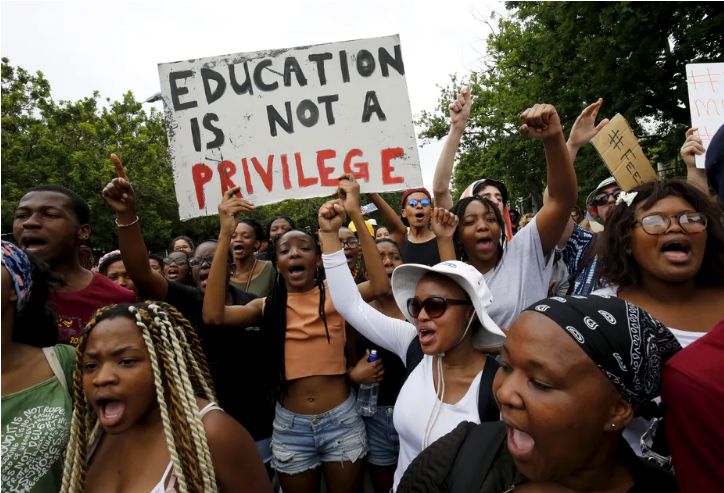
The ANC has done everything possible to meet the demands of the #FeesMustFall and #FreeEducation campaigns — directed by the Economic Freedom Fighters and assisted by RET remnants in the ANC — and billions of rands have been spent on expanding tertiary access to the point that 90% of the population, as determined by a household means test, qualifies.

The universities, donor organisations and big business were bludgeoned by the government into assisting, although most realised that this was likely to be an ever-expanding and bottomless pit.

So it has proved to be. Student demands have each year become more extravagant and in 2021, yet again, the money has run out and the fresh-faced revolutionaries are running amok. 

This year the National Student Financial Aid Scheme (NSFAS) needs another R7bn on top of the R42bn it is already spending.

In protest, the SA Union of Students this week sought to close down all 26 universities until their demands for zero fee increases and for all historical debt to be written off are met.

Yet again, the government capitulated in a trice. To fill the hole, it’s pinching R500m from the budget for Technical Vocational Education and Training (TVET) colleges, and another R2.5bn from the grant that goes to universities for salaries and research, as well as R3.3bn from the National Skills Fund (NSF).

As Higher Education Minister Blade Nzimande cheerfully admits, “I want to be honest with (sic) that. We’re robbing Peter to pay Paul.” For once, a notoriously slippery minister is telling it as it is. 

As always, the universities are the victims of a mess created by the government. Not only are rampaging students targeting them for the ANC’s failure to provide the “free education” it promised, but the budgetary clawback aggravates an already financially parlous situation.

As far back as 2013, a government committee reported that South Africa’s universities were chronically underfunded for the teaching and research demands placed on them. To cover the shortfall adequately, state grants would have to nearly double. 

But instead of increasing state support as envisaged by the committee’s chair — a certain Cyril Ramaphosa — those already inadequate grants have continued to shrink. In order to solve the problem caused by them being cut in the first place, they are now to be further cut. It’s ANC logic.

Equally damaging is the effect of Nzimande’s solution on the more than 4m unemployed youths who lack the skills needed to find work. The NSF’s learnership and workplace-based training programmes, one of their few possible routes out of poverty, are going to be cut back.

Nzimande had nothing to offer but crocodile tears: “I’m personally a firm champion and believer that we must increase support for university students, but at the same time, we must not lose sight of the fact that they constitute less than 5% of the total youth of our country.”

The ANC’s approach is characteristically expedient: relieve immediate political pressure without making the hard decisions necessary for lasting solutions.

Its dilemma is that there are so many cracked and flawed pressure hoses in the labouring South African political system that any relief obtained is of shorter and shorter duration.

Tertiary education students are a highly privileged group, ranking in the ANC’s untouchability index on a par with taxi owners and unionised public servants. And like public servants, they could do with a numbers’ cull and a benefits’ trim.

After all, who would not want to be a cosseted student in a country that has over 50% youth unemployment? All academic fees and are covered; so, too, is accommodation (either in a university residence or comparably priced private residence), transport, meals, personal care and incidental expenses. Every student receives a free laptop. A government that has gogos queueing overnight in the cold and rain for their social grants manages monthly to charge each student’s debit card with the necessary fees.

The entry threshold to the well-paid job of being a student is not high. About a third of matriculants pass at university admission level, while only a Grade 9 pass is required for college admission.

Nor is there any restriction on subject choice at university. In our laissez-faire system, it’s considered as deserving of taxpayer munificence to qualify in a field for which there is little demand as in the high-demand fields of science, technology and engineering.

And as jobs go, the student workload isn’t onerous. Professional students need to pass only 50% of their modules to continue receiving their salaries. 

It’s undeniably important to expand tertiary education access and to do so in such a way that ensures it is not the preserve of the privileged and relatively wealthy. But in a country at South Africa’s stage of development, free higher education is simply not sustainable.

In countries like the United Kingdom and Australia, tertiary education is part-funded with state grants but, increasingly, through direct student fees or a student aid agency with loans. These are repayable after graduation, once the recipient is employed. Vigorous enforcement means significant levels of repayment, thus ensuring the system’s sustainability.

For a while, South Africa followed this disgracefully exploitative colonial model. Except that the NSFAS was, unlike most of its international counterparts, dysfunctional and corrupt. 

In 2017 and 2018 NSFAS rang up R7.5bn in irregular expenditure, including one lucky student who went on a spending spree after it erroneously credited her card with R14m. By the time Zuma, intent on sabotage, decreed the introduction of “free” education the loan model had collapsed and the NSFAS sat with 467,000 graduates owing R20bn and with few of them showing any ubuntu intention of repaying. 

The free education chimaera, like any promise of something for nothing, has vociferous support. The Higher Education Transformation Network, a not-for-profit campaigning for the advancement of black African and women alumni in higher education, this week released a statement in support of the students, reminding us that “free access to higher education is a right not a privilege for the few”. 

“The responsibility to fund higher education is a shared social responsibility shared by government and the business sector”, the HETN declares. “We accordingly call on the business sector to assist the State in funding higher education as it is business that also benefits… In the past decade, the State has invested billions of taxpayer funds in recapitalising the NSFAS as well as funding new university infrastructure… These investments have not been fairly matched by the business sector.”

It’s hard to know what to make of an organisation of university graduates that is seemingly unaware that those “billions of taxpayer funds” spent on higher education came mostly from, um, businesses. And on top of paying their taxes, businesses also voluntarily fund thousands of scholarships and pours hundreds of millions of rands into university coffers through donations, commissioned reports and research.

There is one clue to how seriousy we should take HETN. Its website announces that “all correspondence” with HETN “must be in writing”. There’s a lot to be said for free education, if your country can afford it.

Much more to be said for a good one, if your country can provide it. Unfortunately, the former often makes impossible the latter.


  • Politicsweb

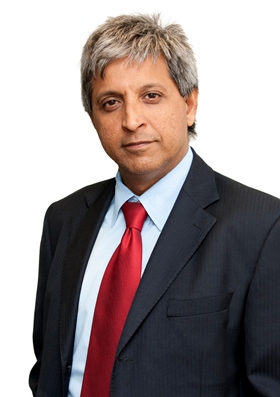
SOAS Director, Professor Adam Habib, Steps Down Amid Investigation Into N-word Use


THE director of SOAS university has stepped aside from his role while an external investigation takes place into complaints of anti-Black racism at the university following his use of the N-word.

Mr Adam Habib is off-duty as of Thursday, ahead of the commencement of the investigation and until the conclusion of the process.

The day-to-day running of the university is being handed over to deputy director Professor Claire Ozanne, who will serve as interim director.

This comes after the educator recently came under fire for using the racial slur in video call with students.

News of Mr Habib’s temporary departure was confirmed by Marie Staunton, Chair of SOAS Board of Trustees, in an internal message sent to the SOAS community which read: “I have agreed with Director Adam Habib that he will step aside while this investigation takes place, so as not to compromise the investigation.

“We will continue to find ways to facilitate the mediated conversations and engagement – including with Adam – that centre the Black community and the SOAS community broadly, in ways that also do not compromise the process of the investigation.”

The move forms part of the university’s action plan to address anti-racism within the institution which includes commissioning Judy Clements OBE to conduct an external investigation into complaints it has received of anti-Black racism more broadly.

This probe will assess unexplored and unactioned complaints about anti-Black conduct across SOAS and how those affect students’ learning outcomes and staff work environment.

The university’s senior leadership team will work alongside the Race, Accountability and Listening Action Steering Group in engaging Black staff and student societies to organise “listening spaces” designed to identify the major strategic and practical shifts that need to occur in the institution.

Mr Habib has again apologised for his behaviour.

“I am mortified that I made this mistake last week and apologise for this. I have fought racism my whole life, battling Apartheid in South Africa, but this has shown me that I still have more to learn and more work to do,” he said.

“Having spent my career and my activism concentrating on equality, poverty and social justice, I moved to the UK to join SOAS a few months ago because I want to be part of positive change here. I will focus my time listening to black colleagues and students, to help to educate myself, to keep on learning, and as I do so I am open to my views changing.”

  • The Independent

South Africa Sticks to Budget Stance Amid Student Protests

0

SOUTH Africa is committed to consolidating debt and fostering economic growth even as it faces pressure to increase funding for universities and raise civil servants’ wages, Deputy Finance Minister David Masondo said.

“Everything is going to be funded within the current fiscal framework,” he said in an interview on Tuesday. “Unavoidable funding pressures will be financed through expenditure reprioritization.”

Masondo’s comments underscore a shift in policy that became evident in last month’s annual budget. It backtracked on plans to raise personal taxes and switched focus to boosting consumption and private investment to shore up an economy that contracted the most in a century in 2020 because of the coronavirus pandemic.

Funding for higher-education institutions was cut by 8 billion rand ($535 million) over the next three years in the budget, as the Treasury signaled its intention to narrow the fiscal deficit and contain debt by reducing expenditure.

The cabinet pledged to make additional funding available to the National Student Financial Aid Scheme last week after students staged protests in several towns to demand free education and the write-off of their outstanding fees.

While the finance and higher education ministers are working out how to access additional money, the budgetary framework won’t be compromised, Masondo said.

The deputy minister also held the line on the government’s plan to freeze salaries for state workers for the next three years.

The wage bill has ballooned over the past decade, has been a major contributor to the dire state of government finances and hindered the hiring of more teachers and nurses to service a growing population.

Negotiations for a new pay deal with labor unions that represent 1.3 million state workers are currently under way. The government reneged on a deal to grant pay increases agreed for the final year of a previous three-year pay deal, arguing that they were unaffordable, a decision the unions are contesting in court.

The government decided against increasing taxes to help fund additional expenditure because of the adverse effect on consumers’ disposable income, according to Masondo. The money could instead be channeled into spending or investments, which would in turn help widen the tax base, he said.

The deputy minister reiterated the government’s commitment to structural economic reforms and said it’s considering selling some of the more than 700 companies it owns, without identifying them.

Repeated bailouts for loss-making state-owned companies including power utility Eskom Holdings SOC Ltd. and South African Airways have been a major drain on the state’s coffers. A presidential review panel recommended in 2013 that the number of state companies be reduced, but no action was taken.

  • Bloomberg

Police Officers Accused Of Killing Mthokozisi Ntumba During Wits University Protest Remanded In Custody

0

NYAKALLO TEFU

THE four police officers accused of killing Mthokozisi Ntumba made their first appearance in the Johannesburg Magistrate’s Court on Wednesday.

Their bail application has been set for 24 March.

Ntumba was shot dead when police dispersed protesting Wits University students in Braamfontein last week.

 Ntumba died at the age of 35, leaving behind his wife and kids.

The police officers Victor Mohammed, Madimetja Legodi, Tshepiso Kekana and Cidraas Motseothata,are facing charges of attempted murder, murder and defeating the ends of justice.

Protests at universities across the country still continue, as thousands call for their historical debt to be scrapped and not only for registration purposes. 

  • Inside Education

Zuma Hits Back At Blade Nzimande Over Free Education Remarks

0

FORMER President Jacob Zuma has responded to utterances by Higher Education Minister Dr Blade Nzimande on the issue of free higher education in the country, according to the SABC News.

Nzimande said if it wasn’t for the former President who announced in Nasrec during the African National Congress (ANC) National Elective Conference that the ANC policy on free higher education will be realised, there wouldn’t be such turmoil at the country’s universities.  

But Zuma says he finds this shocking because free higher education is an ANC policy and has to be implemented. He spoke at his home in Nkandla, KwaZulu-Natal, during a visit by the ANC Women’s League yesterday.  

The league was the latest to visit Zuma, after many others who have been visiting the former president.  

Addressing the issue on Nzimande, Zuma says, “Tell him I said, he must stop being naughty. It’s not a minor thing, to seeing students being shot dead, while they are fighting for a good course. How do we even explain that a person dies for fighting for what is right because an ANC government is failing to implement that. That is why I am asking you to talk to him, not me because I might use harsh words.” 

This is not the first protest around the fees at the university. In 2015, classes were suspended at Wits after students staged a sit-in rejecting the proposed tuition hike of 10.5%. That was the beginning of the #WitsFeeMustFall protest. Below is the infographic on protests at Wits University.

Meanwhile, representatives from various organisations, Friday night, held a candlelight vigil in Cape Town for 35-year-old Mthokozisi Ntumba who was shot dead allegedly by police during a protest by Wits university students on Thursday.  

Ntumba was not part of the student action.   

A group that includes students, learners and workers representatives gathered at the Grand Parade in the CBD also to show solidarity with students that are fighting against financial exclusion.   

Cwayita Wenana from Equal Education explains said, “We unite with students in high education. We unite with other people fighting in other sectors to be in solidarity with students and the cadre who lost his life and also to say we want better from our government we want them to fix and fund our schools, but government has done the opposite they have taken money away from all of us.”

–  SABCNews

SAUS, SASCO and EFF Student Command Embarks On National Shutdown Of All 26 Universities In SA

0

NYAKALLO TEFU

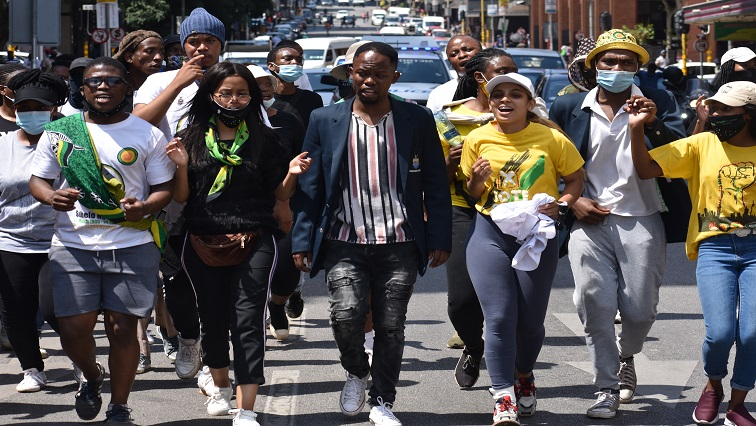
THE South African Union of Students (SAUS) has called for a national shutdown of all higher education institutions following the submission of student demands to the minister of higher education Dr Blade Nzimande during the weekend.

Student protests have been happening in most parts of the country, starting at Wits University and University of Johannesburg.

This is part of the student’s ongoing protest over financial exclusion.

Meanwhile, the South African Students Congress (SASCO) and the EFF Student Command (EFFSC) have also joined calls for a national shutdown of all universities.

SAUS secretary general, Lwandile Mtsolo, said the students’ meeting with the minister at the weekend resolved to call for a national shutdown of all the 26 universities from Monday.

All 26 University SRCs have supported this decision unanimously and the shutdown will continue until our demands are met, said Mtsolo.

The SAUS meeting, which included all student representative councils in the country, was also attended by representatives from National Students Financial Aid Scheme (NSFAS), Universities South Africa, as well as Deputy Minister of Higher education, Buti Manamela.  

Mtsolo said the austerity measures announced by the Finance Minister Tito Mboweni to cut budgets and reduce university subsidies for higher education are a sign of uncaring government.

“We thus unambiguously and vehemently reject the neo-liberal budget that seeks to defund NSFAS thereby putting the future of many students in jeopardy. Austerity must fall,” said Mtsolo.

The union also condemned the brutality and violence by the South African Police Services (SAPS), which led to a killing of one civilian during protests against financial exclusion.

SAUS is demanding financial clearance and the clearance of historical debts for all students to ensure their smooth registration for the academic year.

It wants justice for the family of a person who was killed by police during protests in Wits University, and an end to police brutality. Other demands include immediate provision for post-graduate funding and allocation of National Student Financial Aid Scheme (NSFAS) funding for first time or new students. NSFAS is a government-run scheme that provides financial aid to poor undergraduate students.

SAUS also demanded zero percent fee increase for the 2021 academic year and sought free, quality, decolonised education for the poor and the working class.

It said the Student Representative Council (SRC) leaders are in support of the decision for the national shutdown of universities, and has urged all students across the country to join in the fight against financial exclusion. SRCs are the highest decision-making student body in universities.

In a separate statement, Senior Executive Team (SET) from the Wits University said they have met with the SRC and they will deliberate their demands with the members of the council and other stakeholders before engaging with the SRC on Monday afternoon. 

It also confirmed that University South Africa (USAF) will be meeting with Vice Chancellors of 26 public universities on Monday to discuss some of these issues. The outcome of the meeting will be announced to various constituencies. 

  • Inside Education. Additional reporting by WION.

Afghan Officials Reverse Ban On School Girls Singing After Social Media Outcry

0

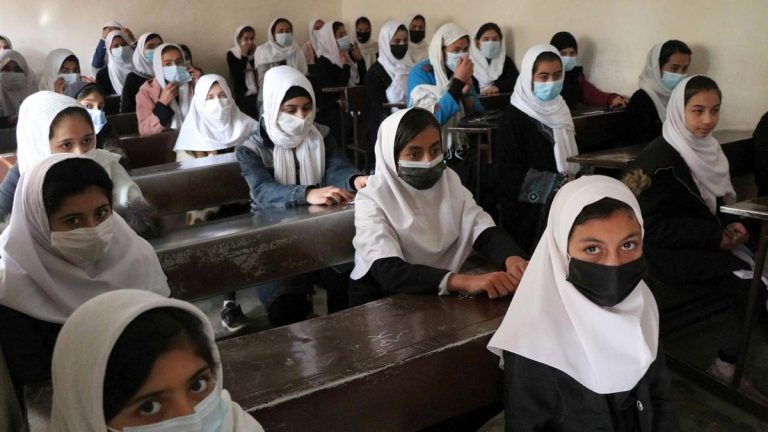
A BAN on girls singing in public imposed by Afghan education officials last week has been overturned after a social media campaign that included local women uploading videos of themselves belting out their favourite songs.

Schoolgirl choirs are a regular feature of official Afghan events, but when education authorities in the capital Kabul banned the participation of girls over the age of 12, it prompted an immediate backlash.

The order raised fears that education officials were “Talibanising” the country, heralding a return to when the Taliban armed group barred the participation of women in almost all parts of society outside their own homes.

The education ministry issued a statement late on Sunday saying the ban “does not reflect the positions or policies of the ministry”.

The announcement followed a furious backlash from social media users using the hashtag #IAmMySong to raise awareness.

“In Afghanistan today the Ministry of Education suffocated the voices of our little girls by making it illegal for them to sing,” tweeted Shamila Kohestani, former captain of the national women’s football team.

“They are quite literally teaching girls that they have no voice. #IAmMySong.”

On Facebook, Tayeb Safa wrote: “I feel the Taliban are making a comeback”.

The controversy comes amid fears of a possible Taliban return to power as the US mulls pulling its remaining troops from the country in the coming weeks in accordance with a landmark deal signed with the armed group last year.

Peace talks between the Taliban and the Afghan government have largely stalled in recent months, while a targeted assassination campaign – including the murders of high-profile Afghan women – has further rattled the country.

Afghanistan continues to be one of the most oppressive countries for women.

Gains in urban areas, however, have raised hopes that opportunities for women were slowly gaining traction.

  • Al Jazeera and News agencies