Home Blog Page 376

Billionaire Robert F. Smith Donates $50 Million To HBCU STEM Education Initiative

FROM eliminating the student loan debt for Morehouse College’s 2019 graduating class to launching an internship program for students of color, billionaire Robert F. Smith has been dedicated to empowering the next generation of leaders.

His latest effort is focused on providing HBCU students with the support needed to pursue careers in STEM fields, HBCU Connect reported.

Smith recently donated $50 million to The Student Freedom Initiative. The nonprofit organization is centered on addressing the disparities surrounding student loan debt pertaining to students from disenfranchised communities.

The nonprofit not only provides students of color from low-income households with financial support, but it also aligns them with paid internships, tutoring and mentorships.

Juniors and seniors who are pursuing STEM-related degrees at historically Black colleges and universities will be eligible to receive support through the initiative over the next five years. Participating HBCUs will be unveiled in November.

“Each year, thousands of Black graduates from HBCUs across America enter the workforce with a crushing debt burden that stunts future decisions and prevents opportunities and choices,” said Smith, who serves as Board Chair of the organization.

“A college education should empower and prepare our next generation for a limitless future. The initiative is purposefully built to redress historic economic and social inequities and to offer a sustainable, scalable platform to invest in the education of future Black leaders. I urge others to join this important cause so that together we can liberate the human spirit.”

Smith’s generous donation comes after the nonprofit received $50 million in June from the Fund II Foundation.

Many efforts are being led to support the financial futures of HBCU students as well as the financial stability of HBCU institutions. The Alpha Kappa Alpha Sorority recently raised over $1 million to donate to historically Black colleges and universities.

(SOURCE: NEWSONE)

Gunmen Storm School In Cameroon, Killing At Least 7 Learners

0

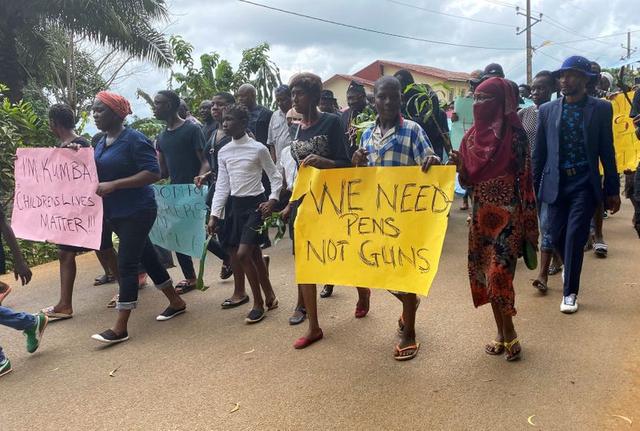
GUNMEN stormed a school in Cameroon on Saturday and opened fire indiscriminately, killing at least six children and wounding about eight more in a region where separatist insurgents operate, officials and parents said.

Arriving on motorcycles and in civilian clothes, the attackers hit the school around midday in the city of Kumba in South West Region, according to the accounts, including from one parent outside the school at the time.

Some children were injured jumping from second storey windows.

It was unclear if the attack was linked to an ongoing struggle between the army and groups seeking to form a breakaway state called Ambazonia in the English-speaking west.

But it was a grim new low in a region that since 2017 has seen hundreds die and thousands displaced because of the conflict, with many children unable to attend school.

 “They found the children in class and they opened fire on them,” city sub-prefect Ali Anougou told Reuters.

Isabel Dione ran into the school to search for her 12-year-old daughter when she heard about the shooting. She found her on the floor of a classroom, bleeding from the stomach.

“She was helpless and she was shouting ‘mum please help me’, and I told her ‘only your God can save you now’,” Dione told Reuters.

The girl was rushed to hospital where she is undergoing treatment for a gunshot wound.

The United Nations’ Office for the Coordination of Humanitarian Affairs said eight children were killed, some by machete, and that 12 were wounded.

Videos circulating on social media filmed by local journalists showed adults rushing from the school with children in their arms, surrounded by wailing onlookers.

One photo verified by Reuters showed the inside of a classroom, where dried blood had pooled on the floor near some scattered flip-flops.

Local education official Ahhim Abanaw Obase confirmed six deaths of children aged between 12 and 14, and added that another eight had been taken to hospital.

Anougou and another official blamed the attack on the secessionists, but did not offer evidence.

Prominent separatist leader Ayuk Tabe described the attack as “inhumane” in a Twitter post and said “anyone responsible for these atrocities must be brought to book.”

Still, many armed splinter groups have emerged from inside the separatist movement since 2017, and one voice rarely speaks for all.

Anglophone secessionists have imposed curfews and closed schools as part of their protest against President Paul Biya’s French-speaking government and its perceived marginalisation of the English-speaking minority. Rights groups have documented abuses on civilians from both sides.

Last year, officials blamed separatists for kidnapping dozens of schoolchildren, which separatist leaders denied.

(SOURCE: REUTERS)

EC MEC Fundile Gade Lambasts SITA For Taking R528m Matric Tablet Contract To Court

0

NYAKALLO TEFU

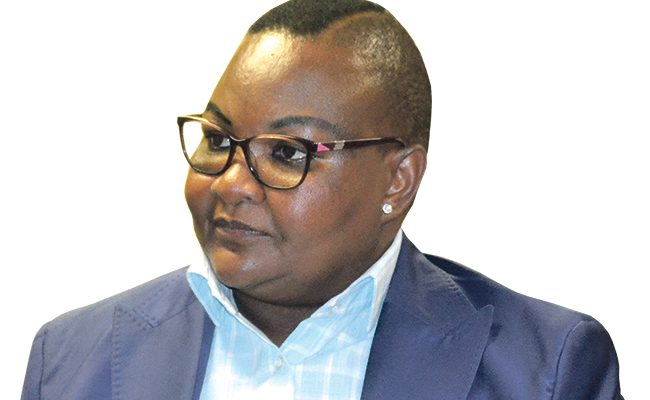
THE Eastern Cape Education MEC Fundile Gade slammed the State Information Technology Agency (SITA) for questioning the department’s decision to proceed with e-learning in the province.

This comes after the provincial education department’s decision to go it alone by providing matric learners with tablets as part of its broader strategy to introduce e-learning in the province.

SITA, which falls under the Communications Minister Stella Ndabeni-Abrahams’ department, argues that every department in South Africa must procure all information technology goods or services through state agency.

SITA also argues that allowing the Eastern Cape department of education (DoE) to continue implementing the suspended e-learning tablets project will give EC matriculants a “perverse” advantage over matriculants from other provinces in forthcoming examinations.

SITA has since taken the R528 matric tablet contract between the Eastern Cape Education Department, Sizwe Africa IT Group and MTN on review.

But in an exclusive interview with Inside Education, MEC Gade said they were going to court with SITA on the basis of the regulation that his department should have bought the tablets via SITA, in terms of the Section 7 regulation.

The department lodged the papers with the court on Tuesday to argue that SITA is incapable of delivering the matric tablets.

“Our argument is very strong because we are saying that SITA indicated its inability to serve the people of the country, and wrote two circulars in 2018 and 2019 that it is incapable of carrying out the mandate designated to them,” said Gade.

The MEC added that after the circulars from SITA, they have not received anything that indicated that they were now ready, hence its decision to get procure tablets elsewhere.

Reports had indicated that 55 000 learners were supposed to receive tablets from the Eastern Cape Education Department.

The MEC says only 6 of them have not been delivered to learners.

“We have delivered almost all the 55 000 of the tablets to all the schools that have been designated to receive them. The only tablets that in our records have not been delivered are just 6 of them, due to them not having the correct information installed in them,” said Gade.

“We feel very strongly that there are learners from disadvantaged communities, which should have been taken care of by the government and leave out the fact that they are learning in established communities.”

(COMPILED BY INSIDE EDUCATION STAFF)

Limpopo Education MEC Polly Boshielo Defends Centralization of PPE Contracts

0

NYAKALLO TEFU

LIMPOPO MEC for Education MEC Polly Boshielo has defended her department’s decision to centralize personal protective equipment (PPE) contracts.

This follows a furore by some principals and school governing bodies (SGBS) in Limpopo who lodged complaints with the Office of the Public Protector about being excluded from procurement of PPEs.

The Public Protector is currently investigating allegations of PPE corruption, including how certain provinces procured multimillion-rand contracts at inflated prices.

The investigations by the Public Protector come after the Special Investigating Unit (SIU) launched a separate probe into tenders for PPE in Gauteng, the country’s economic heartland.

This after politically connected individuals, including former presidential spokesperson Khusela Diko, illegally benefited from government contracts for the supply of PPEs to contain the spread of Covid-19.

In an exclusive interview with Inside Education, Boshielo said she had already met with the Public Protector Busisiwe Mkhwebane over the procurement of PPE saga in her department.

Boshielo said she was satisfied that all PPE contracts given by her department were above board, and most importantly, benefitted the majority of local businessmen in Limpopo.

“We don’t have any problems with PPE in Limpopo. We don’t have any complaints as a department. The question was how do you do procurement at more than 3 000 points or schools,” said Boshielo.

“I am proud that the tenders of PPE benefitted local businesses. It would have been a recipe for disaster [had we not centralized procurement]. There are SGBS and principals who complained but we have taken them to court and dismissed some of them because they didn’t follow processes, including norms and standards.”

Last month, the Sunday Independent reported that a businessman has taken the Limpopo Department of Education to court after it cancelled his R6.7m personal protective equipment (PPE) contract, allegedly because MEC Polly Boshielo was “angry” over the one-hour delivery deadline miss.

Delton Makubane claimed the department terminated the contract awarded to his company, Mhlekazi Group of Companies, even though he had informed relevant officials about possible late delivery every step of the way.

Makubane said his company was initially given 24 hours to supply more than 7 000 digital thermometers before the LDOE withdrew the appointment letter long after the PPE had arrived at the warehouse in Seshego near Polokwane.

(COMPILED BY INSIDE EDUCATION STAFF)

Over 30 Fort Hare Students Now In Quarantine After Attending ‘Wild’ Tavern Parties

NYAKALLO TEFU

THE Eastern Cape Health Department has launched a testing and tracing campaign following a recent outbreak of COVID-19 at the University of Fort Hare’s East London campus.

This, after 30 students tested positive amid allegations of non-compliance to Alert Level 1 Regulations where masks were not worn, social distancing not observed and non-sanitizing of hands not done at a tavern in Quigney on October 3.

Department spokesperson, Siyanda Manana said most of the students that tested positive are from the Nursing Science Faculty and, to a lesser degree, the Law Faculty.

“Students that have attended the parties confirmed that Lockdown Regulations were not adhered to. Patrons who were at the tavern were allegedly more than 300, some allegedly been drinking from one bottle and dancing close
to each other”, he said.

He said the students were quarantined and isolated at the Alice Campus where the University had set aside a residence with 134 rooms.

Manana says they fear a second wave of COVID-19 and there might be a resurgence of the pandemic.

Manana has urged people to avoid places where there are large crowds.

“We have seen an increase in the numbers as the Levels of Lockdown were brought down by the government, however people seem to think that COVID-19, is no more”, Manana said.

(COMPILED BY INSIDE EDUCATION STAFF)

Confidential Report Exposes The Rot At Centre Of NSFAS

NYAKALLO TEFU

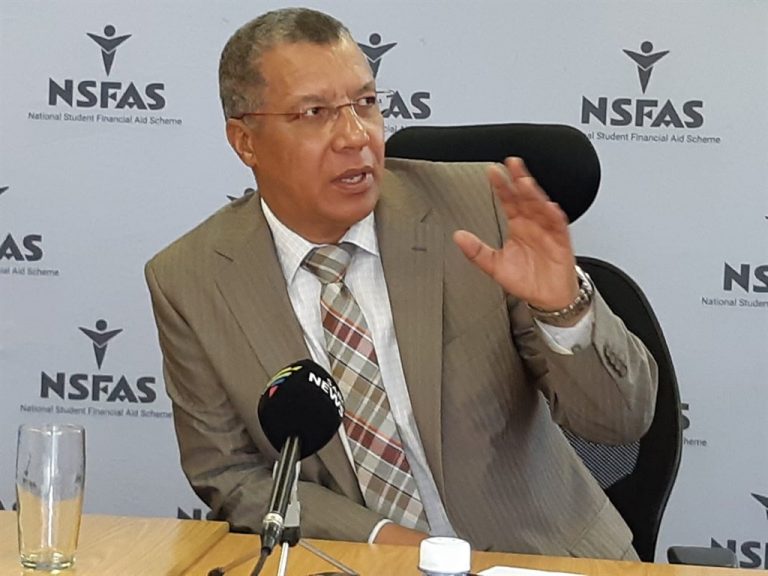
A report by NEHAWU tabled in Parliament has detailed how National Students Financial Scheme’s administrator Randall Carolissen made irregular appointments without following proper processes.

The report was submitted to the portfolio committee on higher education, science and technology.

The report shows that no processes were followed in the recruitment of senior management staff at NSFAS under Carolissen.

Nehawu alleges that this was done in order to create positions for Minister Blade Nzimande’s preferred candidates.

Nehawu claims that Sibongile Mncwabe, a former PA and Acting Chief of Staff to the Minister of Higher Education and Training, “is overseeing all the HR matters at NSFAS in order to open an opportunity for ‘nepotism’.”

Nehawu also claims that Nzimande extended the term of the administration for a period of four more months from September to December 2020.

This was done silently, without the Government Gazette and consultation with stakeholders, according to Nehawu.

“The Minister did not consult with key stakeholders prior to the extension, for example, NEHAWU and SASCO were not consulted,” the union said.

“This appointment has serious constraints on the fiscus due to lack of funds within the government.”

The union also claimed that there has been unnecessary and illegal extension of contracts for the team of NSFAS advisors.

“The extension of all Advisors amounts to fruitless and wasteful expenditure as they all earn around R2 Million each per annum,” said Nehawu.

“In addition to salaries, each advisor receives a package which includes unlimited flights home (similar to members of Parliament), month to month car rentals, airport shuttles and V&A luxury apartments. Some of the Advisors appointed themselves into Executive positions at NSFAS, making them permanent employees before the end of the Administration period.”

NSFAS has denied Nehawu’s allegations.

In its report to Parliament, NSFAS said the administrator, in consultation with Nzimande, acquired the requisite ministerial approval to appoint advisors, in accordance with the legislative prescripts.

“The process of identifying candidates for appointment was therefore a collaborative process with nominations for the various advisory roles sought from: The Administrator; the Department of Higher Education and Training; and the Minister,” said NSFAS.

“The selection of the Advisors was based on their areas of knowledge, expertise and experience, as well as their availability for a short-term role.”

(COMPILED BY INSIDE POLITICS STAFF)

12 Million Children Missed Up To 4 Months Of School Due To COVID-19, Insecurity In Africa

0

AT LEAST 12 million children across Africa’s central Sahel region have been forced out of school as a result of the coronavirus pandemic as well as widespread conflict, a humanitarian group said Monday.

In a statement, the Norwegian Refugee Council (NRC) said children had missed up to four months of school across Burkina Faso, Mali and Niger due to COVID-19 restrictions, while 776,000 could not attend school the entire year due to insecurity in the region.

“Children are in the midst of a dual health and security threat in the central Sahel. All the 40,000 schools in the region were forced to close because of the pandemic, pushing students from pre-school to secondary levels out of class in an area where access to education is often already hampered by growing insecurity, repeated displacement and poverty,” the statement quoted Maureen Magee, the Regional Director of NRC in Central and West Africa, as saying.

Magee added that 4,000 schools have been shut down or razed. While schools begin to reopen in the region, the main parts of educational facilities still lack the necessary resources to halt the spread of the deadly virus.

NRC said that only 15% of 18,000 schools in Nigeria have water points while in Burkina Faso the lack of rooms increases the risk of COVID-19 transmission.

Apart from unacceptable conditions, the raging conflict in the region makes it impossible for many children to get a proper education.

Some 90 attacks were recorded in the central Sahel between January and July 2020 alone.

The highest number of attacks such as arson, looting of schools, abduction, threats and killing of teachers was reported in Burkina Faso with more than 40 incidents.

“Too many children whose lives are already devastated by conflict, now watch their future hang by a thread.”

“The situation for students in conflict-affected schools in Burkina Faso, Mali and Niger remains at a standstill. Over 4,000 schools remained closed for 776,000 students because of insecurity alone during 2019-2020 school year. This is almost twice as much as in 2018-2019,” said the NRC.

Last week, the U.N. High Commissioner for Refugee (UNHCR) said urgent efforts are needed to avoid the “disastrous consequences” of a rapidly worsening humanitarian crisis in the central Sahel region.

To discuss the issue, Denmark, in partnership with Germany, the European Union and the United Nations, is hosting a ministerial roundtable conference for the central Sahel on Oct. 20 in Copenhagen.

“Tomorrow’s pledging conference on the central Sahel must place education and protecting schools firmly on its agenda. It cannot be the site of broken promises once again.”

“Only real political commitments commensurate with the education stakes in the region will enable children to turn over a new leaf and write a brighter chapter for the next school year,” said Magee.

(SOURCE: DAILYSABAH)

Fourways Chess Star Kajol Naidoo Is Voted Sports Achiever Of The Year

0

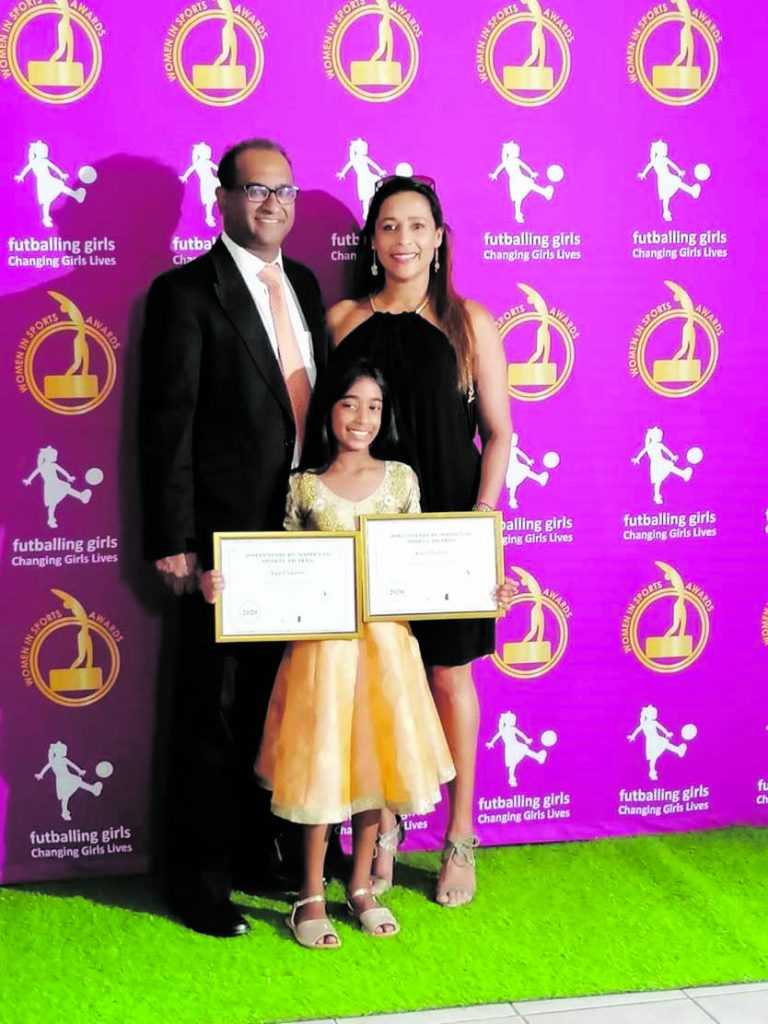
YOUNG Fourways chess player, Kajol Naidoo (9) was awarded Sports Achiever of the Year as well as Sports Athlete of the Year at Johannesburg Women in Sport Awards.

The ceremony, which was held virtually, was hosted by the Johannesburg Sports Confederation in conjunction with the Joburg Metropolitan Council. The finalists for the various categories were selected after what is said to be a rigorous nomination process.

Kajol impressed judges with not only her chess achievements and love for the sport but also for her dedication. Coupled with this, Kajol still found the time and resource to give back to the City by upskilling and sharing her knowledge.

Her father, Gerard, explained she was nominated by Joburg Metro Chess as she is the 2019 U8 girls South African national champion and represented the country in India at the Commonwealth Chess Championship in June.

In the same year in August, she attended the World Chess Cadets Championship in China. “Kajol is also the U8 girls South African Schools individual chess champion (July 2019), and she won gold at the African Youth Chess Championship for U8 girls in Namibia in December 2019.”

The Radford House learner went on to be the only U10 girl player in the category Team A, at the South African Junior Chess Championship in January this year, where she won all her games and her board prize. Her team also broke a long-standing record to have the highest score across all rounds.

Back in February, Kajol won the Gauteng Primary School Female Athlete of the Year Award.

Despite intensive coaching and tournament routines, she finds downtime and relaxation in the outdoors and with her pets, swimming, biking, hiking, running, sketching, painting, playing with Lego and watching movies.

“I am so excited having won these prestigious awards and want to thank my parents, coach Craig Bornheim, and God. I can’t wait to move from Internet tournaments back to the board and to travel internationally and play and win again.”

(SOURCE: FOURWAYSREVIEW)

South Africa Needs Laws To Deal With Deepfakes, Writes UJ’s Professor Tshilidzi Marwala

PROFESSOR TSHILIDZI MARWALA

IT IS election season once again in the United States, and if the latest polls data is anything to go by (and barring anything unusual) Donald Trump will lose this election.

His victory in 2017 was aided by the confluence of Facebook, Cambridge Analytica, Big Data and Artificial Intelligence (AI). We now live in an era where we are always connected to an electronic device, whether we are on Twitter, Facebook, or even WhatsApp.

Being connected means that we are being tracked and consequently influenced to act in a particular way. This influence includes what we buy and how we vote.

One could conclude that we are surrendering our democracy to machines.

Nevertheless, what is wrong with intelligent machines? If intelligent machines can monitor our vital data, determine whether we are at risk of dread diseases, and alert a doctor, why complain about the machine? Machines bring many good attributes to our lives.

Though machines, just like humans, discriminate against ethnic minorities and poor people, they are more correctable than humans are. For example, police in the US use Idemia, which scans faces using algorithms. Yet, results from the National Institute of Standards and Technology have indicated that two of Idemia’s algorithms were more likely to confuse black than white faces.

Machines are corrected by infusing them with representative data while human beings require more than education to be taught not to discriminate.

With the problems we face in the judiciary, where there are accusations of bias, we should perhaps start to think seriously about replacing our lawyers, judges and leaders of Chapter 9 institutions with AI machines. This is serious because AI machines are proving to be more rational and thus logical than human beings.

Going back to Trump, the question becomes, what can go wrong with an election? Recently, I read the book Deep Fakes: The Coming Infocalypse by Nina Schick. One of the big fears about elections is deepfake technology.

They are called “deep” because they are based on deep neural networks, which relate the input (a person’s facial image) to the output (another person’s body). Facebook uses deep neural networks for facial recognition to automatically label images when they are uploaded.

 These deep learning neural networks have been used to create the generative adversarial networks (GANs) that are able to fake a person saying things that they did not say and create images of people that have never existed. In fact, this is akin to transposing the face of one person onto another.

GANs are made of two neural networks with one generating an image or data and another one classifying whether it is real or fake. This continues until the network that is generating the data is so good that the classifiers think they are real. The competition between the generator and classifier networks is called game theory.

GANs can be used for essential functions such as estimating missing data, including pictures that are not complete. For example, they have been used to complete images of incomplete statues of Roman emperors from 2,000 years ago.

GANs can be used to harm people. For example, the first iterations of GANs were used to place female celebrities into fake pornographic movies, showing how fundamentally patriarchal our global culture is. While disturbing, these videos are remarkably convincing.

According to visual threat company, Sensity, non-consensual deepfake pornography accounted for 96% of the total deepfake videos online with 99% of those mapped faces from female celebrities on to porn stars.

The impact of deepfakes in influencing public thought is already apparent. As Quartz journalist Olivia Goldhill put it in November 2019, “Today’s sexist weapon is tomorrow’s political tool”.

For instance, in 2019, a video of Nancy Pelosi, the speaker of the US House of Representatives, was intentionally slowed by 25%, altering the pitch to make it appear as though she was slurring her words.

The video, which went viral after it was initially posted on a Facebook page called Politics Watchdog, is an example of a deepfake. While many amusing doctored videos like this are available online, the use of them in politics presents a disturbing reality. How do we discern the fake from the genuine?

The Pelosi video prompted US intelligence officials to issue a warning ahead of the 2020 elections about the use of deepfakes to influence political campaigns.

In another instance, a deepfake was created to make it seem like Barack Obama had used some unfavourable terms to describe current US President Donald Trump. The potential for disinformation to spread and for public thought to be swayed is stark, and there is an opportunity for these videos to be used to swing elections.

In a political campaign created by RepresentUS, a grassroots anti-corruption organisation, manipulated videos of North Korean dictator Kim Jong-un and Russian President Vladimir Putin were used to warn Americans that their democracy is in danger. Using this technology, people can be created. 

ThisPersonDoesNotExist.com, for example, provides a snapshot of how easy it is to create a new face and transplant your views onto it – effectively creating an AI human that is disturbingly realistic.

As the creator of the website, Phillip Wang put it, “most people do not understand how good AIs will be at synthesising images in the future”.

Deepfakes fall under the general area of information warfare. What can South Africa do to protect people from deepfakes? Firstly, we need to understand what deepfakes are.

Secondly, we need to understand the underlying technologies driving deepfakes.

The underlying technologies driving deepfakes are AI, machine learning, big data and social networks. Thirdly, we need to come up with strategies to control or limit the negative impact of deepfakes.

This should include introducing laws that specifically deal with deepfakes.

Furthermore, it should include capacitating our national intelligence sector to have the capabilities to develop and deploy technologies that limit the proliferation of deepfakes.

  • The views expressed in this article are that of the author/s and do not necessarily reflect that of the University of Johannesburg.


Nigeria: Adamawa Teacher, Oluwabunmi Anani Wins 2020 Maltina Teacher of the Year Award

IN 2015, Nigerian Breweries-Felix Ohiwerei Education Trust Fund introduced the Maltina Teacher of the Year, a national competition, to identify, honour and reward outstanding teachers in Nigeria.

Anani Oluwabunmi, a teacher at Concordia College, Yola, Adamawa State, has emerged the 2020 Maltina Teacher of the Year.

Anani, an English teacher was declared the winner at the grand finale held on Friday, October 16, 2020, at Eko Hotel & Suites, Victoria Island, Lagos.

For emerging the winner of the 6th edition of the Maltina Teacher of the Year, Anani will receive a total cash prize of N6.5 million (N1.5million immediately and N1million annually for the next five years) from the Nigerian Breweries – Felix Ohiwerei Trust Fund.

She would also have the privilege to be part of an all-expense paid capacity development training abroad while a fully equipped computer laboratory or six-classroom block worth N20 million will be built for her school in her honour by the Fund.

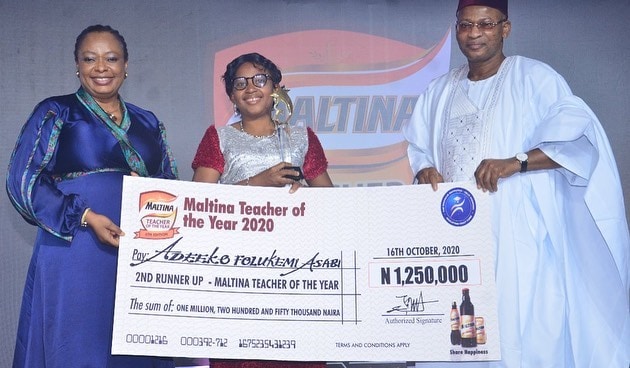
Idele Benedicta, a teacher from Asoro Grammar School Senior, Egor, Edo State emerged the first runner-up winning a total of N1.5 Million while Adeeko Folukemi, a teacher from Patterson Memorial Baptist Grammar School, Abeokuta, Ogun State emerged as second runner-up with a prize of N1, 250.000.00. Other 27 teachers who emerged as state champions were also rewarded with a sum of N500,000 each.

Speaking at the event, the Minister of State for Education, Honourable Chukwuemeka Nwajiuba commended the company’s unflinching commitment in supporting the education sector by rewarding high performing teachers through the annual Maltina Teacher of the Year initiative.

Mr Nwajiuba noted that it was heartwarming to note that the company is keeping faith with such exemplary initiative despite the disruptive impact of the coronavirus pandemic on businesses and economy.

In his welcome address, the Managing Director, Nigerian Breweries Plc, Mr. Jordi Borrut Bel explained that the initiative was designed to recognize, celebrate and motivate teachers whose stories have become great reminders of their role in laying the foundation for a good society.

While congratulating the finalists alongside state champions for coming this far, he stated that the role of teachers cannot be underestimated given their contribution to shaping and moulding lives. “With the Maltina Teacher of the Year, we are saying that our teachers can and should be rewarded for their roles in the development of our nation”, Bel said.

Also speaking at the event, the Honourable Commissioner of Education, Lagos State, Mrs. Folashade Adefisayo who represented the Executive Governor of Lagos State, Mr. Babajide Sanwo-Olu commended Nigerian Breweries Plc while noting that teachers play a significant role in nation-building given their contribution in imparting knowledge in the lives of their students.

In her remarks, the Corporate Affairs Director, Nigerian Breweries Plc, Mrs. Sade Morgan stated that the sixth edition was a clear improvement from the preceding year in terms of participation as the initiative received 1234 entries from teachers all over the country despite the short submission period and other challenges caused by coronavirus pandemic.

Morgan commended the resilience and uncommon passion of teachers for defying the odds by finding new ways to teach students virtually despite the technological limitation noted that their contribution during the difficult period lends credence to their critical role in societal development.

Speaking shortly after she was announced as the winner of the coveted prize, Anani thanked Nigerian Breweries Plc, Maltina for putting smiles on the faces of teachers through this initiative by rewarding and recognizing them.

Since inception, the Maltina Teacher of the Year initiative has produced six grand winners, Rose Nkemdilim Obi, Anambra (2015), Imoh Essien, Akwa Ibom (2016), Felix Ariguzo, Delta State (2017), Olasunkanmi Opeifa, FCT (2018), Ezem Collins (2019) and now Oluwabunmi Anani.

ABOUT MALTINA TEACHER OF THE YEAR

In 2015, Nigerian Breweries-Felix Ohiwerei Education Trust Fund introduced the Maltina Teacher of the Year, a national competition, to identify, honour and reward outstanding teachers in Nigeria.

Maltina Teacher of the Year is supported by the Federal Ministry of Education other stakeholders in education including the Nigeria Union of Teachers(NUT), All Nigeria Confederation of Principals of Secondary Schools (ANCOPPS) and Teachers Registration Council of Nigeria (TRCN).

ABOUT NIGERIAN BREWERIES-FELIX OHIWEREI EDUCATION TRUST FUND

The Nigerian Breweries-Felix Ohiwerei Education Trust Fund was set up in 1994 with a startup capital of 100 million Naira to enable sustained quality education through structured intervention in the sector.

The Fund has footprints across the six geographical zones in Nigeria at primary, secondary and tertiary levels of education. Through the Fund, NB Plc has constructed and furnished over 400 classrooms, sanitary facilities and libraries in 74 communities across the country. The Fund has also granted scholarships to deserving students in tertiary institutions.

ABOUT NIGERIAN BREWERIES PLC

Nigerian Breweries Plc, incorporated in 1946 is the pioneer and largest brewing company in Nigeria. With 23 malt and beer brands within its portfolio, it serves the Nigerian market and exports to other parts of West Africa. Nigerian Breweries Plc which is driven by the corporate philosophy of “Winning with Nigeria”, has continued to take an increasingly active part in supporting education, amongst our other CSR focus areas.

(SOURCE: PREMIUMTIMES)