Home Blog Page 420

COVID-19 Crisis: DBE Announces Phased Re-Opening of Schools for Matrics and Grade 7 Learners

0

Charles Molele and Nyakallo Tefu

Department of Basic Education on Wednesday announced guidelines to reduce the risk of coronavirus infection in schools that are scheduled to re-open next week after month-long closures, calling for thorough sanitization of all schools and warning against gathering in cluster groups.

The guidelines also requests compulsory wearing of masks throughout the school day by learners and teachers, including physical distancing in classrooms and total avoidance of hugging, handshaking and direct contact.

If an infection is suspected or detected, the infected learner or staff member will be considered for isolation and testing.

 These and other stringent measures were announced on Wednesday by Basic Education Director-General Hubert Mweli during a joint meeting between the portfolio committee on basic education and the select committee on education and technology, sports, arts and culture.

The health and safety measures affects more than 12 million learners in South African public and private schools, and 407 001 educators accounting for  23 076 schools in the country.

Early this week, Inside Education reported that  Basic Education Department has proposed a phase-in approach in a leaked confidential document labelled Framework for a Curriculum Recovery Plan- Post Covid19 that will see only Grade 7 and Grade 12 returning to school on May 6, an increasing number of stakeholders, including senior government officials have warned against allowing lower grade learners back in the classroom at the height of the pandemic, saying the action would put the lives of many learners at risk.

https://insideeducation.co.za/government-lobbied-to-limit-re-opening-of-schools-to-grade-12-learners-only/

Mweli said the department will ensure that learners go back to an environment that is safe against any outbreak of COVID-19, which was already claimed 92 lives and infected 4 996 people since the outbreak of the deadly virus since the Spanish flu in 1918.   

Mweli further announced a draft amended school calendar for the 2020 academic year, saying teaches would return to school by the 4th of May, with learners back in the classroom on the 6th of May.  

According to Mweli’s 50-page COVID-19 Basic Education Sector Plan, the re-opening of schools would be phased in, starting with Grade 7 and Grade 12.

The sector plan stipulates that all learners, educators and support staff will receive orientation and training at the start of the school reopening next week, commencing with Grade 7 and 12.

Teachers and learners will also be screened for temperature checks before the resumptions of classes.

“Grades 12 and Grade 7 are phased in first because these are your older, matured and much more aware learners who’ll have adequate infrastructure in primary and high schools. For younger learners, when they come they’ll help to orientate them,” said Mweli.

While the original school calendar year started on 15 January 2020 and would have ended on 4 December 2020, the amended school calendar will end on 9 December 2020.

Mweli said the grades will be phased-in, starting with Grades 7 and 12.

“The lost school days will be recovered by shortening the June holidays to 5 days and the September holidays to a long weekend in order to make up these days. The 4th term will also be lengthened to close on 9 December 2020 for learners and 11 December 2020 for teachers,” said Mweli.

He said the Grade 12 will be expected to write the set fully fledged examinations, based on covering the entire curriculum and other grades will be given a reworked curriculum and assessed on 80%.

The May-June Exams for the National Senior Certificate (for Grade 12) will now be combined with the October-November Exams and rescheduled for November-December 2020.

In addition to safety measures, content in Life Orientation and Skills will be rearranged to address personal hygiene, self-study skills, emotional and psychological trauma at South African schools.

Every lesson should contribute five minutes teaching awareness on COVID-19, Mweli to the joint portfolio committees in education.

“Before teachers teach, each subject must dedicate 5mins to raise awareness about the Covid-19 pandemic. They should not only hear about the coronavirus during orientation, they should learn about it like other learners did when HIV/AIDS hit the world,” said Mweli.

Basic Education Department also announced that procurement of Personal Protective Equipment (PPE) will be centralized as set out by National Treasury regulations.

National Treasury has already contracted the Tshwane-based company Imperial Health Sciences, a decision which has been widely criticized by some in business and government.

IHS is a business unit of logistics giant Imperial South Africa.

The non-executive directors of the multinational company include Phumzile Langeni, Graham Dempster and Peter Cooper.

Langeni is one of President Cyril Ramaphosa’s special investment envoys.

The Portfolio Committee on Basic Education, and the Select Committee on Education and Technology, Sports, Arts and Culture announced on Wednesday afternoon that it welcomed the sector plan and commended the Department of Basic Education for re-opening schools as this would likely also lead the country to get ready and most likely also lead the country to move to a lower level regarding the Covid-19 lockdown. 

The portfolio committee’s chairperson Bongiwe Mbinqo-Gigaba said she appreciated the work done by the DBE behind the scenes.

“Please communicate so our people know what is happening. If there are changes, please inform the public. We are all stressed. But we need to work together. Even if our kids go back to school there will be challenges and our responsibility as MPs is to support and assist and report for those challenges to be rectified,” she said after the presentation.

The committee also commended the department for its efforts in getting the sector ready for the start of schooling next month.

This includes providing masks to learners up to quintile 4 and to all teachers, a basic sanitation and hygiene package, mobile facilities to replace pit latrines, cleaners, screening, additional teaching posts as no classes should have more than 40 learners, additional substitute posts, provision of mobile classrooms to deal with overcrowding as a temporary measure, and incubation camps for progressed and weaker learners, especially in Grade 12, she said.

Meanwhile, SA Democratic Teachers Union reiterated its position on Wednesday that no school should be open until all safety concerns were addressed.

“We urged Department to comply with minimum requirements which we articulated in 14 points,” Sadtu said in statement.

“These included among others, the fumigation and disinfection of schools, proper school infrastructure in the form of proper toilet facilities, observance of social distancing inside the classrooms and on court yards, reduction of class sizes, provision of soap, sanitizers and masks, screening of learners, teachers and support personnel, social distancing in transportation of learners to and from schools and provision of psycho-social services.”
‘Clueless’ Higher Education Minister Failing University Students: EFFSC

0

Nyakallo Tefu 

The Economic Freedom Fighters Student Command (EFFSC) has accused Higher Education Minister Blade Nzimande of ‘inaction’ and ‘indecisiveness’ on how best to deal with the commencement of the 2020 academic year at universities and TVET colleges in the face of the coronavirus crisis.

In an interview with Inside Education this week, EFFSC President Mandla Shikwambana said Nzimande should stop running away from dealing with the issues of remote online learning and the commencement of the 2020 academic year. 

“Minister Blade Nzimande cannot keep running away from us, he needs to address the issues at hand because running away will not work for his department,” said Shikwambana.

“I don’t know if Minister Nzimande is becoming too old to deal with issues of the ministry of Higher Education, but we have never seen any leadership from him up to so far. He is not coming forward with directions. He is just quiet.”

The Departments of Higher Education and Basic Education twice postponed scheduled media briefings on how to go about re-opening schools during the Level 4 lockdown.

Shikwambana said they have written to Nzimande to provide electronic devices for all students (laptops and tablets), data to all students and that all university websites and TVET college websites must be free to access for all students.

He said government should also ensure that network coverage is improved for all students to be able to commence with learning online.  

“All institutions must create an institutional fund to address the issue of finance for all that the EFFSC is suggesting,” said Shikwambana.

The Democratic Alliance Student Organization’s (DASO) chairperson Kwena Moloto said his organization wanted all students to receive the same quality of education, regardless of where they come from.

“There needs to be constant communication across the sector to consistently keep tabs on how students are doing. No academic exclusions of the results that students receive during this time,” said Moloto.

“In addition, no student should lose their NSFAS or bursary based on the results that they receive during the course of this period and no student is charged in the following academic year for any modules that they have to repeat because of difficulties faced owing on to e-learning.”

There has been controversy surrounding the implementation of remote online learning at universities, with most student organizations and students saying that this new system will work against underprivileged students. 

However, some students say they have adapted to remote online and learning despite challenges elsewhere.

Fourth year student at the University of the Witwatersrand Sello Mathibela said the transition from contact lessons to online learning was hard but he eventually got used to it.

“I am actually enjoying it since the lessons are recorded for us to download. Basically, it is great and convenient”, said Mathibela. 

First year student at The University of Johannesburg Thoko Ndaba said online has been going very well for her her fellow students.

Wits has provided students with 30GB of data (10GB day and 20GB night), while UJ has given its students 30G of data (20G day and 10G night express). 

Shikwambana said as much as they are not against e-learning, they view this decision by the department of higher education as a premature solution for the academic year to continue. 

“We are saying that South African students are not ready for this way of learning, not only the students, but the institutions of higher learning and TVET learning”, said Shikwambana. 

Shikwambana added that the higher learning institutions do not have systems that will allow for online learning to be successful in the country. 

Students at some universities like the University of Stellenbosch and the University of Cape Town will only commence with the online system as from May 04. 

Moloto said DASO was the first to student organization to raise the issue online learning. 

“It is difficult times that we are facing and the reality is that we have to adjust because one thing we agree on as student organizations together with the department of higher education, is that we want to see the completion of the 2020 academic year,” said Moloto.

Students at UCT Forms COVID-19 Research Task Team

0

Faculty of Health Sciences students at the University of Cape Town have formed a special COVID-19 research task team to act as the official voice for COVID-19-related research projects and other interrelated functions in progress in the faculty.

In a statement, the university said the task team was formed as a subgroup of a broader group of academics, convened by the Dean of Health Sciences, Professor Lionel Green-Thompson, to coordinate teaching, clinical services, administration and social responsiveness initiatives.

Director of Research at the FHS and research task team coordinator, Dr Yolande Harley said following the outbreak of COVID-19 in South Africa and the subsequent lockdown, staff in the faculty received many requests for information about how research should be managed, how researchers could get involved with COVID-19 projects and the “rules” around COVID-19 research in particular.

The task team’s first priority was to establish the faculty’s approach to research-related activities during the pandemic. 

The document summarised key points, which includes prior COVID-19 communication, and provides additional information to “ensure appropriate research practice”. 

Research into COVID-19 currently underway, or in advanced stages of planning in the faculty, aims to understand a combination of primary, secondary and tertiary interventions to achieve “a meaningful degree of protection” against the disease.

Primary interventions refer to those that prevent patients from contracting the disease, supported by research on vaccine development.

Secondary interventions involve detecting the disease and preventing it from exacerbating, supported by research on diagnosis tools, screening strategies and pathogenesis.

Tertiary interventions concentrate on how to manage the disease and involve research on how to treat COVID-19 complications like cardiovascular, neural and respiratory problems.

Behind the scenes

Harley said that there’s been a hive of research activity progressing behind the scenes (while adhering to lockdown regulations). Each area, while different, has one common goal – to contribute to better managing the pandemic in the country and coming up with ways to deal with other future outbreaks.

“Quite a number of research groups in the FHS are planning and progressing [on] research projects that focus on the COVID-19 pandemic,” she said.

“These studies are tackling a range of challenges related to the virus and the disease it causes.”

Treatment trials

She said researchers are attempting to understand the process in which the virus spreads in the country, as well as how susceptible South Africans, including those infected with HIV and tuberculosis, are to COVID-19.

(Source: UCT) 

Ramaphosa: ‘Poverty, Unemployment and Inequality Continues To Stalk Our Land’

0

Cyril Ramaphosa

On this day twenty-six years ago, a new nation was born in Africa.

On the 27th of April 1994, the men, women and children of South Africa emerged from the dark vale of oppression to stand in the light of freedom.

As millions cast their votes for the first time, they boldly declared to the world that South Africa belongs to all who live in it.

The price of our freedom was paid by generations of patriots.

We pay tribute to the great leaders who resisted colonial domination and who fought for our liberation, both those who have left us and those who are still living. 

We remember Chief Albert Luthuli, Nelson Mandela, Govan Mbeki, Oliver Reginald Tambo, Walter Sisulu, Albertina Sisulu, Stephen Bantu Biko, Robert Mangaliso Sobukwe, Charlotte Mannya Maxeke, Ruth Segomotsi Mompati and Mam Winnie Madikizela-Mandela.

We remember John Langalibalele Dube, Dr AB Xuma, Sefako Mapogo Makgatho, ZR Mahabane, Josiah Gumede, Pixley ka Isaka Seme, King Cetswayo, King Hintsha, Makhanda, Sekhukhune, Makhado, Bambatha and the many brave leaders of the Khoi and San rebellions.

They watered the tree of liberty so we could enjoy its fruit and stand under its shade today. 

We honour their memory and the contribution of the many ordinary compatriots whose names are unknown but whose sacrifices were just as great.

Our Constitution, and the Freedom Charter from which it draws its inspiration, both begin with the words: ‘We, the People’.

They are an ever-present reminder that everything we have achieved as a young democracy and everything we hope to achieve is founded on the will of the people. 

Our Constitution is the defender of all who live in our great land, be they black or white, rich or poor, young or old, man or woman, citizen or resident.

Over the past 26 years we have made great progress in building a common future in which all South Africans have a part.

We have been building homes, schools, hospitals, clinics and universities. 

We have been providing water, sanitation and electricity to many South Africans who never had access to such services.

We have expanded access to health care and education.

We have been hard at work to rebuild our economy and strengthen our institutions.

We have initiated work, internship and study opportunities for young people, assisting them to secure jobs or to be self-employed.

We have accelerated programmes to give our people access to land, and returned land to those who were forcibly removed. 

We are supporting vulnerable families, parents, the elderly, persons with disabilities and our veterans with social grants.

Our young democracy has much to be proud of.

But the devastating legacy of our past runs so deep that at times we ourselves have been found wanting in addressing the suffering it has subjected our people to. 

Poverty and inequality continues to stalk our land. 

A child born to parents of means has a comfortable home, is fed and sheltered, receives a good education and has good prospects for a prosperous life.

For a poor child, every day of life can be a struggle for shelter, for food and for opportunity.

For such a child, their chances of finishing school, of studying further, of gaining useful skills and of finding a job are much smaller.

Even now, after all the progress we have made, the circumstances of one’s birth largely determines where and how we live, where we study, where we work and where we are cared for when we are sick.

It is the greatest form of injustice. It is a stain on our national conscience.

The triumph of 1994 was about much more than being able to vote. 

It was about setting right the wrongs of the past, about redress, restitution and restoration. 

It was about levelling the field for the black child and the white child, and making sure they each have an equal chance in life.

The promise we made on the 27th of April 1994 can no longer be deferred.

We must make real the right of all our people to health care, food, shelter, water, social security and land.

In this final decade of the National Development Plan, we must change the pace of social and economic transformation.

As a country, we are more than capable of building a more equal society where these rights are realised.

For as long as this is delayed, freedom for some is freedom for none.

This Freedom Day, we find ourselves engaged in a struggle that has thrown into sharp focus the poverty and inequality that still defines our society.

The coronavirus pandemic forces us to confront this reality. 

Though we are certainly all braving the same tide, we have not been impacted in the same way by this pandemic.

Some people have been able to endure the coronavirus lockdown in a comfortable home with a fully stocked fridge, with private medical care and online learning for their children. 

For millions of others, this has been a month of misery, of breadwinners not working, of families struggling to survive and of children going to bed and waking up hungry. 

The social relief measures announced last week that are now being implemented are therefore as much about narrowing the gulf of inequality as they are about supporting vulnerable citizens through this trying time. 

With every day that passes, this experience is teaching us much about ourselves, about our society and about our country.

We are learning about the limits of our endurance, about our relations with others and about our very nationhood.

The true lessons of this experience will not just be about the necessity of social distancing, proper hand washing and infection control.
 
They will also be about whether we have the ability to turn this crisis into an opportunity to invest in a new society, a new consciousness and a new economy.

In this new society, the privileged cannot afford to close their eyes to the plight of the poor and sleep peacefully at night. 

This is the time when we should actively work to build a fair and just country

In the South Africa that we all want, no man, woman or child will go hungry, because they will have the means to earn an income, and our social assistance programmes will be matched by efforts to enable communities to grow their own food.

In this new society, the provision of services to our people is the foremost priority of government.

The public servant understands that they are just that: a servant of the people.

Public representatives put the interests of the people ahead of their own.

Before this pandemic was visited on our country, we were deepening our efforts to address poverty, underdevelopment, unemployment and a weak economy.

This pandemic could set these efforts back by many years. 

It will take a great deal of effort and resources for our society and our economy to recover. 

The challenges we faced before this health emergency remain. 

Even as we turn the tide on the coronavirus pandemic, we will still have to confront a contracting economy, unemployment, crime and corruption, a weakened state and other pressing concerns. 

We will have to find new, exceptional and innovative ways to overcome them.

This is not something government can do alone. 

The collaborative spirit with which government, business, labour and civil society formations have worked to drive the national effort to combat the coronavirus is yet another affirmation of just how far we have come. 

Robust engagement, strong institutions, social compacting and consensus-building are all the fruits of the national democratic project that began in 1994.

The business community has shown itself ready and willing to support the workforce and to rally its resources to combat this disease.

The labour movement has worked with its partners in government and business not only to protect its members from the worst effects of this pandemic, but to champion the interests of the poor and unemployed.

Across society, NGOs, non-profit organisations, community bodies, religious communities and individuals are working together to defend our people against this virus and its damaging economic and social effects.

In doing so, they have demonstrated the solidarity and compassion that is at the centre of the concept of ubuntu.

As President Nelson Mandela said: “To be free is not merely to cast off one’s chains, but to live in a way that respects and enhances the freedom of others.”

Respect for the rights of others is the beating heart of freedom. 

Violating the coronavirus response provisions and exposing others to a potentially fatal illness is the worst form of disrespect for others.

This pandemic has changed the face of humankind, not just our country. 

It has reminded us of our own mortality, but also of how interconnected we are.

If we did not realise it before, we all know it now – that our interdependence is key to our very survival as a people. 

This Freedom Day let us stand united against this disease.

Let us also stand united against poverty, inequality and hunger.

We can only overcome this crisis and rebuild our shattered economy if we work together. 

Let the good that has come from this experience – of collective action and unity of purpose – continue. 

Let the generosity of spirit endure.

We owe it to the memories of those who came before us to live the values they cherished, of empathy, compassion and solidarity.

As we are reminded this Freedom Day, we have known far worse and we have prevailed.

Let us keep our arms locked together in a column of defence against this pandemic, a united people.

Let us use this crisis to reaffirm our resolve to fundamentally change our society.

Let us emerge from the coronavirus pandemic a better country, a more equal country.

This year, we are celebrating Freedom Day apart, each of us confined to our homes.

Next year – through your determination, through your courage and through your actions – we will once again celebrate Freedom Day together.

I wish you all a happy and, above all, a safe and peaceful Freedom Day. 

I thank you.

Government Urged To Limit Re-opening of Schools To Grade 12 Learners Only

0

Nyakallo Tefu

About 11 million South African learners might have to spend the rest of the 2020 Curriculum year doing online learning if a proposal by education stakeholders and senior government officials is endorsed by the National Coronavirus Command Council on Wednesday.

Disagreements over whether or not to allow all learners to return to school on May 6 has forced the Departments of Basic and Higher Education to twice postpone the scheduled meetings meant to announce the decision on Friday and Monday. 

While Basic Education Department has proposed a phase-in approach in a leaked confidential document labelled Framework for a Curriculum Recovery Plan- Post Covid19 that will see only Grade 7 and Grade 12 returning to school on May 6, an increasing number of stakeholders, including senior government officials have warned against allowing lower grade learners back in the classroom at the height of the pandemic, saying the action would put the lives of many learners at risk.

The number of COVID-19 cases in South Africa is rising rapidly across the country, even as the whole country is quiet and under lockdown.

By Monday this week, the number of Covid-19 cases in South Africa has increased to 4 793 and the death toll had also risen to 90. 

Gauteng (1 353), KwaZulu Natal (902) and the Western Cape (1 737) are the hardest hit, with a total number of 3 992 confirmed COVID-19 cases as of Monday evening.

Government insiders have told Inside Education that Gauteng is one of the provinces that have opposed proposals to re-open schooling for all learners at a go, as this would put the safety of learners at risk.

“Safety first. That’s our approach,” said a senior Gauteng Education official, who asked to remain anonymous.

He added: “We can regain the curriculum, but unfortunately we can’t regain a life. My worry is that parents can pressurise us about kids, but if one child dies or one child gets this thing [Coronavirus], we are going to be in trouble. We can only risk with matriculants. We can’t risk with others at lower grades. We honestly can’t,” said the senior Gauteng Education official. 

The official said the only reason Gauteng would agree that the Grade 12 learners go back to school was due to the fact that if they don’t, this will cause a serious logistical backlog for government. 

“There might be a generation that will not go to school and you don’t want that because if Grade 12s are still within the system you can’t have Grade 1. These things are interlinked. He said unlike Grade 7s, the Grade 12 would be able to exercise social distance,” said the senior government official.

“At least Grade 12s are adults. You can argue that they know the basics of social distancing and washing hands. But Grade 7s are still young,” said the senior Gauteng official.

National Teachers Union’s president Allen Thompson said his organization was opposed to universal opening of schools.

“We have recommended to the department not to open all classes but just for the matriculants as they will be able to take instruction,” said Thompson.  

“NATU is calling for Grade 12s to be prioritized because we believe they have capacity to follow health guidelines. Grade 7s are still young they won’t follow instructions.”

Thompson said while the teacher union could guarantee the safety of Grade 12s, it believed that Grade 12 learners were old enough to observe social distancing protocols.

“Remember that  we are not sure if Grade 12’s will be safe if they go back to school but they will be able to follow instructions as they are ready to go to tertiary institutions and even the work environment.  We believe they value life more than those coming from lower grades, they know that they are almost done. We believe they will subscribe to the precautions,” he said.

 Thompson said if they go back to classes, Grade 12 learners will be bale to subscribe to ‘necessary’ precautions as required by government.  

SA Democratic Teachers Union (SADTU) has meanwhile called on government to ensure that all safety measures are put in place two weeks before schools, universities and TVET colleges are re-opened.

“The first priority is the safety of all our learning institutions because we cannot afford to lose lives. Corpses can neither be taught nor teach”, said SADTU in a statement.

SADTU said it was, above all, ‘deeply’ concerned about the safety of teachers, lecturers, education support personnel, school learners and students.

“Above all, we are concerned about the readiness of the provincial departments with regard to the availability of health and safety essentials that have to be put in place in the learning institutions at least two weeks before any activity can take place,” it said.

“We have the right to be concerned because Alert 4 Level requires honesty, transparency and accuracy regarding readiness with precautionary measures. We are raising these things because our sister Union, DENOSA has raised these matters and provinces concealed the facts about their readiness until the Minister of Health was shocked when he visited one of the hospitals in the Eastern Cape. We believe education is an enabler. However, it can only be effective in a conducive and safe environment.”

Basic Education spokesperson Elijah Mhlanga has apologized for twice postponing the joint media briefing by the Departments of Basic Education and Higher Education.

“The education media briefing scheduled for tomorrow [Monday] has been postponed. We will issue a media statement soon. Apologies for the inconvenience caused,” said Mhlanga.

He said the debate and discussion on the postponed media briefing has been noted.

“We are tracking the infection rate of the Coronavirus. We are monitoring the behavior of people in relation to the regulations. We said from the start that compliance with regulations would determine the next course of action. Decisions on education are based on the assessment done daily. Whatever criticism you level against the Department do keep in mind that we are dealing with a dangerous virus which has killed people already,” said Mhlanga.

“We need to remember also that the Department had NEVER published a date for the reopening of schools. The anxiety is caused by fake news and leaked discussion documents. That context is critical, never lose sight of the fact that the COVID-19 is a new situation and we have no previous experience on it. The anxiety is understandable because this matter has got to do with people’s lives.”

Mhlanga explained that the Department is one of many other departments that are affected by the current situation.

“Cool heads are required at the moment, we need to make decisions based on scientific evidence. Those who insult us we really must understand, it’s probably the stress. There are parents who say children must go back to school and then you have others who say it’s dangerous to go back now.
We are in a situation where we are expected to reconcile clashing views into a position that will serve the interest all people. Let’s allow the National Coronavirus Command Council to deliberate on these matters and lead us. This is national matter that affects a whole range of stakeholders, not just for one Department. There will be a media briefing soon.”

Western Cape Education Offers School Teachers Tips on How To Teach Learners During COVID-19 Lockdown

0

Nyakallo Tefu 

The Western Cape Education MEC Debbie Schafer has offered teachers guidelines and programs to learn how to make use of online resources.   

Schafer said on Sunday that South African’s needs to start embracing technology and adapt to new challenges brought on by the novel coronavirus pandemic.

“I am very aware of the public sentiment around online learning in South Africa. It is true that not all learners have access to online resources and equipment that can make distance learning possible. I have addressed this in previous parts of this series, and will continue to do so later this week”, said Schafer.

The schools in South Africa have been closed since March due to coronavirus and no learning and teaching has been taking place.

The country has now moved to Level 4 lockdown as of 1st of May.  

This means that learners across the country will continue learning via online programs and teachers who have not familiarized themselves with the digital world have to do so.

“The world has already shifted into a digital landscape, and while we have certainly made great strides in educating our teachers in e-learning over the past five years, we need more teachers to embrace e-learning during these very unusual times, and beyond”, said Shafer. 

 On Sunday, the Western Cape education department published a document which seeks to assist principals and teachers on how to harness the use of technology while learners are still at home.

The link: (https://f3d3d181-c116-4916-98e1-e8d62066fbea.filesusr.com/ugd/be1865_56627c36882440939463f3d6c6a68b8c.pdf)

“There are multiple platforms and tools for online teaching and learning that could be used. Some are more complex than others, while others are already used by many in our daily lives, but just for other purposes,” said Schafer.

Therefore, the WCED has put together some simple guides to up-skill teachers in basic, yet valuable, digital activities.

·       How to download videos from YouTube: 

·       How to set up Facebook for learning & teaching:

·       How to use MS Teams for Education:

Online learning and teaching has been widely criticized in South Africa, with many highlighting that it means the less privileged will be left out as schooling resumes and they don’t have access to resources that have been offered to learners.

The Western Cape education department has also put together a number of programmes for teachers to take part in, for them to be more equipped for the digital world.

 Cape Teaching and Leadership Institute (CTLI) has also developed a course on self-paced learning. The Remote Teaching and Learning FOR TEACHERS course covers five modules to cater for a variety of different needs and interests in online learning:

·       Module 1: DIY Home Classroom

·       Module 2: Teaching Strategies

·       Module 3: Finding Digital Content

·       Module 4: Creating Content

·       Module 5: Sharing Platforms

This course can be accessed on both computer and mobile devices at https://wcedeteacher.wixsite.com/eteacher, or via the School Closure Pack on the WCED ePortal.

Several other smaller “quick and digestible” training snaps will also be prepared and made available e.g. training for teachers on broadcast presenting and how to record with video.

MEC Debbie Schafer: Quality Teaching At Home During COVID-19 Pandemic

0

By Debbie Schäfer, Western Cape Minister of Education

With schools closing all over the world due to Covid-19, online or distance learning have become the new buzz words in many countries.

I am very aware of the public sentiment around online learning in South Africa. It is true that not all learners have access to online resources and equipment that can make distance learning possible.

This, however, cannot be a reason to stop the Department from advancing in this area, and to encourage all teachers and learners to use it, where they can.

The world has already shifted into a digital landscape, and while we have certainly made great strides in educating our teachers in e-learning over the past five years, we need more teachers to embrace e-learning during these very unusual times, and beyond. 

I am not talking about teachers setting up elaborate online learning sites. I am referring to some of the most basic forms of technology or social media, which many South Africans have. These include the use of WhatsApp and Facebook for example.

The WCED has published a document which seeks to assist principals and teachers on how to harness the use of technology while learners are still at home.

There are multiple platforms and tools for online teaching and learning that could be used. Some are more complex than others, while others are already used by many in our daily lives, but just for other purposes. Therefore, the WCED has put together some simple guides to up-skill teachers in basic, yet valuable, digital activities.

These guides cover:

·         How to use WhatsApp

·         How to set up Google Classroom

·         How to download videos from YouTube 

·         How to set up Facebook for learning & teaching

·         How to use MS Teams for Education

The guides are there to assist teachers in reaching their learners, where possible through sharing notes, lessons, activities, videos and assignments.

In addition to this, the Cape Teaching and Leadership Institute (CTLI) has developed a course on self-paced learning. The Remote Teaching and Learning FOR TEACHERS course covers five modules to cater for a variety of different needs and interests in online learning:

·         Module 1: DIY Home Classroom

·         Module 2: Teaching Strategies

·         Module 3: Finding Digital Content

·         Module 4: Creating Content

·         Module 5: Sharing Platforms

This course can be accessed on both computer and mobile devices via the School Closure Pack on the WCED ePortal.

Several other smaller “quick and digestible” training snaps will also be prepared and made available e.g. training for teachers on broadcast presenting and how to record with video.

In these unusual and disruptive times, each school should determine what is the best fit for their teachers and their learner context.

For some, it may be WhatsApp or Facebook. For another teacher, digital may not be an option at all.

As mentioned in Part 4 of the series, I indicated that the WCED is planning to send a survey to all schools to determine their digital needs. This has been distributed to principals and teachers. The results will give us a clearer picture of what is required from each school, grade, and even class. 

We have been encouraged by stories of teachers who are using technology as a means to connect with their learners using different tools.

Ashric Don, a Grade 7 teacher at Klapmuts Primary School, created a Facebook group to support learners in his class with their school work. The initiative has expanded to include multiple grades, and group members now hail from as far away as Namibia.

Evan Papier teaches Economics and Management Science (EMS) and Life Orientation at Groendal Secondary School, and has been using WhatsApp groups, voice notes, photos and video messages to send content to and receive work from his Grade 12 learners. Other teachers from the school are doing the same for their classes.

It can be difficult to create content for e-learning without the right equipment or setting. But Ronald Kock, who teaches at Diazville High School, created an innovative set up to use a cardboard box for screen recordings, and shared the idea on social media.

I would like to point out that Groendal Secondary and Klapmuts Primary School are both Quintile 1 schools. This means that they are no-fee schools classified to be in areas that serve the poorest communities.

These teachers have sought ways and means to connect with their learners despite the poverty levels that exist within their school communities. This is the kind of attitude that we like to see in our teachers.

While this might not be a possibility for every teacher and learner, we can at least try where the opportunities may possibly exist.

The first step is training oneself. We have now given our teachers the tools to do so.

Pietermaritzburg High Court Orders KZN Education Department to Release Draft Scholar Transport Policy

0

Nyakallo Tefu and Charles Molele

The KwaZulu Natal Department of Education has been instructed by the Pietermaritzburg High Court to release a draft scholar transport policy for public comment.

Equal Education’s Jay-Dee Cyster said the court order against KZN Education Department was a huge victory for learners around the country who walk long and dangerous routes to school, sometimes more than 30 kilometres on foot to get into a classroom.  

“Our relentless campaign for scholar transport since 2014, and our legal challenge in the Pietermaritzburg High Court, has succeeded in getting the KwaZulu-Natal Department of Education (KZN DoE) to release a draft scholar transport policy, for public comment.”

She added: “It is as a result of the determination of Equal Education (EE) members that the KZN DoE has finally applied itself to the development of a policy to address the need for safe, reliable, government-subsidised scholar transport across the province.”

“A provincial policy is crucial to clarifying the responsibilities of the departments of education and transport to enable rigorous planning, including data collection and budgeting and ensure implementation.”

KZN Education’s head of department Dr Vusi Nzama said the Department welcomed the court order and will abide by it.

Nzama said the draft KZN Learner Transport Policy document of the Department, published in both English and Zulu, was gazetted on April 16 this year for public comment and scrutiny.

He said the Department has now given the public 30 days to submit comments on the draft scholar transport policy document.

“We have now availed the copy of the draft document to the Equal Education and the High Court and we are satisfied with the court order. It is now out for public comment,” Nzama told Inside Education on Monday

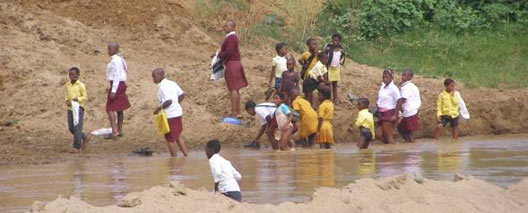
Learners in the KZN province have been pictured crossing rivers to get to school, with many traveling long distance of over 30 kilometres, resulting in members from Equal Education fighting for safe, reliable, government-subsidized scholar transport across the province.

The draft KZN Learner Transport Policy document, which has been by Inside Education, stipulates that all learners from Grade R to Grade 12 have a Constitutional right to safe and secured learner transport to and from school.

The policy document also sets out the criteria for who qualifies for learner transport, citing that any learner who travels a minimum distance of 3 kilometres to the nearest appropriate school qualifies for learner transport.

It document also states that that learners who have difficulty learning in mainstream schools as a result of a disability, including visual impairment, hearing impairment, physical impairment, medical impairment and intellectual disability, qualify for learner transport.

“If, as a consequence of budgetary constraints, the implementing authorities are unable to provide all learners who qualify for learner transport with transport, the Head: Education shall on the advice of the Director: Learner Transport prioritise learners in each district in keeping with the intent and purpose of the KZN Learner Transport Policy,” according to policy document.

It further states that Principals of schools, the KZN Education’s Head of department and district officials should work together to ensure every learner has access to safe and secure transport.  

“The school Principals shall inform learners’ parents/guardians who applied for learner transport whether their applications were successful and in the case of those learners who were unsuccessful, inform the learners’ parents or guardians in writing why their applications were unsuccessful,” according to the KZN Learner Transport Policy.

The policy document also stipulates that officials in charge of learner transport shall prepare a consolidated list of all learners requiring learner transport at schools in each district.

“The list should include information on the current number of learners receiving learner transport in each school, the number of vehicles servicing each school, the number of learners that were eligible for learner transport but not provided transport, together with any other relevant information,” according to the draft policy document.

“The implementing departments shall be guided by the criteria for the identification of beneficiaries for learner transport as set out in the National Policy and as amplified further hereunder. The KZN DOE shall act consistently and with transparency and to this end it shall ensure inter alia that school Principals are regularly informed of the prioritisation criteria under the KZN Learner Transport Policy.”

On Monday, Equal Education said it will be requesting an extension of the deadline in order to allow time for its legal representatives to go through the draft scholar transport policy.

Cyster said Equal Education said the court action against KZN Education Department was a long and protracted one but well worth it.

“In October 2019, represented by the Equal Education Law Centre (EELC), we returned to court to get the KZN DoE to stop wasting time and publicly release the provincial scholar transport policy. We were able to secure a court order by consent in the Pietermaritzburg High Court that the KZN DoE must release the draft scholar transport policy by a particular date,” said Cyster.

She said the EE’s campaign titled #LongWalkToSchool has achieved the victories, including the provision of government-subsidised buses to three schools in Nquthu in 2015, the publication of the National Learner Transport Policy in 2015, and the delivery of buses and taxis to 12 Nquthu schools in 2018.

“We also manage to win public commitment from the national Department of Basic Education to work with National Treasury to explore the introduction of a conditional grant to fund scholar transport,” said Cyster.  

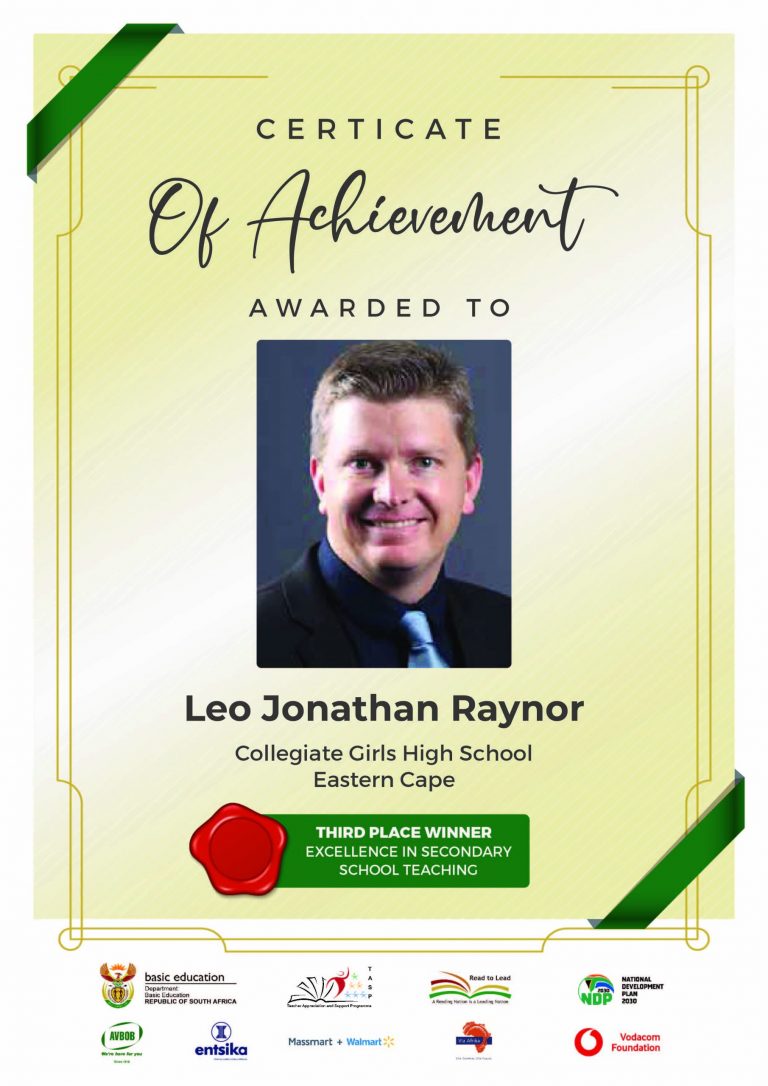
Our Teach of the Week is Leo Jonathan Raynor from Collegiate Girls High School in Port Elizabeth, Eastern Cape

CLASSROOM CORNER

Teacher of the Week

Teacher: Leo Jonathan Raynor

School: Collegiate Girls High School in Port Elizabeth, Eastern Cape

 Eastern Cape school teacher Leo Jonathan Raynor was impressed by the excellent teachers he had when growing up and decided to follow their example.

His goal was to mould the minds of the youth, and let them realise that they were important and that they could make a difference.

He added that their voices need to be heard and not squashed.

Being a teacher allows him to encourage learners to have the confidence to use their voice in a productive and constructive way.

He says teaching has become a profession that is not just one of sharing of information but rather one of mentorship and guidance along with the necessary imparting of important life skills and information.

He enjoys conversations in the classroom which are around topics of current interest, historical significance and just the general concerns of young people.

This means that each and every day is filled with thought-provoking questions and intense conversation.

Being involved in extra-mural activities and tours allows him a unique opportunity to get to know learners in a more authentic environment and build bridges that extend beyond the classroom.

He feels that one of his strengths is his keeping up-to-date with technological advancements that can be used to share information with learners.

He also strives to maintain positive relationships with every learner that he teaches.

Raynor states that he has thoroughly enjoyed the NTA journey and learnt a lot through the process.

He adds that he will cherish the experience for many years.

He plans to continue to deliver excellence in the field of teaching and to mould the minds of the future. 

UK Universities Seek Government Bailout In COVID-19 Lockdown

0

The COVID-19 pandemic and an ensuing recession will lead to 111,000 fewer UK and 121,000 international first-year students attending the British universities this year, resulting in a 2.5-billion pound funding black hole, a report from a leading university staff union warned this week.

According to London Economics consultancy’s analysis for the University and College Union (UCU), the largest decline in income is the expected loss of 1.51 billion pound from students outside the European Union (EU), with Chinese and Indian students making up a majority of this international group of students who pay significantly higher tuition fees.

The report finds that universities hit hardest by the falls in fee and grant income are those that cater for significant numbers of international students, with their difficulties having severe knock-on effects for the rest of the sector.

It concludes that without government intervention, an estimated 30,000 university jobs are at risk, with a further 32,000 jobs under threat throughout the wider economy.

“This alarming report shows that university staff and students are now staring over the edge of a cliff and desperately need the government to step in and protect the sector,” said UCU general secretary Jo Grady.

“Our world-renowned universities are doing crucial work now as we hunt for a vaccine and will be vital engines for our recovery both nationally and in towns and cities across the UK. It is vital that the government underwrites funding lost from the fall in student numbers. These are unprecedented times and without urgent guarantees, our universities will be greatly damaged at just the time they are needed most,” she said.

According to the report, the coronavirus pandemic and an ensuing recession will lead to 111,000 fewer UK and 121,000 international first-year students attending the British universities this year, resulting in a 2.5-billion pounds funding black hole.

The total economic cost to the country from the reduced direct and indirect economic activity generated by universities due to the loss in income is estimated at more than 6 billion pounds.

According to London Economics, all universities would suffer substantial falls in income, with 91 institutions – almost three-quarters – left in a critical financial position where income only just covers expenditure.

“Many institutions have a very considerable exposure to international students, and the pandemic will result in a very substantial loss in enrolments and income. Government support of universities is crucial to protect students in the short term and institutional research and teaching capacity in the longer term,” said Dr Gavan Conlon, partner at London Economics.

Alistair Jarvis, chief executive of Universities UK representative group which had tabled a proposal for state support recently, said the government must take “urgent action” to financially support institutions.

“Some institutions will be particularly impacted by any combined reduction in international student numbers and increased deferrals,” said Jarvis.

The government’s approach so far has been to encourage universities to access the financial measures already put in place to tackle the fallout of the pandemic.

These include a furlough or forced leave scheme for staff who are paid 80 per cent of their wages by the government as well as continuity loan schemes, unveiled by UK Chancellor Rishi Sunak last month.

But the Opposition Labour Party has stressed that universities cannot be treated like any other business.

“UK universities must be valued as part of the frontline response to the coronavirus pandemic, supplying students to the NHS [National Health Service] and conducting world-class research into the virus.

“Labour is calling on the government to underwrite all Higher Education institutions to secure their future and their role in our economic recovery and acknowledge their contribution to the national effort to fight this pandemic,” said Rebecca Long-Bailey, Labour Shadow Education Secretary.

(This story is auto-generated from a syndicated feed in London)