Home Blog Page 438

NSFAS Needs A Complete ‘Re-imagination’ Administrator Tells Parliament

The National Student Financial Aid Scheme (NSFAS) requires nothing less than a “complete re-imagination” of its operating model and governance structure, the administrator appointed by government to turn around the national funding scheme told Parliament.

Randall Carolissen told the National Assembly’s portfolio committee on higher education, science and technology that previous models implemented by NSFAS had all failed.

“The only reason we have reasonable success is because it’s placed under administration. If you are going to impose the same model onto NSFAS, my personal belief is you will have an administrator again in two years’ time – or the place might well be shut down,” he cautioned.

Committee Chair, Philly Mapulane said: “It is unacceptable that the entity attributes its poor performance on the fact that the key performance indicators were not developed in line with the SMART criteria.

Notwithstanding the fact that the Administrator was appointed to take over governance and management and bring stability to the entity, it appears that more focus was on crisis management and less focus on ensuring that predetermined targets were achieved.”

https://insideeducation.co.za/nsfas-applications-flooding-in-ahead-of-november-deadline/

Carolissen was briefing the committee for the 2018/19 financial year. The auditor-general gave the scheme a qualified audit for the year under review.

NSFAS declared accumulative irregular expenditure of R7.58bn – a huge jump from the R284.7m it declared in the previous financial year.

In his report, the auditor-general noted that the irregular expenditure at NSFAS was not complete, as management was still in the process of quantifying its full extent.

Reasons for the qualified opinion included that the auditor-general could not confirm the correctness of transactions due to institutions to the tune of R1.25bn.

The AG could also not obtain sufficient appropriate audit evidence for bursary expenditure paid outside of the entity’s normal disbursement process. The total bursary expenditure was R24.6bn for the year.

The AG also found that contingency liabilities were understated by R6.3bn.

Carolissen explained that some of the irregular expenditure was not a loss, but resulted from cases of erroneous disbursements where earmarked funds were shifted.

“The qualified opinion rests on a lot of the historical issues we found in our clean up of NSFAS. Irregular expenditure, which we had covered, went up to R7.5 billion. Many things we qualified for should have been qualified earlier.”

These included funds paid from wrong accounts, payments made to wrong institutions, and overpayments to students.

In some cases, students would be contracted for “ridiculously low” amounts like R5, R10 or R1,000, but NSFAS would make the correct payment.

However, because the payment differed with the contracted amount, it becomes an irregular payment according to the Public Finance Management Act.

“This speaks to the irregular records that we found when we came into NSFAS,” he said.

https://insideeducation.co.za/nsfas-puts-contingency-measures-in-place-amid-strike/

Carolissen was appointed as the administrator of the crisis-ridden scheme in August 2018 for a period of one year. He was re-appointed for a second term due to the many issues that still needed to be resolved.

The agency only achieved two out of 16 key performance indicators in the year under review.

Carolissen explained that they engaged the auditor-general and brought in an expert on their dismal performance in key performance areas (KPAs), who showed that the poor performance was a result of the KPAs being poorly formulated and “not smart.”

To this end, he said they had submitted a new set of KPAs for consideration.

“As much as we wanted to measure against the set of KPAs as previously proposed, it was proved to be almost an impossible task,” he said.

MPs from across the political party spectrum suggested a complete overhaul of the scheme.

“There should be a complete overhaul of NSFAS’ application process [and] how funds are disbursed,” said DA MP Baxolile Nodada.

“Regardless whether they go through the process of appointing new management … they need an overhaul.”

Nodada’s views were echoed by other MPs, who put Carolissen on the spot by asking him if he agreed.

“Yes, the models that have been implemented have failed. A complete re-imagination of NSFAS is required,” admitted Carolissen. 

The Committee urged the Minister of the Department of Higher Education, Science, and Technology, Blade Nzimande to expedite the establishment of the Ministerial Task Team to review the business processes of the entity which will make long term recommendations on the future models, structures, systems and business processes necessary for effective NSFAS.

Mapulane said the Committee will also convene quarterly meetings with the entity to assess progress made in the disbursements of funds and progress towards achieving predetermined targets.
South Africa Must Up Its Game And Produce More Teachers

A UNESCO report, which examined the number of teachers that each country needs, found that sub-Saharan Africa needs an additional 6,3 million teachers if it’s to attain universal primary education by 2030.

The Centre for Development and Enterprise predicted that South Africa will need to have 456,000 teachers by 2025 to offer quality education.

According to the Department of Basic Education, South Africa’s public education system has 410,000 teachers. These teachers are employed in approximately 25,000 schools across the country and are responsible for teaching 12.9 million pupils.

South Africa doesn’t graduate the adequate number of teachers to meet the supply and demand.

Currently, the country’s initial teacher institutions graduate 15,000 new teachers per year. This is below the 25,000 mark required to maintain an effective teacher-pupil ratio.

But between 18,000 and 22,000 teachers leave the profession every year. This figure is higher than teachers who join the profession.

The Teaching and Learning International Survey published in July 2019 found that the average age of the South African teacher was 43 years.

The survey also found that 32% of teachers were aged 50 and above. This means that in the next decade almost half of the current teaching workforce will have to be replaced.

In addition, South Africa is particularly lagging in producing teachers in science, technology, engineering and mathematics.

Teachers are regarded as the essential drivers of a good quality education system.

If South Africa can’t successfully recruit, retain, and train enough suitably qualified teachers it won’t be able to provide quality education to the citizens to meet the country’s social and economic needs.

The challenges

There are a number of contributors to the country’s escalating teacher shortage. These include:

  • Increased pupil enrolments. The number of pupils is expected to rise from some 12.4 million in 2013 to 13.4 million in 2023. On paper, and drawn from current demographic statistics, learner enrolment in South Africa is projected to decrease from 2023 onwards.
  • However, such projections don’t include undocumented migrants and refugee seekers who contribute to an unanticipated increase in school enrolments.
  • Challenging working conditions, which include lack of facilities for teaching, overcrowded classrooms, inadequate incentives, poor parental participation and policy overload.

There’s also an oversupply of teachers in certain subjects and also in certain geographical locations – such teachers are at times not absorbed by the system.

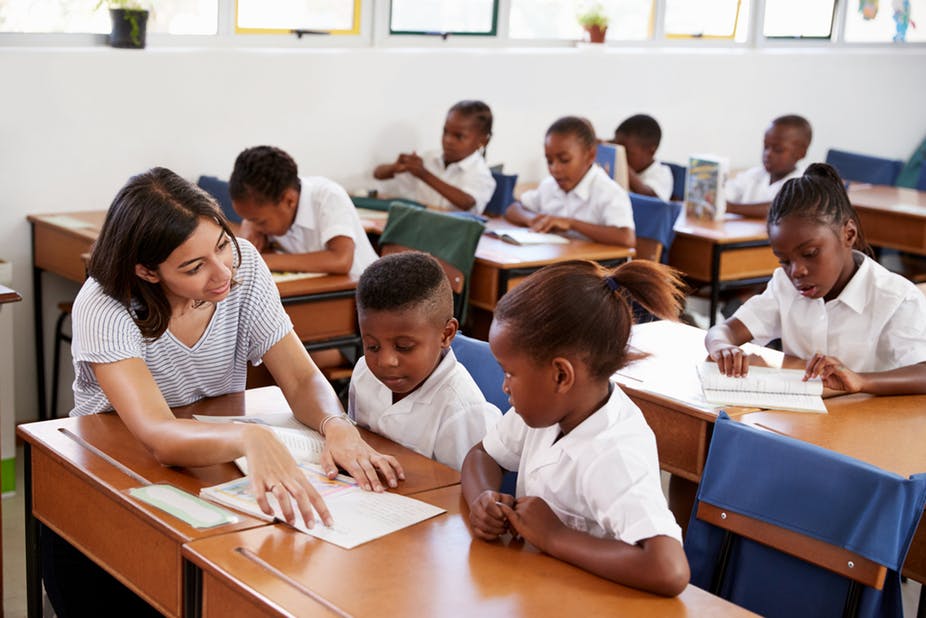
Image result for south african teachers

There’s also a shortage of qualified teachers to teach content subjects in specific languages, for example, teaching life sciences in Afrikaans, foundation phase, and technical subjects.

In some instances, teachers may not be willing to teach in township and rural schools.

Even in rare cases where teachers are willing to teach in rural areas or resource-constrained schools, their teacher education and training doesn’t prepare them on how to facilitate teaching and learning in rural environments.

What needs to be done

To solve this shortage of teachers in the short term would require the country to tap into a pool of experienced teachers who are willing and qualified to re-enter the teaching profession.

The country also needs to provide better incentives to teachers, such as better working conditions, job security, motivation and safety.

South Africa employs a considerable number of migrant teachers who help alleviate teacher shortages.

But a more strategic plan needs to be developed, especially for scarce and critical skill subjects such as science, technology, engineering and mathematics.

Such a plan will allow the Department of Basic Education to recruit teachers from neighbouring countries while developing capacity to replace migrant teachers.

A longer-term view needs to look into investing resources in initial teacher education through funding of student teachers.

In 2017 the largest reallocation of resources towards the government’s priorities was for higher education and training.

Image result for south african teachers

This amounted to an additional R57 billion to fund the phasing in of fee-free tertiary education. This was in addition to the R10 billion provisionally allocated in the 2017 budget.

Those students should then enter into service contracts with the Department of Basic Education for a certain period. Currently the government has the Funza Lushaka Bursary Programme which supports teaching studies and is made available to qualified students to complete a teaching degree.

Bursary recipients are then required to teach at public schools equivalent to the duration of bursary received.

There’s still a need for a robust evaluation of the Funza Lushaka Bursary Programme, however, there are indications that it’s making a positive difference in the public schooling system.

South Africa should also expand distance education to enable student teachers to learn while working to sustain themselves and support their families.

The education system must create conducive working conditions, which will ensure the retention of teachers, especially those with the most experience and with scarce skills.

And finally, teachers in oversubscribed subjects need to be re-skilled so that they can teach in areas where there is a shortage.

Mncedisi Maphalala, Professor and Dean, Faculty of Education, University of Zululand and Nhlanhla Mpofu, Senior Lecturer, University of the Free State

This article is republished from The Conversation under a Creative Commons license. Read the original article.

Telecom Firms Pledge Support For ICT Roll-Out In Special Needs Schools

Basic Education Minister, Angie Motshekga, recently convened the first ICT Roundtable on resourcing special needs schools with ICT equipment.

Telecom giants Vodacom, MTN, Liquid Telecom (Neotel), Cell C and Telkom all pledged their support towards strengthening digital education in South African schools, starting with education for learners with special needs.  

Basic Education Director-General Hubert Mathanzima Mweli said the rollout of the ICT programme will be carried out in three phases.

“The first phase, which is planned for 2020, will focus on 447 schools that are specialising in the curriculum for learners with special education needs. Phase two will be implemented in quintile 1 to 3 schools. Phase three will focus on strengthening digital education in affluent schools.”

Motshekga said the implementation of ICT in the basic education sector requires a collaborative effort between Government and the private sector, and called on ICT service providers to come on board in accelerating the implementation of ICT and connectivity in schools.

South Africa Takes Steps To Assure The Quality Of Its Doctorates

Sioux McKenna, Rhodes University

Around the world there has been a massive increase in demand for doctoral education. This mostly stems from the idea that the “knowledge economy” requires high-level skills.

The claim that there’s a correlation between a country’s economic stability and the proportion of its population who have doctorates has led to national targets being set for doctoral graduation.

In 2010, 1,420 doctoral candidates graduated in South Africa. Since then the number has more than doubled. The high increase in both intake and graduation has led to concerns about quality.

https://insideeducation.co.za/andc2019-catalyse-social-science-to-build-a-more-just-society-nzimande-tells-doctoral-graduands/

A key question is: how did South Africa find the capacity to double its numbers given that the number of supervisors has grown at a markedly slower rate over this period?

A significant amount of money has been invested in doctoral education. The national funding formula gives all universities a strong incentive to increase their doctoral intake.

But there are questions to be asked about whether the quality of doctoral education justifies these investments of taxpayer money.

The quality of doctoral graduates matters because, as the highest level of education, it sets the tone for quality throughout the university.

To answer some of the concerns, South Africa’s Council on Higher Education is about to conduct a national review of higher education institutions that offer doctoral-level qualifications.

This will be the first of its kind for the council, which, among other things, is responsible for developing and implementing systems of quality assurance for higher education.

The review

Every institution that offers doctoral qualifications has to develop a self-evaluation report indicating how it ensures it meets the doctoral standard.

The report has to specify, with evidence, how the institution assures the quality of every step of the doctoral curriculum.

Image


This ranges from selecting students to allocating supervisors, providing institutional support, developing and reviewing proposals, ethical clearance and the examination process.

It also needs to demonstrate how the institution ensures that its graduates embody specified doctoral attributes.

A review panel then verifies and interrogates the claims by the institution. This is followed by a report to the institution. Institutions that don’t meet all the requirements are required to submit an improved plan to the council.
If there are serious concerns after this, the Council on Higher Education has the authority to withdraw accreditation from the academic institution.

Research shows that funding is a key determinant of the rate at which doctoral candidates complete the degree.

It’s also known that some universities are research intensive with numerous seminars, research design courses and research chairs. But in others, the supervisor and doctoral candidate may feel quite isolated.

Many South African universities were dissuaded or even forbidden from offering postgraduate education during apartheid past and so have had to build a research culture over a relatively short space of time.

These institutions may lack research infrastructure and have challenges attracting researchers to their rural campuses.

It’s not clear how the review process will strike a balance between such a context and the need to reassure the public that the South African doctorate meets international standards.

Implications

We do not know whether the rapid increase in number of doctorates has led to a weakening of quality. Perhaps the rise in predatory publications, a problem faced across the continent, suggests there is cause for concern.

What is known is that some institutional audits undertaken ten years ago uncovered problems with examination processes at doctoral level. This review is an opportunity to revisit the issue.

The quality of the doctorate has significant implications. Poor doctoral education can set the scene for the nature of knowledge creation and dissemination in the whole university.

If quality processes don’t safeguard academic integrity at doctoral level, then they are unlikely to protect quality at lower levels.

Taxpayer money subsidises doctoral programmes, so the qualification should produce the kinds of knowledge and highly skilled graduates who can make a meaningful contribution to society.

Given that South Africa’s funding formula greatly rewards doctoral education, all universities are being pushed to offer it across all faculties, regardless of availability of supervision and resources.

There have been some cases where large numbers of doctoral candidates were admitted without the necessary capacity. The only way to change this, in my view, is to have a funding formula that rewards institutions on their own strengths.

But the country’s history makes any real move towards institutional differentiation a no-go area. So steps need to be taken to ensure that all doctoral programmes meet the threshold standard.

Is the review the appropriate tool to achieve this?

Quality assurance generally seems to encourage bureaucracy and compliance and be part of a rising managerialism in institutions. But it’s a good thing to start a conversation about what a doctorate is really for, and how to tell whether quality is being assured.

Perhaps the review will open the space for a national discussion on some of the conservative aspects of doctoral education in the country. For example, the funding formula suggests that the doctorate takes three years, even though most countries offer the doctorate over four.

And those four years are on top of strong schooling and university foundations.

Many countries also offer structured coursework as part of the PhD accreditation process. South Africa’s policy precludes this.

And the dominant approach to doctoral education in the humanities and social sciences remains the master-apprentice supervision of individual studies.

This is despite the fact that the United Kingdom, from which South Africa inherited the model, is now offering an array of more flexible models. Neither is there a strong tradition of vivas (oral exams) for the South African doctorate.

Far more innovative approaches are needed. The review might be the vehicle for the necessary institutional conversations.

Sioux McKenna, Director of Centre for Postgraduate Studies, Rhodes University

This article is republished from The Conversation under a Creative Commons license. Read the original article.

Presidential Commission On 4IR Presents Draft Diagnostic Report To Ramaphosa

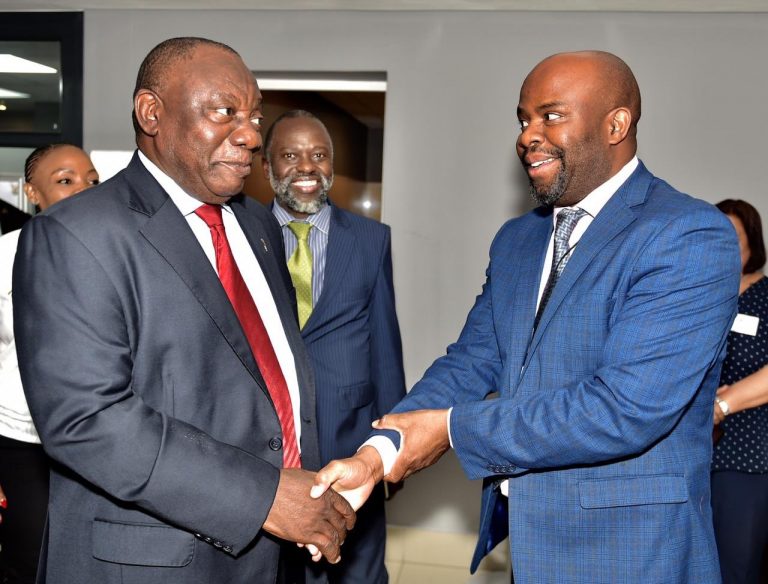
The Presidential Commission on the Fourth Industrial Revolution (4IR) presented its draft diagnostic report to President Cyril Ramaphosa Thursday.

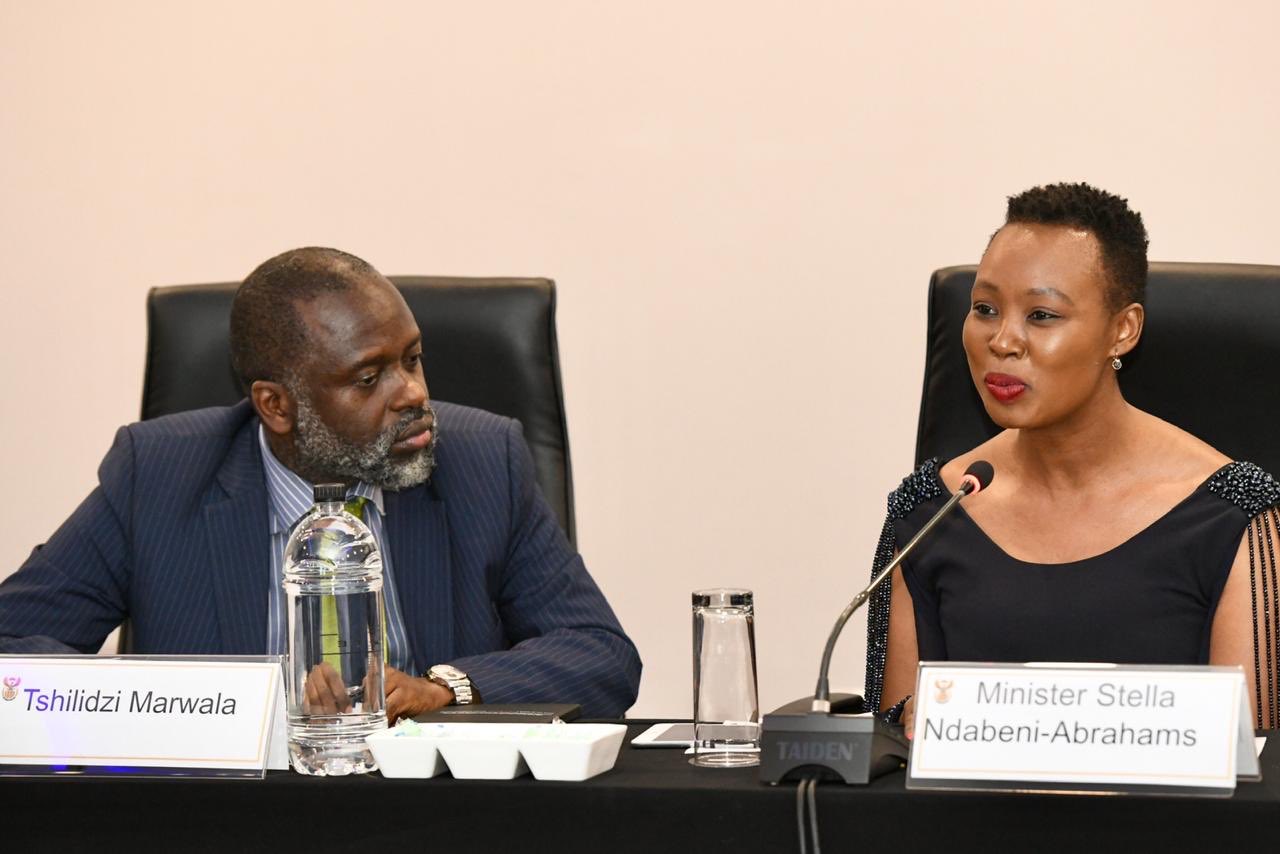
The Commission, chaired by the President with Professor Tshilidzi Marwala as Deputy Chairperson, is tasked with advising government on relevant “policies, strategies and action plans to position South Africa as a smart, connected and competitive global player,” a statement from the presidency said.

The President commended the Commission for the work done thus far, particularly its focus to align the country’s envisaged 4IR strategy to the objectives of the National Development Plan (NDP).

“The work of this Commission is critical to ensuring that we propel our country into the future. This future will be one where South Africa will have a globally competitive, inclusive and shared economy,” said Ramaphosa.

Image

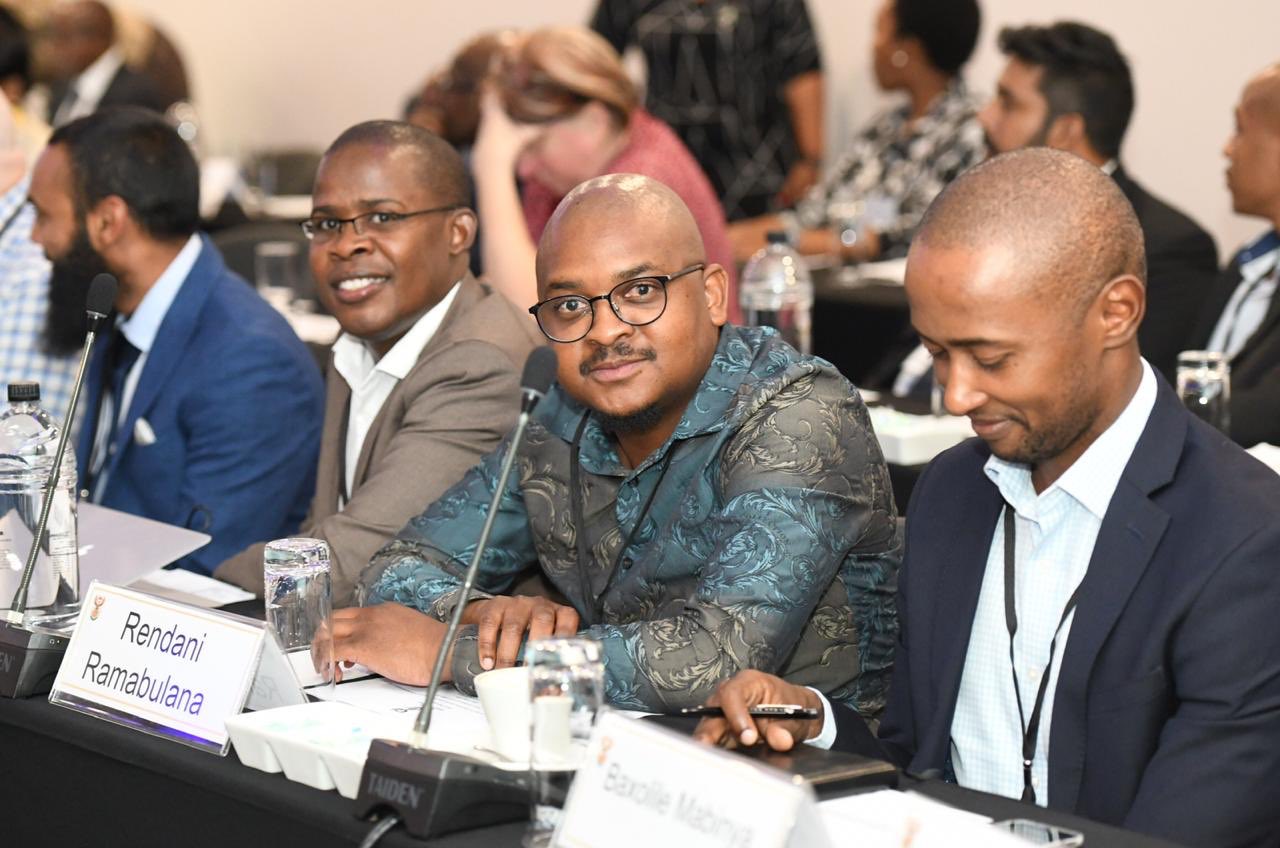
The work of the Commission is centered on eight work streams dealing with the impact of technological advancement on human capital and the future of work, as well social and economic development, the Presidency said.

Ramaphosa further welcomed the Commission’s commitment to practical and tangible recommendations which will be developed in collaboration with, and with the active participation of, a cross section of South Africans.

Image

The final report of the Commission is expected to be finalised by February 2020 and presented to Cabinet for consideration.

Do Not Neglect Research & Innovation When Talking Investments, Cautions DIRCO Minister Pandor At #SAIC19

Riyaz Patel

It’s time for Africa to become serious about investing more in research, development and innovation, International Relations and Cooperation (DIRCO) Minister Naledi Pandor has said.

Speaking during the Science and Technology Showcase at the 2019 South Africa Investment Conference, she said Africa is not realising the potential and opportunity that science and innovation hold for its development.

https://insideeducation.co.za/female-csir-researchers-break-new-ground/

“It is from this continent that we must develop the response to HIV/Aids and new drugs against tuberculosis.

“It is also on this continent that we are building the largest radio telescope in the world, so we should wake up to the opportunities of science and innovation,” the DIRCO minister said.

Pandor, South Africa’s former Science and Technology Minister, spoke of Africa’s “massive innovation capacity,” pointing to with young people who are using the power of technology to transform lives.

Many of the world’s fastest growing economies are in Africa, noted Pandor, adding that “living standards on the continent are improving and we have a young and eager population demanding new products and demanding technology.”

“Wherever we are, if we talk business, could we [also] talk research development and innovation, and not neglect it as an area of opportunity on the African continent,” Pandor said.

Hydrogen South Africa (HySA) Infrastructure director Dr Dimitri Bessarabov told delegates attending the showcase that many countries were seeking ways to decarbonize their energy supply and that hydrogen was one way of achieving that goal.

This would also hold benefits for South Africa, he noted.

“Hydrogen currently grows at a rate of about 10%, which presents a very good investment opportunity. The industry [generates revenues of] $100-billion a year and it can make South Africa a superpower for energy exports,” he said in his presentation.

Bessarabov also noted hydrogen’s versatility as an energy carrier and commodity chemical, which could also enable the integration of different sectors of industry.

Gender Inequality In Education Is Still An Issue In Kenya And South Africa

Beatrice Akala, University of Johannesburg

Women still aren’t fully represented in higher education in Kenya and South Africa, despite changes in law and policy over the years.

This failure of the education sector to harness and develop women’s talents curtails their ability to contribute meaningfully to society.

The constitutions in both countries guarantee every citizen a right to education. This is regardless of gender, sex, or social class. Higher education in particular holds great value for the public good. It is central to the development of individuals and nations.

But there is still uneven development between genders. In Kenya and South Africa women still struggle to access institutions of higher education. And they also struggle to succeed in science, technology, engineering, and mathematics (STEM) related courses, and to progress into postgraduate studies.

I address this in my research paper. I focused on Kenya and South Africa because both countries have progressive legal frameworks. My aim was to find out how these progressive frameworks translated into real life opportunities for women.

My study found that although both countries have progressive policies that support gender equality and equity, things are different on the ground. Higher education still excludes many women, in particular those from marginalised communities.

Progressive policies such as gender equality policies and equity clauses have been enacted in both countries.

But gender skewing is still prevalent in public higher education institutions in terms of throughput, completion rates, areas of study and enrolment in postgraduate studies.

The difficulties particularly black women face in higher education are a continuation of the social conditions they live under. This includes poverty, racism, geographical positioning and institutional cultures that still have a gender bias, and sexism.

The South African story

In South Africa’s higher education institutions, systemic gender inequality is seen through through skewed enrolments, stereotypical course selection, and poor career progression.

Historically, black South African women suffered “triple marginalisation”, precipitated by race, sexism and social class.

One of the consequences was that very few black people had access to higher education despite the fact that they made up 70% of the population.

Before 1994, black students, both male and female, accounted for 9% of total enrolments in higher education. The apartheid system, which was supported by a male-dominated political order, made it difficult for black women to access and participate in education meaningfully.

South Africa’s post-1994 democratic reform agenda addressed gender marginalisation through law and policy.

Affirmative action was formalised through new laws that were designed to enable formerly marginalised groups to access courses such as medicine and engineering through a quota system, and improved general access to higher education.

The Kenyan story

Women and girls are progressing steadily in the Kenyan education systems. But they still encounter challenges.

While the Kenyan government has created policies that offer equal opportunities to all, it has paid much less attention to the way policy is converted into action.

The gender gap in primary education is not as wide as in higher education. According to the Ministry of Education records, of the 85% of learners who progress from primary to secondary school, 30% proceed to higher education. Women account for just one third of total enrolments.

Kenyan women have been on the margins of power for decades. This can be ascribed to inferior education, lack of opportunities, sexism, ignorance and demeaning cultural practices that relegated them to privates spaces.

Gender inequality is not limited to higher education. It permeates all tiers and levels of living and learning.

For example, girls are more likely to drop out of school than boys due to factors such as poverty, insecure learning environments, the high cost of education, and long distances from education institutions.

These factors affect boys too, but they give rise to additional risks in the case of girls, such as early pregnancies and sexual abuse.

Other challenges are the burden of household chores and family responsibilities assigned to girls.

As a result, fewer girls than boys are enrolled in primary and secondary schools and fewer are eligible for higher education. This limits their access to future job opportunities.

Redressing the balance

In both countries, legal mechanisms and policy interventions have given women better access to higher education.

But there are still reasons for concern. Transition and completion rates have to improve, and there has to be a balance in fields of study and fairness in terms of progression at the workplace.

In addition, governments need to address the root causes of marginalisation.

As a start, the Kenyan and South African governments need to tackle poverty and enforce women’s rights. Following on from that a shift is necessary to change the way society thinks about how it treats its women.

In addition, higher education institutions ought to rethink their strategies and policy goals to ensure that women are benefiting from reforms.

For their part, NGOs and educational institutions can do more to tackle gender based violence, ensure safe learning spaces and educate communities about dangerous cultural practices that promote sexism and marginalisation of girls and women.

The shift is possible if all stakeholders can work together through harmonisation of their programmes.

Beatrice Akala, Post Doctoral Research Fellow, University of Johannesburg

This article is republished from The Conversation under a Creative Commons license. Read the original article.

Bickering Over Bursaries Between Arts & Culture And Wits Leaves Students Destitute

Wits University Masters students who were promised bursaries by the Department of Arts and Culture, say payment delays have had a serious impact on their lives and studies, with some left destitute, Eyewitness News reported Monday.

It’s understood that 19 students have been waiting for funds from the Department, which confirmed in August it would be covering their accommodation, tuition, meals and books.

In a letter to Wits dated 20 August, the Arts and Culture Department’s Reinette Stander confirmed that funding would be processed for the students.

However, not a cent has been paid since with the Department blaming Wits, saying the university had not submitted all the required documents.

Wits has denied this. University spokesperson Buhle Zuma said: “Wits has complied with all the requirements from the department. We are confident that this process will be completed soon.”

But amid the claims and counter-claims, the affected students are in dire situation.

At least one of them was forced to sleep at Johannesburg’s Park Station, while others sought shelter at laboratories and lecture halls, Eyewitness News reported.

Others are relying on handouts from good Samaritans to survive.

“I’m unable to get my food and textbook allowance. My fees are high,” one student said.

That money needs to be paid…,” said another, “…if the department doesn’t pay the money, then we won’t graduate next year, we won’t get our certificates next year.”

A student from the Eastern Cape told the radio station, that he’s had to rely on food handouts from fellow students.

“A friend of mine got me lunch. If someone from the residence is lazy to go and collect their meal, they’ll give me their meal.”

This final year student said having lost both his parents, he was totally reliant on the funds from the Department of Arts and Culture.

I’m surviving by the grace of God. I don’t have parents, I’ms squatting with a friend from Newtown because I came from Richards Bay knowing that the department would provide me with money for accommodation, tuition fee and meals. It’s November and I haven’t received that yet.

Gauteng Education Extends Admission Placement Period For 2020 To End November

The Gauteng Department of Education (GDE) has extended the admission placement period for the 2020 academic year to November 30.

The process initially commenced on May 20, with parents receiving seven additional days to submit documents until July 22.

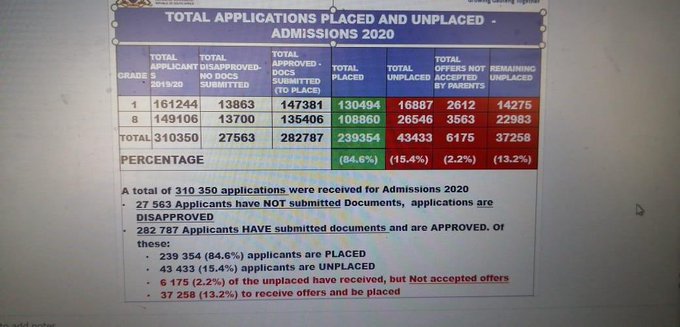
“During this period, 310 350 applications were made for grades 1 and 8. Of these, 27 563 applicants have not submitted any documents, while 282 787 submitted documents as required,” GDE spokesperson Steve Mabona said in a statement Sunday.

As a result, the placement period commenced in September with an end date of October 31, however, the process is ongoing until all pupils are placed.

“During this period, the department remains committed to placing the 282 787 who submitted documents. To date, 234 290 applicants have been placed, while 43 797 are unplaced,” Mabona added.

The department noted as “concerning” the 4 700 applicants who have not accepted their offers.

Parents are reminded that they are only afforded a period of seven days to accept the offer.

In addition, approximately 411 schools are said to have reached capacity.

“Most of these schools have already reached their capacity to accommodate as many learners as possible. Applicants who cannot be accommodated at these schools are placed at schools with available space,” Mabona said.

According to the department, pupils were placed according to the following criteria:

  • The applicant pupil’s place of residence is closest to the school within the feeder zone.
  • The applicant pupil has a sibling attending the school.
  • The place of employment of at least one of the applicant pupil’s parents is within the feeder zone of the school.
  • The applicant pupil’s place of residence is within a 30km radius of the school.
  • The applicant pupil’s place of residence is beyond a 30km radius of the school.

Parents should therefore accept placement offered by the department as these cannot be changed, Mabona said.

Parents are urged to log on to the system however, if they do not have access to the internet they may visit the nearest district office for assistance.

Gauteng Education MEC Lesufi Apologizes To Parents Over Admissions Glitch

Gauteng Education MEC Panyaza Lesufi say his department is fully aware of the admission disruptions at district offices and has apologised to parents.

The department opened its offices Sunday, with officials deployed to deal with school placements for the 2020 academic year.

Lesufi said staff were “intimidated and in some instances attacked.”

They had aimed to complete the application process by the end of last month but that did not happen.

It has now allocated Sundays for officials to try to get through a large number of parents that have been queuing outside its offices.

His spokesperson Steve Mabona said parents need to understand that not all children would be placed at the schools of their choice.

“We announced the top 20 high-pressure schools on the first day of admissions. We said it’s going to be impossible for all children to be placed there.”

Panyaza Lesufi@Lesufi

The problem is that our staff members were intimidated and in some instances attacked. We’ve to persuade them to go back to work.We’re trying to resolve the impasse as soon as possible.The major problem is parents who didn’t accept offers and those who didn’t submit documentation https://twitter.com/fils_hermann/status/1190920224930963456 …#Notoafrohatred,filshermann@fils_hermann@Lesufi after queuing for 3hrs ,le system is offline.What for next my Daughter?We need assistance MEC8511:20 AM – Nov 3, 2019Twitter Ads info and privacy157 people are talking about this

Panyaza Lesufi@Lesufi · 11h

Parents please take note that majority of our ‘good schools’ are full and we are trying to find proper alternatives however there will be no learner without a school. Be assured

Panyaza Lesufi@Lesufi

Lesufi tweeted the latest placement report.

View image on Twitter

He’s told parents that a technical caused the misunderstanding on when parents should go to the district offices.

Lesufi assured parents that placements for every child who applied on time will be settled by the end of this month.