Home Blog Page 472

South Africa lowers university admission requirements

Francesca Villette

Universities in the province have shown mixed reaction to the amended minimum admission requirements for entry into bachelor’s degree programmes, which includes a 30% pass in language.

Higher Education and Training Minister Naledi Pandor made the changes after consulting the Council on Higher Education, and it applies to the 2019 academic year intake.

The changes mean a minimum admission requirement of 30% is needed in the language of learning and teaching of the higher education institution, coupled with an achievement of between 50 and 59% in four 20-credit National Senior Certificate (NSC) subjects.

A 20-credit subject makes up the seven-subject package needed to obtain an NSC. In March, the department revoked the designated list of subjects for the NSC, meaning learners need to score higher than 50% for any four subjects, excluding life orientation.

An institution will still be entitled to specify subject requirements for a particular programme. For example, maths and physical science might be considered as requirements for admission to a BSc.

Stellenbosch University spokesperson Martin Viljoen said the amendments did not challenge learners to achieve their best.

“Passing any Grade 12 subject at 30% is a poor indicator of the probability of a student passing a quality bachelor’s degree. The latest gazetted announcement still does not challenge high school learners to adequately prepare for bachelor’s studies,” Viljoen said.

Cape Peninsula University of Technology (CPUT) spokesperson Lauren Kansley said the university would amend the minimum requirements and changes would eventually be presented at institutional academic forums, including Senate.

“Acceptance into university remains a competitive process and CPUT always endeavours to provide a space to the most well-deserving and academically achieving individuals.

“This remains the case and learners should always aim to achieve the best results to give them a competitive edge,” Kansley said.

The University of Cape Town (UCT) said it welcomed the fact that more applicants would be eligible for degree admission.

Spokesperson Elijah Moholola said: “The university notes the amendment in the admission criteria for degree admission, specifically the removal of the designated list, and welcomes the fact that more applicants will now be eligible for degree admission.

“Insofar as admission to UCT is concerned, the university has always credited performance in all official NSC subjects, and this will not change in the future,” Moholola said.

University of the Western Cape’s acting rector and vice-chancellor Professor Vivienne Lawack said they have not received a formal notice or communique from the Ministry or Department of Higher Education and Training, and would only be able to assess the situation once it had received formal communication.

Higher Education and Training spokesperson Lunga Ngqengelele said the process had taken two years and Universities South Africa (USAf) was one of the three representatives in the small working group, which looked into issues.

“The Basic Education Department was requested by USAf to consider amending the minimum admission requirements for higher education certificates, diplomas and degrees as there were a number of subjects which were excluded from the designated list, but which were important for some learning and career pathways.

“The Basic Education minister commissioned research on this matter, and USAf was party to it. The research report was published in 2016, and researchers recommended that changes should be made to the minimum admission requirements.”

Cape Times

South Africa: Learners battle government to make their schools clean and safe

Thembela Ntongana and Kimberly Mutandiro

“Please care about black learners education” and “Where do your priorities lie? In appealing or in fixing our schools?” These were some of the placards held up by Equal Education (EE) activists and students who had slept outside Parliament to demand school safety.

About 80 members of EE, mostly school students, braved the cold weather and wind on Wednesday night. They arrived around 8pm in taxis lined with mattresses.

On Thursday, they handed over a memorandum to the office of Minister of Basic Education Angie Motshekga, the office of the director general Hubert Mathanzima Mweli, and the office of the Western Cape Minister of Education Debbie Schafer.

“We are still fighting the fight for norms and standards which we have been been fighting since 2013. We are here to say the 2016 deadline was missed and students from Eastern Cape, Limpopo and other rural areas are still dying … for quality education 24 years after democracy,” said Western Cape EE Head Ntsiki Dlulani.

“We are here to hold our government accountable to deliver and implement the policies that they created themselves. We are here today to remind them that 2020 is around the corner for the norms and standards deadline. We do not want to see implementation in 2020; we want them to start now.”

The Department of Basic Education set Norms and Standards for South African school infrastructure in 2013, and provided its own deadline to fix the infrastructure standards by 2016, which it failed to meet. EE campaigned against the missed deadline and when the department failed to engage with it, EE took the department to court. EE won the case in the Bhisho High Court in July 2018.

Weapons in schools

Dlulani said they are asking the department to see that by 2020 all schools should have alarm systems, perimeter security, and access control. She said schools in Khayelitsha have no fencing; the security guards are not properly trained; and the schools are faced with learner to learner or learner to teacher violence.

“Learners are bringing weapons to schools … We have been attending safety conferences. The MEC was not there. No one talked about safety in schools which is a dismal failure,” said Dlulani.

“Black students are not taken seriously … The so-called future of this country is dying because of lack of decent infrastructure,” said Thembela Jacobs, a student at Cosat High School in Khayelitsha

Another Grade 11 student from Marian RC Secondary School in Elsies River, Chwaita Mpeqeke, said they have to walk with R1 in their pockets to avoid being beaten up.

“The aunties that cook in our school also serve as security guards. They sometimes accompany us to the bus stop because the security only works after hours when we have gone home,” said Mpeqeke.

“Gangsters are shooting each other around our school. They come to the bus stop, throw us with stones, and ask us for money … You are constantly in fear because you don’t know what might happen,” she said.

Head of the Western Cape Department of Education Anne Schlebusch said, “I can confirm that we did have a meeting with EE representatives in which we outlined a lot of the practical matters that have been raised through the committee. We will continue with our building and maintenance programme in partnership with other government departments to try and address the concerns.”

Accepting the memorandum in Parliament for the minister, official Thabi Motlala said the memorandum will be given to the minister to read and respond.

Learners march in Gauteng

On Thursday, EE held similar action in Gauteng demanding better sanitation in schools across the country.

Learners from 15 schools around Gauteng marched from the Johannesburg City Library to the Gauteng Department of Education.

According to EE, a survey in 2013 revealed that toilets for 11 schools in Tembisa were not up to standard. EE then marched in 2014 to the department to demand decent sanitation.

“MEC [Panyaza] Lesufi promised to spend R15 million upgrading sanitation at all schools in Tembisa and a further R150 million on sanitation in the province,” a recent report by EE states. “However, serious sanitation issues remain, even in a wealthy urban province such as Gauteng.”

The report says that schools in 2017, which had received upgrades, still faced challenges and needed maintenance.

Angela Bukenya from EE said prior efforts to secure a meeting with the Department of Education after the 2017 findings were fruitless. “We resorted to doing the march today [Thursday] because the Department of Education have not responded to our meeting requests.”

The memorandum made several demands which centred around transparency in the procurement of contractors appointed in building sanitation in schools and maintenance. It also called for a better budget to be allocated by the department to save schools from having to use school funds to carry out upgrades.

Zandile Mahlangu, a grade 11 Learner at Asser Maloka Secondary School in Soweto, said, ”Our school toilets are broken. There is usually no toilet paper or soap.”

“Our water taps do not work. The toilet roof is broken. We do not get toilet paper or soap for washing hands, which is a health hazard,” said Elethu Sigudu, a grade 10 learner at Phomolong Secondary School in Tembisa.

A grade 11 learner at Phamufhindo Secondary School in Daveyton, Jeanette Mabunda, said, “Our toilets are always full of water [flooded] and we have to walk through the water. The toilets do not flush. No one is doing repairs.”

Chief of Staff for Department of Education Roche Mogorosi signed and received the memorandum.

Members of Equal Education sang songs and slept outside Parliament on Wednesday night. Video: Ashraf Hendricks

Teachers use violence against children in Uganda

Katherine G Merrill

In many parts of the world, teachers use violence against their students. This can become routine, and the school transforms from a nurturing into a harmful environment for millions of children. Students exposed to violence are at risk of health problems later in life, such as depression, alcohol abuse and lower educational achievement.

Because of this, the United Nations has declared that all violence against children is a violation of human rights. But violence still happens. This has led to efforts to understand why teachers use violence against children.

Some studies have tried to identify characteristics of students that make them vulnerable to violence from their teachers or other school staff. My colleagues and I took a different approach by focusing on school staff members.

We found that there was a higher risk of school staff members using violence if they: had a teaching role at the school, personally approved of physical discipline practices, had children of their own, were between the ages of 30 and 39, used physical violence against individuals who are not students and were a victim of intimate partner violence.

We hope these findings increase the effectiveness of interventions by highlighting the qualities of school staff that may make them more likely to use violence against their students.

The study

Violence against students is very common in Uganda, even though corporal punishment was banned in 1997. A study done by our team found that 93% of boys and 94% of girls reported having ever been a victim of physical violence from a school staff member, and that over 50% had experienced such violence in the past week.

Similarly high reports of physical violence from school staff have been documented in the region, including in Kenya and Tanzania.

Our team carried out surveys with school staff members from 42 primary schools in Luwero District, in central Uganda. We wanted to know which factors might contribute to teachers being more likely to use violence – specifically physical violence – in their classrooms. The three types of risk factors examined were; the individual and their characteristics, the school and the community.

We wanted to learn about the staff members’ characteristics and asked them how often they used physical forms of violence against students. This included twisting a student’s ear or arm as punishment, hitting or caning a student, or making a student stand or kneel in a hurtful way, among other acts.

We found that staff violence was very common. Out of 645 staff surveyed, 43% reported that they had used physical violence against students in the past week.

There was a correlation between school staff using physical violence and these factors:

We did not find any correlation between staff members’ use of physical violence and other factors, such as the school environment or the neighbourhood surrounding the school.

Some of our findings are supported by research elsewhere. For example, studies in South Africa and Asia and the Pacific have shown that people who perpetrate violence in one setting are likely to do so in others. Studies also show links between being a victim and a perpetrator of violence.

Toolkits

Programmes that support staff to use positive forms of discipline rather than violence are likely to benefit staff as well as students. In particular, our findings suggest that there could be value in developing programmes that address staff members’ own experiences of violence and that target staff who use violence against other people beyond just students.

Programmes like the incredible years programme, the Irie classrooms toolbox and the good school toolkit already exist. These aim to reduce violence from teachers against students, for instance, through group activities promoting non-violent discipline strategies and classroom management techniques.

Alongside these types of programmes, we also need to strengthen our understanding of whether, and if so how, the school and community context might affect a school staff member’s use of physical violence. These approaches could play an important role in helping to protect children in schools, in Uganda and elsewhere.

Katherine G Merrill, Johns Hopkins University

South Africa: Wits University inaugurates first black female chancellor

Roland Mpofu

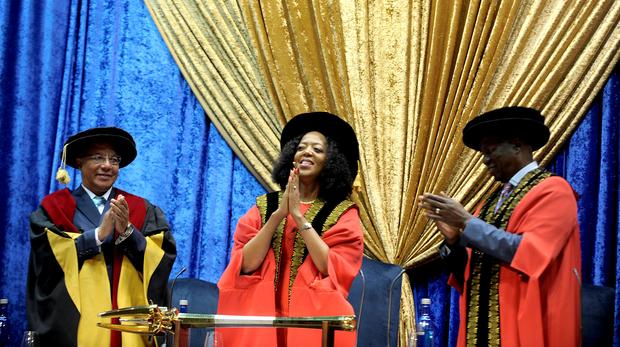
A first in its 96-year-old history, Wits University on Saturday inaugurated its first black female chancellor – Dr Judy Dlamini – in a ceremony attended by dignitaries and academics including Minister of Science and Technology Mmamoloko Kubayi Ngubane.

Dlamini takes the reins from Justice Dikgang Moseneke who has served for two six-year terms in this position, she starts are duties immediately.

The ninth Chancellor of the University will serve as the titular head of the institution and the guardian of the University. Dlamini had nothing but praise African women and said they have always led no matter where they found themselves in the world, although they have not received the recognition for their selfless service.

“In spite of the ruling party’s efforts to legislate on women empowerment, we are not there yet. Gender democracy, gender consciousness that validates women in the eyes of others, gender consciousness by both men and women, is what we need. The consciousness that reminds us that we are equal in spite of being different. Our contribution and talent need equal recognition from gender bias.

Dlamini who is a medical doctor by profession and a leading businesswoman, author and philanthropist, called for the decolonisation of education that she said starts with knowing “your history, knowing who you are and embracing it. This is supported by doing research that seeks to solve African problems, collaborating with institutions of excellence globally, including African institutions”.

Her major attribute is creating and adding value to society and humanity. Dlamini has worked in different sectors of the economy using her diverse skills sets and degrees in different subject areas.

After practising as a medical family practitioner for many years, she specialised in Occupational Health and consulted for different companies. She holds an MBChB from the University of Natal, a Doctorate in Business Leadership from Unisa, an MBA from Wits University and an Innovation and Entrepreneurship Certificate from Stanford University.

Dlamini is the founder and executive chairman for Mbekani Group that celebrated 20 years in business in 2016.

She is the former chairman of Aspen Pharmacare Limited (Aspen) a JSE-listed South African pharmaceutical manufacturer and distributor. She is a published author of Equal but Different, which was a bestseller for several weeks.

She is the recipient of the African Economy Builder Lifetime Achiever Award for 2016 and holds several other awards. She will be receiving an honorary doctorate from the Nelson Mandela University this year.

The Sunday Independent


Online applications for NSFAS closed

0

Staff Reporter

Online applications for the National Student Financial Aid Scheme (NSFAS) closed at midnight after the deadline was extended in the hope of receiving more applications from Technical and Vocational Education and Training (TVET) colleges.

This was also to give extra time to those who failed to submit supporting documents.

Higher Education and Training Deputy Minister Buti Manamela said: “The student funding scheme has processed over 400 000 applications, with a large majority of those for students wanting to attend universities.”

Applications were opened in September and, initially, the deadline was set to November 30 for all submissions for students seeking funding at public tertiary institutions for the 2019 academic year.

The Department of Higher Education and Training said the date had to be extended because more than 50 000 applicants required supporting documents or because of the poor quality of the documents submitted.

Prospective students had to have all the necessary documents attached the first time, which included certified copies of IDs for parents or guardians and the applicant, proof of income and signed a consent form.


South Africa: Teachers fake qualifications

Nico Gouws

Two teachers have been arrested in Mpumalanga after an investigation revealed they had allegedly used fake qualifications to get their jobs.

Hawks spokesperson captain Dineo Sekgotodi said Sibongile Rose Khuzwayo, 48, and Nonjabulo Bahle Mabuza, 31, were arrested on Thursday.

The pair appeared in the Wakkerstroom periodical court on Friday and were released on R3,000 bail.

Both were hired at the Seme Secondary School.

“Both suspects practised as teachers for eight and two years respectively. It is alleged that the Mpumalanga education department suffered a combined loss of more than R2.4m,” said Sekgotodi.

“The department became suspicious about the qualifications of the educators in 2017 and requested them to submit their qualifications. The pair allegedly opted to resign.

“The department opened a case with the local police which was later transferred to the Hawks for further investigations.”

Khuzwayo and Mabuza were then arrested in connection with fraud.

The case has been postponed to February 6 2019.

Uganda: Government tasks varsities to focus on research, innovation

0

Shabibah Nakirigya

Uganda’s Education ministry has urged institutions of higher learning to channel their energies and finances in carrying out research and innovation, a measure, government said will help tame unemployment in the country.

Mr George Mutekanga, the Assistant Commissioner in charge of Private schools and Institution of Higher Learning, said that universities and tertiary institutions should be a cornerstone in resolving the unemployment puzzle particularly among the youth.

“Our biggest concern is that we have so many graduates who are unable to do what we expect them to do and the problem comes from universities which are not doing their best in terms of research.

“They must carry out research and find out the gaps why graduates are not doing well,” Mr Mutekanga said on Thursday while speaking at the 5th graduation ceremony of International University of East in Kampala.

Uganda has over 35 universities but majority produce graduates who cannot find jobs or even create theirs.

“Higher institutions of learning must ensure that they include research on their programme so that student improve their hands-on component because without research they are like schools not universities,” Mr Mutekanga added.

Dr Nishikant Sonwalkar, a guest speaker at the graduation ceremony proposed that Ugandans adapt online learning, which can help transfer skills from developed countries to least developed ones like Uganda.

“We need to turn to the new frontier in the educational technology that allows creative thinking and learning, the mobile, augmented reality, collaborative can help much to provide information to everyone,” he said.

He added that with online learning, learners can access directly from the researchers and provide numerous learning path ways to conduct creative learning and encourage student to explore creative ways of learning with brain wave adaptive learning process.

“I encouraged students to become creative leaders in their professional and know that there is always creative solution to any problem that they will face,” he said.

The university Chancellor Emmanuel Tumusiime-Mutebile said that moving forward into 2019 and beyond, IUEA will continue to pioneer a relevant and quality education especially in science and technology.

“Through using innovation in our learning strategies, we will make quality education accessible to the greatest number of people in Africa, regardless of language, background, age or nationality,” he said.

Over 400 graduates were awarded certificates, diplomas, bachelor’s degree and masters in different disciplines, which include information technology, computer science, Science in environment and management , Science in software engineering, civil engineering and many more.

Zimbabwe: Schools venture into fish farming

Emmah Chinyamutatinga

Eight schools in Manicaland have embarked on fish farming to boost nutrition, economic development and income generation.

Nearly 1 560 fingerlings were stocked in 69 ponds at seven primary schools and one secondary school in Mutasa District.

The schools include St Peter’s primary and secondary, Nyatsatsa, Samanga, Nevongo, Samaringa, Chitombo and Nyakatsapa primary schools.

Mutasa Agritex livestock specialist Mr Shupai Majee said they were introducing fish farming to help communities boost  nutrition since the district had the highest percentage of malnutrition according to the Zimbabwe National Nutrition Survey.

“A number of schools, as well as ordinary people in Mutasa District have adopted fish farming,” he said. “This is a good project for the community, which if implemented well and monitored properly, can generate good incomes for the farming community and important in terms of nutrition.”

Mr Majee said the project promoted and developed aquaculture as a fully-fledged and vibrant sector.

South Africa: Boy stabbed in school toilet to be laid to rest in Zimbabwe

Thuso Masango

The grade 1 pupil who was stabbed and killed in a school’s toilets on Monday will be buried in his mother’s native land of Zimbabwe on Saturday.

However, a memorial service will be held on Thursday in memory of Charlton Karuweruwe at Dikeledi Makapan Primary School where he was killed.

This, according to his family, was to afford his school mates, friends and residents of Makapanstad in the North West to pay their last respects to him.

Charlton’s death sent shock waves across the country after an older boy from Mmankala Technical High School allegedly slept in the primary school’s toilets before stabbing and killing him in the morning.

The suspect, who is 17, was arrested and will appear in court again on Tuesday.

North West education MEC Sello Lehari’s spokesperson Freddy Sepeng said the department was saddened by what had happened and the pupils as well as teachers at the school were receiving psychological counselling.

Sepeng said a task team had been formed to help the family with funeral arrangements.

“The school is receiving psychological counselling and a task team have been formed to assist the bereaved family.”

The boy’s death happened barely three months after the nation woke up to news of the brutal killing of a 24-year-old teacher in Zeerust, also in North West, allegedly by one of his 17-year-old pupils.

Residents who spoke to Sunday World on Friday said after the incident on Monday, they assaulted the suspect and he was admitted at a nearby clinic.

When the newspaper visited the Karuweruwe family, some neighbours were there to comfort the family.

The boy’s aunt Nothisah Nhongo described him as a good boy who did not talk much except when with his peers.

“His mother is my sister and she is not in a good state. It is going to take a while before she can recover as she has lost her last-born child and we don’t know why this happened to him. We want to know why he [the suspect] did such a terrible thing to Charlton,” she said.

The aunt also cleared the air around reports that the suspect had a romantic relationship with the deceased’s sister.

“People are lying and making assumptions about the whole thing. We did not know the suspect nor have seen him before,” she said.

South Africa: Sex predator’s sentence hailed

Lindi Masinga

Education MEC Panyaza Lesufi said he welcomed the 23-year sentence meted out to sex offender Collan Rex, the former water polo assistant at Parktown Boys High who was convicted of assaulting schoolboys.

“We wish to thank the entire school population including learners, educators, parents and all officials for an excellent job of providing a watertight case in ensuring that justice prevailed,” said Lesufi. “We also extend our gratitude to the law enforcement agencies, including the police and the prosecution team for their tireless efforts in securing an appropriate judgment.”

The department thanked the Teddy Bear Clinic, other psychological workers and all health professionals who worked on what it described as a “complex and emotionally straining case”.

The department said the sentence served as a deterrent to all those who were found guilty of sexually assaulting pupils at schools.

Rex was yesterday sentenced to 23 years’ imprisonment for sexual and common assault by the High Court sitting at the Palm Ridge Magistrate’s Court. Judge Peet Johnson sentenced Rex to 20 years for 144 sexual assault charges and an additional three years for 12 common assault charges.

“The court must send out the message that sexual assault of children will not be accepted and such behaviour will not be tolerated,” the judge said.

“It is unfortunate that irresponsible sexual bullies find their way into the schooling system. You are a danger to society, and children in particular. A harsh sentence is called for. “

Rex, himself a former Parktown boys pupil, was found guilty of the charges after he was caught on CCTV at the school assaulting students.

“It’s clear your actions had a devastating impact on their lives and their families,” Judge Johnson told him. “There were attempts to commit suicide and some are on constant suicide watch.”

He said the only thing that saved Rex from more convictions was that some of the boys could not remember exact days and times.

“They were so afraid of you that they tried to hide away from you.”

The judge said he had never come across anyone who had committed so many sexual assaults and considered Rex a serial sexual offender and sexual bully who had exploited the abusive culture at the school.

“Your conduct was discovered by chance,” Judge Johnson said, adding that he did not believe Rex at any point thought his actions were wrong.

One of Rex’s victims said he was happy with the sentence and was now focused on recovering.

South African Male Survivors of Sexual Abuse founder Rees Mann said the sentence would send a strong message to predators.

“Twenty-three years gives the opportunity for the boys to heal.”

African News Agency (ANA)