Home Blog Page 488

South Africa’s university students face a crisis: nearly a third go hungry

Stephen Devereux

There is a common perception that students represent the elite, and so cannot possibly suffer from hunger. But this is a myth. In fact, the available evidence suggests that students are more likely to be food insecure – they are not able to access adequate nutritious food on a daily basis – than others in the general population.

I reviewed a number of studies conducted at several South African universities over the past five years. These show that, on average, nearly a third of students at the country’s universities live with food insecurity. The actual numbers might be even higher since some students may be ashamed to admit that they’re poor and hungry.

Official statistics estimate that 26% of the country’s broader population is food insecure. One obvious reason why students are more vulnerable to food insecurity is that they have effectively left home but they are not yet employed, so they have low or zero income and depend on family support, bursaries or loans.

There are several underlying drivers of hunger among students. These include the fact that they come from poor families – poverty stands at 55% nationally – as well as the fact that living costs are high.

But the strongest predictor of food insecurity among students is race – an unsavoury legacy of apartheid. For instance, 24% of white students but 79% of black African students at the University of the Free State were found to be food insecure in 2013.

Even though South Africa’s democracy is now 23 years old, there are still no signs of improvement in several key indicators of inequality, including the racial distribution of hunger.

Food insecurity among students isn’t confined to South Africa. Studies at several US campuses have found that between 14% and 59% of students are food insecure. The national prevalence is 14.5%. As in South Africa, black students in the US are disproportionately at risk.

How students cope

The consequences of food insecurity for students can be very serious. Being hungry can impair academic performance or even lead to students dropping out. It can also cause mental health problems such as anxiety, depression and even thoughts of suicide.

Hunger reduces the ability to concentrate on studying, to write fluently, or to perform well in exams. Researchers have suggested that not having access to enough nutritionally adequate and safe food could be one of the reasons why almost half of South African university students never graduate.

Students respond to food insecurity and hunger by finding alternative sources of food, like eating with friends or relatives. They also ration their consumption by eating cheaper food, only drinking fluids or fasting. They borrow money or seek work so they can afford more or better food. But taking on work reduces their time and energy for studying.

Interventions

The National Student Financial Aid Scheme (NSFAS) disburses loans to pay for fees, accommodation and living expenses for poor students. It also provides food vouchers. But it often disburses the funds as well as the vouchers late. In addition, the vouchers aren’t enough to ensure students can feed themselves.

Universities, NGOs and students themselves are trying to help. Many universities have introduced food banks, food gardens, meal vouchers and free breakfasts or hot lunches. The University of the Free State launched a “No Student Hungry” campaign. NGOs such as Stop Hunger Now and Gift of the Givers are feeding thousands of university students. One student at the University of the Western Cape set up a Facebook page called “Fairy Godmother”, where struggling students write candidly about their financial needs and invite others to contribute donations.

These initiatives provide essential support to hungry students, but they tend to be uncoordinated and under-funded. They often depend on the generosity of university staff and the resources of each university – which only reproduces preexisting inequalities between wealthier and poorer universities.

Besides, academics and university staff should not be responsible for feeding their students. Ultimately, this is a government responsibility. The right to food is in South Africa’s Constitution, but it isn’t being upheld for South Africa’s students.

Hunger on South Africa’s campuses is an invisible crisis that should be prioritised at the highest policy level. Efficient management at NSFAS is urgently needed to disburse funds to students on time.

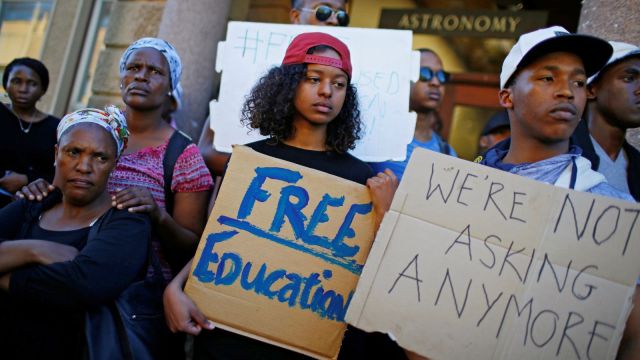
The government’s commitment to free higher education for poor and working class students must include not only fees but basic needs, especially food. This might require a new vision for financing higher education in South Africa: one that takes students’ daily realities of hunger and deprivation into account.

This article is based on the author’s keynote address at the National Colloquium on Access to Food for Students in South African Tertiary Institutions on 14 August 2018.

Stephen Devereux is a Research Fellow, Institute of Development Studies, University of Sussex
TUT Soshanguve students march to the offices of police minister

Gemma Ritchie

Following the death of Tshwane University of Technology law student Katlego Andries Monareng last week, students on the north and south campuses at Soshanguve are marching to the offices of Police Minister Bheki Cele.

According to student leader Sthembiso KaShandu, university staff, trade unions and NGOs have been asked to pledge solidarity with students and join them on the march on Wednesday.

The march is meant to “garner public sympathy to force the minister of police to give this issue special attention,” said KaShandu.

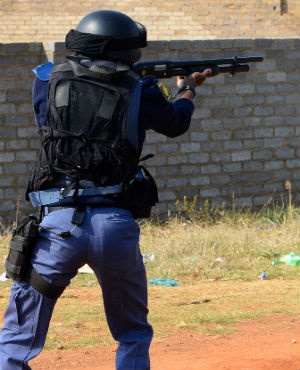
 Monareng was allegedly shot by a police officer following a protest against a perceived ‘rigged’ student representative council election outside Soshanguve north campus.

TUT and the Independent Police Investigative Directorate (Ipid) have initiated a forensic investigation into last week Thursday’s events.

According to Ipid spokesperson Moses Dlamini, the ballistic report will take six weeks before results will be made available. He said the directorate is still investigating the bullet that killed Monareng.

This week, all six TUT campuses were closed as the institution mourns the death of Monareng. Flags were also flown at half-mast. The university will hold a memorial service on Thursday, and Monareng’s funeral will be held on Saturday at Bushbuckridge in Mpumalanga.

The issue of the SRC elections — which were never completed following allegations of vote-rigging — will be handled after a week of mourning, said Dr Eskia Moroka, deputy vice-chancellor of student affairs and extra-curricula development.

Although academic activities have been put on hold, “Students must not lose a single day of teaching,” said deputy vice-chancellor Professor Stanley Mukhola.

“The exams were suppose to start in early November, but now we have decided they will start on November 12 and end on November 30,” Mukhola added.

The re-examination date has been rescheduled from December 3 to 14.

TUT said that it is supporting the family by paying for the funeral and supporting Monareng’s family by dispatching social workers in this time of grief.

“We aspire to be a people’s university. We are proud to cater for the poorest of the poor,” said vice-chancellor Professor Lourens van Staden. MG

Money will be paid by NSFAS to students from today

Tamar Kahn

The National Student Financial Aid Scheme (NSFAS) is due to begin disbursing outstanding funds to tens of thousands of students on Thursday‚ says higher education & training minister Naledi Pandor.

Fielding questions from MPs on Wednesday‚ Pandor assured legislators that the NSFAS was moving swiftly to ensure eligible students received the money they were due.

The NSFAS had for years battled to manage applications for funding while collecting on outstanding student loans‚ and then buckled under the extra demands created by former president Jacob Zuma’s surprise announcement in 2017 that students from poor and working-class families would be entitled to free higher education from 2018.

Thousands of students have faced delayed payments‚ prompting protests at tertiary institutions earlier this year.

Pandor placed the scheme under administration earlier in August and appointed Randall Carolissen as administrator.

Statistics provided by Carolissen indicated about 63‚000 students‚ the majority from technical and vocational education training colleges‚ were due to receive funds‚ she said.

“What is pleasing is that in the first seven days of the administrator’s work‚ we have had massive support from institutions and student organisations to get students to sign documents to ensure disbursements. Within the next four days we will see significant disbursement of funding‚” Pandor said. – Sowetan


Ghana’s legal education in danger – Prof Kotey

Staff Reporter

Professor Emmanuel Nii Ashie Kotey, Justice of the Supreme nominee, has proposed that all institutions offering legal education in the country are dis-accredited.

He said it was important that was done if the need be, before the institutions drove the legal profession into a ditch, adding that, legal education in the country was at the “crossroads.”

In this regard, he wants proper scrutiny done to ensure that all the institutions, including the University of Ghana, re-looked at legal education with all the fitting requirements, so as to produce quality law practitioners.

According to the associate Professor of the Faculty of Law, University of Ghana, the schools appeared in structure but were offering no better tuition in law; a situation he said, was dangerous for the country.

Appearing before Parliament’s Appointment Committee in Accra yesterday, Professor Kotey said, if care was not taken, Ghana, known for producing astute lawyers could run out of stock of that pride.

Giving reasons for his proposals, he said as part of a panel to interview LLB holders who were seeking to do their Masters in Law at the University of Ghana, majority of the applicants could not tell the panel the requirements of a valid contract.

“I think legal education in Ghana is at the cross roads. There are people with law degrees who could not tell me the requirements of a valid contract. People could not tell me what a lease is and others could not discuss a single case in constitutional law.

“When I asked about the December 31 case, somebody said it was the 31st December Women’s Movement” he said to loud laughs from the committee members.

“I think the problems that we are confronting is a very very serious one. Legal education requires the root before the branch,” he added.

He said when some of the applicants were given the option to come out with a case of constitutional law to be discussed, they could not mention a single one.

Describing his experience on that panel as one which exposes Ghana to serious legal problems, Prof. Kotey said legal education needs rethink from accreditation to training.

He questioned the capacity of the many institutions offering law programmes saying “if care is not taken, we will be churning out lawyers who don’t know any law.”

Asked if he would present a paper to the Chief Justice for consideration, Prof. Kotey said he would consider it if given approval as a Justice of the Supreme Court.

Speaking on corruption, Prof. Kotey said he was ready to assist in the fight against the canker.

To him, there should be no need glossing over the fight against corruption because it is just a matter of applying the laws backed by evidence. – Ghanaian Times


English teacher accused of k-word rant

Jeff Wicks

A Westville Girls High School teacher who resigned amidst a racism scandal is accused of calling black people the k-word.

The English teacher‚ Danielle de Bruyn‚ has rebuffed attempts to contact her on Tuesday – a day after she tendered her resignation. The school issued a statement which condemned her racist remarks‚ insisting that her “loss of control and bigoted view” was not congruent with the ethos of the school.

De Bruyn is understood to have become embroiled in a heated debate with her English class over drawing similarities between the set book‚ Harper Lee’s To Kill a Mockingbird‚ with the South African political landscape and farm killings.

A relative of one of the pupil’s who was in the class at the time of the outburst‚ who spoke to the publication on condition of anonymity‚ said that De Bruyn was alleged to have “gone off on a tangent” while discussing the set book.

“My sister told me they were discussing the book and she went off on a tangent trying to draw comparisons in farm killings and the content of the book.

“She was saying that there was reverse racism now because farmers were responsible for putting food on the table and now they were being subjected to attacks. She went on to say that blacks would never have been able to do half the things in the country if it wasn’t for white people‚” she said.

“She was speaking to the black girls in the class when she called them ‘these k****rs’. This happened in front of a full class and she didn’t stop. She went crazy‚” she added.

“After she apologised the HOD came and told the girls that it had taken a lot to humble herself in front of them and they should move on.”

The relative said that her family was considering registering a criminal case of crimen injuria.

Parent and deputy chair of the Gender Commission Mfanozelwe Shozi said that his daughter told him that a discussion on land and race had gotten De Bruyn riled up.

“The teacher said that Zimbabwe was an amazing country when it was called Rhodesia under the white regime and that when it was taken by Africans it became a basket case‚” he said.

“She said that South Africa would have the same fate if expropriation of land without compensation was pursued…she said if South African land was returned to African people it would end up like Zimbabwe‚” he added.

He said the teacher had used the k-word‚ insisting that Africans could not run the country properly.

“She even said that in her home her parents are scared and have guns under their beds. She said that if she could meet Julius Malema she would shoot him. They [the learners] tried to stop her and she continued.

“I welcome her resignation but my worry is that these kinds of comments in a mixed classroom are divisive. Now that the criminal element has left the school‚ we can return to the business of study while the management takes action.”

In a letter issued by the school on Tuesday‚ principal Catherine Raw outlined the scope of the school’s probe which was initiated last week.

“I am sad and troubled to let you know that one of our staff stepped out of her role of teacher and used her position of parent in the classroom to make racist remarks and share her biased opinion of the South African political situation.

“By doing this‚ not only did she break the law and violate the code of the school‚ but she also created a hurtful and unsafe environment for the learners in her class‚” Raw wrote.

She said that the school was made aware of the incident on Thursday last week‚ and by Friday morning had initiated its own internal investigation.

“The teacher requested an opportunity to apologise to the class. It was pointed out to her that this did not alter the investigation process in place.”

The allegations were put to De Bruyn by TimesLIVE via Facebook Messenger. The message was read and the reporter was blocked.

KZN Education Department spokesman Kwazi Mthethwa said the matter would be dealt with.

“We condemn racism and all schools are expected to uphold the values and principles enshrined in the Constitution. We are not going to waste any time‚ we will deal with this right away‚” he said.

“The MEC for Education in KwaZulu-Natal‚ Mthandeni Dlungwane‚ hates racism with a passion and in fact he’s addicted to non-racialism. He is not going to allow pupils to be reminded of apartheid. We will make contact with this school urgently.” – Sowetan

Schools re-open amid uncertainty over teachers strike

Simon Ndonga

Schools are set to re-open on Monday across the country amid as uncertainty over the teachers strike.

Students are preparing for the busiest term, which is set to run until October 26 with preparations for national examinations in high gear.

The Kenya Certificate of Primary Education (KCPE) examinations will take place between October 29 and November 1 while the Kenya Certificate of Secondary Education (KCSE) examinations have been scheduled for November.

And even as students go back to school, the Kenya National Union of Teachers (KNUT) issued a strike notice after their demands were not met following talks with the Teachers Service Commission.

Last week, the teachers’ union held a consultative meeting with the Teachers Service Commission (TSC) where they mutually agreed to form a Monitoring and Evaluation Committee, which will work on contentious issues.

During the meeting, KNUT Secretary General Wilson Sossion stated that the strike can only be called off after the commission successfully addresses the issues of concern to the union, which include the withdrawal of all circulars, which were crafted without the involvement of the union and withdrawal of Teacher Delocalization policy.

He further called on the TSC not to engage non-parties to the CBA in labour matters, for instance KESSHA and KEPSHA as industrial issues are not within their purview.

During the meeting, TSC expressed its commitment to an amicable settlement of any issue affecting teachers in the course of their professional duties. – CapitalFM


NSFAS CEO Steven Zwane suspended

Staff Reporter

The National Student Financial Aid Scheme (NSFAS) suspended its executive officer Steven Zwane with immediate effect on Monday evening.

“The suspension follows allegations of maladministration against Zwane. To ensure fairness and allow the process to proceed uninhibited‚ Zwane has been relieved from his duties pending the outcome of the investigation‚” NSFAS spokesperson Kagisho Mamabolo said.

The student funding scheme said Zwane’s suspension was to ensure “fairness” of the investigation into the allegations.

“The NSFAS administrator, Dr Randall Carolissen, is in the process of reviewing governance at Nsfas. This is in line with the ministerial mandate to oversee the management, governance, and administration of the entity. This includes all necessary forensic and other investigations currently under way,” the entity said in a statement.

Early this month, the South African Students’ Congress (Sasco) called on Higher Education and Training Minister Naledi Pandor to fire Zwane over “inefficiencies and lack of leadership” after Nsfas halted 2019 applications that were expected to commence on August 1 due to payment backlogs from 2017 and 2018.

Last month, the National Health and Education Workers’ Union also called for Zwane’s head as well as that of Sizwe Nxasana, who resigned as Nsfas chairperson on August 9.

Nxasana admitted that the NSFAS payments system had come under extreme strain after then president Jacob Zuma announced last December that students from poor families would receive free higher education.

These events surface at a time when the scheme is under a lot of pressure.

Earlier this month, the National Education, Health and Allied Workers’ Union (Nehawu) said Zwane — a former chief operating officer at Barclays Africa — was hired illegitimately, accusing him of nepotism and demanded his resignation.

The statement added that administrator Randall Carolissen was currently reviewing governance at NSFAS.

“This is in line with the Ministerial mandate to oversee the management‚ governance‚ and administration of the entity. This includes all necessary forensic and other investigations currently underway.”

NSFAS came under fire recently after Pandor instructed the institution to halt funding for 2019 students because a backlog in disbursing aid for 2017 and 2018 had not been cleared. NSFAS has an annual budget of R30bn. Pandor reportedly wrote a letter to the board asking it not to open applications for next year until all 2018 processes were properly concluded.

In an radio interview, Deputy Minister of Higher Education and Training Buti Manamela said the implementation of fee-free higher education policy found NSFAS trying to come to terms with some of the challenges that it has faced before. And it had to readjust its system in order to ensure all were in place.

He said the adjustment meant that some students could not receive their allowances. Some believe that their allowances are insufficient.

Pressure mounted for Pandor to fire the chief executive of NSFAS and disband its board following the ongoing challenges in disbursing money for students who were promised free education.

KZN education steps in at school where 2 pupils were killed over phone

Kaveel Singh

A KwaZulu-Natal school where two pupils were stabbed and killed will undergo a multitude of changes when government interventions are implemented, MEC for education Mthandeni Dlungwana has said.

Dlungwana, who visited Masakhaneni High School with a high-level provincial delegation on Monday, addressed hundreds of pupils, parents and community stakeholders in KwaMakhutha, south of Durban.

Sihle Mngadi, 20, and Mangaliso Mbatha, 18, died after they were stabbed over a cellphone by pupils from another school. The two were stabbed after allegedly attempting to stop the fight.

Pupils and parents listened intently as Dlungwana called for improved discipline and more respect from pupils. Learning and teaching at the school has been disrupted by the incident.

“We are committed to changing things that are not in accordance with the law.”

According to the MEC, there have been several challenges over many months that led to the double tragedy at the school.

‘You think you are in charge’

He said there were factions of teachers and parents that supported “certain people at the school”.

“There is no respect. Even teachers are not respected. A circuit manager came here and did not receive any respect.”

Dlungwana lashed out at pupils who interrupted him during his address.

“Some of you think you are in charge. You are not. I am here to do my work; not play around. We are very serious. We are worried about you and your behaviour. You will realise your behaviour was a mistake and you will regret it.”

He said the school was also alleged to be a “drug den”.

“Our first commitment is to re-fence the school. We also have issues where teachers are absent, coming late and leaving early. We are also conducting an investigation regarding alleged financial mismanagement.”

Teachers blocked from coming to school

Dlungwana said another big challenge was that some teachers were prevented from coming into the school.

“There were parents that blockaded the gates and refused teachers entry. Some thought teachers were dismissed, but that was not true.

“The teachers decided they would no longer be coming in because of the blockade.”

There was a serious challenge in forming a good working relationship with the principal and some teachers, he said.

Dlungwana said full teaching was expected to commence at the school by Tuesday.

“The most important thing is to have teaching start. We are expecting pupils to attend by tomorrow.”

Dlungwana said that, together with MEC for safety community and liaison Mxolisi Kaunda, he would attempt to root out “rough elements in the community”. – News24

Nigeria to introduce indigenous languages to teach Mathematics and Science

Socrates Mbamalu

Nigeria might be a country facing too many challenges, but the latest announcement by the Minister for Science and Technology, Dr Ogbonnaya Onu that the country will soon use indigenous languages to teach Maths and Science is a welcome development if implemented.

Nigeria might be a country facing many challenges, but the latest announcement by the Minister for Science and Technology, Dr Ogbonnaya Onu that the country will  soon use indigenous languages to teach Maths and Science might be a stepping stone towards development if implemented.

During the inauguration of the inter-ministerial committee on the teaching of Mathematics and Science subjects in local languages in Abuaja, the minister, said primary and secondary schools in the country will soon start teaching Mathematics and Science subjects in indigenous languages.

This announcement was welcomed and seen as a step forward in the process of preservation and elevation of indigenous. The inter-ministerial committee, which would be comprised of the Federal Ministry of Science and Technology and the Ministry of Education will work towards the realisation of the project.

The magnanimity of such a project is not to be understated. Nigeria, a country of over 600 languages has English and French as its official languages. English is currently used as the medium of instruction in primary and secondary schools despite the existence of a language policy in education that recommends that indigenous languages should be used as the medium of instruction in primary schools.

The U-turn by the Nigerian government might as well be in compliance with this policy. The minister said the committee would develop the capacity of the local languages to serve as effective tools for teaching Mathematics and Science subjects. Whether the committee will also include linguists and language experts, it still remains relatively unknown.

With the minister pointing to India and China as examples of countries that use their languages as mediums of teaching in their schools, he hoped making use of indigenous languages to teach the various subjects would ignite an interest in the subjects.

But does all the talk on the issue mean anything without the increment in the budget allocation for both education and science and technology? This project is complex and ambitious, which needs extensive multi-sector support, research, government investment, training and development. The implementation of the proposal will be a huge challenge. The training of teachers specifically for this purpose is one of the challenges.

Read original article here.

Meet Kenya’s Fridah Mokaya; University of Connecticut’s first black Female Nuclear Physics PhD graduate

Kylie Kiunguyu

Moving from her native Kenya to pursue a masters in Physics, Dr. Fridah Mokaya went on to join the University of Connecticut PhD program as the only black Physics PhD female (student) in her department but feels “coming from nowhere with no connections” worked in her favour

Dr. Fridah Mokaya is the first of her family to pursue a science course despite a rocky start. For a lot of people who attain the accolades she has science came easily but for Dr. Mokaya it took dedication and determination.

In high school when it came time to pick her examinable subjects she missed the cut off mark for Physics by a mere 2% but her father intervened to help steer her to her fate.

She told African Warrior Magazine, “One thing I will never forget is that in all this, my Dad did not talk much, he just told the teacher that I was his daughter and he knew me and what I can do and he had no doubt that I will excel in physics. This was the turning point.

My Physics teacher Mr. Orinda, saw how distressed I was and knowing my potential told the deputy principal that he had allowed me in the Physics class on condition that I had to perform. Let’s just say that I worked hard and it paid off.   I got an “A” in Physics when I sat for my KCSE exam. Looking back, I know that were it not for the deep belief that my parents and teacher had in me, I may not be where I am.”

The next disappointed came in University. When she was about to graduate from Jomo Kenyatta University of Agriculture and Technology in Kenya for a Bachelor of science degree in Physics she found herself lower of the list than she had hoped.

“I did my four years in campus with very good grades and just a few days to graduation when the graduation list was out, lo and behold my name was on the second-class honors lower division list.  I had never felt so distressed in my life. All the arduous work I had put in, including the late nights for a second class lower?” she said “I was very heart broken.”

As fate would have it she ended up pursuing her master’s degree (M.Sc. Physics) in the United States at the Binghamton University (SUNY). Then moving on to the PhD Program at the University of Connecticut where she conducted research in the field of Experimental Nuclear and Hadronic Physics.

“In the simplest terms, we use the nucleus as a “laboratory” to study fundamental interactions. So why is all this important? Well, it’s because it enables us to understand the fundamental building blocks of nature.” She elaborated

Not only was she the only black Physics PhD female (student) in my department she also had to juggle being a new mother.

“I want everyone to know that anyone can achieve anything you want in life… Challenges along the way should propel you to keep going and not discourage you.”

“If I could influence more women to pursue STEM related subjects, then I will be the happiest person.” She concluded.

Read original article here.