Home Blog Page 506

‘Code of silence no longer exists’ – Lesufi on Parktown Boys High

Yoliswa Sobuwa and Nico Gous

Gauteng MEC of education Panyaza Lesufi expressed the need for the establishment of a new code of conduct during his visit to the Parktown Boys’ High School in Johannesburg on Tuesday.

“We have learnt of the events taking place in the hostel especially during parties and when the pupils leave hostel to come to school. There are accusations that pupils are sharing blades to cut their beards. Also if something happens to them they must keep quiet,” he said.

“That is something that I felt I must come and address and officially declare in front of learners and educators that the code of silence no longer exists but a new code will be formulated. If anyone is aggrieved they have a right to complain,” Lesufi said.

Lesufi said grade 8 pupils are taken to a camp outside the school’s premises where they are mistreated.

“Some of the boys come back really traumatised and if they speak out there are allegations that a product called ‘Deep heat’ will be rubbed in their private parts. That code of silence must come to an end,” Lesufi said.

Lesufi also voiced concerns about a liquor license being given to the hostel.

“That licence needs to be reviewed as there are allegations that liquor is sold to pupils during hostel parties. We value this school and pupils should be protected at all times. ,” Lesufi said.

Parktown Boys’ High School is not new to controvery.

In April, two teachers from the school were accused of racism and assault.

IOL reported an art teacher‚ Nik Muiznieks resigned after he was recorded during a rant directed at some pupils. In the 45-minute rant he allegedly called some of the pupils “black and white monkeys”. He also allegedly asked an Indian pupil where he can buy explosives to blow up the boarding house‚ and also called him “Isis”.

He allegedly resigned after the school started a disciplinary process.

Maths literacy teacher Remo Murabito was also accused of assaulting a pupil in class. IOL reported that she allegedly stomped on his foot and slapped him before calling him a “nuisance in my life”.

Parents spoke of the trauma their children endured as a result of alleged racism and sexual assault at the school.

“Every single bit of this evidence was presented to the headmaster‚ to the SGB (school governing body) and it was too much for them and they tried to squash the information‚” said one parent in a meeting with Gauteng Education MEC Panyaza Lesufi.

A man alleged his nephew was sexually assaulted and Deep Heat was rubbed on his genitals. He said his sister did not attend the meeting due to the “sensitivity and the painful trauma that she is going through”.

Nine teachers have been implicated in allegations of racism and sexual assault in the department’s report presented in April. Law firm Fasken Martineau compiled the report.

“There were nine teachers that were implicated‚ but four we’ve got evidence against them. Of the four‚ two are employed by the department and two are employed by the school‚” Lesufi said.

The four teachers will be suspended. One teacher has already resigned and another is facing disciplinary proceedings.

In 2017, the school was hit by scandal after a former Parktown Boys High School assistant water polo coach was charged with sexually grooming more than 20 pupils in 2015. He was arrested in November 2016 after some of the boys‚ aged 15 and 16‚ came forward in early 2017.

Read original story here.


Digital technology can help reinvent basic education in Africa

 Erwan Lequentrec and Francesc Pedró 

African countries have worked hard to improve children’s access to basic education, but there’s still significant work to be done. Today, 32.6 million children of primary-school age and 25.7 million adolescents are not going to school in sub-Saharan Africa.

The quality of education also remains a significant issue, but there’s a possibility the technology could be part of the solution. The digital revolution currently under way in the region has led to a boom in trials using information and communication technology (ICT) in education – both in and out of the classroom.

A study carried out by the French Development Agency (AFD), the Agence Universitaire de la Francophonie (AUF), Orange and Unesco shows that ICT in education in general, and mobile learning in particular, offers a number of possible benefits. These include access to low-cost teaching resources, added value compared to traditional teaching and a complementary solution for teacher training.

This means that there’s a huge potential to reach those excluded from education systems. The quality of knowledge and skills that are taught can also be improved.

The irresistible digital revolution

Access to means of communication is now a key part of daily life for the vast majority of people living in Africa. Mobile telephone prices and the cost of communication have dropped. Mobile telephone use has increased from 5% in 2003 to 73% in 2014. There are 650 million mobile phone owners on the continent (more than the US and Europe combined) and 3G mobile networks are growing rapidly.

Costs are falling and rural areas will soon be reachable thanks to a number of developments. These include undersea cables connecting Africa to other continents, fibre-optic cables that provide connectivity within the continent and recent satellite connection plans. Access to wired Internet remains low with 11% of households connected. But access to mobile Internet is already helping the region catch up. Smartphone penetration levels should reach 20% in 2017.

This rapid expansion of mobile Internet services is already contributing to the region’s economic and social development. This is particularly the case in areas such as financial inclusion (mobile banking), health (mobile health) and farmers’ productivity.

Given the features of mobile telephones (voice calling, text messaging) and smartphones (reading texts and documents, MP3, images and video) and their wide availability, their potential for improving access and quality of educational services is also boundless.

M-learning (or m-education) – educational services via a connected mobile device – is the main lever for growth in educational information and communication technology and for making content available. This could be for learning (teacher training, learner-centred teaching, tests) or making up for the lack of data for education system management.

New technologies for learning

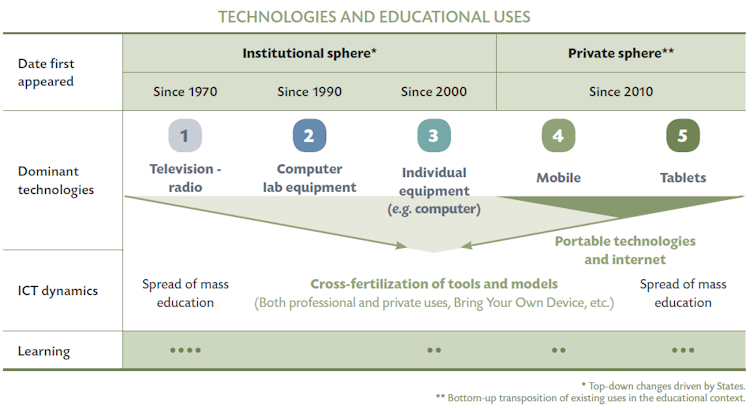
Mass communication technology has been used as a principal driver of education in Africa since the 1960s. Countries such as Côte d’Ivoire, Niger and Senegal developed major programmes using radio and then television to promote basic education, improve teacher training and even teaching pupils directly. These programmes reached a high number of pupils at a relatively low cost. But results in terms of academic performance remain difficult to evaluate.

The mass distribution of computer hardware then took over in the 1990s. Many national and international programmes started to concentrate on equipping schools with computers to facilitate digital education and offer new educational media in the form of educational software and CD-ROMs. Use was mainly centred on schools. But trials were often launched without clear pedagogical objectives and state-defined policy frameworks.

Digital Services for Education in Africa

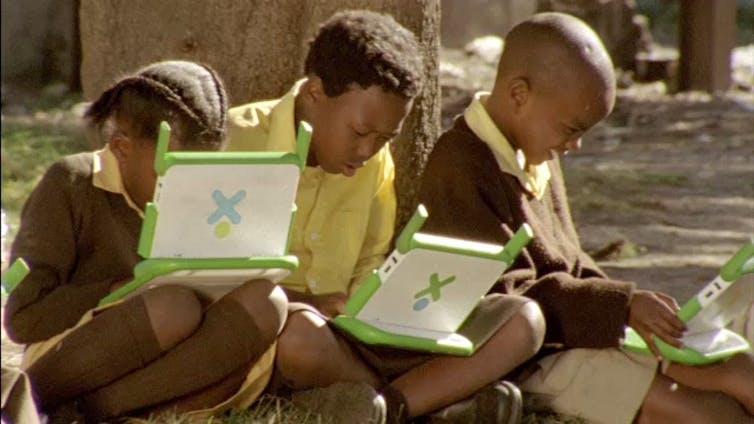
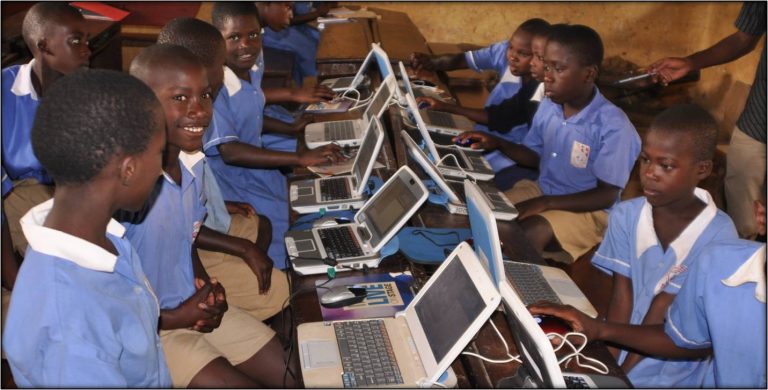
The arrival of personal computers in the 2000s facilitated the individualisation of school ICT. The US One Laptop per Child project, launched in several African countries in 2005, aimed to equip schools with laptops at low cost.

Nearly 2 million teachers and pupils are involved in this programme across the world. More than 2.4 million computers (at a cost of around $200 including an open teaching platform) have been delivered. Evaluations show that the use of portable or fixed computers in the classroom has only a limited effect on pupils’ academic performance. But it may have a positive impact on certain cognitive abilities if pupils can use their computers at home in the evening.

The One Laptop per Child programme equips thousands of African schoolchildren. One Laptop per Child/Flickr

Contents and uses

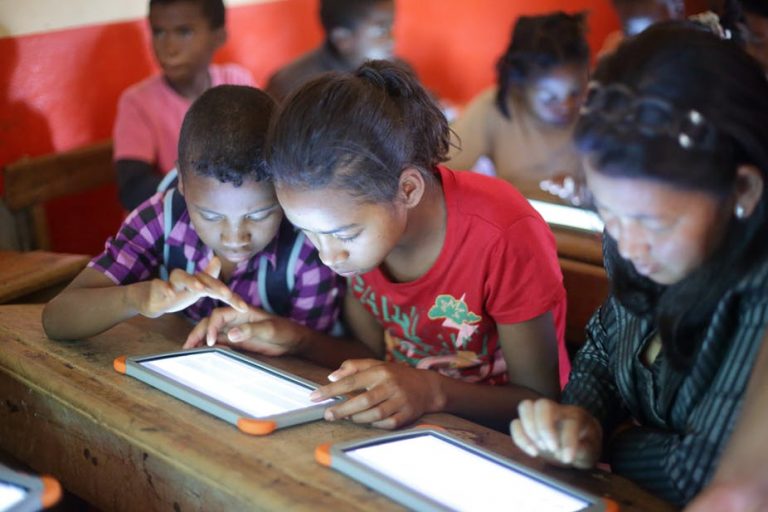
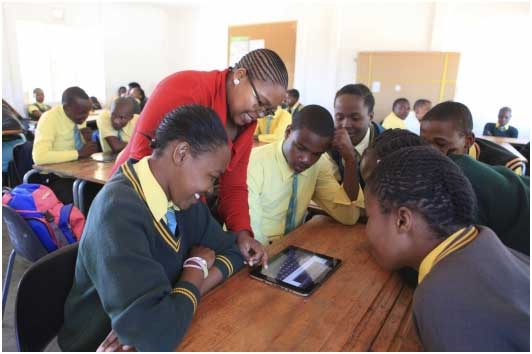
Since 2010 the large-scale diffusion of mobile communications technology has transformed practices with easier access to educational resources in and outside school. The arrival of low-cost, low-consumption smartphones and tablets allows ICT in education to gradually move out of the school environment.

There has been a shift from a tool-based approach to one that’s centred on content and use. These mobile tools, particularly tablets, offer important opportunities to tackle the lack of books and textbooks. The distribution of Kindle-style readers to 600,000 children in nine African countries has seen a considerable impact on reading and on pupils’ results in educational tests.

The sending of text messaging containing short lessons, multiple choice tests or audio recordings have also been shown to have an important effect on teachers. This is also true of MOOCs (massive open online courses) adapted to African countries’ needs and capacities.

The cross-fertilisation of teaching models and tools has broadened the potential of information and communication technology in education. Some technologies, perceived as outdated, are undergoing a partial revival thanks to the combination of media that can be used in any single project. For example radio and television programmes are inexpensive and attract a considerable audience. Combined with Internet and mobile phones they provide promising educational results.

The BBC’s Janala English-instruction programme for the people of Bangladesh is a good example of cooperation between very diverse actors.

What are the conditions for success?

Most African countries are showing an interest in technology in education. But a range of conditions must be satisfied to ensure that they are deployed efficiently within the educational landscape. This includes:

  • Responding to technical and economic constraints
  • Responding to users’ needs and strengthening their capacities
  • Finding sustainable funding models
  • Facilitating effective multi-stakeholder collaboration.

Although the time for innovation and experiment will never end, now is the moment to put systems and strategies in place for moving to the next level, particularly by setting up stakeholder coalitions. ICT will not resolve all of Africa’s education problems. But it can help to fundamentally change the current paradigm of skills development systems.

New school already crammed beyond capacity

Vincent Lali    

Last week angry parents refused to vacate a school in Khayelitsha, demanding their children be admitted. “They crammed their kids into classrooms by force,” said ward councillor Andile Lili (ANC).

Noluvuyo Guzula, who is a parent and works as a cleaner at the school, said she and other parents forced their children into Enkanini Primary School in Zwelitsha because the trains are crammed and not safe.

“We want our kids to attend school within Zwelitsha because they can’t go to school in other townships when trains don’t run,” said Guzula. Her child was in Grade 3 at Vuzamanzi Primary School in Site C, Khayleitsha.

Children also came from Kuyasa, Nkazimlo and Noxolo Xauka primary schools.

“If we don’t squeeze them into the new school [Enkanini], the department will never do anything to help them,” she said.

“We don’t want our kids to cross big, busy roads and railway lines before they reach their schools. We want them to attend school close by,” said Lili.

A number of school children have been killed crossing roads.

A senior teacher said, “Because of the large number of learners, there will be no effective learning here … Contact time with learners won’t be enough. Remember, these kids are still in a foundation phase where a teacher still has to show them how to handle a pencil.”

“If they continue to learn in an overcrowded classroom, they may still be unable to write when they leave Grade 1,” she warned.

The school currently accommodates learners up to grade 5.

“We asked the department to give us 22 classrooms, but it has given us only 12. We want the department to bring about 14 classrooms which are idling at nearby Ludwe Ngamlana Primary School,” said Lili.

Bronagh Hammond, Director Communications at the Western Cape Education Department said the mobile classrooms were “earmarked for various [other] projects”.

“The demand for accommodation for schools in the area grew and parents were not prepared to leave their children at the neighbouring schools … Because of the demand for accommodation for learners in Grade 1-5, the department could not extend the school beyond Grade 5 in terms of capacity.”

The second phase of the new Enkanini school project will see Grades 6 and 7 added, said Hammond. “Negotiations to secure and erect additional mobile classrooms are underway.”

The interim school governing body is in the process of filling the last two vacant teacher posts. “This should relieve some of the overcrowding at the school,” said Hammond.

The department also said learners receive a sandwich daily, milk once a week and fruit twice a week through the National Schools Nutrition Programme. Cooked meals will be provided when the necessary infrastructure is in place in the third term of 2018.

Read original story here

Nelson Mandela University disrupted as NSFAS fails to pay fees

Joseph Chirume

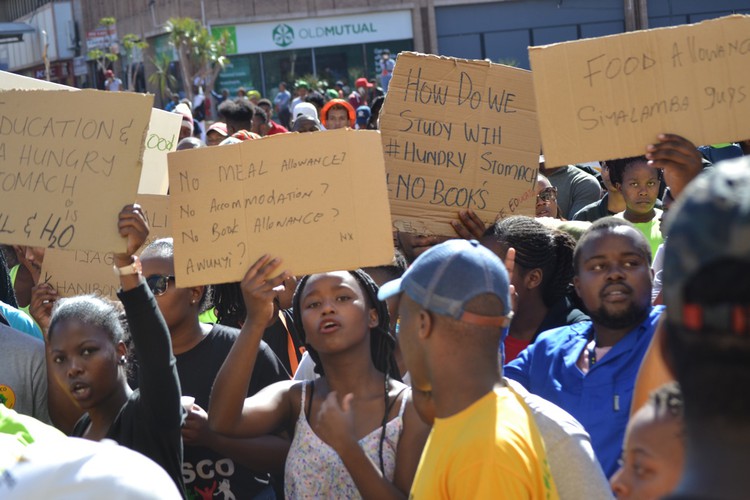
Nelson Mandela University students disrupted classes for several days last week, protesting against conditions at off-campus residences and demanding the speedy payment of fees by the National Student Financial Aid Scheme (NSFAS).

On Wednesday morning, led by the South African Student Congress (SASCO), students blocked entrances to all campuses with rocks and tree branches.

A SASCO statement said the central issue is free higher education and the “atrocious conditions in which we find ourselves as far as financial aid is concerned”.

“It cannot be that a certain group of students are expected to continue with tests, examinations, and assignments without textbooks, meals, and the relevant support material they would have received from NSFAS,” said SASCO.

In a statement, Nelson Mandela University said it will provide emergency financial support for qualifying and NSFAS-funded students who are still waiting for the funds so that they can buy food and books.

“The university will reclaim funds provided from NSFAS,” read the statement.

Students marched to the city hall and submitted a petition to Mayor Athol Trollip.

SRC president Bamanye Matiwane said: “We are against the increase in municipal rates at accommodation where students are living. We also want the mayor to buy these old buildings in the metro so they can be used by students.”

“We also want the metro police to protect off-campus students because shuttle services are found far away from residences,” added Matiwane.

Matiwane said the lack of transport “directly impacts the poor, black majority and particularly women that are left with no option but to walk to their various residences and are left stranded in an environment that is unsafe and [where] they are consistently victimised”.

“There are busses used in 2010 World Cup. We want students from townships like Zwide and Motherwell to use them for free by just producing their student cards.”

Sibongile Dimbaza, spokesperson for the Mayor said: “As a municipality we sympathise with the students, but we are limited because we are bound by law.”

“We cannot take those dilapidated buildings [off-campus residences] or force landowners to reduce their rentals because that is private property. Also, we depend on collecting tariffs for our revenue to fund poor residents and supply them with good services.”

Read original story here

Zimbabwe: Teachers headed for clash with government

Nokuthaba Dlamini

Teachers are headed for a clash with government after the Zimbabwe Teachers’ Association (Zimta) yesterday officially declared they would down tools when schools open in a couple of weeks to press for an increase of their salaries and allowances and the revocation of the new curriculum.

The declaration, endorsed by all 10 provinces, was signed by Zimta president Richard Gundane and secretary-general Tapson Nganunu Sibanda in Victoria Falls at the end of the association’s 37th annual national conference.

Zimta said the strike was in accordance with the section 65(3) of the Constitution, which guarantees the right to collective job action, fair and safe labour practices and fair standard wages.

“Now, therefore, the 37th annual national conference of the Zimbabwe Teachers’ Association do, hereby, declare that schools will not open for the second term of 2018 and for the avoidance of doubt, our members will be on strike and will withdraw their labour effective May 8 until the issues raised herein above are resolved,” Sibanda declared.

Teachers at the conference said government had failed to meet their demands and that of pupils.

“This is the beginning of a long struggle which seeks to emancipate us as workers of the government,” one teacher, who spoke on condition of anonymity, said.

“The government has no will to do collective bargaining with us and set up a correct bargaining system. For many years, we have asked them to introduce bargaining chambers that suit our system. We had an agreement that was put in place for allowances and salary increment and government has not attended to that since 2013. We say enough is enough,” Zimta Matabeleland South provincial chair Akuneni Maphosa said.

He said the new curriculum had to be withdrawn or redone, as it was riddled with errors.

Another teacher said: “Vacation leave is a major condition of service that was taken away from us. Therefore, we are claiming it back. We need time to rest. Since 2016, we have not gone for leave because they say they have no money to pay stand-in teachers.”

The job action threat comes after doctors and nurses at public health institutions downed tools, demanding better worker conditions and wages.

The strike crippled the health delivery system, leaving thousands of patients stranded.

Read original article here.

Africa Grapples With Huge Disparities in Education

Zipporah Musau

At the dawn of independence, incoming African leaders were quick to prioritize education on their development agendas. Attaining universal primary education, they maintained, would help post-independence Africa lift itself out of abject poverty.

As governments began to build schools and post teachers even to the farthest corners of the continent, with help from religious organizations and other partners, children began to fill the classrooms and basic education was under way.

Africa’s current primary school enrolment rate is above 80% on average, with the continent recording some of the biggest increases in elementary school enrolment globally in the last few decades, according to the United Nations Educational, Scientific and Cultural Organization (Unesco), which is tasked with coordinating international cooperation in education, science, culture and communication. More children in Africa are going to school than ever before.

Yet despite the successes in primary school enrolment, inequalities and inefficiencies remain in this critical sector.

According to the African Union (AU), the recent expansion in enrolments “masks huge disparities and system dysfunctionalities and inefficiencies” in education subsectors such as preprimary, technical, vocational and informal education, which are severely underdeveloped.

It is widely accepted that most of Africa’s education and training programs suffer from low-quality teaching and learning, as well as inequalities and exclusion at all levels. Even with a substantial increase in the number of children with access to basic education, a large number still remain out of school.

A newly released report by the United Nations Development Programme (UNDP), “Income Inequality Trends in sub-Saharan Africa: Divergence, Determinants and Consequences”, identifies the unequal distribution of essential facilities, such as schools, as one the drivers of wide income disparities.

Ayodele Odusola, the lead editor of the report and UNDP’s chief economist, makes the following point: “Quality education is key to social mobility and can thus help reduce poverty, although it may not necessarily reduce [income] inequality.”

To address education inequality, he says, governments must invest heavily in child and youth development through appropriate education and health policies and programmes.

Higher-quality education, he says, improves the distribution of skilled workers, and state authorities can use this increased supply to build a fairer society in which all people, rich or poor, have equal opportunities. As it is now, only the elites benefit from quality education.

“Wealthy leaders in Africa send their children to study in the best universities abroad, such as Harvard. After studies, they come back to rule their countries, while those from poor families who went to public schools would be lucky to get a job even in the public sector,” notes Odusola.

Another challenge facing policy makers and pedagogues is low secondary and tertiary enrolment. Angela Lusigi, one of the authors of the UNDP report, says that while Africa has made significant advances in closing the gap in primary-level enrolments, both secondary and tertiary enrolments lag behind.

Only four out of every 100 children in Africa is expected to enter a graduate and postgraduate institution, compared to 36 out of 100 in Latin America and 14 out of 100 in South and West Asia.

“In fact, only 30 to 50% of secondary-school-aged children are attending school, while only 7 to 23% of tertiary-school-aged youth are enrolled. This varies by sub-region, with the lowest levels being in Central and Eastern Africa and the highest enrolment levels in Southern and North Africa,” Lusigi, who is also the strategic advisor for UNDP Africa, told Africa Renewal.

According to Lusigi, many factors account for the low transition from primary to secondary and tertiary education. The first is limited household incomes, which limit children’s access to education. A lack of government investment to create equal access to education also plays a part.

“The big push that led to much higher primary enrolment in Africa was subsidized schooling financed by both public resources and development assistance,” she said. “This has not yet transitioned to providing free access to secondary- and tertiary-level education.”

Another barrier to advancing from primary to secondary education is the inability of national institutions in Africa to ensure equity across geographical and gender boundaries. Disabled children are particularly disadvantaged.

“Often in Africa, decisions to educate children are made within the context of discriminatory social institutions and cultural norms that may prevent young girls or boys from attending school,” says Lusigi.

Regarding gender equality in education, large gaps exist in access, learning achievement and advanced studies, most often at the expense of girls, although in some regions boys may be the ones at a disadvantage.

Unesco’s Institute for Statistics reports that more girls than boys remain out of school in sub-Saharan Africa, where a girl can expect to receive only about nine years of schooling while boys can expect 10 years (including some time spent repeating classes).

More girls than boys drop out of school before completing secondary or tertiary education in Africa. Globally, women account for two-thirds of the 750 million adults without basic literacy skills.

Then there is the additional challenge of Africa’s poorly resourced education systems, the difficulties ranging from the lack of basic school infrastructure to poor-quality instruction. According to the Learning Barometer of the Brookings Institution, a US-based think tank, up to 50% of the students in some countries are not learning effectively.

Results from regional assessments by the UN indicate “poor learning outcomes in sub-Saharan Africa, despite upward trend in average learning achievements.” Many children who are currently in school will not learn enough to acquire the basic skills needed to lead successful and productive lives. Some will leave school without a basic grasp of reading and mathematics.

Overcoming

The drivers of inequality in education are many and complex, yet the response to these challenges revolves around simple and sound policies for inclusive growth, the eradication of poverty and exclusion, increased investment in education and human development, and good governance to ensure a fairer distribution of assets.

With an estimated 364 million Africans between the ages of 15 and 35, the continent has the world’s youngest population, which offers an immense opportunity for investing in the next generation of African leaders and entrepreneurs. Countries can start to build and upgrade education facilities and provide safe, non-violent, inclusive and effective learning environments for all.

The AU, keeping in mind that the continent’s population will double in the next 25 years, is seeking through its Continental Education Strategy for Africa 2016–2025 to expand access not just to quality education, but also to education that is relevant to the needs of the continent.

The AU Commission deputy chairperson, Thomas Kwesi Quartey, says governments must address the need for good education and appropriate skills training to stem rising unemployment.

Institutions of higher learning in Africa, he says, need to review and diversify their systems of education and expand the level of skills to make themselves relevant to the demands of the labour market.

“Our institutions are churning out thousands of graduates each year, but these graduates cannot find jobs because the education systems are traditionally focused on preparing graduates for white-collar jobs, with little regard to the demands of the private sector, for innovation or entrepreneurship,” said Quartey during the opening of the European Union–Africa Business Forum in Brussels, Belgium, in June 2017.

He noted that if African youths are not adequately prepared for the job market, “Growth in technical fields that support industrialization, manufacturing and development in the value chains will remain stunted.” Inequality’s inclusion among the Sustainable Development Goals (SDG 10: Reduced Inequalities) serves as an important reminder to leaders in Africa to take the issue seriously.

For a start, access to early childhood development programmes, especially for children from disadvantaged backgrounds, can help reduce inequality by ensuring that all children begin formal schooling with strong foundations.

The UNDP, through its new strategic plan (for 2018 through 2021), will work to deliver development solutions for diverse contexts and a range of development priorities, including poverty eradication, jobs and livelihoods, governance and institutional capacity and disaster preparedness and management.

*Africa Renewal is published by the UN’s Department of Public Information (DPI)

 

Hundreds of teachers protest as KZN MEC tables budget

Nompendulo Ngubane    

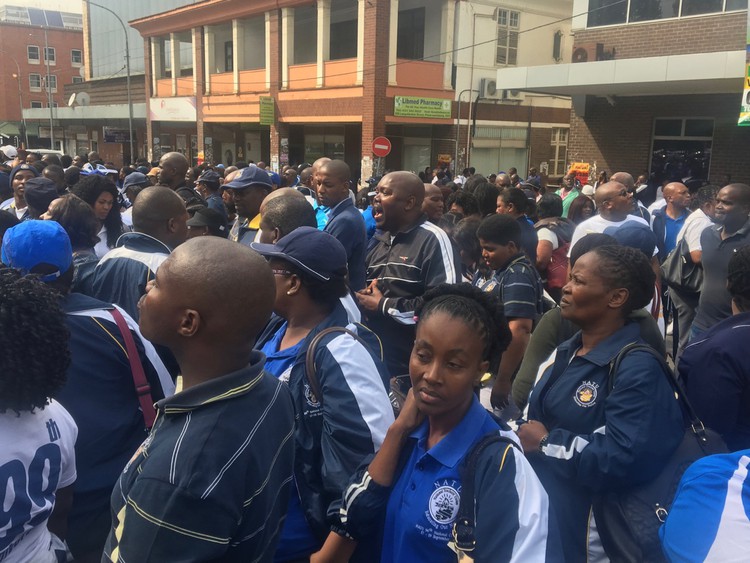
Hundreds of Grade R teachers from across KwaZulu-Natal protested outside the legislature in Pietermaritzburg on Thursday. They demanded that MEC for Education Mthandeni Dlungwane speak to them. They wanted to know when they will get the increase, which they say they were promised in 2016. Teachers said they cannot survive on a salary of R6,500 per month.

Dlungwane was meant to table his 2018/19 budget at 3pm in the legislature. His speech started an hour later.

Teachers from the National Teachers Union (NATU) and South African Democratic Union (SADTU) came from as far afield as Zululand, Msinga, Manguza, Dukuza and Esikhawini.

“We are not going anywhere,” said a teacher from Mvoti. “As we are here, some grade R learners have no teachers. We want our money. I was not paid in April. Instead of paying us, he [Dlungwane] committed himself to a sanitary towel project. Millions are being spent on that project. We have been waiting since 2016. Nothing is happening. How can the department say it doesn’t have money? They are spending millions on sanitary pads.”

The teacher said the pads were piling up in the schools. “Some teachers have made a business. They sell them. They no longer serve the purpose,” she said.

Members of NATU started to protest at about 10am. They were later joined by SADTU members. Rain did not stop the protesters from singing and chanting. At times, both unions’ members sang together.

A teacher from Manguza said: “We can’t be waiting forever. What can we do with R6,500? … I’m the breadwinner at home … That money doesn’t cover my living expenses. I end up taking money from loan sharks. Their interest is high. I end up with nothing. Our children don’t go to private schools like their [government] kids. We demand this increment.”

Spokesperson for the Department of Education Kwazi Mthethwa said the teachers will be paid. He did not say when. “The MEC has told the KZN legislature that he will increase the stipend of grade R teachers. Those who are qualified will receive an increase of R1,250. Teachers who are not qualified will get an increase of R750,” said Mthethwa.

Vice President for NATU Nkululeko Ngcobo said money is not the only issue. “Some school don’t have textbooks. The department is announcing the budget. We don’t know where that money goes. They say big amounts of money but schools are suffering … The money doesn’t reach our schools.”

Ngcobo said, “The schools that suffer the most are the ones in rural areas. Some of the teachers have not been paid this month. Why is that? We are tired of the department’s corruption.”

Read the original article here.

Dept explains why 23 Vuwani schools have still not been repaired

Chester Makana

The Limpopo education department has said that 23 schools that still need to be repaired after protests in Vuwani in 2016 will not get special treatment over those that need improvement in the province.

The department’s comments come after the DA wrote to the provincial legislature to demand that it explain why only eight of 31 schools torched in Vuwani had been rebuilt.

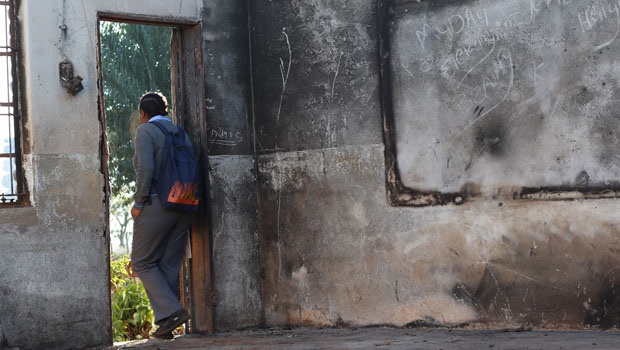
Violence erupted in the area after the Municipal Demarcation Board recommended that the Malamulele and Vuwani municipalities be merged. Residents turned their anger towards 31 schools and torched them. They also prevented pupils from attending school.

The department confirmed in a written statement to the DA that R177m was allocated in the 2016/17 financial year to fix schools damaged by storms or destroyed in protest action.

DA provincial leader Jack Smalle said in a statement that the contract for the rebuilding of the schools was only awarded in February last year. He said it was astonishing that more than a year later, only eight schools had been attended to.

“The DA can confirm that the Department of Public Works, Roads and Infrastructure has conducted an assessment that estimated the damages to all 31 schools was worth R177.5m, however, the assessment report further indicated that the upgrades and maintenance required [at] the same schools, including the riot damages, amounted to R462m,” said Smalle.

“It is clear that the ANC-led government has utterly failed the children of Vuwani once again,” he added.

Departmental spokesperson Sam Makondo said that funds were allocated to the province, but it was not specifically for the Vuwani schools. He said the money was to repair 68 damaged schools across the province.

“The work is ongoing. Some schools will be demolished, others will be in need of refurbishment,” said Makondo. News24

Green Smart Centre turns sun energy into education solutions

Fundisiwe Maseko

Education is key to economic growth and a country’s economic performance is directly linked to the skills of its workforce and the quality of its education system. Skills shortages and challenges in delivering quality education in rural areas in South Africa stresses the importance of smart education solutions for businesses, communities and the education system.

The world is moving at an immense pace. Globalisation and international trade continues to highlight the importance of a competitive advantage to compete in the global marketplace. This necessitates governments and businesses to invest in ongoing training and to maintain pressure on education systems to deliver a healthy future workforce.

Going green is getting smarter by the day

The Sizwe Africa IT Group has taken the application of solar to the next level by turning sun energy into mobile education centres. Sizwe’s solar-powered Green Smart Centres provide businesses and government schools, especially in rural areas, with secure and self-sustaining computer-driven classroom facilities.

We don’t need no education

The education system in South Africa faces severe challenges, such as accessibility to schools in rural areas and access to up-to-date resources. Studies show that learners lack basic skills and knowledge compared to peers across the world. The knock-on effect on universities and the workforce can be seen in low graduation rates and high unemployment rates.

Internships and on-going in-house training are great ways to bridge the gap but more can be done to ensure a stronger educational foundation and a competitive future workforce. Fortunately, there are many new initiatives dedicated to bringing education and the workforce up to speed.

Make the e-learning circle bigger

Learner accessibility is key. These secure mobile structures seat 27 learners and can be transferred between locations. Each centre can extend its reach with a wireless router that can facilitate additional external devices such as laptops, smartphones and computers.

Knowledge is power

Educators using the centre will be fully trained by the online content provider and will support the demand for full-time educators. Interactive e-learning content supplied by the online content provider consists of interactive copy, videos and assessments, which supplement all major subjects in the public and private school syllabus.

No more reinventing the wheel

Each centre comes with an interactive smartboard that allows educators to record and save lessons, notes, verbal explanations and comments onto the server. Educators can develop unlimited educational material and resources. All learning information, progress monitoring, assessment data and reports are stored locally within the unit.

Lock up and go

Safety and security is in place to create a productive and enjoyable learning environment. All viewing screens and furnishings are securely bolted and a security camera keeps a close eye on the classroom and server room.

Go green and smart with CSI initiatives

Whether to get new employees up to speed or swiftly address a critical skills shortage within the business, Sizwe’s plug-and-play Green Smart Centres can significantly improve the speed and productivity of onboarding and internal training sessions.

Businesses can donate centres as part of their CSI initiatives – a smart way to go green. By investing in education, businesses invest in the quality of their own future workforce and by extension, economic growth in South Africa.


South Africa needs school league football

Mosibodi Whitehead

The 2018 World Cup is set to kick off in Russia on 14 of June 2018.  The focus will inevitably turn to Bafana Bafana’s failure to qualify for the global showpiece and the argument that South Africa lacks the football development will be advanced as the root cause of Bafana’s underperformance.

However, to say South Africa lacks football development is to ignore some simple facts.

The national U20 men’s team Amajita qualified for the U20 FIFA World Cup in South Korea last year and before that the National U23’s qualified for the 2016 Rio Olympics.

We must not forget that the men’s U17’s participated at the 2015 U17 FIFA World Cup. Also, most PSL teams have well-functioning academies whose players find regular game time in the Multi Choice Diski Challenge.

You should begin to see a picture of a pipeline that supplies footballers to the professional ranks.

The problem is the lack of structured and regular nation-wide schools amateur football which impacts on the quality of players promoted to the professional ranks.

The best example can be drawn from the lack of proven goal scorers in South Africa.

After 29 league matches and with just one round of fixtures left to play in the country’s highest league, the ABSA Premiership, the joint top goal scorers are Mamelodi Sundowns’ Percy Tau and Polokwane City’s Rodney Ramagalela.

The two have netted a paltry eleven goals each.

Compare that with legendary Bafana striker Phil Chippa Masinga who scored almost a hundred goals, 98 to be precise, in just over 3 seasons with the same Sundowns a quarter of a century ago and the lack of present-day goal scoring quality is clear.

Masinga says his ability to find the back of the net was honed during his days playing schools football. During the 80s, when the National Professional Soccer League (NPSL) matches were typically played on weekends, midweek schools league football was a big thing.

Townships would be brought to a standstill on Wednesday evenings as football lovers rushed home from work in town to watch high school boys playing top class football.

Many of those boys including Masinga made their NPSL debuts while still in school. Chippa played for Jomo Cosmos as a 17-year old. He believes that pressure of playing regular league schools football is what allowed him to quickly find his feet in the professional ranks.

“We were playing football week in, week out. On weekends we would play for our amateur teams and during the week we would play at school. In order for a player to improve they have to play football on a weekly basis,” explains Masinga.

He added, “Now we’ve got academies, some of them have to wait for tournaments to play. Are they playing league games? Are they playing week in and week out,” says Masinga.

That is the problem. Too much of our age group football is played in either tournament format or in sporadic academy leagues and there are just not enough schools playing football across the length and breadth of South Africa.

By the South Africa football Association’s own admission, “We need to galvanise everyone and get the more than 20 000 schools involved. We will approach the former Model C schools,” said Safa President Danny Jordaan in July 2017.

As a result, our players do not grow accustomed from a young age to the weekly pressure, however small, of having to consistently deliver excellence. The benefit of league football is that the repetition allows for incremental improvement and as the youngsters get older they become more competitive.

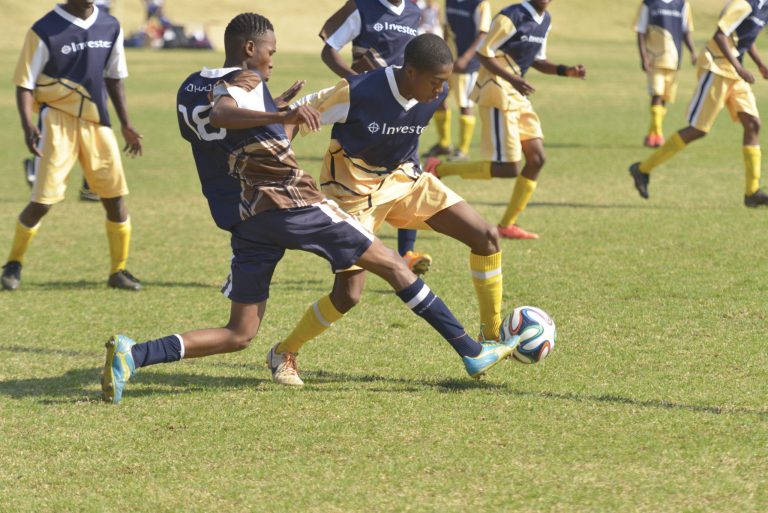
Thankfully there is hope and it comes in the form of the Investec Soccer League. The League, which is made up of 20 Soweto high schools, was first piloted in 2008 as the brain-child of Investec Corporate Social Investment in partnership with the Gauteng Department of Education.

This league typically runs from April to September which means that each school is guaranteed to play at least 9 matches during the league phase and as many as 3 more should they qualify for the knockout phase at the end. Already there have been successes in the form of players scouted to the professional ranks.

Thulani Secondary School of Snake Park in Dobsonville won the 2017 title with one of their star players Sifiso Sithole who is now part of 2017 PSL Champions Bidvest Wits’ development structures.

Wits coach Gavin Hunt believes that one of the answers to our underperforming Bafana Bafana could lie in replicating such leagues around the country.

“Cricket and rugby school sport is huge. We need to create the same environment for football,” says Hunt.

He adds that this is what used to happen when he was at school.

“That’s why we only identify talent at 22 and 23 in the PSL. When I was at school that’s what used to happen. When I was a professional I was still at school. It doesn’t happen anymore and it’s what needs to happen for us to identify talent earlier,” says the four-time PSL winning coach.

What we need for Bafana Bafana to reclaim its title as a force on the continental and global stage are regular, organised and nationwide schools league football.

Not only will this give us a greater pool of players to select from, but it will also raise the standard of the game such that the players coming into the professional ranks are of a superior quality.

This in turn will improve the standard of football in the PSL meaning that we will be able to produce with greater consistency the type of player that will be able to score that crucial goal that will take Bafana to the World Cup.

Masinga scored a goal against Congo in 1997 to qualify Bafana for France ’98.

Themba Zwane missed a penalty against Senegal in Dakar to extinguish the last glimmer of Russia 2018 hope.

One played regular schools league football, the other didn’t.

Whitehead is sports broadcaster and writer.