Home Blog Page 509

Education for black people in SA is in a terrible state

Gugu Nonjinge

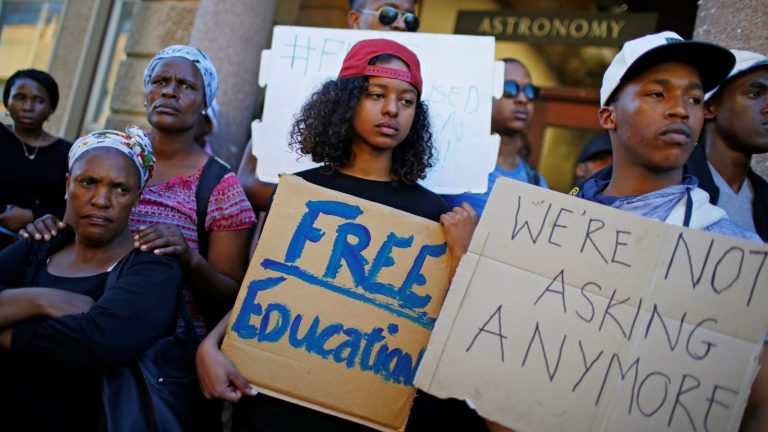
On December 16, 2017, former president Jacob Zuma announced that government would be phasing in fully subsidised higher education and training for poor and working-class South Africans over a five-year period.

This statement left many South Africans hopeful and eager to see an important change in our education system.

 Former finance minister Malusi Gigaba’s 2018 Budget speech highlighted the education of South Africa’s youth as one of the top three national priorities. But it inadequately responded to the burning issues at the heart of the country’s education crisis.

President Cyril Ramaphosa’s 2018 state of the nation address earlier this month similarly failed to acknowledge the crisis facing the youth who, despite being hungry for education to better their lives, face an education system that continues to isolate them.

One can’t help but wonder, what is the actual state of our education system?

South Africans have been living in a post-apartheid state for just over two decades. The country is still fighting against historical inequalities. As it was under apartheid, education for black people is far from ideal. Investments continue to be made in well-resourced areas rather than in the areas that actually need investment.

In 2015, the Organisation for Economic Co-operation and Development (OECD) ranked South Africa’s education system in the bottom two out of the 76 countries the organisation reported on.

Disparities within the education system are still an issue despite the fact that there are plans, such as the National Development Plan (NDP) 2030 or the Accelerated School Infrastructure Delivery Initiative (Asidi), to improve education and foster future human prosperity.

Since the drafting of the NDP 2030, various research shows that significant changes to the education system still have not been fully implemented. The NDP states that it “will ensure that all vulnerable families will receive access to comprehensive childhood development services, free education, nutrition plans, improved school infrastructure and quality teachers”.

Even though these ambitions are important, key factors that hinder impoverished families are not being considered, such as the cost of clothes, supplies and transport; access to application and bursary options; and ongoing danger and violence on the commute to school.

Last year, the South African Child Gauge revealed that a staggering 58 percent of children cannot read fluently and with comprehension at the end of Grade 4. Owing to a lack of financial support, smaller schools in rural areas have had to close. The lack of sufficiently educated and motivated teachers, and the lack of teaching facilities, also places a huge strain on the system.

The financial burden for local governments and for the families of the pupils in previously disadvantaged populations is high. The majority of pupils still live in the poorest conditions in rural areas and in the growing townships of the major cities.

However, the standard of education in South Africa varies from region to region and school to school.

A department of higher education report in 2015 indicated that a vast 47.9 percent of university students did not complete their degrees, with black students having the highest dropout rate, one-and-a-half times higher than white students. In effect, this means that only 5 percent of African and coloured young people in South Africa successfully complete university. Indeed, the education system is failing the majority of young people.

During the past 20 years, some progress has been made to raise the level of education in South Africa. But there are still issues of overcrowding and unsanitary situations that need to be addressed. The nation needs to look into investing in the social services that are imperative to ensure socioeconomic justice and equality.

To achieve a successful education system, the South African department of education should develop capacity within the teaching force and put in place internal controls to increase accountability, transparency of the learning process and the use of resources at all government levels and in the classroom. It should improve understanding of languages and, lastly, dedicate itself to improving education resources and infrastructure in townships and at rural schools.

The challenges our education system faces are not new. As a nation we need to be willing to do things differently. These dimensions of deprivation do not occur in isolation; they intersect and have a cumulative impact on young people’s lives. An unprecedented level of cooperation between government, civil society and the corporate sector is therefore needed to address these complex challenges and drive coordinated, intersectoral action.

Gugu Nonjinge is the communications and advocacy officer at the Institute for Justice and Reconciliation and an NDP 2030 youth brand ambassador.

Read the original article here

Nsfas to receive more money from government

Mary Jane Mphahlele

The Minister of Higher Education and Training Naledi Pandor says government will cough up more money for Nsfas, including an additional R7.1 billion to fund bursaries for poor and missing middle students.

Pandor made the announcement during a press briefing in Cape Town where she gave progress made so far in implementing free education.

The department together with National Students Financial Aid Scheme (Nsfas) were taken by surprise late last year when former president Jacob Zuma announced in December that higher education was to be free for students from poor and working-class families as of 2018.

Pandor said: “Additional government funding of R7.1 billion in 2018 has been allocated to fund bursaries for children of poor and working-class families entering universities and TVET colleges, with R4.5 billion set aside for qualifying university students and R2.6 billion for TVET college students”.

She said the department would increase the baseline allocation to Nsfas to support poor and working-class university and TVET students from R9.8 billion in the current financial year, to R35.3 billion in 2020/2021.

“This implies a need for improved efficiency and systems development at Nsfas. We will further allocate an additional R105 million over the Medium Term Expenditure Framework to assist Nsfas to increase and strengthen its administrative capacity,” said Pandor.

She raised concerns over delays faced by students who are eligible for grants from the Nsfas, but were not yet allocated funds.She said the department was dealing with the matter.

Students from universities across the country have expressed concerns that they were accepted by Nsfas, and signed necessary documentation, but were not allocated funds.

Pandor has also expressed confidence in the student-centered funding scheme. This scheme will expedite funding through an expanded bursary scheme which replaced the previous loan and partial bursary scheme.

Pandor said under the new scheme, there will be preconditions to be satisfied before students are funded.

“Although first time entering students will not be expected to pay back the costs of their bursaries, they will be expected to meet certain conditions and expectations, including those relating to satisfactory academic performance and service conditions,” said Pandor.

The bursary is available to “poor and working-class South Africans students” from households with a gross combined annual income of R350 000.

The department aims to fund 83 000 students in 2018, while over 400 000 potential students applied for Nsfas this year.

Pandor has called out for cooperation between institutions and Nsfas to ensure the successful implementation of the new scheme.

Read original article here

Judge dismisses damages claim for child who drowned in pit toilet

Ciaran Ryan  

There was shock and disappointment this morning when Judge Gerrit Muller of the Polokwane High Court dismissed a claim for roughly R3 million in damages brought against the Limpopo Department of Basic Education following the drowning of five year old Michael Komape in a school pit latrine in 2014.

The Komape family, assisted by public interest law firm SECTION27, argued the case over more than two weeks in November last year, with several witnesses painting a grim picture of a family still grieving over the loss of the child.

Michael’s mother found his lifeless body with a hand protruding above a pool of faeces in a pit latrine in Mahlodumela Primary School, outside Polokwane four years ago.

His mother, Rosina, fainted on discovering her son’s body at the school.

Muller read out the order to the packed court, dismissing the family’s claims for R940,000 in general damages and R2 million in Constitutional damages.

There will be no financial relief for the family, though Judge Muller did award a total of R12,000 for future medical expenses for two of Michael’s surviving siblings, Oniva and Maria.

There was no award of future medical expenses for a third younger sibling, Moses.

The judge then gave the Limpopo education department until 30 July to come up with a plan for the installation of “safe and secure” school toilets across the province.

Such plans have been published by the province’s education department in the past, though never fully actioned. This time it will have no choice, as it has been made an order of court.

Also present in court was Elijah Mhlanga, spokesperson for the Department of Basic Education.

He said President Cyril Ramaphosa had already called for an audit of school pit latrines around the country and that the department would comply with the order.

“We’re committed to providing acceptable school infrastructure in all schools across the country and are preparing an audit which will be properly costed,” he said.

SECTION27 attorney Sheniece Linderboom said afterwards the family was disappointed with the judgment, and SECTION27 would consider appealing once it had further studied the order and consulted with the family.

SECTION27 put out a statement following the judgment: “While we welcome the structural interdict to provide adequate and safe sanitation for learners in the Limpopo Province, we are at the same time extremely disappointed that the suffering of the Komape family and the circumstances of Michael ‘s death has been insufficiently recognised and acknowledged.”

“It is our view that this is a missed opportunity for developing the law in respect of constitutional damages. The failure to award damages in this case stands in contrast to the damages that were awarded by the retired Deputy Chief Justice Mosenke to the families of the Life Esidimeni victims for the callous treatment of the victims in that case.”

“SECTION27 is still studying the judgment but have taken further instructions from the Komape family in respect of this, we anticipate that we will be appealing the damages aspect of the judgment in the Supreme Court of Appeal.”

Judgment explained

The positive for the plaintiffs in the court order was the structural interdict compelling the education department to come up with a plan within three months for the roll-out of infrastructure to the province’s schools so as to prevent a repetition of Michael’s tragic death.

Muller rejected the family’s claim for damages relating to grief on the basis that it was not a recognised psychiatric injury.

“There is, in my opinion, neither reason in law nor any policy consideration to draw a distinction between grief and any other psychiatric injury or harm,” reads the judgment.

Muller further justified his decision based on testimony from the family’s psychologist that members of the family had shown improvement in their psychological condition since undergoing counselling.

Muller’s judgement also concludes that the right to basic education “includes provision of adequate and safe toilets at public schools for learners”, and that the government’s failure to provide these facilities had breached various human rights clauses contained in the Constitution.

The judge then weighed the claim for Constitutional damages, which would benefit the family rather than society as a whole, with an order which would prevent such a tragedy recurring and benefit learners across the province.

“I have come to the conclusion, after a careful consideration of all the facts, that a structural interdict is the only appropriate remedy that is just and equitable which will effectively vindicate the Constitution.

The best interests of all learners at schools must take preference. It is the only means by which the state will be compelled to take active steps to provide the lacking basic sanitary requirements to learners in those schools.

It will, no doubt be a mammoth task for the state to undertake. But that cannot deter this court from ordering the state to comply with its obligations in terms of the constitution,” reads the judgment.

The state was ordered to pay the Komape family’s legal costs, and the costs of several of their witnesses in preparation for the trial.

The CFA is the most brutal exam in the world of finance

0
Will Martin , Business Insider US

 Every year thousands of young people embark on one of the most mentally grueling experiences of their lives by taking the Chartered Financial Analyst (CFA) exams.The CFA has three levels and is a qualification designed to ensure people working in certain parts of the financial industry have all the right knowledge to do so, and is notoriously tough.

Pass rates most years are around 40-50%, and most people study for more than 300 hours before taking the test.

More than 100,000 people around the world take the test in more than 100 countries every year, and becoming a CFA charter holder is a huge leg up for anyone hoping to build a career in investment management.

But what does the test actually involve? Business Insider got hold of a recent practice test from the CFA Institute — the body which administers the exam — to see just how difficult it really is.

We’ve picked out a handful of questions taken from the CFA Level One, which is, in theory at least, the easiest exam.

The full exam is six hours long and consists of 240 multiple choice questions.

“For many students, parts of the CFA Program exams that commonly cause the most trouble are those covering Fixed Income and Derivatives,” Alex King, a director for examination development at the CFA Institute told Business Insider.

Check them out, along with the correct answers and explanations from the CFA Institute, below:

QUESTION — A portfolio of securities representing a given security market, market segment, or asset class is best described as a:

A) Benchmark

B) Security market index

C) Total return index

ANSWER — B

“A security market index represents a given security market, market segment, or asset class and is normally constructed as portfolios of marketable securities.”

QUESTION — Colin Gifford, CFA, is finalising a monthly newsletter to his clients, who are primarily individual investors. Many of the clients’ accounts hold the common stock of Capricorn Technologies. In the newsletter, Gifford writes, “Based on the next six month’s earnings of $1.50 per share and a 10% increase in the dividend, the price of Capricorn’s stock will be $22 per share by the end of the year.” Regarding his stock analysis, the least appropriate action Gifford should take to avoid violating any CFA Institute Standards of Professional Conduct would be to:

A) Separate fact from opinion.

B) Include earnings estimates.

C) Identify limitations of the analysis.

ANSWER — B

“Although pro forma analysis may be standard industry practice, it is not required by the Standards of Professional Conduct. Earnings estimates are opinions and must be clearly identified as such. It is also important for investors to be able to identify limitations of analysis when making investment decisions.”

QUESTION — Cost–push inflation is least likely to be affected by an increase in:

A) Employee wages

B) Finished goods prices

C) Commodity prices

ANSWER: B

“Cost–push inflation arises due to increases in costs associated with production: wages and raw materials prices.”

QUESTION — Labour markets are best described as a type of:

A) Capital market.

B) Goods market.

C) Factor market.

ANSWER — C

“Factor markets are markets for the purchase and sale of factors of production. Labor markets are a type of factor market in which households offer to sell their labor services.”

QUESTION — A corporation issues five-year fixed-rate bonds. Its treasurer expects interest rates to decline for all maturities for at least the next year. She enters into a one-year agreement with a bank to receive quarterly fixed-rate payments and to make payments based on floating rates benchmarked on three-month Libor. This agreement is best described as a:

A) Futures contract.

B) Forward contract.

C) Swap

ANSWER — C

“A swap is a series of forward payments. Specifically, a swap is an agreement between two parties to exchange a series of future cash flows. The corporation receives fixed interest rate payments and makes variable interest rate payments. Given that the contract is for one year and the floating rate is based on three-month Libor, at least four payments will be made during the year.”

QUESTION — An industry characterised by rising volumes, improving profitability, falling prices, and relatively low competition among companies is most likely in which of the following life-cycle stages?

A) Growth

B) Mature

C) Embryonic

ANSWER — A

“An industry in growth stage is characterized by rising volumes, improving profitability, falling prices, and relatively low competition among companies.”

QUESTION — To evaluate the potential effect of an innovative and unique type of business transaction on financial statements, an analyst’s best approach is to:

A) Monitor the actions of standard setters and regulators

B) Gain an understanding of the transaction’s economic purpose.

C) Consider the approach taken for “new” transactions that arose in the past.

ANSWER — B

“By understanding the economic purpose of a transaction and applying the conceptual framework, an analyst may be able to evaluate the potential effect on financial statements, even in the absence of specific standards.”

  • More than 100,000 people a year take the exam to earn the Chartered Financial Analyst qualification.
  • It is notoriously difficult —  fewer than 50% of people pass the first level.
  • Below are seven questions from recent sample papers to give a flavour of the test.++

Red tape is alienating academics from their own research and work

Keyan Tomaselli

When South African academics want to set up a new degree module, they’re entering into a process that can take years to germinate. These modules must be approved through an incredibly cumbersome process – departmental, school, faculty, various university quality control committees, an institution’s senate, the South African Qualification Authority. Only then can they be registered by the National Qualification Framework.

This is just one example of the bureaucratic chores that now occupy academics’ days. It’s a reality that prompted me to edit a new book called Making Sense of Research (Van Schaik, Pretoria, 2018). It’s written by supervisors, deans, research coordinators and lecturers who offer suggestions about how students and academics can negotiate the reams of red tape that typify modern universities.

Bureaucracy is necessary to manage large institutions. But it can also be alienating. It alienates the researcher from their field or discipline. It alienates those who are researched from those who conduct the research. And ultimately, it alienates both researchers and the researched from the academy.

Take the example of student protests held under the banner of “fees must fall” between 2015 and 2017. Events unfolded on an hourly basis at breakneck speed. These deserved careful study and scrutiny by trained academics who knew what questions to ask and what information could be gleaned. But procedural knots meant it was impossible to secure ethical clearance, for instance, and this hampered knowledge production.

That in turn hampered the benefits for the public, who could have learned from research conducted on the ground during these important protests. And then researchers are dismissed as being distanced from the real world – irrelevant and out of touch with breaking events. The problem, of course, is that real world events don’t conform with research committee schedules.

Dodging red tape

This trend towards bureaucratised research and teaching, particularly in the humanities, has come about because outputs must be measured, managed, and made to justify bottom lines to qualify for state subsidies. Everything from students – too many – to resources – too few – must be managed, administered and audited.

Bureaucracy, as anyone who has encountered it knows, makes it increasingly difficult to get any work done. For academics this means that field work is placed on the back burner. Just registering a topic for field work can take many months and involve multiple committees and numerous university divisions. These time-consuming and increasingly cumbersome procedures – though often necessary – delay the start of work, students’ progress through a degree and publications linked to the planned field work.

This process alienates academics from the “meat” of their work, the active research that produces nuanced results. Many students and their supervisors are responding defensively. They simply conduct desk-top research that relies on texts already published by other scholars.

This is the quickest, cheapest route. It helps both academics and the students they supervise to circumvent red tape. But it’s a route that excludes subject communities or research participants who used to be the focus of interactive academic work. These groups are left in the background and reduced to mere texts in contemporary research projects.

So the instrumentalisation of research practices alienates those who have traditionally cooperated with researchers and who expect tangible benefits from such partnerships.

The third alienation is of researchers and the researched from the academy. What works for the university as an institution does not necessarily work for the lecturers or students. Students do research because this is a curriculum requirement. But they must also become aware of why they are doing research, who it will benefit (or disadvantage) and what the implications might be

There is a fourth alienation, too, exemplified by the many hoops academics must jump through to register and begin teaching a new module or the requirements for designing field work. Knowledge has a rapidly decreasing half-life. It is being revised continuously. Too much bureaucracy alienates academics and students from breaking developments that impact their own disciplines.

Over-regulation means academics are often teaching approved but outdated knowledge rather than updating it daily.

Arresting alienation

The good news is that this alienation can be turned around. In Making Sense of Research, contributors offer advice for making sense of academic rituals. It’s not a dry book about “how to” research as much as it is about “why” do research and how to negotiate the institutional swamps in conducting it.

Ordinary academics can kick back against the system in a useful way, despite the cautioning effects of managerialism. There are creative ways to deal with bureaucracy; the best is to take students off campus and into the fields of the real world.

Books and articles about the real world must be complemented with direct exposure to those worlds. Bureaucrats must recognise that experiential learning is the best kind. Sitting in classrooms and being referred solely to books that other people wrote is only half the story. The full story involves getting one’s hands dirty in the field, too. That may be costly; it may transgress timetable schedules and stress capacity – but it must be done to tackle the growing problem of academic alienation from life.

Keyan Tomaselli is Professor at the University of Johannesburg
Read the original article here

Nigeria: Dangote Foundation Donates N120 Million Secondary School in Lagos

Premium Times

The Dangote Foundation says it has donated a well-equipped secondary school in Lagos valued at N120 million ($330 000) as part of its interventionist’s programme to boost education.

The foundation has also offered annual free tuition to 250 indigent pupils.

Aliko Dangote, the Chief Executive Officer of Dangote Group, said this at the inauguration and handing over of the school with well-equipped laboratories to Nawair-Ud-Deen Comprehensive College, Idi-Oro, Mushin.

“Aliko Dangote Foundation started in 1993 with the principle of ‘to whom much is given, much is expected’ and looking at the less privileged ones among us have compelled the foundation to provide some reliefs.

“The four major goals of Aliko Dangote Foundation are education, health and nutrition, economic empowerment and disaster reliefs,” he said in a statement by Tony Chiejina, the Head of Communications of the group.

He said his education mission was targeted at reducing the number of out-of-school children, supporting talented and underprivileged young children to achieve their full potential as well as educating girls and women on health-related issues.

500,000 kids not at school, say it’s ‘useless’

Prega Govender

570,000 children and teenagers were not attending educational institutions in 2016, including more than 45,400 who found education “useless or not interesting”.

About 104,000 were from the compulsory schooling age group of seven to 15 years while the remaining 466,000 were 16 to 18 years old.

These figures are contained in a report titled General Household Survey: Focus on Schooling 2016, which was released by the Department of Basic Education last month.

It has a close working relationship with Statistics South Africa which conducts the survey in about 22,000 households.

The department uses the responses of the survey to assess its progress on access to schooling as well as “the quality, efficiency and equity in educational programmes”.

Almost 99% of seven- to 15-year-olds were in school, which showed that there was “near universal rates for compulsory education”. In contrast, only 85.1% of 16- to 18-year-olds were attending educational institutions.

According to the report, research indicated that the main predictor of dropping out was “poor-quality early education”.

“Encouragingly, no respondent in this age group [seven to 15 years] stated that marriage or lack of transport are reasons for not attending any education institution,” the report stated.

At least 6.3% of the seven- to 15-year-olds were not attending school because they were unable to perform academically, while 2.2% had left after falling pregnant.

A total of 82,995 girls aged 14 years and older reported being pregnant in 2016.

Alluding to those children who found education “useless or not interesting”, the report stated: “As a society, it is concerning that among both the seven- to 15-year-olds and the 16- to 18-year-olds there were noteworthy proportions of out-of-school pupils who stated that the reason for not attending is because they regard education as being of no value to them.”

Martin Gustafsson, an education economist and member of the Research on Socio-Economic Policy (ReSEP) team at the University of Stellenbosch, said the matter of out-of-school children was “concerning” and a problem.

“But what’s also a problem are children who are in school and who don’t learn anything or learn almost nothing. So being in school gives you a certain advantage, but it’s no guarantee that you are getting an education.”

“Ideally you would want youths up to the age of 18 to be in school. It’s useful to consider that South Africa’s enrolment ratios for 16- to 18-year-olds are about typical for middle-income countries, so it’s not as if we’re way behind.”

Gustafsson said, however, that with the exception of Namibia all countries falling under the Southern African Development Community (SADC) had an exam at the primary school level that resulted in a national certificate being awarded.

“But in South Africa, if you leave school before the end of Grade 12, and almost 45% of youths don’t successfully complete Grade 12, you have no national certificate despite all the years you’ve been in school.”

Gustafsson said there should be a national certificate at the end of Grade 9 to help school leavers enter the labour market.

“The main reason youths drop out is because they are not coping. The foundations weren’t laid in primary school so they just repeat grades.”

Elijah Mhlanga, spokesperson for the Department of Basic Education, said they were concerned that such a large number of pupils were not in school despite the government’s efforts to make access to education “convenient for everybody”.

He said a range of measures, such as no-fee schools and the provision of a nutrition programme and pupil transport, had already been implemented to attract pupils to school.

“All that’s needed now is for parents and guardians to help us to encourage their children to come to school.”

Mhlanga attributed the increase in the number of 16- to 18-year-olds not attending educational institutions to societal problems such as unemployment, poverty, drug abuse, a lack of positive role models and being in conflict with the law.

Commenting on the observation by some children that they found education “useless or not interesting”, he said: “We understand that the academic stream can be boring for those who are not academically inclined, so we are working hard to implement the three-stream career pathing model to expand the offering to cater for all interests.”

This model will give pupils the opportunity to pursue either the academic stream or the technical occupational or technical vocational programmes.

Read the original article here


The cold shadow of university exclusion

Thato Rossouw 

For black students at the University of the Free State, the word “exclusion” is probably the most life-changing word they will ever come across in their academic careers.

It is a word that, once uttered to them, has the ability to change their lives, and the change is never for the better. Unfortunately, it is also a word that only a few in the black student community on campus are privileged never to hear uttered; a word whose notoriety is such that, even those who haven’t heard it said to them on campus know the pain it causes.

Black students fear this word because its utterance — mostly in an email with the words “financial” and/or “academic” preceding it — has the ability to remove them from a space that could take them out of the din of blackness they currently live under and elevate them to a human status, as was preached to them from a very young age.

They fear this word because having it said to them means they will no longer be able to reach the end goal that all black students on campus aim to reach: having the tools to help them resemble whiteness — “humanness” — in the best possible way.

Because they were denied access to options available to the humans they find themselves surrounded by, black students, whose nonhuman nature is qualified and perpetuated by the university system, are forced to live in the university space without showing any signs of retaliation towards it, mainly because it is a system they were told might someday give them their humanising degree.

Not only are the black students expected to live in a perpetual nervous condition (a state they find themselves embodying no matter where they are), but must do so without causing any discomfort for the humans.

They live paradoxical lives. On the one hand, their status as university students gives them social advantages over other black people. This is because they might seem one step closer to learning the ways of the white person, which is to say, they are one step closer to becoming human. On the other hand, the very university that is meant to grant them human status also constantly reminds them how much they will never be human, no matter how much they try.

This paradox confuses them. It causes in them a dissonance that distorts their sense of reality.

On certain days they see themselves as an intricate part of the university space and not just passive entities in it. They see themselves as active participants in the space that they believe humanises them more and more as each day passes. But on other days, they doubt whether humanisation is possible — whether their existence in the space means anything to the humans around them.

The black students are alive because they feel for, or want to feel for, those around them. But does this make them human?

The humans around them sometimes greet them, looking at them as if they recognise the “human” in them, but they still doubt whether they are equal. They walk the same corridors, attend the same classes and write the same exams, but does this mean they are as human as the white people? The answer, unfortunately, is a resounding, “No.”

The humans around them have something they don’t: a sense of assurance of their position in the space they occupy.

The word “exclusion” doesn’t affect these humans as much as it does the black students. They are happy, these humans, to be where they are and, while the black students spend their time praying never to receive the dreaded email of exclusion, the humans continue living their lives the only way they know how — free from any worries.

The black students were promised access to the university space by those who look like them but those promises are never kept.

It is as if, because they are responding to the calls of black students, the people making these promises are unable to deliver words that hold an ounce of truth; as if blackness taints those words as they are spoken, and nullifies their significance as soon as they are uttered.

The students hear them speak but the words they hear don’t mean anything to them.

It is April and the black students’ time at the University of the Free State is almost up. A few days ago, some of them received the dreaded email informing them to pay up or leave, and their academic futures now hang in the balance.

The word “exclusion” has finally cast its cold shadow over their lives, and they are now left to their own devices as they watch their one chance of becoming like the humans they share their space with slip away.

In the beginning of the year, they were provisionally registered on condition that they pay the debts they acquired the previous year — amounts reaching R15 000 — and the costs of registration.

The same thing happened the previous year and, according to the students representative council (SRC) mid-term report for 2016/2017, a total of 5 678 students faced deregistration on January 30. The number was reduced to 337 by April 12 and, through the SRC and other stakeholders’ efforts, no students were deregistered. But this year’s cohort of black students aren’t as fortunate.

In March, an appeals committee was set up by the university and the students facing deregistration were asked to submit their appeals not to be deregistered. The email they received said they should appeal if they had “a guaranteed sponsor or guaranteed upcoming funding which will cover [their] 2017 debts and 2018 fees”.

Many submitted their appeals and a member of the SRC confirmed that 25 students’ appeals were denied, and they were already deregistered at the time of writing.

Although this number is deemed “low” statistically, it still represents 25 young people whose dreams are shattered because they can’t pay their fees.

For the 25 who have been deregistered — a number that could rise — the only option is to go back home and find a way to pay the university what they owe. The SRC and other concerned stakeholders are trying to change things but, until those efforts produce positive results, the students have no other alternative but to go home.

Many students are questioning the university’s insistence on continuing to deregister students when a promise of free education was made to them the previous year.

They are questioning the existence of an appeals committee that decides which of them is worthy of existing on campus and which are not. They are calling for no student to be deregistered — a call that many say is falling on deaf ears — so that they don’t have to see their friends go home because they can’t afford university.

It has been a week that has seen 25 students fall at the altar of financial exclusion, and promises to see more suffer the same fate — the academic death of many black students.

Thato Rossouw is a second-year student at the University of the Free State

Are ‘non-competitive sports days’ really better?

SA School Sport

57% of parents with children at primary school say school sports day have become more “non-competitive” than competitive and that they prefer competitive sport.

Non-competitive sport means everyone joins as part of a team instead of being singled out. There are no school records to be broken and no tears on podiums. The survey, done by Families Online, found that 86% of parents prefer competitive school sports.

Under 300 parents completed the survey.

Sports psychologist Amanda Hills also says competitive sports at schools is better than sports with no element of competition.

“This to me that’s absolute nonsense,”  says Hill who adds that non-competitive sports does not teach children useful life skills.

“Children have to learn to lose as well as win. It is unfair not to celebrate the achievements of a sporty child, especially if they are not so celebrated in the classroom,” she adds.

At the same time, she concedes that too much competition may be debilitating for younger children.

Any sports day needs to be fun because children will remember any positive or negative feelings to do with sport from that age. If they have a negative experience, it could put them off doing sport for good,” she says.

However, another survey by Marylebone Cricket Club and charity Chance to Shine found that the majority of children would be happy to see the competitive element removed from school sport.

Almost two thirds (64%) of eight to 16-year-olds polled said they would be “relieved, not bothered or happier” if winning or losing were not a factor.

 The poll surveyed 1,000 children and 1,000 parents.

Although 84% of children believed experiencing winning and losing was important, the survey revealed that many would rather play sport for fun, or would be relieved if less was at stake.

This means there are no school records to be broken but also, no tears on podiums.

The same survey revealed that 22% of parents said they would have less interest in watching school sport if it was not competitive.

The survey also found that 89.3% of parents of eight to 16-year-olds believed it was “important” or “very important” for their children to taste victory or defeat in sport.

Just under two in five (39%) children said their parents would be less interested without a competitive factor.

Pushy parents

The poll also suggests that pushy parents who shout orders at their offspring from the touchlines are on the rise.

About 86% of the children surveyed, along with 97% of the parents, said that they felt some mothers and fathers were more concerned about winning than the children themselves.

Asked what was most important about school sport, both parents and children agreed that teamwork and exercise were the key aspects.

The study follows a report by education watchdog Ofsted in 2013 that said there was not enough strenuous physical activity in school PE lessons.

Chance to Shine is launching a campaign to stress the importance of competitive sport and fair play in schools.

So we all can see the problem. It is vital to give children who excel in sports recognition. At the same time, it is important to teach children the values of fair and good competition, which includes both winning and losing.
No child should experience sport through relentless public failure, nor should they be led to feel that beating everybody is the ultimate goal.


Matric supplementary exams shifted to mid-year

Inside Education

The Department of Basic Education has announced its decision to move matric supplementary exams.

From 2019, the second national examination will take place between May and June.

The decision was backed by national education stakeholders to allow for more people to complete their matric qualifications. Many, however, have raised concerns that the decision may affect those applying to tertiary institutions.

 This decision was passed last year in Parliament.

Elijah Mhlanga, spokesperson of the Department of Basic Education, said the decision was taken for many reasons, including that all of those who qualified to write did not register, and half of those who did, did not write the exams.

“This has resulted in loss of millions of rands to the department over the years. Extra costs include having question papers and answer sheets prepared, venue hire, and hiring invigilators; and markers. Regardless of whether people arrive, markers are paid according to the number of registrations,” he said.

Mhlanaga added that these exams are expected to take place between May and June because there are already exams in session during this time.

“The infrastructure already exists,” he said. “All we need to do is open it up for much larger use.”

The failure rate of supplementary exams are also higher, and this could be attributed to the short preparation period between end-of-year exams and the supplementary exams. Having the exams at the mid-year point will allow those writing to study longer, ensuring higher success rates.

Mhlanga also said that the second matric exam caters for other needs. Those who failed a subject may apply to rewrite it, but those who are not satisfied with their mark despite passing the subject will also be able to rewrite the subject.

The downside of this decision being passed is that those who have applied to write will have to wait for the following year to register for university courses. The Department of Basic Education, however, believes that this is better for the majority.

This decision was passed last year in Parliament. “In 2018, we want to concentrate on raising the matter more, to make the public aware,” said Mhlanga.

The National Professional Teachers’ Organisation of SA (Naptosa) supports the decision.

“For us, it is about creating access for more people to complete their matric. For better or worse, our (education) system is geared more for an academic child.


“Having a second sitting mid-year means we can afford people who’ve failed the opportunity to rewrite, and those who can only sit for some of their exams in December get an opportunity to sit for the rest in June – a six-month gap, as opposed to having to wait a year,” said Naptosa.

Ultimately, there is no way in which to avoid the six months to a year of lost time. This means that more pressure will be put on matric pupils to pass the first time around and to avoid these delays.