
By Thapelo Molefe
The Public Protector has launched a separate systemic investigation into student accommodation after inspections at sampled higher education institutions uncovered concerns about unsafe and poor living conditions.
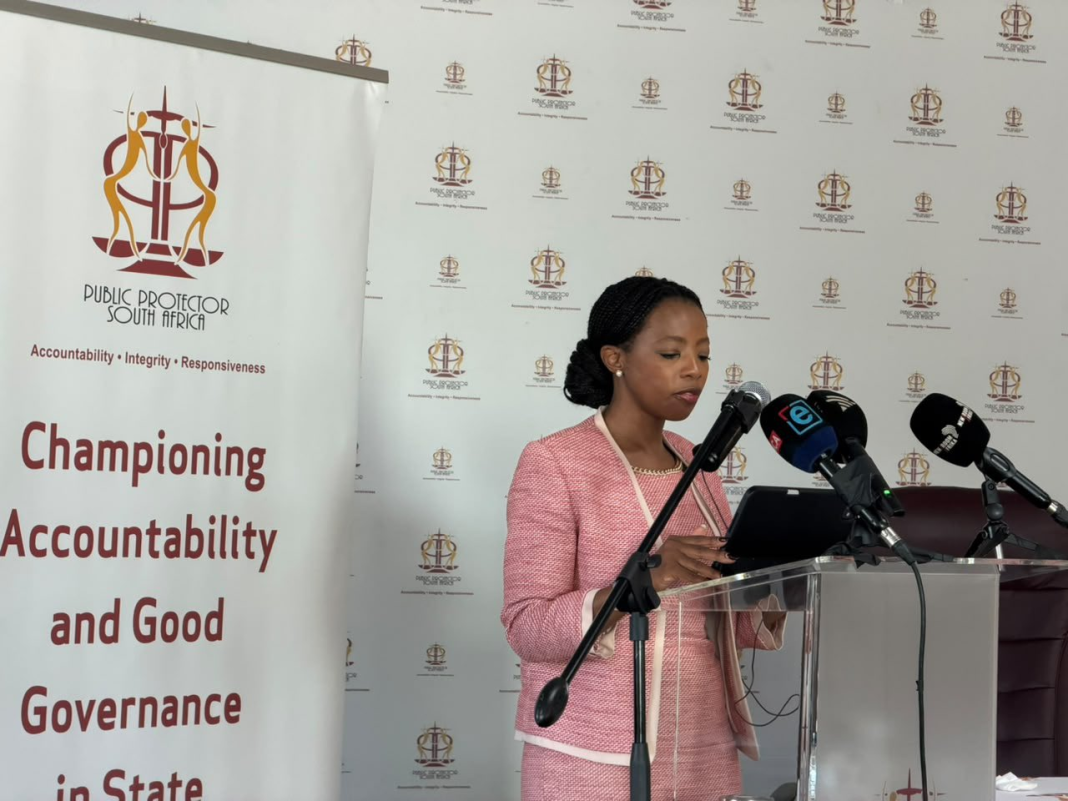
Public Protector Advocate Kholeka Gcaleka announced the investigation on Tuesday during a briefing in Pretoria on her broader investigation into systemic failures at the National Student Financial Aid Scheme (NSFAS).
The separate investigation will examine concerns including delays in the payment of accommodation allowances, weaknesses in the accreditation and verification of private accommodation, and risks of fraud, exploitation and student housing instability.
Gcaleka said the accommodation concerns emerged during the broader NSFAS investigation but would not form part of the current investigation.
“No findings or pronouncements are made herein,” she said.
However, she warned that government should not wait for the outcome of the new investigation before taking action.
“Given the dire circumstances already observed by the Public Protector relating to the unsafe and poor state of student accommodation, government ought to initiate processes to urgently address the needs of students and not await the outcomes of the Public Protector’s investigation,” Gcaleka said.
The Public Protector’s broader investigation also found that students who had completed their studies were being denied access to their academic qualifications because of unresolved tuition accounts.
Gcaleka said higher education institutions should adopt less prejudicial methods of recovering student debt.
“The Public Protector is accordingly of the view that the higher education sector should adopt less prejudicial debt-recovery mechanisms,” she said.
The investigation found that 12 students who lodged complaints with the Public Protector had tuition-related accounts that had been underpaid by NSFAS by a combined R601,000.
Although the students had completed their studies, they were unable to obtain their certificates.
Following intervention by the Public Protector, the accounts were eventually settled.
Gcaleka said the withholding of qualifications had consequences beyond the outstanding debt.
“Although these students have completed their studies, the withholding of certificates limits their ability to access employment, pursue further studies and participate meaningfully in the labour market,” she said.
The Public Protector has called on the Minister of Higher Education and Training and tertiary institutions to reconsider their debt recovery methods within 90 days of receiving the final report.
The recommended approach would allow graduates access to the qualifications needed to become economically active while providing for debt recovery mechanisms that could operate once affected students become income earners.
Gcaleka also highlighted a measure introduced by the Department of Public Service and Administration (DPSA) in 2024 that could provide relief to graduates whose certificates are being withheld.
The DPSA directive allows government departments to verify qualifications using verified academic records where applicants do not possess certificates.
“This progressive initiative will bring about much needed relief to students affected by student debt, as it would enable them to apply for posts in the public service utilising their confirmation letters and academic transcripts,” Gcaleka said.
The Public Protector has proposed that tertiary institutions conduct an audit of academic certificates being withheld and provide information on affected graduates, including the amount owed and the year they completed their studies.
Higher Education and Training Minister Buti Manamela welcomed the Public Protector’s findings, saying government interventions at NSFAS were ultimately aimed at protecting students and strengthening the institutions responsible for supporting them.
“At the centre of the Minister’s intervention is the overriding interest in the wellbeing of students and Post School Education and Training institutions,” Manamela said.
He said NSFAS existed to ensure that students who could not afford higher education were able to access and participate in the post-school education and training system.
“Every intervention must therefore ultimately contribute to ensuring that students receive the funding and the complete support they need to access higher education without unnecessary administrative failures,” he said.
The accommodation investigation will separately examine problems affecting students’ access to safe and secure housing.
The Public Protector said the investigation would consider the administration of accommodation allowances, as well as the systems used to accredit and verify private accommodation.
The probe will also examine risks of fraud and exploitation linked to student housing.
Gcaleka said the decision to launch the separate investigation followed the broader assessment of the higher education funding system and inspections conducted at institutions.
The Public Protector’s wider investigation found that accommodation instability was among the consequences experienced by students when funding and allowance payments were delayed.
The new investigation will determine the extent and causes of the accommodation problems and whether systemic failures by relevant institutions and government entities amount to maladministration or improper conduct.
INSIDE EDUCATION