By Charmaine Ndlela
South Africa’s education quality councils have told learners and parents to verify institutions and qualifications before registering for post-school studies in 2026, saying that fraudulent and unaccredited providers intensify their marketing around the matric results period.
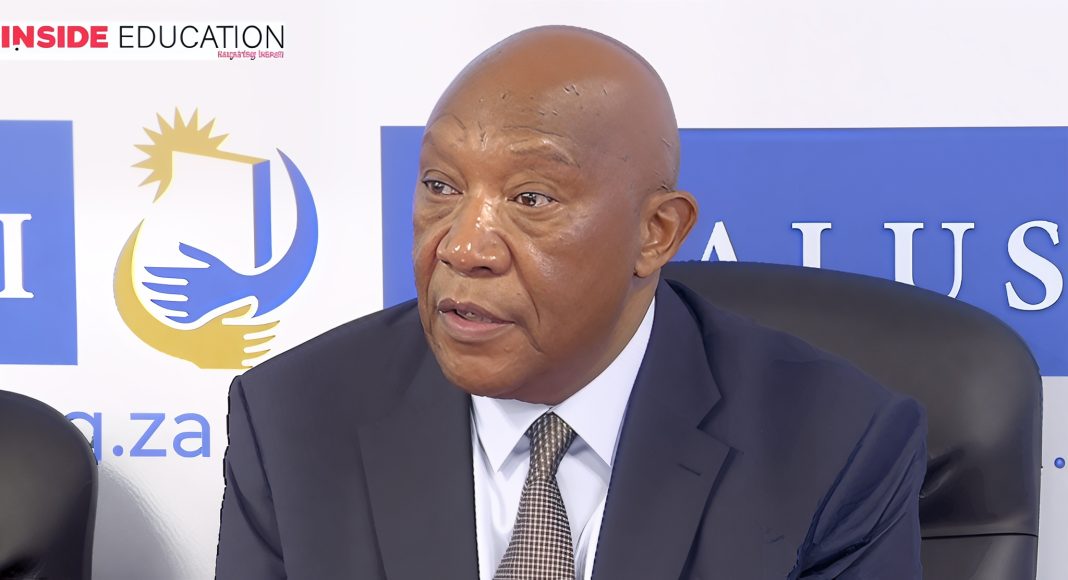
The warning was issued at a joint media briefing in Pretoria by the Quality Council for Trades and Occupations (QCTO), Council on Higher Education (CHE), Umalusi, and the South African Qualifications Authority (SAQA).
The organisations said the country’s education system remains credible but that the rise of bogus providers threatens learners’ futures and families’ finances.
Umalusi chief executive Dr Mafu Rakometsi said no school, public or private, may operate or issue qualifications without proper registration and accreditation. He said illegal operators often promise “quick” matric certificates or shortcuts into the National Senior Certificate system.
“Parents and learners must understand that only institutions registered with the provincial education departments and accredited by Umalusi may offer qualifications such as the NSC and NCV [National Certificate Vocational],” Rakometsi said.
He said that fraudulent matric rewrite centres and back-room tuition centres, sometimes with misleading names, tend to emerge during the results period.
“There are no shortcuts in achieving a credible qualification. Any organisation that claims to issue a matric certificate without proper registration is deceiving the public,” he said.
QCTO CEO Vijayen Naidoo said the occupational training space is also increasingly targeted by scammers falsely claiming to offer occupational certificates or the historic “Red Seal” trade test.
“As opportunities grow in the occupational training space, so does the number of unaccredited and bogus institutions claiming to offer QCTO certificates. Let us be clear: a QCTO qualification is only valid if it is offered by a QCTO-accredited skills development provider and assessed through a QCTO-accredited trade test or assessment centre,” he said.
Naidoo said more than 900 occupational qualifications and part qualifications are registered on the National Qualifications Framework, with growing demand in areas such as renewable energy, solar photovoltaic installation and hybrid vehicle technologies.
He cautioned that fraudulent providers, including online operators, lure learners with promises of guaranteed certificates and fast-track trade tests.
“If something sounds too good to be true, it is a scam,” he said.
Naidoo said the QCTO has also uncovered “unscrupulous activities” among some accredited providers and trade test centres, with action being taken alongside SAQA, the Department of Higher Education and Training and law enforcement.
The QCTO is managing a national transition away from pre-2009 “legacy qualifications”.
It said all already-achieved legacy qualifications remain valid, but that the last enrolment for such programmes is now June 2026, with completion teach-out periods running to between June 2027 and June 2029.
CHE CEO Dr Whitfield Green said higher education capacity constraints leave many school-leavers vulnerable to illegal operators. He said the post-school system can absorb only about half of the more than 815,000 candidates who wrote matric this year.
“No institution purporting to be a higher education institution can offer qualifications unless those qualifications are accredited by the Council on Higher Education and registered on the National Qualifications Framework,” Green said.
“There is no grey area. If it is not accredited by the CHE and not registered on the NQF, it is an illegitimate qualification,” Green said.
CHE communications manager Ntokozo Bhengu asked the media to help amplify the message.
“It saddens us when you find a student from a rural area whose parents had to sell livestock to pay for tuition, only to discover upon graduation that the qualification is not registered. The student has been duped and scammed, and the parents have lost money. By then, the kraal is empty. There is not a single cow left because they were trying to invest in the future of their child.
“We plead with the media to help us elevate the message and spread it across the country so that it reaches all students and parents to avoid this unnecessary pain and suffering,” Bhengu said.
Accredited qualifications and providers can be checked on the:
• QCTO website: www.qcto.org.za
• SAQA qualification search
• DHET registers
INSIDE EDUCATION