
By Charmaine Ndlela
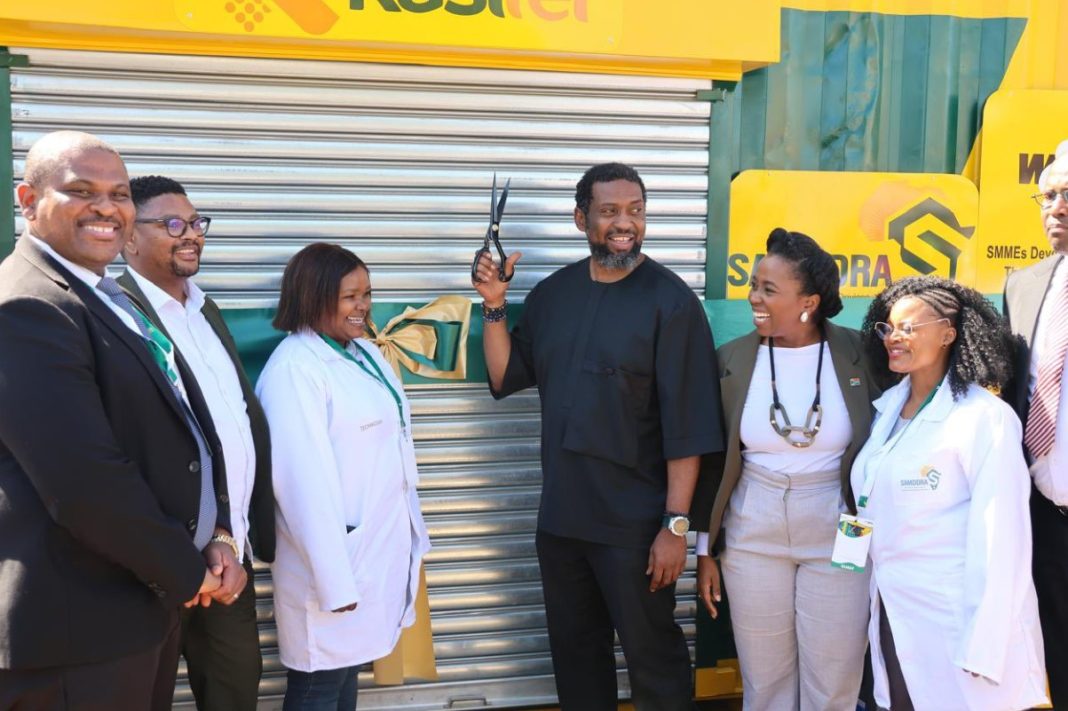
Higher Education and Training Minister Buti Manamela has officially handed over fully equipped cellphone repair containers to 25 entrepreneurs in Sebokeng, as part of a R19 million programme aimed at turning technical skills into sustainable businesses and employment opportunities.
The handover ceremony took place at the Saul Tsotetsi Sports Complex on Monday and forms part of the Cellphone Repair Skills Programme, which seeks to equip 500 disadvantaged South Africans with practical cellphone repair skills and business opportunities.
The broader initiative provides for 50 fully equipped business containers, with the latest handover benefiting an additional 25 entrepreneurs.
The programme is being implemented by the Wholesale and Retail Sector Education and Training Authority (W&RSETA), in partnership with the South African Mobile Devices Distributors and Repairers Association (SAMDDRA), under the W&RSETA Small, Medium and Micro Enterprise (SMME) Development Programme.
Since its introduction in 2024, the programme has trained 326 South Africans against a target of 500 beneficiaries.
The three-month practical training programme equips participants with cellphone repair skills while preparing them to establish and operate businesses in their own communities.
Speaking at the handover, Manamela said government was committed to expanding the initiative and would seek to support at least 25 more entrepreneurs in the new year.
“The commitment that has been made by government and SETA is that they will expand, they will extend this commitment to a minimum of 25 more in the new year,” he said.
Manamela also challenged other Sector Education and Training Authorities (SETAs) to collaborate with W&RSETA to expand the programme and explore funding opportunities beyond government.
“This is a challenge to the rest of the other SETAs to collaborate with Wholesale and Retail SETA. Why should we only look for money within the state?”
He said the private sector, particularly telecommunications companies and mobile device manufacturers, should be brought into efforts to support young entrepreneurs entering the cellphone repair industry.
“The private sector, the telecoms companies, the manufacturers of that are endorsing some of the products and want to be specialists in those,” Manamela said.
According to the Minister, the cellphone repair industry has significant potential to create opportunities for young people, women and persons with disabilities.
“We need to support the rest of the young people who want to do business, men and women, who want to contribute to employment creation, who also want to make an impact in their communities and ensure that they have a sustainable life,” he said.
Manamela said the demand for mobile technology services demonstrated the need to expand the skills pipeline.
He referred to an estimate presented by the Association of Mobile Distributors that suggested demand for about 20,000 mobile technology technicians.
“He estimates that 20,000 mobile technologies are in demand. And so that’s something that we need to ensure that we address,” he said.
The minister said the programme also demonstrated the important role small businesses could play in tackling unemployment.
“The National Development Plan targets 11 million jobs coming out of small businesses,” he said.
The National Development Plan’s employment target is to create 11 million additional jobs by 2030, while envisaging that about 90% of new jobs would come from small and expanding firms.
The minister said beneficiaries should not only be viewed as recipients of training and equipment, but as emerging business owners capable of creating jobs themselves.
“I was trying to hear from each of the businessmen and women… at least each of them have employed some additional persons. Some of them even went on to employ two people in their businesses,” he said.
Manamela said the programme could also create opportunities beyond cellphone repairs, particularly in electronic waste management.
“There are also other things which they’ve mentioned, which I think we should not underestimate, the potential that their businesses have, expanding into e-waste, which is green jobs,” he said.
He acknowledged that some beneficiaries had raised concerns about competition within the industry and said government needed to ensure that trained entrepreneurs were supported to build sustainable businesses.
“What it means is that we need to support them, that there might be equality, something that’s guaranteed, something that’s endorsed, something that’s also a decent place to work and get yourself fixed,” he said.
Manamela said the fact that some beneficiaries were operating from their homes should not be viewed as a limitation.
“There’s no reason why it can’t be their home,” he said.
He also drew parallels between the cellphone repair programme and the township spaza shop economy, saying skills should determine who participates in small business rather than race, gender or age.
“Any person, given the right skills and trade, can run a spaza shop. It’s not something that’s designated to a particular race or a particular gender or a particular age,” he said.
He said the same principle should apply to cellphone repair businesses and other enterprises in the township economy.
“As long as you’re given the necessary skills, spaza shops have been there historically in our communities,” Manamela said.
Manamela said the success of the cellphone repair programme could provide a model for broader small-business development if government and its partners were able to replicate it in other communities.
“If this model works, and it has worked in the past, it means that our investment into small business development will begin to yield results in terms of employment,” he said.
Beneficiaries are based in several parts of the country, including Gauteng, KwaZulu-Natal and Limpopo, with locations including Sebokeng, Soshanguve, Polokwane and Umlazi.
Manamela said the programme should be expanded to communities that had not yet benefited.
“If they succeed, we have a model that we can replicate,” he said.
He also called on communities to support the trained technicians by using their services instead of opting for cheaper repairs from unqualified individuals.
“These are qualified. These have the necessary skills. Some of them have been in the trade for quite some time,” he said.
The minister said the next phase of the programme should focus on helping beneficiaries sustain and diversify their businesses, while creating more employment opportunities.
“We must not just invest into the business, but look at various possible ways of diversifying their businesses,” he said.
INSIDE EDUCATION