
By Lebone Rodah Mosima
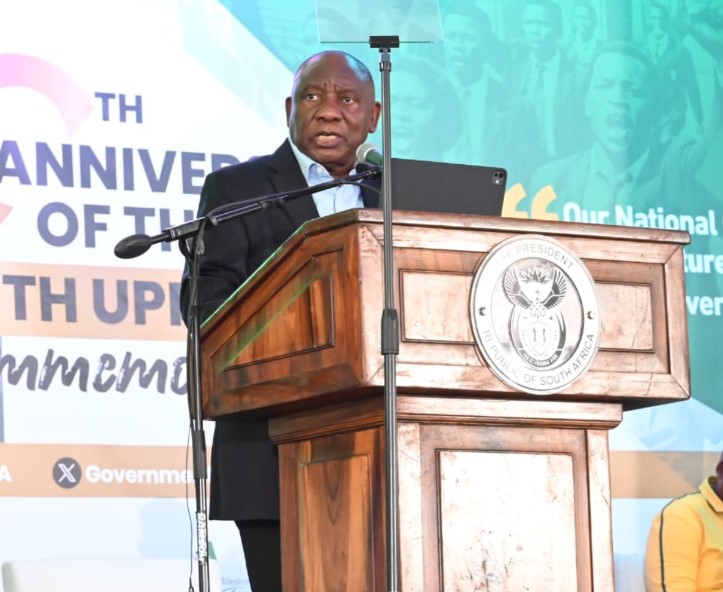
President Cyril Ramaphosa said on Tuesday that youth unemployment had become South Africa’s defining post-apartheid challenge, as the country marked 50 years since the 1976 Soweto uprising.
Speaking at the national Youth Day commemoration at the FNB Stadium precinct in Johannesburg, Ramaphosa said South Africa had made significant gains since apartheid, including expanded access to education, higher education funding and public employment programmes.
But he said the central challenge was whether those gains were translating into jobs, skills and dignity for young people.
“The question before us today is not whether young people have the courage to change South Africa. The youth of 1976 answered that question,” Ramaphosa said. “The question before us is whether South Africa is doing enough to create opportunities worthy of their sacrifice.”
Youth Day marks the anniversary of June 16, 1976, when schoolchildren in Soweto marched against apartheid education and the imposition of Afrikaans as a medium of instruction. Police opened fire on protesters, turning the uprising into one of the defining moments of resistance to white minority rule.
Ramaphosa said the youth of 1976 had fought exclusion from education, while today’s generation faced joblessness, poverty and inequality.
“Theirs was the struggle to enter the classroom. Ours is the struggle to ensure that what begins in the classroom does not end in the unemployment queue.”
Ramaphosa said more than 4.7 million young South Africans were unemployed and that the youth unemployment rate stood at 46 percent.
“Behind every statistic is a young person who wants to work, wants to contribute and wants to build a future,” he said. “We cannot accept this as normal.”
He said young people were also among those most affected by violent crime and theft, describing unemployment and insecurity as threats to South Africa’s prosperity and social stability.
In a speech delivered amid rising public anger over crime, unemployment, poor service delivery and illegal immigration, Ramaphosa warned against blaming foreign nationals for South Africa’s domestic problems.
“Even as we recognise the challenge of illegal immigration – which we are taking decisive action to address – our problems are our own. And which we have a responsibility to fix ourselves,” he said.
He said frustrations in communities were real, but that the roots of the crisis lay elsewhere.
“The roots of these challenges lie primarily in inequality, slow economic growth and weaknesses in service delivery,” Ramaphosa said. “Addressing these challenges requires practical solutions, not the scapegoating of vulnerable people.”
Ramaphosa said government was responding on three fronts: expanding public employment, youth service and workplace experience; reshaping the skills system so qualifications led more directly to work; and opening the productive economy to young people.
He said more than 5.7 million young people were registered on the SA Youth.mobi platform, with more than 2 million gaining access to earning opportunities. He said the Presidential Employment Stimulus had created work and livelihood opportunities for more than 2.5 million unemployed South Africans, of whom 82 percent were young people and 66 percent were women.
He also said the revitalised National Youth Service had placed more than 130,000 young people in paid service opportunities, with an additional 100,000 community service youth employment opportunities currently available.
Ramaphosa said the state would invest R1 trillion in infrastructure over the next three years, including roads, dams, schools, hospitals, clinics, electricity lines, railways and ports.
“This investment will create apprenticeships, artisan development, skills transfer and enterprise development for young people,” he said.
He called on employers to hire young people without demanding experience they had never had the chance to gain.
“The young person in front of you does not lack ability. They lack only the chance to prove it,” Ramaphosa said. “Hire for potential, not only for experience.”
Ramaphosa said government would strengthen support through the Employment Tax Incentive, saying the first job was “the hardest to get and the most important a person ever has.”
He also urged young people to register and vote in the 4 November local government elections, saying they should be central to fixing municipalities, not only as councillors but as “engineers, planners, artisans, water technicians, electricians, data specialists and entrepreneurs”.
He said the best way to honour the generation of 1976 was not through remembrance alone, but through building a country where young people could learn, work, serve, build, create and own.
“Let us honour them not in words alone, but in deeds,” he said. “Where opportunity is not the privilege of a few, but the birthright of all.”
INSIDE EDUCATION