
By Johnathan Paoli
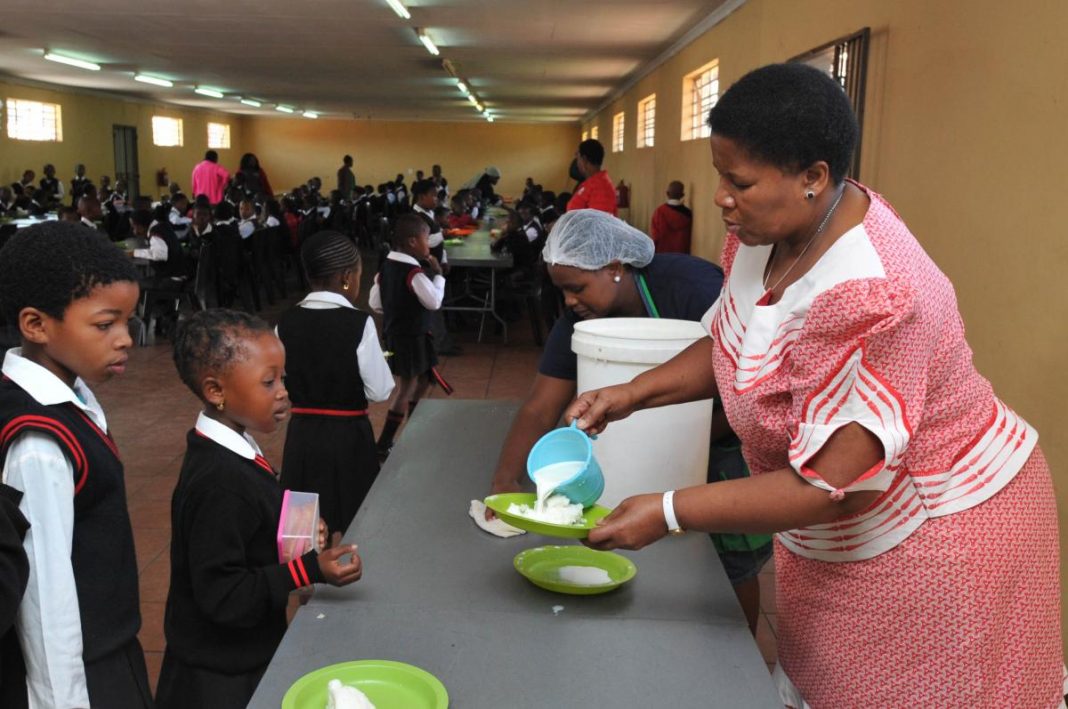
Basic Education Minister Siviwe Gwarube has called on government, business and civil society to join forces in protecting and strengthening the National School Nutrition Programme (NSNP), describing it as one of the country’s most precious assets and a vital lifeline for millions of learners.
Speaking at the 3rd annual Oceana CEO-CSI engagement at Oceana Maritime Academy at the Hout Bay Harbour, Gwarube urged stakeholders to treat school nutrition as a “national compact” that demanded accountability, transparency and sustainable partnerships.
“As we gather under the banner of corporate social investment, I want to call on all of us to treat the NSNP as a national compact. A compact that says no child should go hungry. No child should be poisoned by negligence or greed. No child should be left behind because we failed to protect the most basic right, the right to food,” Gwarube said.
The event, held under the theme “Feeding Futures: Food Security for Children in South Africa”, brought together government, corporate leaders and civil society organisations including the Peninsula School Feeding Association (PSFA).
Oceana, which is one of the country’s largest fishing companies, hosted the engagement as part of its corporate social investment (CSI) programme.
Gwarube highlighted the link between early childhood development, nutrition and long-term educational outcomes.
Drawing on the story of two children, Sipho and Lindiwe, she illustrated how unequal access to resources in the early years led to divergent life trajectories.
The minister emphasised that the differences between them were opportunity instead of intelligence or potential, noting that while Sipho had access to quality early learning, Lindiwe entered Grade 1 already three years behind her peers.
“This story reminds us that if we fail to secure strong foundations in early childhood and nutrition, our ambitions for excellence at higher levels of learning will never materialise,” Gwarube said.
Launched in 1994, the NSNP has grown into one of Africa’s largest feeding schemes, providing daily meals to about 9.7 million learners across South Africa.
Gwarube stressed that the programme was more than just a meal.
“For millions of children, it is the difference between being able to concentrate and dropping out. We have evidence that absenteeism has decreased in schools because learners know they will receive a meal. Nutrition is the difference between dignity and despair, between opportunity and exclusion,” she said.
However, the minister also acknowledged the programme’s vulnerabilities.
Cases of expired or contaminated food deliveries, tender manipulation and profiteering by suppliers have undermined trust and placed children at risk.
The minister argued that safeguarding the NSNP required partnerships that went beyond financial contributions.
She commended Oceana for training thousands of food handlers in schools, ensuring that food safety and hygiene standards were upheld.
Gwarube said that accountability must be upheld at every level—from government officials and suppliers to schools and communities.
Parents, NGOs and business partners should also serve as watchdogs to ensure quality and transparency.
The minister challenged corporate South Africa to think beyond short-term CSI projects and invest in long-term, system-wide partnerships that built resilience in the school nutrition value chain.
“How do we ensure that local communities benefit, that small-scale farmers, fishermen, and food producers are part of the solution? How do we innovate in food distribution, storage, and monitoring so that we prevent waste and extend reach?” she asked.
She also linked nutrition to broader societal challenges, including climate resilience, sustainable food systems and job creation for young people.
The engagement showcased the role of organisations such as the PSFA, which has decades of experience in feeding children in disadvantaged communities.
Oceana, meanwhile, has positioned itself as both a food producer and a partner in ensuring that food safety knowledge reaches schools.
Oceana CEO Neville Brink reaffirmed the company’s commitment to CSI initiatives that go beyond philanthropy, focusing instead on practical interventions that strengthen communities.
“We believe that food security is central to education and that no child should face the burden of learning on an empty stomach,” Brink said.
Gwarube framed the NSNP as a test of South Africa’s collective will to prioritise children’s wellbeing over corruption and self-interest.
“It tests whether we can protect our children from the worst instincts of corruption. It tests whether the government and business can act together for the public good. If we pass this test, the dividends will be extraordinary: better learning outcomes, better health, greater dignity, and greater trust,” she said.
The minister stressed that feeding children was not only a moral responsibility, but also an investment in South Africa’s future.
She described the challenge now being in sustaining momentum, expanding partnerships and ensuring that no child was left behind due to hunger or negligence.
INSIDE EDUCATION