
By Johnathan Paoli
In an important national dialogue on skills development, stakeholders and leaders from the government, industry, academia and civil society convened to confront one of South Africa’s most pressing challenges: youth unemployment and the growing skills gap.
Hosted by the Chemical Industries Education and Training Authority (CHIETA) in partnership with Inside Education, the event, held at the Unisa Graduate School of Business Leadership, marked a major step towards reshaping the country’s workforce development agenda.
Framed under the theme “Bridging the Skills Gap: Advancing Workforce Development for a Sustainable Future”, it was opened by Inside Education executive chairman Matuma Letsoalo, who urged delegates to take bold action in tackling the mismatch between economic investment and job creation.
“This dialogue is more than symbolic, it’s about planting seeds of knowledge and collaboration to close this gap and build a workforce that supports sustainable livelihoods,” Letsoalo said.
He questioned why R500 billion in investment, largely directed towards capital-intensive sectors like energy, had not translated into significant employment gains, suggesting a critical shortage of appropriately skilled workers as a root cause.
In his opening remarks, CHIETA CEO Yershen Pillay echoed this call for alignment across sectors.
“It’s not just about jobs, but livelihoods—skills that don’t just meet market demand but respond to human needs,” Pillay said.
He emphasised three strategic imperatives, namely cross-sector collaboration, disciplined execution and ecosystem alignment.
Notably, he highlighted the role of the CETA CEO Forum’s Strategic High Impact Programmes Committee in unifying and accelerating efforts across all 21 Sector Education and Training Authorities (SETAs).
Pillay also drew attention to CHIETA’s impact, with over 241,000 youth trained in the past five years. A total of 80% of them were under 35.
He called for “transformational training”, and not just job readiness, but “life readiness”.
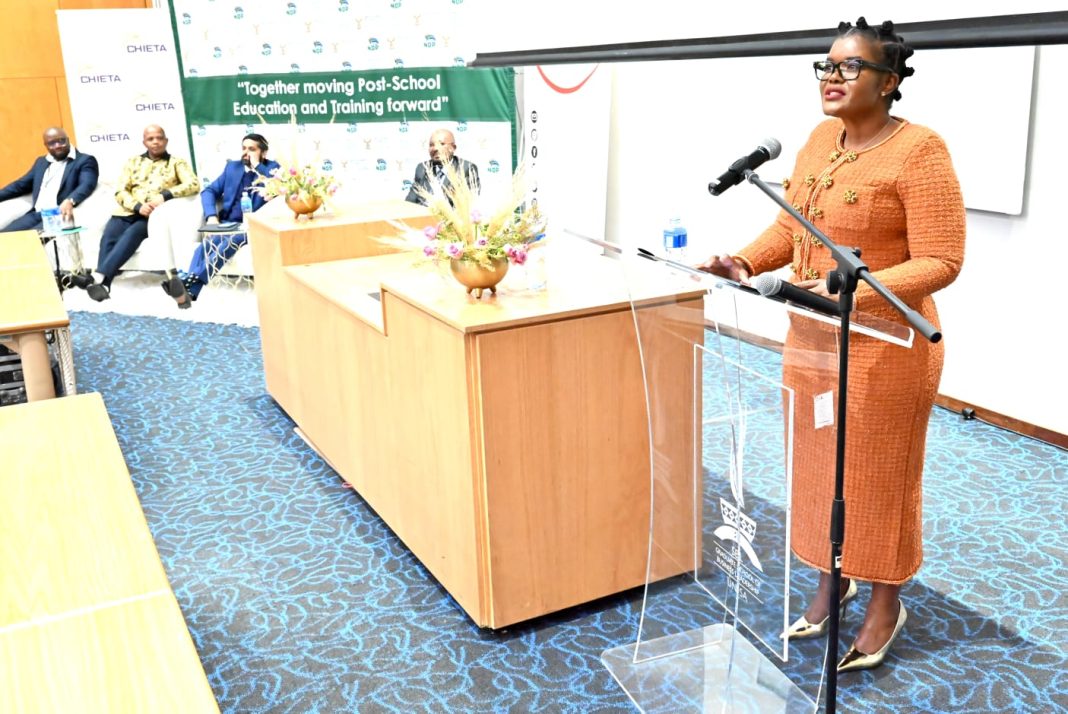
The day’s keynote address by Higher Education and Training Minister Nobuhle Nkabane set a decisive tone.
Drawing from the government’s Medium-Term Development Plan (2024–2029) and the White Paper for Post-School Education and Training, the minister framed skills development as a national imperative to reduce poverty, promote inclusive growth, and build a capable developmental state.
Nkabane spotlighted the crisis facing South African youth, with over 62% of those aged between 15–24 unemployed, and 3.8 million not in education, employment, or training (NEET).
She stressed that the crisis was not just a number but a national emergency, urging SETAs to prioritise digital, green and industry-aligned skills, such as cybersecurity, AI and cloud computing.
CHIETA’s work was singled out for praise.
Its SMART Skills Centres, which are digital-enabled training hubs with a focus on rural outreach, have trained more than 30,000 individuals and will expand to all provinces in 2025.
A recent multi-SETA partnership to establish a Green Hydrogen Centre of Specialisation at the Council for Scientific and Industrial Research was hailed as a forward-looking model for inter-SETA collaboration in emerging sectors.
Nkabane emphasised the global and continental context of South Africa’s skills strategy, aligning it with Africa’s Agenda 2063, the UN Sustainable Development Goals and the country’s G20 presidency.
Higher Education and Training director-general Nkosinathi Sishi concluded the leadership segment by reaffirming the state’s commitment to local level implementation and community resilience, noting upcoming investments in university expansion and innovation-focused campuses.
He said the dialogue was expected to produce a roadmap of actionable outcomes, with stakeholders unified in their resolve to move beyond policy into measurable, sustainable impact.
As South Africa grapples with economic recovery and technological transformation, he described the dialogue as representing a turning point that centred skills not only as a tool for employment, but as the foundation for a more just, inclusive and prosperous society.
INSIDE EDUCATION