
Strengthening the voice of African science globally through pan-African collaboration is imperative for shaping a stronger continent, says UP Future Africa Director
Edwin Naidu
PRETORIA – Inter-African collaboration among academics and science researchers on the continent remains low despite widespread calls at a political level to foster partnerships, according to Dr Heide Hackmann, University of Pretoria’s Director of Future Africa at the University of Pretoria.
“There’s been steady growth in international (foreign) collaborative papers with countries outside Africa: 58% of all papers in 2022 were multi-authored papers with at least one African author compared to 34% in 2003,” says Dr Hackmann.
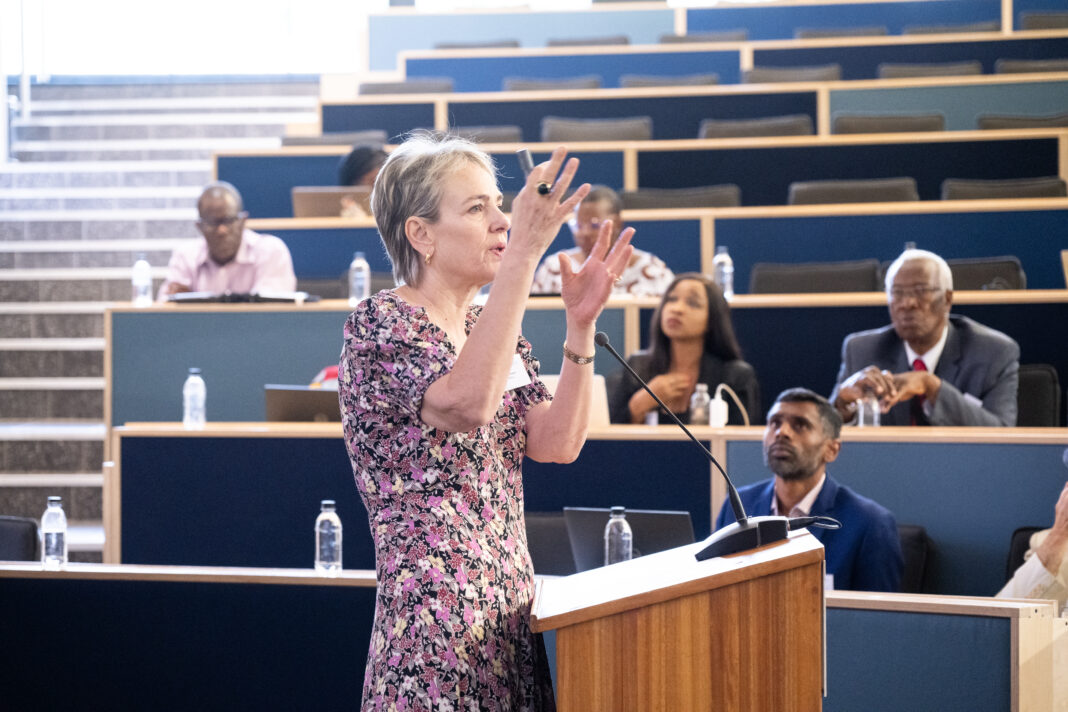
Dr Hackmann was part of a panel discussing “Research funding flows in and for Africa: A SGCI Masterclass Working Paper” by, among others, fellow presenter Prof Johann Mouton, (Director of the Centre for Research on Evaluation, Science and Technology (CREST) at Stellenbosch University) at a Masterclass under the auspices of the Science Granting Council Initiative (SGCI) Annual Forum and Global Research Council (GRC) Sub-Saharan Africa Regional Meeting in Mombasa, Kenya.
The draft paper, funded by the International Development Research Centre (IDRC), shows that an increase in foreign collaboration (measured only by multi-authorship) in any study of science in Africa was linked to the massive investment by international funders in fields (such as global health, agriculture, climate change, astronomy, and astrophysics) where international collaboration is essential.
In addition to Prof Mouton, and Dr Hackmann, the research team that compiled the review was made up of Stellenbosch University’s Dr Isabel Basson, Dr Ahmed Hassan, and Ms Lynn Lorenzen; Future Africa’s Mr Jason Owen, STEPRI (CSIR-GHANA): Dr Wilhemina Quaye, Dr Gordon Akam-Yonga, Dr George Essegbey, Dr Justina A. Onumah and Dr Nana Kofi Safo; and, the Centre for Science and Technology Studies (Leiden University): Dr Rodrigo Costas, Dr Ismael Rafols and Mr Jonathan Dudek.
Considering the challenges faced by the world, Dr Hackmann adds that people are recognising the importance of strengthening African science systems by strengthening the voice of African scientists in global science arenas. Ahead of a consultative meeting, which is part of the 2023 South Africa Science Forum event, convened by Future Africa and the International Science Council (ISC), entitled “Unleashing the global potential of African science: Towards the next level of collaborative action,” on 4 December, Dr Hackmann says longstanding efforts to build scientific capacity and develop African science systems are starting to yield positive outcomes with Africa’s share of academic publication output more than doubling from 1.5% in 2005 to 3.2% in 2016, and the citation impact of African-authored papers has been increasing steadily over the past 30 years from 0.48 in 1980 to 0.73% in 2014.
“Furthermore, institution-building efforts such as the Science Granting Councils Initiative (SGCI) were strengthened, and new multilateral funding partnerships have emerged, for example, the 20 clusters of research excellence of the African Research Universities Alliance (ARUA) and the Guild of European Research-Intensive Universities (The Guild).” Despite these positive developments, persistent challenges exist across the broader African science ecosystem.
During the presentation in Mombasa, Prof. Mouton says, however, that the low public and private investment levels in research and development (R&D) remain a trend in most African countries. This bleak narrative contrasts with knowledge production patterns by African nations as bibliometric studies of articles authored or co-authored by scientists and scholars over the past two decades show healthy annual growth, according to findings in a paper on global science funding flows in Africa. According to Mouton, research publication output increased nearly tenfold, from 13,470 articles in 2003 to 128,076 published articles by African academics and scientists in 2022.
Prof Mouton indicates that the results presented at the Masterclass only constitute the work of the first three months of a more extensive study that will continue until the end of 2024 as the team will systematically track the flow of science funding to the 17 SGCI countries in Africa by analysing the top funders in the world. The aim is to understand better who funds science in what fields in African countries and the beneficiaries of such funding.
He says the paper reviewed many publications, highlighting the structural effects of the new and changing funding landscapes in and around Africa, with two significant aspects emerging from this overview of scientific research institutions in the African continent today: the increasingly complex governance arrangements amidst multilateral funding frameworks and the increasing involvement – even need – of national institutions and the very central role of universities.
Discussing the paper, Dr Hackmann adds that the extensive data-driven study notes a clear link between the increase in overall publication output (and world share), which is linked to a commensurate increase in foreign-authored publications. “And the latter are most prevalent where African scientists have received the biggest chunks of international funding. The increased output and prominence of African science was driven by increased international collaboration, which is linked to the increased funding of research by international funders,” Dr Hackmann says.
While knowledge production in many African countries remains fragmented, Dr Hackmann says the study attributes it to various factors: low academic population, low if non-existent participation of private businesses, insufficient budgets, and often uncertain commitments of national Governments. However, large philanthropic funders and global actors have tried to address the issue with apparent policies or clustering of knowledge sources such as the Centres of Excellence.
Despite positive developments, Dr Hackmann says persistent challenges still exist across the broader African science ecosystem, with a large share of scientific outputs from the continent primarily noticeable in “islands of excellence”, mainly in South Africa, Kenya, Egypt, Tunisia, and Algeria, leaving most of the continent with weaker science systems, underscoring the imperative for the global science system to collaborate with the continent.
In terms of options for next-level collaborative action, Dr Hackmann urges the establishment of an African Science Leaders’ Forum – not a new institution, but an alliance of committed partners that will regularly convene and connect African science system leaders across various science sectors to boost the visibility and voice of African science on a global stage.
INSIDE EDUCATION