
Staff Reporter
As the Class of 2023 celebrate their matric success, it’s time for matriculants to consider the options that provide a lifeline to the future underpinned by job creation and entrepreneurship.
That’s the message from Yershen Pillay, Chief Executive Officer of the Chemical Industries Education and Training Authority (CHIETA), who believes that not all matriculants will find a place at the country’s 26 universities, for example, the University of Kwazulu-Natal received more than 160 000 applications for 9 000 first year places.
“Therefore, we believe that the opportunities for further studies at Technical and Vocational Education Training (TVET) are key to building the skills pipeline. At CHIETA, learners through companies are also given extensive opportunities to learn skills that will gear them for a better future,” says Pillay.
Through its various programmes, CHIETA, through its Upcoming Discretionary Grant Funding Windows, working with corporates provides potential opportunities for 615 internships, 1085 learnerships, 1 395 skills programmes,1285 TVET student for Working in Learning and 1 000 learners receive STEM training.
Against the backdrop of South Africa’s unemployment rate, which according to Statistics SA is expected to trend around 34% percent in 2024, the need for using skills development opportunities is key to changing the narrative.
StatsSA found that some young people have been disengaged from the labour market and are also not building on their skill base through education and training – they are not in employment, education, or training (NEET). The NEET rate is an essential additional labour market indicator for young people. There were about 10,2 million young people aged 15–24 years, of which 36,1% were not in employment, education or training.
“This gives us a vital opportunity as the CHIETA to push forward with our strategy for innovating for impact to contribute to sustainable livelihoods through innovative solutions for skills development, education, and training,” says Pillay.
Therein lies the opportunity to make a dent in unemployment, especially among the youth, through skills development.
In a boost for skills development in South Africa and Africa, one among many innovative initiatives was the signing of a ground-breaking memorandum of understanding between the CHIETA and the China Europe International Business School (CEIBS).
The goal of the MoU is to merge efforts by the two institutions to drive innovation, skills development and training in Africa and will be in place until 31 March 2025. CHIETA’s role includes sourcing corporate entrepreneurs in the chemicals sector to upskill them and identifying 4th Industrial Revolution-linked programs. The impact of this is that it will help provide youth with skills to combat unemployment.
CHIETA has continued identifying strategic opportunities to support the National Development Plan (NDP) and the Economic Recovery and Reconstruction Plan (ERRP) to ensure we tackle unemployment and the skills shortage.
Transformational goals are being met through a wide range of discretionary grant funding directed towards women, youth and people living with disabilities. One project that has contributed to poverty alleviation by reducing unemployment is the smart food cart programme.
Beneficiaries of the programme are provided with computer tablets, allocated a food cart fitted with a location-tracking and reporting device, and an e-commerce app. In this way, township-based small and medium enterprises are empowered, increasing their numbers in townships. It has had a transformative effect on communities.
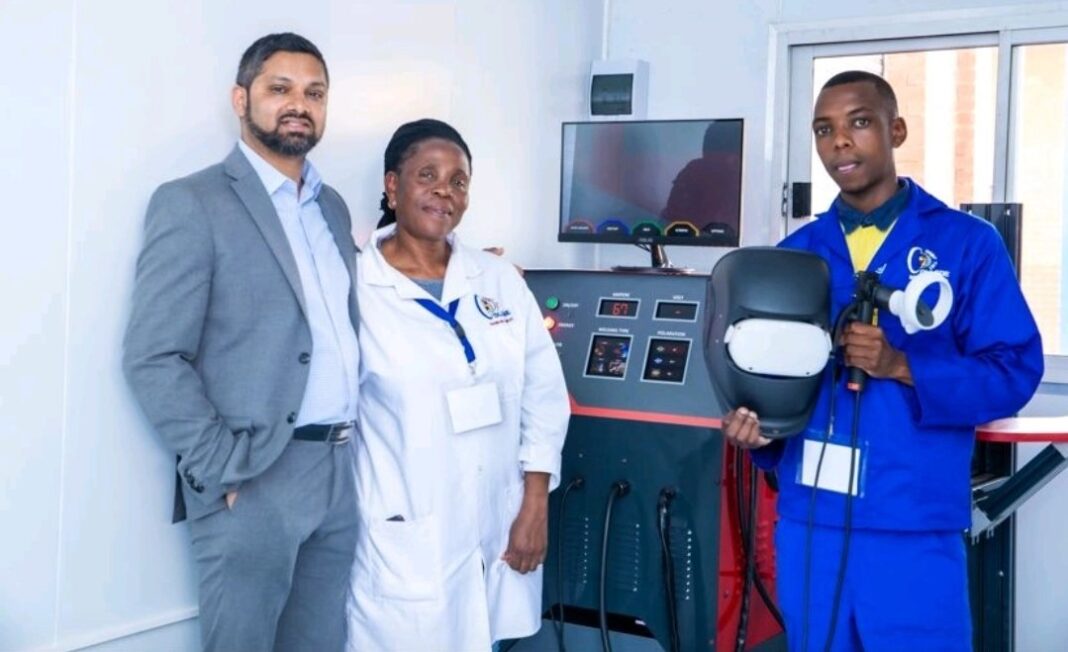
Another major programme launched during the year is the Smart Skills Centres, in which rural learners are taught digital skills to keep abreast with artificial intelligence developments.
The CHIETA intends to establish these centres in all nine provinces. Another project that stands out is the AlgoAtWork Robotics Academy in Richards Bay, in which children are taught essential skills for an AI-driven workplace in the future. Numerous bursaries flow into learning support and programmes for retrenched employees, a fundamental way the CHIETA supports the ERRP.
“As the statistics show, unemployment is a real challenge – and concern. Bold initiatives must be implemented to enable youth to succeed beyond matric, and CHIETA is determined to play a key role in changing the landscape,” concludes Pillay.
INSIDE EDUCATION