
Staff Reporter
South Africa’s commemoration of Youth Day should force the country’s universities to confront how little higher education has changed since the 1976 Soweto uprising, a University of Cape Town academic has said.
The country will on Tuesday mark 50 years since the June 16, 1976 student protests, when young people took to the streets against apartheid education policies, including the enforced use of Afrikaans in schools.
The protests were met with violence in Soweto, Johannesburg, and became a defining moment in South Africa’s struggle against apartheid.
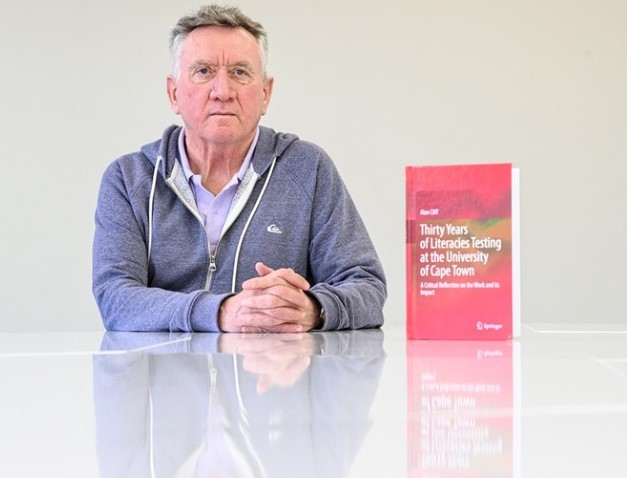
Emeritus Professor Alan Cliff, from UCT’s Centre for Higher Education Development, said the anniversary should not only be a moment of remembrance, but also one of reflection on access, representation and transformation in higher education.
“16 June 1976 was a watershed moment in South African politics and life. I was a first-year student at Rhodes University, and we were crowded around the radio listening to news releases from the protests in Soweto. Television had only just launched in this country and coverage was minimal and highly selective,” he said.
“We had to imagine/create from audio coverage what is now taken as routine in video reporting. I remember a huge range of emotions and opinions among my fellow students at the time – from left and right of the political spectrum.
“But I also remember thinking that this was a moment of critique: finally, issues of white hegemony and the right to learn in Mother Tongue and the language of learning and teaching had been the fulcrum around which protests had erupted. School children had taken up the cause – and the iconic, deeply human image of Hector Pieterson being carried from the protests remains imprinted forever.”
Cliff, whose career has spanned decades of work on literacy testing and higher education readiness, said universities had to be honest about the slow pace of change in the sector.
“We have to challenge ourselves to be honest about how relatively unchanged higher education has remained. Global North knowledge systems remain hegemonic and valorised. We have to think about which students and staff are able to see themselves represented in higher education? What systems signals does the sector emit that make it easier or tougher for students to participate/feel represented – this was at least part of the reason for the more recent student protests represented by #RhodesMustFall, for example,” he said.
He said institutions needed to rethink who was taught, how students were taught, and what it meant for students and universities to be “literate”.
As someone focused on access, redress and success in higher education, Cliff said progress had been made in widening access, but deeper questions remained about whether institutions had adapted sufficiently to changing student cohorts.
“The most satisfying part of our journey has been seeing the extent to which higher education access for all students to all institutions has indeed widened. The work on literacies assessment has been deeply satisfying especially in terms of its relationship to academic development and programme provision,” he said.
“It has also been meaningful to work on troubling the notion that literacies development is only about the identification of student support needs, to a much more holistic understanding of literacies work being about curriculum, teaching and learning, and assessment and the responsiveness of higher education institutions to changing student cohorts.”
Cliff said the concept of literacy should extend beyond language, reading and writing, and should include the ways students learn, participate and succeed within institutions shaped by inequality.
“We need to think about what it takes for a student to be higher education ‘ready’ and what it takes for higher education to be ‘ready’ to teach that student,” he said.
“As emeritus, I am in a reflective mode these days: looking back on 30 years of conceptualising notions of literacies and on the work of developing assessments of these. I am working on using social and critical realist lenses to assess the impact of the work through its history; its purposes; how and why it has been perceived and received in particular ways as a function of educational histories and decades (at least) of segregation, inequality and how these legacies remain powerfully difficult to redress.”
He said higher education must rethink its own assumptions about literacy, student potential and institutional readiness.
“How we think about learning potential and ability to be successful has to take account of educational background, educational inequality, how students can learn to be literate in the broadest (socially situated) sense; how higher education itself needs to re-think and critique its own view of literacy and its responsiveness to student diversity and knowledge forms. We need to think about what it takes for a student to be higher education ‘ready’ and what it takes for higher education to be ‘ready’ to teach that student,” Cliff said.
INSIDE EDUCATION