
By Lebone Rodah Mosima
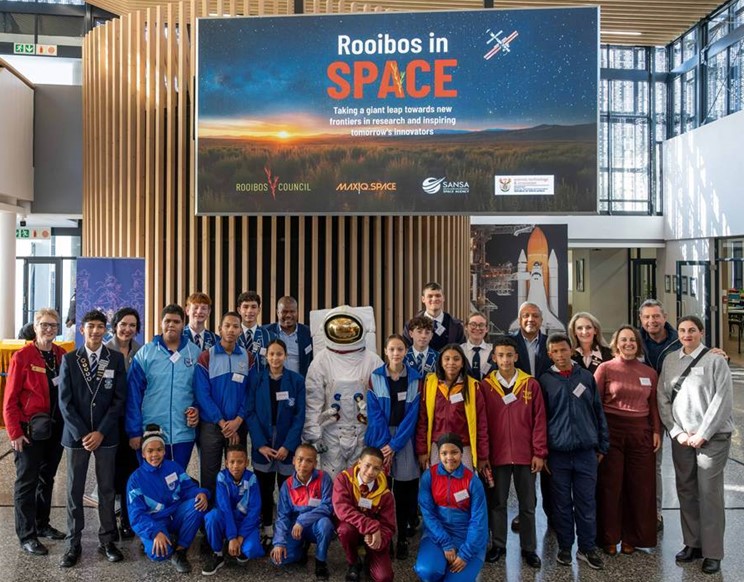
Learners from seven schools in the Cederberg will take part in a scientific experiment examining how exposure to space affects the germination and growth of rooibos seeds.
The Rooibos in Space programme, launched at Parklands College’s Innovation Centre in Cape Town last week, will see rooibos seeds sent to the International Space Station later this year.
The seeds are expected to be launched in October and exposed to microgravity and space radiation for several weeks before being returned to South Africa.
Learners will then plant the space-travelled seeds alongside a control group that remained on Earth. They will collect and analyse data on germination, plant growth, resilience and yield.
The participating schools are based in the Cederberg, where rooibos occurs naturally and is commercially cultivated. Learners will work with local rooibos farms as part of the structured scientific investigation.
A parallel experiment will be conducted at Parklands College to provide additional comparative data.
The initiative was conceptualised by the South African Rooibos Council and is being delivered in collaboration with space-focused STEM education company MaxIQ Space, with support from the South African National Space Agency.
It is intended to give learners practical exposure to space science, plant biology, sustainable agriculture and scientific data collection.
Said South African Rooibos Council director Dawie de Villiers: “Rooibos has long been part of South Africa’s agricultural heritage. This project places it within a broader scientific context, where plant biology, space research and education intersect. It also reflects the importance of investing in scientific literacy and skills development for the next generation of researchers and innovators.”
The participating schools will also take part in an extended STEM education programme aligned with curriculum outcomes.
The programme will introduce learners to the scientific method and show them how researchers develop experiments, record observations, analyse data and compare results.
MaxIQ Space founder and director Judi Sandrock said the initiative was designed to give learners experience of an authentic research project rather than only teaching space science as a theoretical subject.
“The value of this project lies in giving learners exposure to real research processes linked to space science. It provides a structured opportunity to develop scientific thinking, data analysis skills and an understanding of how experimentation works in practice.”
The project comes as international space agencies increase their research into the possibility of growing plants during long-duration missions.
Plants could potentially support future crews by providing food, contributing to oxygen production and helping to create more sustainable living systems during extended missions beyond Earth.
Previous experiments aboard the International Space Station have examined how crops including lettuce, peas and soybeans respond to microgravity and other environmental stresses.
Representatives from the Western Cape Education Department, SANSA, the University of Cape Town, the South African Radio Astronomy Observatory, the rooibos industry and the City of Cape Town attended the launch.
SANSA science engagement manager Thandile Vuntu said space science was increasingly connected to fields affecting people’s everyday lives.
“Initiatives such as this help build awareness of the skills required for future participation in the sector, but also align with national priorities around skills development, innovation capacity and strengthening South Africa’s position in emerging scientific fields. They further highlight the importance of collaboration between industry, government, academia and the science sector in building a strong pipeline of future scientists, engineers and researchers,” he said.
Dr Kelebogile Gasealahwe, a South African Radio Astronomy Observatory postdoctoral fellow at UCT, also addressed learners during the launch.
Gasealahwe, whose research focuses on X-ray binary systems, spoke about her journey from Kimberley to a career in astrophysics and encouraged learners to remain curious and consider the range of career paths available in science, technology, engineering and mathematics.
She also highlighted South Africa’s role in global astronomy research through facilities such as the MeerKAT radio telescope.
Learners outside the participating schools will be able to become involved by entering a national competition to design the official Rooibos in Space mission patch during July and August.
Organisers said public updates, learner activities and mission milestones would continue to be shared ahead of the planned October flight.
INSIDE EDUCATION